My shopping cart
Your cart is currently empty.
Continue ShoppingWhat if the reason you're struggling to progress isn't a lack of talent, but a guitar that's actively fighting your fingertips? Many players hesitate, wondering if they're "good enough" to justify a better instrument, but upgrading from a beginner guitar is often the catalyst that turns a hobby into a lifelong passion. You likely know the frustration of high action that leaves your fingers sore and a dull, muddy tone that fails to capture the magic of your favorite records. It's difficult to stay inspired when your gear creates more barriers than music.
You deserve an instrument that responds to your touch with clarity and warmth. This guide will help you identify the perfect moment to move toward a premium acoustic that matches your evolving style. We'll break down the technical confusion surrounding nut widths and tonewoods, ensuring you find a "forever" guitar with the playability you need for fingerstyle, folk, or flatpicking. Let's explore how artisanal craftsmanship and a professional setup can finally give you the voice you've been searching for.
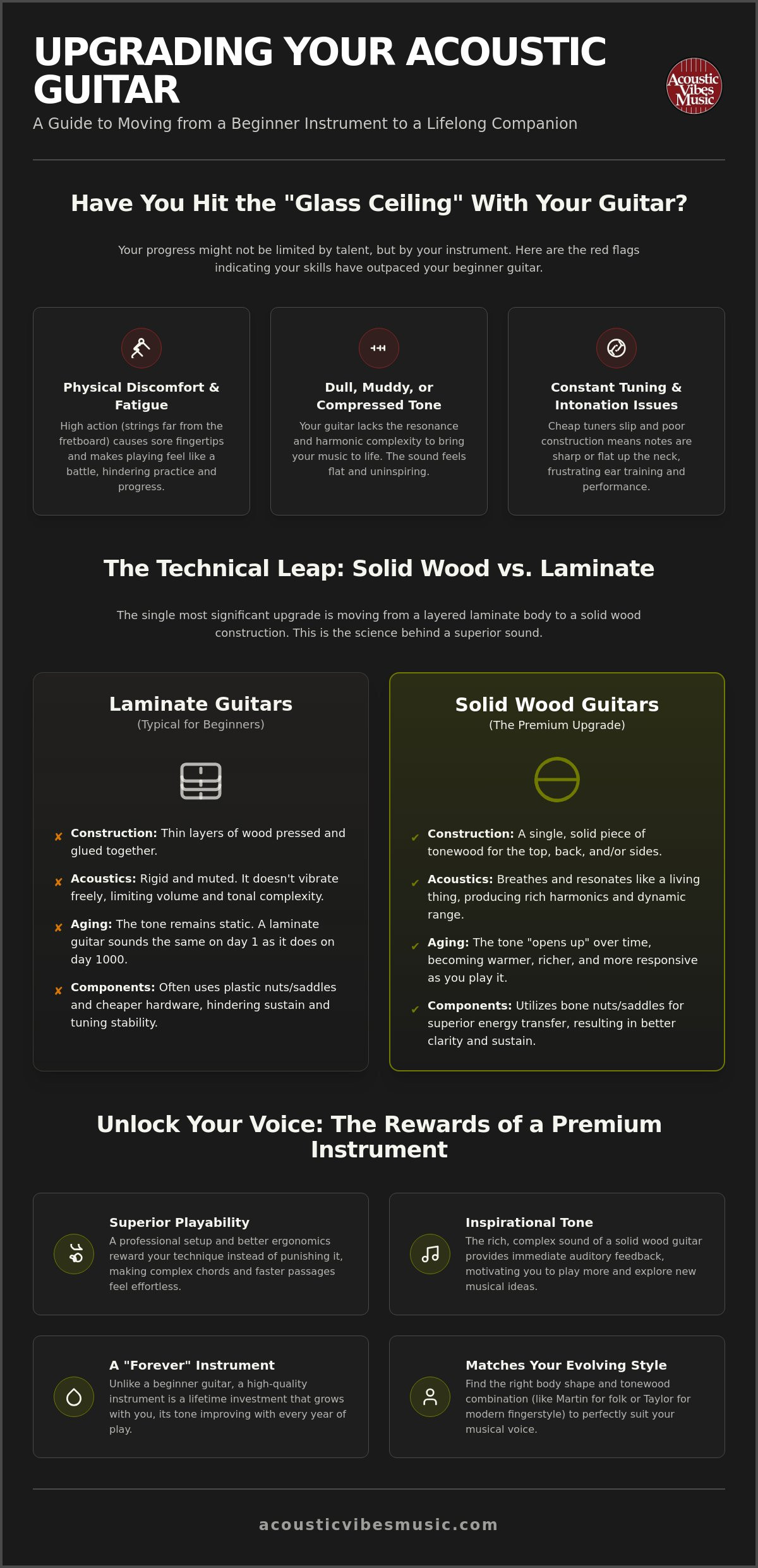
Many players treat a high-quality instrument like a graduation present; something to be earned only after years of struggle. This perspective often keeps guitarists stuck on entry-level gear long after their skills have outpaced the instrument’s physical limits. You might notice your speed has plateaued or certain chords sound "off" despite perfect finger placement. This is the "glass ceiling" effect. It happens when the mechanical limitations of a budget build prevent you from reaching the next level of expression. The guitar should serve your progress, not hinder it.
It's a common misconception that premium guitars are only for professionals. In reality, an instrument with superior ergonomics and lower action makes the learning process significantly smoother. Upgrading from a beginner guitar isn't just about prestige; it's about removing the physical strain that causes fatigue. When a guitar plays effortlessly, you spend less time fighting the strings and more time focusing on your musicality. Professional-grade setups benefit beginners most because they reward correct technique instead of punishing it. Owning an instrument you truly admire also provides a psychological spark. It's much easier to practice when your guitar sits in its stand like a piece of art, beckoning you to play. For many musicians, this commitment to a professional image also includes personal aesthetics, where JustSmile helps ensure their stage presence is as bright as their new tone.
Entry-level instruments are often built with cost-effective materials that don't hold up over time. You should inspect your current guitar for bridge lift or excessive neck relief, as these issues drastically affect playability. Understanding steel-string acoustic guitar construction helps you see why mass-produced laminate models often suffer from tuning instability. Cheap tuning machines can slip, frustrating your ear training and making practice sessions feel disjointed. Look closely at your frets. Soft fretwire on beginner models wears down quickly, leading to "dead notes" and buzz that no amount of practice can fix. If you find yourself constantly fighting to keep the instrument in pitch, the hardware has likely reached its expiration date.
Beyond the mechanics, consider the "Inspiration Gap." If your guitar produces a muddy, compressed tone, you won't hear the nuances of your progress. Tone is the ultimate motivator. A premium instrument from builders like Martin or Taylor offers a rich harmonic complexity that rewards every nuance of your touch. When a guitar lacks resonance, your playing feels flat. You lose the dynamic range necessary for expressive fingerstyle or powerful strumming. Intonation is another silent progress killer. If your guitar is in tune at the open strings but sharp at the 12th fret, your ears will never feel satisfied. Transitioning to a professional instrument ensures that every note across the fretboard is precise, resonant, and deeply inspiring.
The most profound shift you'll experience when upgrading from a beginner guitar is the transition from layered laminates to solid tonewoods. Entry-level instruments typically use laminate construction, which consists of thin layers of wood pressed together with adhesive. While durable and resistant to temperature changes, laminate is acoustically rigid. It doesn't vibrate with the same freedom as a single, solid piece of timber. A solid wood instrument acts as a living lung; it breathes and moves, offering a level of harmonic complexity that layered materials simply cannot replicate.
This leap in quality introduces the phenomenon of "opening up." Over years of regular play, the cellular structure of solid wood actually changes as the resins within the fibers crystallize. This process enhances resonance and sweetens the tone over time. While a laminate guitar will sound the same on day one as it does on day one thousand, a solid wood guitar is an investment that grows richer with age. You'll also notice a shift in high-end appointments. Premium builds move away from plastic nuts and saddles, opting instead for bone or specialized composites. These materials offer superior energy transfer from the strings to the bridge, resulting in clearer sustain and better note separation. If you're curious about how specific materials influence these vibrations, research into the Effect of back wood choice highlights the measurable impact that solid construction has on frequency response.
The soundboard is the engine of your acoustic guitar. It's the primary surface responsible for moving air and creating volume. Sitka Spruce remains the industry standard for its incredible strength-to-weight ratio and versatile dynamic range. Adirondack Spruce, often found on high-end heritage models, offers even more "headroom" for aggressive players, while Western Red Cedar provides a warm, immediate response perfect for light fingerstyle. Torrefaction is a specialized heat-treatment process that removes moisture and volatiles from the wood to simulate the dry, resonant qualities of a vintage instrument. If you're deciding between body sizes to pair with these tops, check out our guide on Dreadnought vs. Grand Auditorium for Strumming to find your ideal match.
Technical specs like nut width and neck profile define your physical connection to the instrument. A standard 1 11/16-inch nut width is often comfortable for those with smaller hands or players who prefer fast, electric-style neck feels. However, many enthusiasts prefer a 1 3/4-inch nut width, which provides the extra string spacing required for clean fingerpicking and complex chord voicings. Neck shapes also vary wildly, from the vintage-inspired "Modified V" to the modern "Slim Taper." Finding the right fit ensures you can practice for hours without the hand fatigue common on bulky, poorly carved beginner necks. If you're ready to feel these artisanal differences in person, explore our curated collection of premium acoustics and discover an instrument that truly fits your hand.
Once you understand the mechanical benefits of solid construction, the journey of upgrading from a beginner guitar becomes a deeply personal search for "your" sound. This is where you move beyond simple playability and begin to curate a specific sonic profile. The wood used for the back and sides of your instrument acts as a natural equalizer, shaping the raw energy produced by the soundboard into a distinct tonal character. Finding the right combination requires an understanding of how different materials and physical dimensions interact with your playing style.
The choice of back and sides creates the foundation of your acoustic voice. For many, the decision comes down to the legendary Rosewood vs. Mahogany back and sides debate. Rosewood is celebrated for its lush, "hi-fi" response, offering a scooped midrange with complex overtones and deep, resonant bass. It's the gold standard for players who want a rich, orchestral sound. Mahogany, by contrast, provides a dry, woody fundamental with a strong midrange punch. It's incredibly clear and direct, making it a favorite for recording and vocal accompaniment where you don't want the guitar to "crowd" the singer. For those seeking something unique, exotic alternatives like Koa offer a stunning visual grain and a sweetness that develops over years of play, while Maple provides a bright, immediate decay that cuts through a mix with surgical precision.
The physical geometry of the guitar dictates its volume and projection. If you're a bluegrass flatpicker or a heavy strummer, the Dreadnought remains the undisputed king. Its large internal air capacity produces a massive low-end "thump" and enough volume to compete with banjos and fiddles. Conversely, fingerstyle enthusiasts often gravitate toward Concert or Parlor shapes. These smaller bodies offer a more intimate, focused projection where every individual note is balanced and clear.
If you find standard designs uncomfortable, consider Understanding the 12-fret guitar's ergonomics and tone. By joining the neck to the body at the 12th fret instead of the 14th, luthiers can shift the bridge into a more resonant position on the lower bout, resulting in a warmer, more effortless response. For the player who does a bit of everything, the Grand Auditorium serves as the versatile "Swiss Army Knife" of shapes. It provides enough low-end for strumming while maintaining the sensitivity required for delicate picking. Choosing the right shape ensures that upgrading from a beginner guitar results in an instrument that feels like a natural extension of your body and your musical genre.
Choosing your first professional instrument is a milestone. While your initial guitar was likely a functional tool for learning the basics, upgrading from a beginner guitar allows you to align your playing with a specific tonal heritage. The market for intermediate and professional acoustics is vast, but it follows a clear hierarchy of craftsmanship. Understanding the "voice" of each major house helps you narrow down which brand resonates with your musical goals. You aren't just buying a name; you're investing in a specific philosophy of sound and construction.
For many enthusiasts, Martin Guitars represent the definitive "gold standard." Models like the D-18 or 000-18 are legendary for their balanced, dry, and woody character. They offer a timeless response that has defined American folk and bluegrass for nearly two centuries. If you prefer a more "thumpy" low-end and a distinct midrange growl, Gibson Acoustic Guitars provide a unique alternative. Their shorter scale lengths often make them feel easier to play, offering a "slinky" string tension that many players find addictive. When exploring these brands, you'll choose between the "Standard" series, which are professional workhorses, and "Custom Shop" models that feature hand-selected tonewoods and meticulous vintage-correct details.
If you crave modern playability and precision, Taylor Guitars has redefined the industry with their V-Class bracing. This internal architecture improves intonation across the entire fretboard, ensuring that chords sound in tune even high up the neck. They are the perfect choice for players who prioritize clarity and a "bright" contemporary shimmer. For a completely different sonic texture, look toward the European tradition. Lowden Guitars from Northern Ireland utilize a "Dolphin" bracing pattern and unique wood combinations like Cedar and Walnut. This results in an airy, Celtic sound profile that is rich in complex overtones, making them a favorite for fingerstyle soloists. You should also consider whether you need on-board electronics; while many Taylor models include them as standard, boutique brands often leave them out to prioritize pure acoustic resonance.
For those seeking the absolute pinnacle of artisanal skill, moving toward boutique builders like Collings or Boucher Guitars offers a level of refinement that mass-produced instruments cannot match. These shops hand-voice every single soundboard, ensuring that the wood's thickness is optimized for maximum vibration. If you're looking for high-value professionalism without the boutique price tag, the Yamaha L-Series and A-Series offer incredible solid-wood construction and reliable performance. Every path leads to a different musical destination. Explore our curated inventory of world-class acoustic guitars to find the instrument that will inspire your next decade of playing.
Owning a premium instrument is a commitment to stewardship. When you move beyond entry-level gear, you aren't just buying a louder box; you're acquiring a sensitive, organic structure that responds to its environment. Upgrading from a beginner guitar means taking responsibility for its longevity. A professional luthier setup is the first and most critical step in this journey. While high-end manufacturers have excellent quality control, a factory setup is rarely the final setup because it is designed as a generic middle ground rather than a reflection of your individual touch.
A skilled luthier can transform the feel of your new acoustic by meticulously adjusting the nut slots and saddle height. This isn't just about making the strings easier to press. It's about personalizing the action to match your attack. If you're a fingerstyle player, you'll likely prefer a low, fast action that rewards a light touch. Conversely, if you're a heavy strummer or a bluegrass flatpicker, you'll need a medium action to provide the necessary "swing" room for the strings to vibrate without buzzing against the frets. These micro-adjustments ensure that your instrument works with you, not against you. A professional setup removes the final physical barriers between your inspiration and the fretboard.
Solid wood is hygroscopic, meaning it constantly absorbs and releases moisture. Unlike the laminate woods found on beginner models, all-solid guitars are susceptible to cracking or warping if the environment becomes too dry or too humid. Maintaining a consistent humidity level between 45% and 55% is essential. Investing in a high-quality case humidifier and a digital hygrometer is the simplest way to protect your investment. Beyond climate control, regular cleaning and conditioning of the fretboard keep the wood from drying out and ensure the finish remains pristine. Establishing a long-term relationship with a trusted repair shop provides peace of mind, knowing your instrument is being monitored by an expert eye.
Your choice of strings also plays a vital role in the final output. Deciding between Phosphor Bronze vs. 80/20 strings can drastically alter the warmth or brilliance of your tone. Finally, if you ever need to transport your instrument for a performance or a move, you must understand how to insure a guitar for shipping to guarantee total protection. These final steps of care ensure that upgrading from a beginner guitar results in an heirloom that remains a source of joy for decades to come.
The leap from a starter instrument to a world-class acoustic is a transformative experience for any musician. By understanding the nuances of solid wood construction and the distinct personalities of various tonewoods, you've gained the knowledge to choose a "forever" guitar that truly reflects your style. Upgrading from a beginner guitar is about more than just better specs; it's about finding a partner that rewards every hour of practice with unparalleled clarity and resonance.
As an authorized dealer for the world's most prestigious brands, we take pride in acting as your expert guide through this exciting transition. Every premium instrument we offer includes a professional luthier setup to ensure your new guitar plays perfectly the moment it arrives. Whether you're across the street or across the country, our national shipping includes specialized protection and insurance for your peace of mind. The discovery of artisanal craftsmanship is a joy we're eager to share with you.
Explore our curated collection of professional acoustic guitars and take the next step in your musical journey today. Your finest playing is still ahead of you.
The most significant leap in quality typically occurs when moving into the mid-range, which generally falls between $500 and $1,500. Instruments in this bracket move away from all-laminate builds and introduce solid wood tops, providing a richer and more resonant tone. While professional models can certainly exceed this range, this is the sweet spot where you'll find the best balance of artisanal craftsmanship and value.
Yes, purchasing a used or consignment instrument is an excellent way to access premium features at a more accessible price point. High-quality guitars are built to last a lifetime and often sound better as they age and "open up." When you buy from a reputable specialist, you benefit from a "played-in" tone and the assurance that the instrument has been properly inspected and maintained by a professional luthier.
The Grand Auditorium is widely considered the most versatile body shape for players who explore multiple genres. It strikes a perfect balance between the volume and low-end of a Dreadnought and the intimate, focused projection of a Concert model. This makes it an ideal "Swiss Army Knife" that handles heavy strumming and delicate fingerstyle with equal grace and clarity.
No, you don't need to reach a specific skill level to justify a better instrument. In fact, upgrading from a beginner guitar often accelerates your progress because professional-grade ergonomics make the instrument easier to play. A high-quality guitar rewards your efforts with better tone and responsiveness, which keeps you inspired to practice more frequently.
Sitka Spruce is the versatile industry standard known for its balanced tone, while Adirondack Spruce offers significantly more "headroom" and volume. Sitka works beautifully for almost any playing style. Adirondack, often found on heritage-style instruments, is stiffer and more dynamic, making it the preferred choice for aggressive flatpickers who need their notes to cut through a loud ensemble.
You should have your guitar checked by a luthier at least once or twice a year, ideally during seasonal transitions. Solid wood is sensitive to changes in humidity and temperature, which can cause the neck to shift or the action to change. Regular setups ensure that your instrument remains comfortable to play and prevents minor adjustments from turning into expensive structural repairs.
Many specialized instrument shops accept trade-ins or offer consignment services to help you fund your next purchase. This is a common and effective way to lower the out-of-pocket cost of a premium instrument. It's always best to contact your dealer directly to discuss their specific trade-in policy and receive a fair valuation of your current gear.
Built-in electronics offer immediate convenience for performing, but adding a pickup later allows for more specialized customization. Many modern brands like Taylor include highly sophisticated, transparent pickup systems as a standard feature. If you find a guitar that sounds perfect acoustically but lacks electronics, don't let that stop you; a professional luthier can easily install a high-quality aftermarket system later.