My shopping cart
Your cart is currently empty.
Continue ShoppingImagine the heavy silence as you unlatch a flight case, expecting the warm glow of a vintage Gibson, only to find a jagged whiplash snap across the headstock. With roughly 4% of all annual parcels arriving damaged in the US, that nightmare is a statistical reality for thousands of unsuspecting musicians. Learning how to insure a guitar for shipping isn't just about ticking a box at the post office. It's about mastering the delicate balance between structural immobilization and the right financial safeguards.
We understand that your instrument is more than wood and wire; it's a piece of artisanal history. You've likely felt the anxiety of handing over a high-end acoustic to a carrier, wondering if their declared value actually covers a climate-induced finish crack or a crushed side. This guide promises to transform that dread into confidence by providing a specialist’s blueprint for total protection. We'll explore the critical difference between carrier liability and true insurance, reveal the packing secrets used by elite luthiers, and ensure your next delivery is as flawless as the instrument itself.
Movement is the enemy. If you can hear a "thud" or feel a slight shift when you gently rock your shipping container, the instrument is at risk. This is the core of the Immobilization Principle. In the world of high-end instruments, a secure fit is the only thing standing between a successful delivery and a heartbreaking repair bill. Understanding how to insure a guitar for shipping begins with the realization that your packing job is actually your primary defense. Most carriers will summarily deny a claim if they find any evidence of "insufficient packaging," regardless of the coverage you purchased.
Acoustic guitars are significantly more vulnerable than their solid-body electric cousins. While an electric guitar relies on dense slabs of wood, an acoustic is a hollow, pressurized chamber of thin tonewoods held together by delicate bracing. The tension of the strings alone exerts hundreds of pounds of pressure on the bridge and neck joint. When a box is dropped, that internal energy can cause a catastrophic failure. To prevent this, we utilize a three-layer defense system: meticulous internal case preparation, a high-quality hard-shell case, and a heavy-duty outer shipping box.
You should also recognize that standard carrier liability is rarely enough. Many people confuse "declared value" with comprehensive shipping insurance, but they are not the same. While a carrier might offer a basic level of protection, they often require proof of negligence. Professional packing provides the evidence you need to show that you did your part. It creates a clear paper trail of care that makes a successful insurance payout much more likely if the unthinkable happens during transit.
Boutique instruments like Martin Guitars and Collings Guitars are crafted with thin, responsive nitrocellulose finishes. These finishes are breathtakingly beautiful but notoriously sensitive to temperature shocks. If an instrument is packed with improper padding that traps moisture or reacts chemically with the lacquer, you may find "finish checking" upon arrival. Adopting an heirloom-quality mindset means treating the packing process with the same reverence the luthier used during construction.
Don't reach for the morning newspaper. The ink can transfer to a light spruce top, and the acidic paper can mar a delicate finish. Standard bubble wrap should also be kept away from direct contact with the guitar body, as the plastic can "off-gas" and leave permanent marks on the lacquer. Instead, use these specialist-approved materials:
Before you even consider the outer container, you must stabilize the instrument's internal environment. A guitar is a living, breathing assembly of wood under immense physical stress. When you are learning how to insure a guitar for shipping, you quickly realize that insurance adjusters look for any excuse to blame the shipper for structural failures. Preparing the interior of the case is your best defense against claims of negligence. It starts with a deep understanding of the physics at play inside that hard-shell sanctuary.
Clear out the clutter. Capos, clip-on tuners, and loose picks are not just accessories; in transit, they become internal projectiles. A metal capo bouncing against a spruce top for three days will cause irreparable gouges. Empty the accessory pocket or ensure it is taped shut. Once the case is clear, lay a single sheet of acid-free paper between the strings and the fretboard. This prevents the strings from vibrating against the frets and marring the metal, while also protecting the bridge from potential impact pressure.
Climate is the silent destroyer. If you are shipping across climate zones, a specialized humidipack is mandatory. These two-way systems maintain a consistent 45 to 55 percent relative humidity inside the case. This prevents the tonewoods from shrinking or expanding rapidly, which is often the root cause of finish checking or seam separations. While FedEx shipping guidelines provide a baseline for general transport, a high-value acoustic requires this extra level of micro-climate control to ensure it arrives in the same condition it left your hands.
The debate over string tension is settled by luthier logic. Do not slacken the strings completely. Total slack can cause the neck to bow backward as the truss rod loses its counter-pressure, potentially leading to nut-drop or bridge issues. Instead, tune the guitar down two or three half-steps. This relieves the extreme bridge pressure without sacrificing the structural integrity of the neck. Maintaining this slight tension prevents the nut from falling out of its slot if the guitar experiences a sudden jolt during its journey.
High-end instruments, especially those from Boucher Guitars, often feature torrefied tops and thin nitrocellulose finishes. These artisanal materials are breathtaking but fragile. Never let bubble wrap touch the guitar directly. The plastic can react with the lacquer, causing "bubble wrap burn" that is nearly impossible to buff out. Shroud the entire instrument in a soft cotton cloth or acid-free tissue before it enters the case. This creates a barrier against both chemical reactions and physical abrasions. If you're unsure about the specific needs of your instrument's finish, our expert curators can guide you on the best preservation practices for heirloom-quality builds.
Remove the endpin. It is a small component, often made of plastic, bone, or ebony, but it represents a massive structural liability during transit. If the shipping box suffers a vertical drop, the impact force concentrates directly on that pin. It acts like a wedge, potentially driving through the endblock and splitting the delicate tonewood sides of your instrument. Tuck it safely into the accessory pocket. This simple step is a hallmark of professional handling and a prerequisite for many successful damage claims.
The Cradle Method focuses on total immobilization. You want the guitar to feel like a single, solid unit with its case. Fill the empty spaces around the upper and lower bouts with crumpled acid-free paper. Avoid using bubble wrap for this specific task; you need firm, supportive paper that won't compress or shift over time. If you want to know how to insure a guitar for shipping effectively, you must realize that a policy payout often hinges on proving the item was unable to move within its primary container.
While many industry resources provide a detailed guide on how to ship a guitar, the specialist's secret lies in the "Internal Shake Test." Once your padding is in place, close the lid without latching it and give the case a gentle, rhythmic rock. If you feel even a millimeter of movement or hear a faint "thud," add more padding. The goal is a snug, glove-like fit that protects the artistry of the build.
The headstock is the most fragile part of any acoustic instrument. A sudden jolt creates a "whiplash effect," where the heavy tuning machines pull the headstock forward while the body remains stationary. This generates enough kinetic energy to snap the wood at the nut, even if the outer case remains pristine. You must pack enough paper under and over the headstock so it is suspended in air. It should not touch the back or the top of the case. For those shipping compact 12-fret models, pay extra attention to the neck heel support to ensure the bridge and nut remain perfectly stable during transit.
Secure every latch with care. If your case has seen years of service, consider a single wrap of painter's tape over the latches to prevent them from popping open during rough sorting. Take clear, high-resolution photos of the finished internal packing before you close the lid for the final time. These images serve as vital evidence, proving you followed specialized immobilization standards. This level of documentation is exactly how to insure a guitar for shipping with total peace of mind.
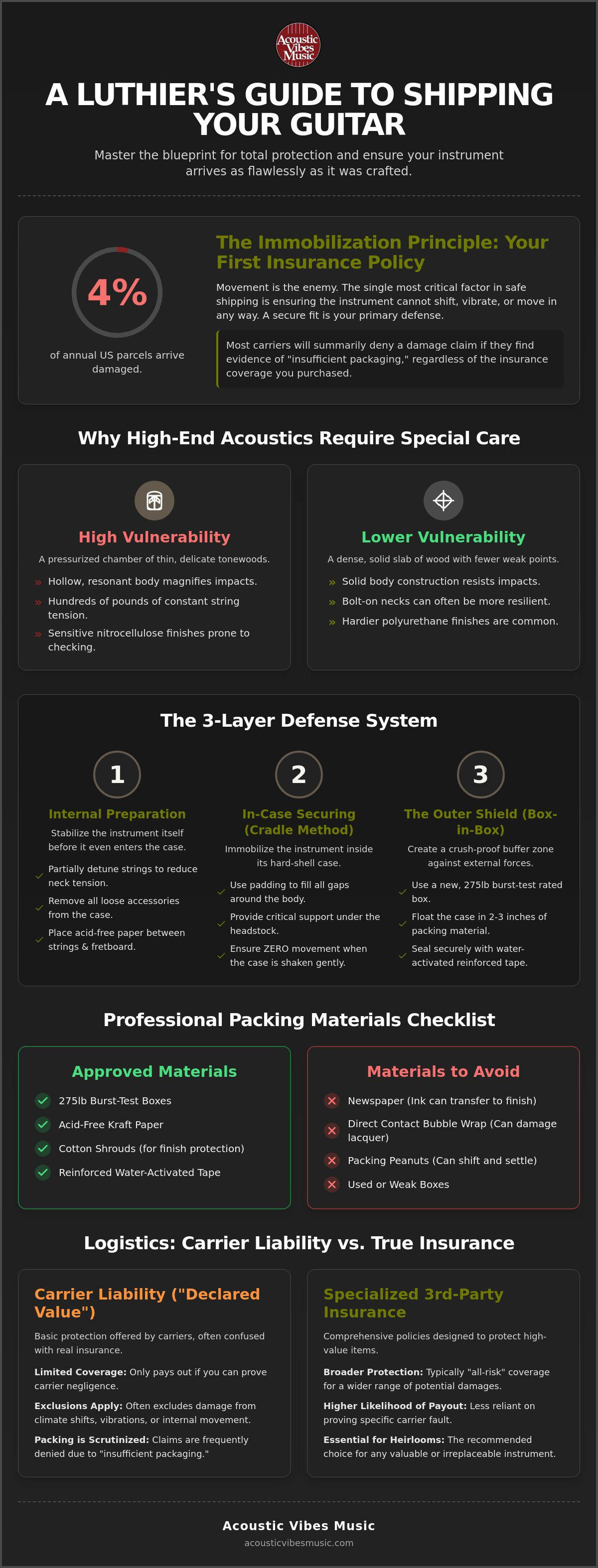
Once your instrument is immobilized within its case, you must build its external fortress. The outer shipping box is not just a container; it is a sacrificial shield designed to absorb the kinetic energy of drops and shifts. When you research how to insure a guitar for shipping, you will find that carriers prioritize the "burst test" rating of your cardboard. For a high-value acoustic, nothing less than a 275lb burst-test double-walled box will suffice. This structural integrity ensures the box won't collapse under the weight of other parcels in a crowded sorting facility.
For ultra-premium High End Acoustic Guitars, we recommend the "Box-within-a-Box" method. This involves placing the guitar case inside a standard shipping box, then placing that entire box inside a slightly larger secondary container. The two-inch gap between the boxes is filled with dense packing material. This dual-layer architecture provides an incredible buffer against side-impacts and temperature fluctuations, significantly reducing the likelihood of finish checking or structural cracks.
Sealing the box correctly is the final step in structural defense. Use the H-tape method. Apply heavy-duty packing tape along the center seam of the top and bottom, then apply tape across the side edges to create a literal "H" shape. This prevents the flaps from catching on conveyor belts and ensures the box remains rigid. While many people plaster "Fragile" stickers everywhere, "This Side Up" arrows are far more effective. They guide the handlers on how to orient the package, keeping the guitar in its safest vertical position.
Standard guitar boxes are often designed for thin electric gig bags and are frequently too short for high-end hard-shell cases. Measure your case carefully. You need a box that allows for at least four to five inches of crumpled kraft paper at the bottom. This creates a dedicated "crush zone." If the box is dropped vertically, the paper compresses to absorb the shock before the energy reaches the endblock of your guitar. Ensure the case is centered so that it does not touch the walls of the outer box at any point.
Before you print that label, perform one last check. Lift the sealed box and give it a firm, controlled shake. You should feel the weight of the guitar, but you should not feel the case sliding or "thumping" against the cardboard. If there is movement, open the box and add more side-fill. A perfectly packed guitar should feel like a single, solid object. Once you are satisfied, record the final weight and dimensions accurately. If you are ready to ship an instrument or looking to add a new masterpiece to your vault, explore our curated collection of master-built acoustics and see how we handle every shipment with specialist care.
"Declared Value" is the most misunderstood term in the shipping industry. It is not insurance. When you pay a carrier for a higher declared value, you are simply increasing the limit of their liability. To successfully collect on a claim, you must typically prove that the carrier was negligent, which is notoriously difficult if the outer box appears undamaged. This is how to insure a guitar for shipping with actual security: bypass the carrier's basic options and secure a dedicated policy from a third-party specialist like Heritage or Clarion. These providers understand the nuance of vintage tonewoods and offer broader coverage that includes theft and accidental damage during transit.
Timing is just as critical as the policy itself. Never ship a high-end acoustic on a Thursday or Friday. If you do, your instrument will likely spend forty-eight hours sitting in a non-climate-controlled warehouse or a stagnant trailer over the weekend. This exposure to extreme temperature swings is a recipe for structural disaster. Always ship on a Monday or Tuesday morning. This ensures the package stays in constant motion and arrives at its destination before the logistics network slows down for the weekend. For those handling a truly irreplaceable instrument, consider letting a specialist shop manage the logistics. We have the specialized accounts and packing infrastructure to ensure your guitar receives white-glove treatment from door to door.
Alternatively, some collectors prefer to personally transport their high-value acquisitions to avoid the risks of third-party shipping altogether. If you are traveling through Romania to secure a new addition to your collection, you can find out more about renting a vehicle that provides the safety and climate control necessary for sensitive cargo.
When you are personally handling the transport of a prized instrument, the overall atmosphere of your vehicle matters as much as the security of the case. Companies like Flava Car Scents offer premium fragrances that can redefine your driving experience, making the journey to bring home your new guitar as memorable as the first time you play it.
The most powerful tool in your arsenal is the unboxing video. Instruct the recipient to film the entire process, from the first cut of the tape to the final inspection of the headstock, to provide undeniable evidence of the instrument's condition upon arrival. Claims are frequently denied due to "insufficient packaging" or the lack of a required signature, so ensure every step of our previous packing guides was followed to the letter. Most importantly, enforce the 24-hour acclimatization rule. Opening a box too soon after it arrives from a cold climate can cause the nitrocellulose finish to shatter into a web of cracks, a tragedy that insurance rarely covers because it is considered preventable user error.
Check the national weather map before you print a label. Avoid shipping during extreme heatwaves or mid-winter polar vortexes, as even the best packing cannot fully insulate a guitar from six hours on a freezing tarmac. While both FedEx and UPS are industry giants, many specialists prefer FedEx for high-value instruments due to their specific "musical instrument" handling protocols. However, be aware that many carriers limit the declared value of instruments older than twenty years to $1,000 unless you have a commercial account. If your new arrival needs a professional setup or a health check after its journey, schedule a luthier appointment with our expert team to ensure it's performing at its absolute peak.
Protecting a master-built instrument doesn't end at the workshop door. It continues through every layer of acid-free paper and every specific clause of your insurance policy. By mastering the immobilization principle and opting for specialized third-party coverage over basic carrier liability, you ensure your guitar’s story continues for generations. Understanding how to insure a guitar for shipping is the final, essential skill every serious collector must acquire to truly safeguard their investment.
At Acoustic Vibes Music, we live and breathe these technical nuances. As an authorized dealer for legendary brands like Martin, Taylor, and Collings, we bring decades of logistics expertise to every shipment we handle. Whether you require a professional post-transit setup from our luthier repair services or you're ready to add a new masterpiece to your vault, we act as your trusted advisor. Explore our curated collection of boutique acoustic guitars and discover the peace of mind that comes with specialist care. Your next great musical discovery is waiting, and we'll ensure it arrives in flawless, concert-ready condition.
You should loosen the strings by two or three half-steps to relieve pressure on the bridge and soundboard. Avoid removing all tension entirely, as the neck needs counter-pressure against the truss rod to maintain its structural balance. This middle ground protects the delicate geometry of your instrument during rapid altitude or temperature shifts.
Shipping a high-end acoustic in a gig bag is a significant risk that we strongly discourage. Most insurance providers will reject a claim for "insufficient packaging" if the instrument is not secured in a hard-shell case. A rigid case provides the necessary structural foundation to survive the mechanical pressures of modern sorting facilities.
Declared Value is not true insurance; it is simply a limit on the carrier's liability that often requires you to prove their negligence. Third-party insurance is a separate, specialized policy that provides comprehensive coverage for damage, theft, and loss. Understanding these nuances is vital when learning how to insure a guitar for shipping properly.
Carrier liability rates in 2026 typically start around $1.65 to $1.70 for every $100 of value over the initial $300 threshold. Specialized third-party insurers often offer more competitive rates, sometimes ranging from 0.6% to 1% of the total value. These specialized policies frequently provide much higher coverage limits than standard parcel services.
Removing the endpin prevents a vertical drop from turning that small component into a wedge that splits the guitar’s endblock. Even a short fall can concentrate enough force on the pin to crack the surrounding tonewood. Tucking it into the accessory pocket is a hallmark of professional packing and a crucial step in how to insure a guitar for shipping.
You must wait at least 24 hours before opening the shipping box to allow the instrument to acclimatize to its new environment. Rapidly exposing a cold guitar to a warm room can cause the nitrocellulose lacquer to shatter instantly. This "finish checking" is often permanent and can be avoided with simple patience.
Never place bubble wrap in direct contact with a nitrocellulose or artisanal finish. The plastic can react chemically with the lacquer, leaving permanent "burn" marks or impressions that require professional refinishing. Wrap the guitar in a soft cotton shroud or acid-free tissue before adding any plastic padding to the case.
If damage occurs, stop immediately and document everything with high-resolution photos and video. Do not discard any of the packing materials or the shipping box, as adjusters will need to inspect them to verify your claim. Contact your insurance provider within the first 24 hours to initiate the recovery process.