My shopping cart
Your cart is currently empty.
Continue ShoppingHave you ever felt like your heirloom Collings or vintage Martin is holding something back, muffled by a tonal veil you can't quite lift? It's a common frustration for collectors who find that "bright" or "warm" labels on a pack of strings rarely tell the whole story once they're tensioned over premium rosewood or mahogany. Choosing between phosphor bronze vs 80/20 strings for acoustic guitar isn't just about brand loyalty. It's a strategic decision; it's the final EQ filter for your instrument.
With 42% of players now opting for advanced coated technology, the market has evolved far beyond the basic alloys of the past. Discover the metallurgical secrets behind these alloys and learn exactly which wrap wire will unlock your instrument's hidden voice. We'll explore how 80/20 bronze provides that crisp, vintage zing and why phosphor bronze remains the gold standard for rich, complex overtones. You'll gain the confidence to pair the right set with your specific tonewood and learn how 2026 innovations like Elixir Attune or Martin Era™ strings can preserve your perfect tone for the long haul.
Every set of strings begins in a foundry. While many players treat string selection as an afterthought, the specific chemistry of the wrap wire acts as the primary filter for your guitar's natural voice. The core debate of phosphor bronze vs 80/20 strings for acoustic guitar centers on two distinct alloys. One is a traditional brass; the other is a sophisticated bronze variant designed for the modern era. Understanding the difference requires looking past the packaging and into the molecular structure of the wire.
Despite the common name, 80/20 bronze is technically brass. It consists of 80% copper and 20% zinc. This alloy has been the mainstay of acoustic music for decades, prized for its initial "zing" and transparent clarity. However, the industry shifted in the 1970s when manufacturers introduced phosphor bronze. By adding approximately 1% phosphorus to a 92% copper and 8% tin base, engineers altered the metallurgy of phosphor bronze to create a more resilient, harmonically complex string. This addition wasn't just for show. It significantly reduced oxidation and changed the way the string vibrates against the core.
A curious marketing paradox exists within this comparison. You'll find some brands labeling phosphor bronze as "bright" due to its sparkling high-end overtones, while others call it "warm" because of its rich, chocolatey bass. Conversely, 80/20 is often described as "bright" because of its piercing initial attack, yet it lacks the complex harmonic sustain of its counterpart. This discrepancy is why we often see collectors confused; the labels vary by brand, but the chemistry remains constant.
Think of 80/20 bronze as a "scooped" EQ setting. It emphasizes the fundamental note and the high-frequency "chime" while pulling back the midrange. This makes it an exceptional choice for cutting through a dense mix or adding life to a naturally dark instrument. Phosphor bronze offers a more balanced, "flat" response. It provides a wealth of complex harmonic overtones that fill the sonic space between the bass and the treble. As strings age, 80/20 loses its high-end zing rapidly, often sounding "dead" within days. Phosphor bronze tends to settle into a consistent, mellow state that maintains its musicality for weeks.
The phosphorus in the alloy acts as a deoxidizing agent during the manufacturing process. This makes phosphor bronze inherently more resistant to corrosion than the zinc-heavy 80/20 brass. Your own skin chemistry plays a massive role here. If you have a high-acid pH level in your sweat, you'll find that uncoated 80/20 strings can lose their brilliance in a single session. For high-end instruments like those from Martin Guitars or Collings Guitars, we often recommend treated versions to protect the instrument's tonal bloom from the elements while preserving that "new string" feel.
If you've ever marveled at the high-fidelity sound of a modern acoustic recording, you're likely hearing the influence of phosphor bronze. This alloy has become the definitive standard for the "modern" acoustic voice. It delivers a wide frequency response characterized by crisp, shimmering highs and a robust, well-defined low end. While 80/20 bronze is often associated with the dry, woody sounds of pre-war instruments, phosphor bronze provides the harmonic complexity that contemporary players crave. This versatility is exactly why it serves as the default factory setup for the majority of premium builders today.
When weighing the phosphor bronze vs 80/20 strings for acoustic guitar debate, many collectors find the initial "settle-in" period particularly fascinating. Straight out of the pack, these strings can exhibit a slightly metallic zing that might feel aggressive. However, after a few hours of play, the alloy matures. It moves from that initial sheen into a deep, woody warmth that retains its clarity. This transition makes them the superior choice for fingerstyle players and solo performers who need their instrument to fill a room with a full, orchestral resonance. This tonal profile is detailed extensively in guides on common acoustic string types, where it's often noted for being darker and more harmonically dense than brass alternatives.
The inherent "sparkle" of phosphor bronze makes it a perfect companion for Taylor Guitars. It accentuates their signature clarity without becoming brittle. On smaller body shapes like the Grand Concert, these strings add a necessary layer of complexity and "bloom" to the notes that might otherwise feel too fundamental. We also find that they beautifully complement the sophisticated, modern voicing of Lowden Guitars, where every overtone is meant to be heard. If you're looking to hear how these strings interact with world-class tonewoods, we invite you to explore our curated collection of premium acoustics.
While 80/20 starts bright and fades fast, phosphor bronze is often cited as providing the best guitar strings for warm tone once they've been properly broken in. The specific ratio of copper and tin allows for a sustaining low-frequency resonance that feels "expensive" and lush. This warmth doesn't sacrifice note separation, which is vital for complex chord voicings or recording environments where you want the guitar to sit perfectly in the mix. Phosphor Bronze is the definitive all-purpose alloy for the contemporary player.
While phosphor bronze dominates the modern market, the traditionalist often looks elsewhere. For those chasing the dry, punchy snap heard on classic folk and bluegrass records, 80/20 bronze is the undisputed king. This alloy provides a fundamental-heavy tone that prioritizes note separation over harmonic density. It's the "zing" that defines the vintage acoustic experience. When evaluating phosphor bronze vs 80/20 strings for acoustic guitar, players quickly realize that 80/20 offers a more transparent window into the instrument's construction.
The secret to the 80/20 allure lies in its "scooped" frequency response. By pulling back the midrange, these strings allow the natural resonance of the wood to take center stage. They don't color the sound with the same lush overtones found in phosphor bronze; instead, they provide a focused, percussive attack. For the professional touring musician, this clarity is invaluable on stage. However, there's a trade-off. These strings are highly reactive. They offer a brilliant, golden glow both visually and sonically, but they tend to lose their sparkle faster than phosphor bronze as the zinc in the brass alloy oxidizes.
Rosewood is prized for its "scooped" mids and thunderous low end, but on some instruments, this can lead to a sound that feels overly dark or muddy. Pairing Rosewood back and sides with 80/20 bronze is a masterstroke in tonal balancing. The strings provide the necessary high-end bite to counteract the wood's natural bass-heavy profile. This combination is particularly effective for achieving note clarity during fast, complex flatpicking runs. It's no wonder that 80/20 is often considered the secret weapon for a Martin Dreadnought. As noted in Martin Guitars' guide to string materials, this alloy's crispness is essential for that legendary pre-war snap.
On guitars that are exceptionally resonant or harmonically "busy," phosphor bronze can sometimes create too much harmonic clutter. 80/20 bronze simplifies the signal. It focuses the energy on the core frequency of the note, helping the guitar "cut through" a multi-instrument mix without fighting for space. Beyond the sound, there's a certain aesthetic reverence for a fresh set. The bright, gold-like hue of new 80/20 strings looks stunning against a dark ebony bridge or a vintage sunburst finish. It's a tactile and visual reminder of the instrument's heritage. Explore this classic sound and find your next heirloom among our premium acoustic guitars today.
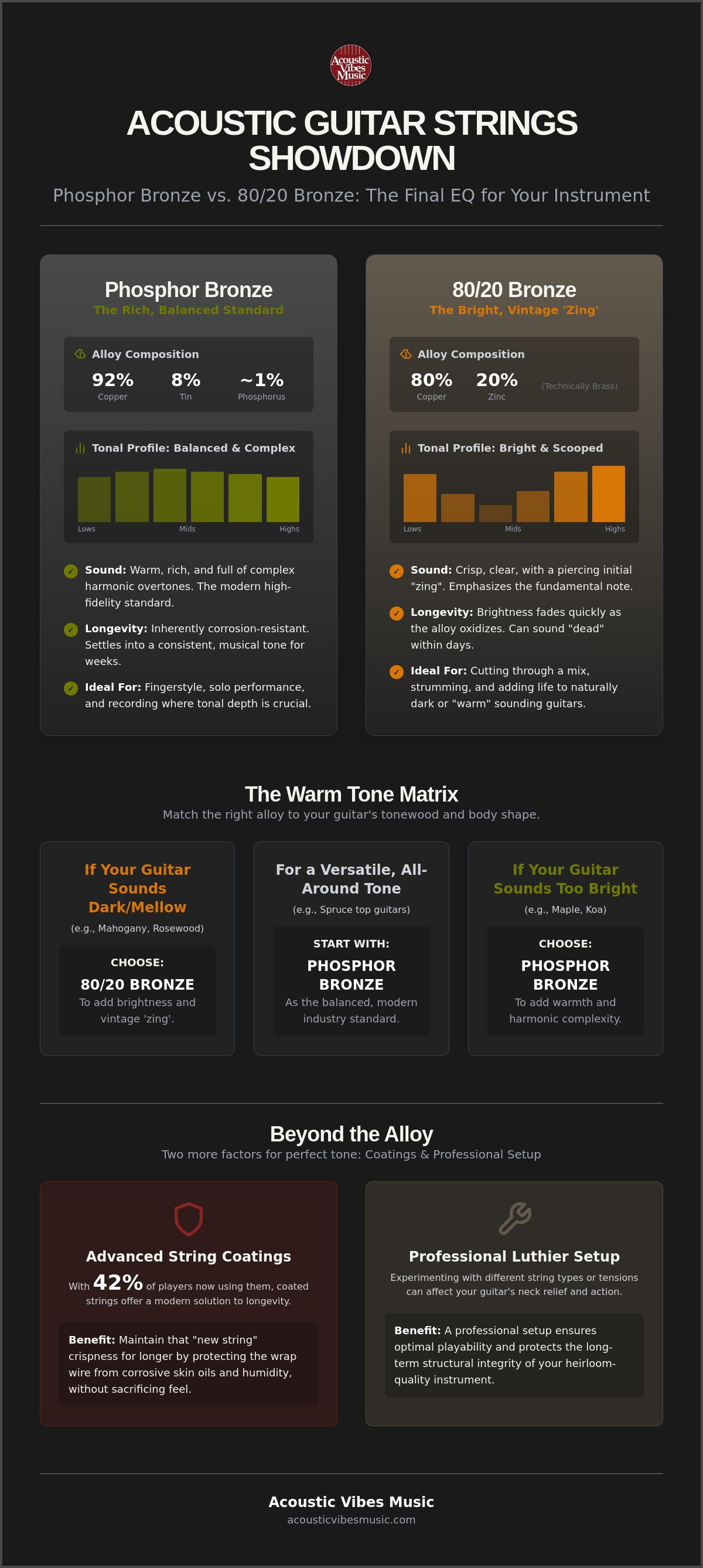
Achieving the perfect acoustic voice is an exercise in tonal equilibrium. Think of your strings as a corrective lens. If your instrument is naturally dark, you need a string that provides light. If it's overly bright, you need an alloy that adds depth. This "Balance Principle" is the foundation of the phosphor bronze vs 80/20 strings for acoustic guitar selection process. It requires a deep understanding of your guitar's sonic architecture, from the bracing pattern to the specific top wood used by the luthier.
Body size plays a massive role in this equation. A massive dreadnought produces a significant amount of low-end energy. Often, 80/20 bronze is used to provide the high-frequency definition needed to keep that bass from becoming overwhelming. Conversely, a smaller Grand Auditorium might lack the natural "thump" of a larger guitar. In these cases, phosphor bronze adds a necessary layer of richness. Your choice between a Dreadnought vs. Grand Auditorium significantly dictates which alloy will feel most balanced under your fingers.
Top-wood materials further refine this response. Sitka spruce is the versatile standard, responding well to both alloys. However, Adirondack spruce is stiffer and offers higher headroom. It can sometimes sound "tight" when new. Using 80/20 strings on Adirondack can emphasize its punchy, cannon-like projection, while phosphor bronze can help "sweeten" its response for more delicate passages. For those seeking the absolute best guitar strings for warm tone in 2026, new options like Martin Era™ treated strings offer a "Flexible Core" that enhances this sweetness on even the stiffest spruce tops.
Strummers often seek a cohesive "wall of sound." Phosphor bronze is the winner here, providing a blended harmonic texture that feels rich and full. For flatpickers, the story is different. They need the "zing" and projection of 80/20 to ensure their lead lines cut through the ensemble. Fingerstylists typically lean toward phosphor bronze for its delicate touch sensitivity and the way it highlights the subtle nuances of their technique. If you're ready to hear these pairings in person, browse our latest arrivals to test these combinations on world-class instruments from Boucher Guitars or Collings.
Choosing between phosphor bronze vs 80/20 strings for acoustic guitar is only the first step in the journey toward your signature sound. The physical interaction between string tension and your instrument's geometry determines the ultimate playability and safety of your investment. For owners of high-end acoustic guitars, string gauge is a structural consideration as much as a tonal one. A jump from extra-light to medium strings adds significant pounds of pressure to the bridge and soundboard. This shift can alter the neck relief and saddle height, potentially choking the very resonance you're trying to enhance.
Tonal transfer depends on the entire chain. The nut material and saddle height act as the gatekeepers of vibration. If your setup is optimized for the lower tension of 80/20 bronze, switching to a higher-tension phosphor bronze set might require a minor truss rod adjustment to maintain that effortless feel. Environment plays a silent but vital role too. In dry climates, wood shrinks, which can cause the action to drop and strings to buzz. Professional maintenance ensures your guitar remains a stable platform for whatever alloy you choose to explore.
Coating technology has undergone a radical evolution. We've moved past the days of "muffled" tones into an era where 42% of players choose treated strings for their longevity. Modern micro-coatings like D'Addario XS or Elixir Nanoweb provide a slick feel without sacrificing the raw tonal bloom. For boutique instruments like a Collings or a Boucher, premium treated strings are often the best way to preserve the luthier's intent over months of play. While Polyweb offers a warmer, smoother feel, the newer 2026 technologies like Elixir Attune aim for a tactile experience that is virtually indistinguishable from uncoated wire.
Watch for the warning signs of improper tension. If you notice the back of the bridge lifting or a sudden "belly" forming behind the bridge pins, your string tension is likely too high for the bracing. Most professional collectors should change their strings every three to four weeks to prevent old, oxidized metal from wearing down the frets. This frequency ensures that the intonation remains precise and the tactile experience stays inspiring. A warm tone starts with a healthy, humidified instrument and a precision setup.
Finding the right balance between phosphor bronze vs 80/20 strings for acoustic guitar is more than a simple maintenance task; it's a deep dive into the heart of your instrument's metallurgy. You've seen how the complex overtones of phosphor bronze enrich a modern build, while the focused "zing" of 80/20 bronze restores the woody clarity of a vintage dreadnought. By matching these alloys to your specific tonewoods and maintaining a healthy, humidified environment, you ensure every note rings with the precision the luthier intended.
As specialists in heirloom-quality instruments and authorized dealers for Martin, Taylor, and Collings, we believe the finest guitars deserve an equally refined approach to setup and care. Our in-house luthier services are available by appointment to help you fine-tune your instrument's performance. Ready to hear the difference for yourself? Explore our curated collection of premium acoustic guitars and accessories and discover the artistry of world-class craftsmanship. Your perfect tone is waiting to be heard.
Phosphor Bronze is the superior choice for players seeking a rich, warm tone. While 80/20 strings provide a bright, percussive "zing" when new, Phosphor Bronze settles into a deep, harmonically complex warmth after a few hours of play. The copper and tin mixture allows for a lush resonance that fills the midrange, making it ideal for fingerstyle and solo performances on modern instruments.
Phosphor Bronze strings generally offer better longevity in an uncoated state compared to 80/20 bronze. The inclusion of phosphorus acts as a natural deoxidizer during the manufacturing process, which helps the alloy resist corrosion from humidity and skin acidity. If you have particularly acidic sweat, you'll find that 80/20 brass strings lose their brilliance and turn dull much faster than their phosphor-infused counterparts.
You can usually switch between these alloys without a new setup as long as you keep the string gauge identical. However, it's worth noting that the tension of phosphor bronze vs 80/20 strings for acoustic guitar is slightly different; phosphor bronze typically exerts more pull on the neck. On a high-end instrument with a sensitive setup, this minor tension shift might necessitate a slight truss rod adjustment to maintain perfect action.
The bright, gold-like appearance of 80/20 strings is a result of their high zinc content. Because 80/20 is technically a brass alloy consisting of 80% copper and 20% zinc, it carries a distinct yellow luster. In contrast, Phosphor Bronze contains more copper and a small amount of tin, which gives the wire a darker, reddish-brown or copper hue that many collectors find visually complementary to dark ebony bridges.
Performance varies by brand, but industry leaders like Martin and D'Addario have spent decades refining their 80/20 formulas. Martin strings are often favored by bluegrass players for their traditional "snap," while 2026 innovations from brands like Elixir have introduced "Attune" technology to 80/20 alloys. This provides a more consistent wrap wire that minimizes the harsh metallic overtones sometimes found in budget-tier brass strings.
You'll know your strings are dead when the instrument loses its harmonic sustain and begins to sound "thuddy" or muffled. Visually, inspect the underside of the strings for dark oxidation spots or physical pitting where the wire contacts the frets. If your guitar suddenly feels difficult to tune or the intonation seems "off" across the fretboard, the string core has likely lost its structural elasticity and requires replacement.
Light gauge strings, typically a .012-.053 set, are the safest and most tonally balanced choice for vintage instruments. Older guitars often feature delicate bracing and hide glue joints that may not withstand the 180-plus pounds of tension produced by medium sets. Choosing a light gauge provides enough energy to drive the aged soundboard without risking bridge lift or neck heel separation on a prized heirloom.
Bridge pins act as the final anchor for the string's vibration and do subtly influence the overall EQ. Denser materials like bone or liquid metal pins can increase sustain and add a touch of high-end shimmer to your sound. Many enthusiasts prefer traditional ebony pins because they absorb a small amount of high-frequency energy, which helps round out the phosphor bronze vs 80/20 strings for acoustic guitar debate by adding a touch of organic warmth.