My shopping cart
Your cart is currently empty.
Continue ShoppingThat massive, room-filling resonance you crave might actually be the very thing sabotaging your vocal performance and muddying your rhythm. It's a common trap for many enthusiasts. You seek the legendary "thump" of a large-bodied instrument, only to find the low end becomes an unruly blur during a heavy session. Choosing between a dreadnought vs grand auditorium for strumming isn't just about body size; it's about how the air moves inside the chamber to support your specific musical voice.
We understand the frustration of feeling overwhelmed by a boomy bass that competes with your singing or dealing with the physical fatigue of a wide lower bout. This guide promises to help you find a guitar that harmonizes raw power with crystalline note definition. We will examine how elite builders like Boucher and Collings refine these iconic silhouettes for 2026. From the thunderous projection of the latest Martin Super Dreadnoughts to the balanced shimmer of Taylor's Next Generation Grand Auditoriums, you'll gain the confidence to select a masterpiece that elevates every chord you strike. Let's explore the tactile artistry and technical nuances that make these shapes the pillars of the acoustic world.
The acoustic guitar is essentially a sophisticated wooden air pump. When you strike the strings with a plectrum, you initiate a complex transfer of kinetic energy from the bridge to the soundboard and finally into the air within the body. This is why the debate of dreadnought vs grand auditorium for strumming is so central to your performance. The architecture of the instrument dictates how that energy is sculpted. A larger air chamber emphasizes different frequencies than a contoured one; for a strummer, this means the difference between a wall of sound and a surgically precise rhythm.
Understanding this relationship is vital for any enthusiast looking to make a high-end investment. If you have a heavy right hand, you need a soundboard that can handle the input without distorting. Conversely, a lighter strummer might find a massive body unresponsive. We see this play out daily when helping collectors choose between the traditional power of a Collings dreadnought or the modern balance of a Boucher Grand Auditorium. The choice ultimately defines your sonic footprint on stage or in the studio.
Born from a desire for sheer acoustic volume in the early 20th century, the Dreadnought (guitar type) remains the undisputed heavyweight of the industry. Originally pioneered by Martin, this shape features a wide waist and a deep body that creates a massive internal volume. This architectural choice facilitates a powerful bass response and a slightly "scooped" mid-range. It became the standard for bluegrass and folk because it could compete with the volume of banjos and fiddles. When you dig in, the dreadnought responds with a visceral, percussive thump that provides a rock-solid foundation for any ensemble.
If the dreadnought is a battleship, the Grand Auditorium is a high-performance grand tourer. Introduced as a signature innovation by Taylor Guitars in the 1990s, this shape features a narrower, "cinched" waist. This physical narrowing alters the focus of the mid-range, providing a balanced frequency response where no single note overpowers another. It serves as the perfect bridge for the modern player. It offers enough headroom for spirited strumming while maintaining the sensitivity required for intricate fingerstyle passages. The result is a refined, "hi-fi" sound that records beautifully and sits clearly in a modern mix.
Tone is not merely an abstract quality; it is the direct result of physical architecture. When we analyze the dreadnought vs grand auditorium for strumming, we are essentially comparing two different frequency response curves. The dreadnought is built for a "scooped" sound, emphasizing deep lows and crisp highs, while the Grand Auditorium (GA) pushes the mid-range to the forefront. This architectural difference defines how your chords will sit in a room or a recording mix. For the enthusiast, understanding these curves is the key to matching an instrument to their musical identity.
Headroom is a critical concept for the aggressive strummer. It refers to the amount of energy a guitar top can handle before the sound begins to distort or "compress" in an unpleasing way. A large dreadnought typically offers massive headroom, allowing you to dig in with a heavy pick without losing clarity. Conversely, the narrower waist of the Grand Auditorium naturally compresses the air inside the chamber. This creates a "tighter" feel, providing immediate feedback and a focused punch that many modern players find more controllable. Tonal balance in a Grand Auditorium is the intentional alignment of frequencies where the mid-range projects with the same authority as the highs and lows.
The dreadnought is famous for its low-end "oomph." This percussive foundation provides a rhythmic drive that can fill a hall without amplification. However, this power comes with a caveat. In lesser builds, that massive bass can become "muddy," drowning out the delicate trebles of your strumming pattern. High-end makers like Collings or Martin use precision bracing to ensure that bass remains articulate. To see how different materials can further refine this massive soundstage, explore our guide on Rosewood vs. Mahogany Back and Sides.
Where the dreadnought offers a wall of sound, the Grand Auditorium provides a window. The defining characteristic of GA strumming is string separation. Even during complex, fast-paced rhythm work, you can hear the individual character of every note within the chord. This "shimmer" makes the GA a darling of recording engineers. It occupies a specific frequency pocket that leaves plenty of room for vocals and other instruments. Don't mistake this balance for a lack of power. Modern innovations in Taylor Guitars and boutique Boucher models have proven that a well-voiced GA can rival the volume of much larger instruments while maintaining superior clarity.
Experience these tonal nuances for yourself. Feel the difference in response by exploring our curated selection of premium acoustic guitars today.
Strumming is a visceral, repetitive act that engages the entire upper body. It requires a fluid motion of the shoulder, elbow, and wrist to maintain a consistent rhythm. When evaluating the dreadnought vs grand auditorium for strumming, the physical dimensions of the instrument often dictate your endurance as much as your tone. A dreadnought typically features a deeper body, often reaching five inches at the tail block. This depth forces the picking arm further away from your core, creating an "over-the-shoulder" reach. For some, this provides a powerful lever for aggressive rhythm work; for others, it can lead to shoulder fatigue during a long set.
In contrast, the Grand Auditorium offers a "tucked-in" feel that many modern players find indispensable. The narrower waist allows the instrument to sit lower on your leg, naturally pulling the strings closer to your body. High-end builders like Collings are masters of refining these dimensions. They often utilize subtle tapers in the body depth or expertly rounded binding edges to ensure that even their most powerful instruments feel intimate and responsive. These ergonomic nuances turn a great guitar into a lifelong companion.
The "cinch" of the Grand Auditorium is its greatest ergonomic asset for the seated player. When you play without a strap, the GA nestles into your lap with a level of stability that a dreadnought lacks. The dreadnought’s wider waist means it sits higher on your thigh. This can be challenging for smaller-framed enthusiasts, as you might find yourself reaching over the lower bout to find the sweet spot near the soundhole. If you spend most of your time playing in a studio chair or on a couch, the GA’s contours offer a significant advantage in posture and comfort. It simply stays where you put it.
Playability isn't just about the body shape; it's about how the strings respond to your plectrum. Most dreadnoughts utilize a long scale length to maintain the high tension required for that signature "snap" and projection. While this tension is excellent for driving a heavy pick, it does require more physical effort. Some enthusiasts find that a 12-fret guitar design bridges this comfort gap. By shifting the bridge's position, these instruments often feel "softer" under the fingers while retaining surprising volume.
You can also fine-tune the experience through string gauge selection. Light-gauge strings on a dreadnought can reduce the physical "fight," while a custom set on a GA can help it feel even faster. The goal is to find a configuration where the instrument effectively disappears, leaving nothing between you and the music.
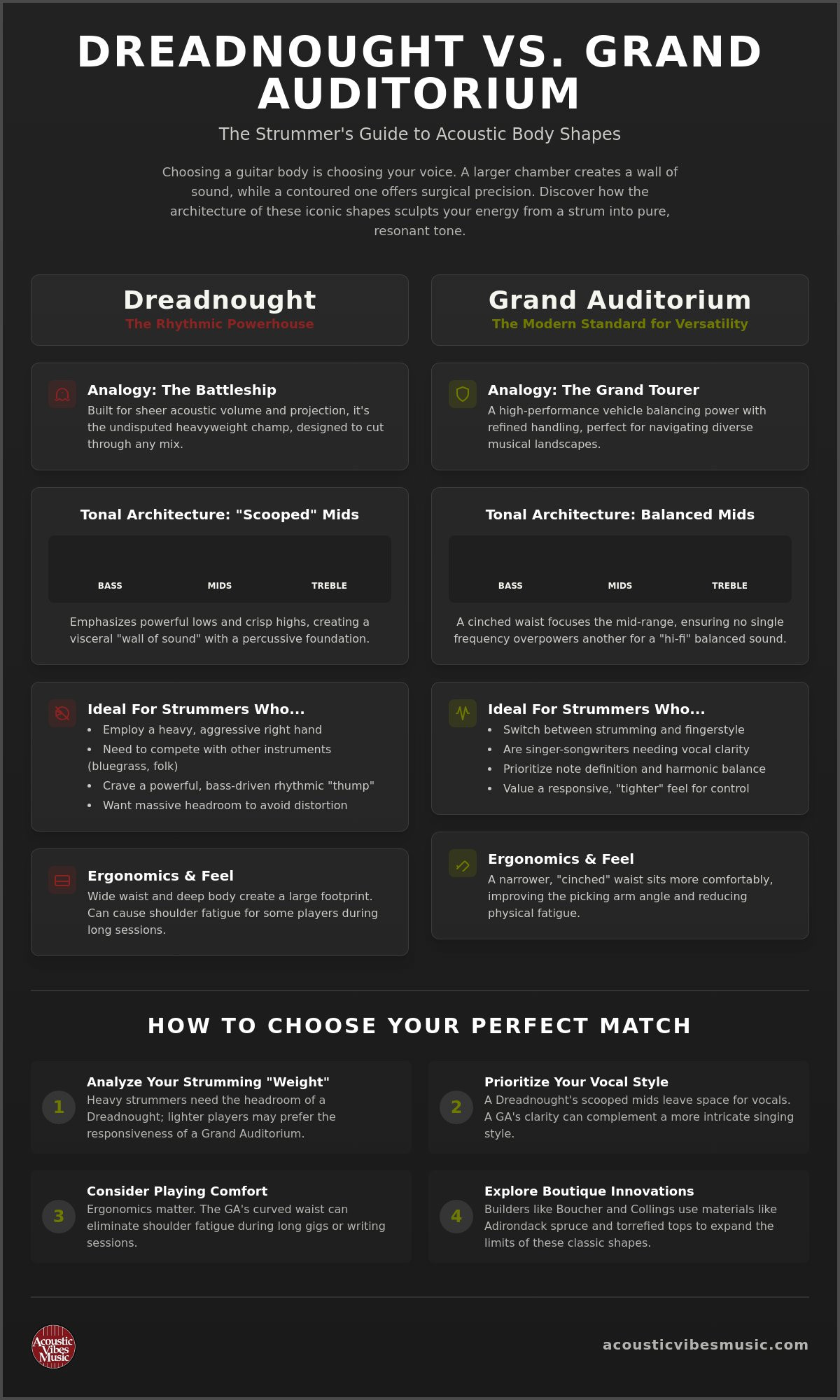
Your choice between a dreadnought vs grand auditorium for strumming isn't just about how you hear the guitar; it's about how the guitar hears you. Every player possesses a unique "strumming weight," a combination of pick thickness, wrist velocity, and emotional intensity. If you're a heavy hitter, you require a soundboard with enough surface area to translate that high-velocity energy into pure sonority. Strike a chord too hard on a smaller instrument, and you may "overdrive" the top. This results in a compressed, thin tone where the notes lose their individual identity and begin to fight one another.
Beyond the physical input, we must consider the frequency pocket of the human voice. The dreadnought is famous for its "V-shaped" EQ profile. By emphasizing the deep bass and the crystalline trebles, it naturally "scoops" the mid-range. This architectural quirk is a gift to vocalists; it creates a sonic cradle where the human voice, which lives primarily in the mid-range, can sit without competition. Conversely, the Grand Auditorium’s mid-forward voice provides a tighter, more present accompaniment that suits modern pop and folk styles perfectly. It’s about finding a partner that supports your performance rather than one you have to sing over.
For the player who uses thick picks and high-energy downstrokes, the dreadnought remains the king of the stage. The larger soundboard acts like a bigger speaker cone, moving more air and providing the headroom necessary for aggressive play. This is why Gibson Acoustic Guitars like the legendary J-45 are often called "Workhorses." They offer a percussive "thump" that can anchor a full band. When you dig in, the dreadnought responds with a visceral growl that smaller shapes simply cannot replicate.
If your style is more about nuance and dynamic storytelling, the Grand Auditorium might be your ideal match. It offers a "polite" accompaniment that doesn't overwhelm a delicate vocal delivery. While the dreadnought carries a belt-style vocalist with ease, the GA provides a shimmering, articulate backdrop for solo performers. It allows for quick transitions between light strumming and intricate fills without a jarring change in volume. To find the instrument that best complements your unique vocal range, explore our curated selection of professional acoustics today.
Evaluate your style with this quick checklist:
Choosing between a dreadnought vs grand auditorium for strumming becomes a far more nuanced journey when you step into the world of boutique craftsmanship. Mass-produced instruments follow a rigid template, but master luthiers treat every piece of wood as a unique variable. This is where high-end construction techniques, such as the use of torrefied tops, completely redefine the performance limits of these shapes. A torrefied soundboard has been thermally cured to mimic the cellular structure of vintage wood, giving a brand-new dreadnought the dry, resonant "bark" of a pre-war heirloom. It's an investment in a sound that usually takes decades to develop.
Boutique builders also utilize premium materials like Adirondack spruce to push the boundaries of headroom. While a standard Grand Auditorium might "break up" under heavy strumming, an Adirondack-topped GA can handle aggressive play with surprising composure. If you're ready to find your next masterpiece, we invite you to explore our High End Acoustic Guitars for Sale, where every instrument is hand-selected for its exceptional tonal personality and investment value.
Whether you prefer the dreadnought vs grand auditorium for strumming, our curated collection offers the finest examples of both. Boucher Guitars has mastered the art of the Adirondack top. Their Studio and Goose series instruments provide a level of projection that often leaves players questioning the need for a larger body. If you demand the ultimate in power, Collings Dreadnoughts offer a "piano-like" clarity that is consistent across the entire fretboard. Every note in a strummed chord rings with equal authority. For those seeking a different aesthetic, Lowden Guitars provides the "F" body shape. It is a sophisticated European interpretation of the Grand Auditorium, offering a lush, harmonically rich voice that is unlike anything else on the market.
Purchasing a premium instrument is a significant milestone. Our role as an expert curator is to ensure the guitar you receive is a perfect match for your technique. We provide a level of scrutiny that goes far beyond a standard retail inspection. Every dreadnought or GA undergoes a meticulous setup process in our luthier shop, ensuring it plays perfectly the moment you open the case. We also specialize in national shipping, using proven methods to protect your investment during transit. If you're still undecided on the right shape for your style, contact us for a personalized tone consultation. We're eager to share our knowledge and help you find the instrument that inspires your next great performance.
Your journey through the nuances of the dreadnought vs grand auditorium for strumming reveals that the "perfect" guitar is a deeply personal alignment of physics and artistry. Whether you crave the percussive authority of a battleship sized body or the surgical mid range clarity of a contoured waist, your decision defines your sonic footprint. Remember that your strumming weight and vocal range are the final judges. A heavy handed rhythm player will find a home in the dreadnought’s massive headroom, while the dynamic singer songwriter may prefer the intimate response of a Grand Auditorium.
As an authorized dealer for the Martin Custom Shop, Taylor, and Collings, we act as your expert guide to premium craftsmanship. Every instrument includes a professional luthier setup before it leaves our gallery, ensuring perfect action for your national shipment. If you're still weighing these iconic shapes, reach out for a personalized tone consultation with our passionate curators. Explore our curated collection of premium Dreadnought and Grand Auditorium guitars today. Your next heirloom is waiting to be discovered.
A dreadnought isn't inherently too large for a beginner, but its deep body and wide lower bout can be physically demanding. If you're a smaller-framed player, the "over-the-shoulder" reach might cause discomfort before you've mastered your basic rhythm patterns. Starting with a Grand Auditorium often provides a more ergonomic entry point. It allows you to focus on your technique without fighting the instrument's bulk during those first critical months of practice.
You can certainly use a Grand Auditorium for bluegrass, though it won't produce the same thunderous "G-run" as a traditional dreadnought. In an ensemble with a banjo and fiddle, the GA’s balanced mids might struggle to cut through the acoustic mix. However, boutique models with Adirondack tops can offer the increased headroom needed to hold your own. It's a versatile choice if you value clarity over raw, percussive volume.
The dreadnought’s superior bass response comes from its massive internal air volume and wide waist. These architectural features allow low-frequency sound waves to develop fully before exiting the soundhole. In the debate of dreadnought vs grand auditorium for strumming, the dreadnought wins on raw low-end power. Its larger soundboard acts like a bigger subwoofer, moving more air with every stroke to create that signature, visceral thump in your chest.
The Grand Auditorium is generally superior for home recording because its balanced frequency response prevents the common issue of "mic boom." Dreadnoughts often require careful microphone placement to avoid an overwhelming low end that muddies the track. A GA sits perfectly in a digital mix, providing a shimmering, articulate sound. It leaves plenty of room for vocals and other layers without requiring extensive EQ work in your software.
Waist width acts as a sonic filter for your rhythm work. A wide waist, like that on a dreadnought, allows for a more "open" and bass-heavy soundstage. A narrow waist, found on Grand Auditoriums, compresses the air inside the body. This creates a tighter, more focused mid-range. This physical narrowing emphasizes note separation and prevents your chords from becoming a wash of indistinct frequencies during fast paced, aggressive strumming sessions.
Choosing a Grand Auditorium is a wise move if you struggle with shoulder fatigue or chronic pain. The "cinched" waist allows the guitar to sit lower on your leg, which brings the strings closer to your core. This reduces the angle of your picking arm significantly. This ergonomic advantage lets you play for longer periods without the strain associated with reaching over the deep, boxy frame of a full-sized dreadnought.
Taylor Guitars pioneered the Grand Auditorium, but boutique builders like Boucher and Collings have refined the shape for high-performance strumming. Boucher is particularly noted for using Adirondack spruce to give their GA models incredible projection and headroom. For those seeking a European flair, Lowden’s "F" body offers a lush, harmonically complex alternative. These makers ensure that a smaller shape can still deliver a professional, room-filling sound on stage.
Body shape is the primary architect of your sound, while wood type acts as the interior designer. The physical dimensions of the dreadnought vs grand auditorium for strumming determine the fundamental EQ and volume. Once the shape is chosen, tonewoods like Rosewood or Mahogany refine the character. They add either metallic shimmer or warm, woody punch to the established foundation, but they won't change the instrument's basic ergonomic feel.