My shopping cart
Your cart is currently empty.
Continue ShoppingThe most transformative shift you can make to an acoustic guitar’s voice isn't found in the choice of tonewood or string gauge; it's hidden in the geometry of the build. Many players find themselves asking, what is a 12-fret guitar, only to realize it isn't just about having fewer frets to reach. It's a deliberate design choice that shifts the bridge into the center of the lower bout, turning the guitar into a more efficient, resonant acoustic engine. If you've ever felt that a standard dreadnought is a bit too cumbersome or its tone feels too clinical, you're likely searching for the soul of this vintage-inspired layout.
It's easy to assume that losing two frets of access is a compromise, but for fingerstyle players and collectors, it's actually a massive upgrade in warmth and playability. We're currently seeing a significant resurgence in this design, with legendary builders like Gibson and Taylor releasing stunning new models in 2026 to meet the growing demand for handcrafted excellence. This guide will walk you through the physical differences in bridge placement and help you decide if a 12-fret fits your personal playing style. From the historical heritage of Martin to the modern precision of Collings and Boucher, you'll learn why this ergonomic powerhouse is the secret weapon of the world's most discerning guitarists.
To truly understand what is a 12-fret guitar, you have to look past the number of frets on the fingerboard. The name specifically describes the geometry of the instrument, marking the exact point where the neck and the body meet. On a standard modern acoustic, this intersection happens at the 14th fret. On a 12-fret design, the body extends further up the neck, meeting it at the 12th fret. This subtle shift fundamentally alters the instrument's physics. It isn't just a shorter neck; it's a complete repositioning of the acoustic engine.
It's a common misconception that a 12-fret guitar always features a shorter scale length. While many "Short Scale" models exist, the term strictly refers to the body join. You can easily find instruments with a full 25.4-inch scale length on a 12-fret body. This combination creates a unique tension profile and a specific hand feel that many players find incredibly rewarding. It's about where the hand sits in relation to the body, creating an intimate playing experience that 14-fret models often struggle to match.
When the neck join moves to the 12th fret, the bridge is naturally pushed further back into the center of the lower bout. Think of the guitar top like a drumhead. The center is the most flexible and resonant area. By placing the bridge here, builders can extract more vibration and a deeper bass response from the wood. Visually, these instruments are often stunning. They frequently feature an elongated upper bout and a slotted headstock. This headstock design isn't just for vintage aesthetics; it creates a steeper break angle over the nut. This increases downward string pressure, contributing to the guitar's signature punchy and clear response.
This design isn't a modern experiment. It's actually the original blueprint for the acoustic world. The early history of the steel-string guitar was defined by the 12-fret configuration, which evolved directly from 19th-century classical and parlor instruments. For decades, this was the industry standard. However, the 1930s brought a seismic shift. As guitarists moved into loud jazz orchestras, they needed more upper-fret access to compete with horns and banjos. This led to the 14-fret "Orchestra" and "Dreadnought" models that dominate the market today.
Despite that mid-century shift toward longer necks, we're currently witnessing a massive revival. Modern enthusiasts and fingerstyle players are rediscovering the tonal magic of these proportions. Brands like Martin continue to honor their deep 12-fret roots, while boutique masters at Collings and Boucher refine the design for the modern stage. It’s a return to form that prioritizes tonal richness and artisanal heritage over sheer fretboard real estate.
The sonic profile of a 12-fret guitar is often described by enthusiasts as haunting, orchestral, or even piano-like. When asking what is a 12-fret guitar, the answer lies as much in the ears as it does in the eyes. While you might expect a smaller scale or a shorter neck to produce a thinner sound, the opposite is true. These instruments possess a remarkable ability to punch above their weight class, delivering a low-end authority and harmonic richness that often eclipses much larger 14-fret dreadnoughts.
This "bigger" sound is primarily the result of increased air volume and soundboard efficiency. Because the neck meets the body earlier, many builders elongate the upper bout to maintain a standard scale length. This creates a larger internal chamber, allowing more air to move inside the instrument. The result is a fundamental note that feels more supported and a bass response that is deep without becoming muddy. It’s a balanced, hi-fi sound that captures the full spectrum of the guitar's voice with startling clarity.
The bridge functions as the primary engine of the soundboard, driving every vibration from the strings directly into the wood. By shifting the bridge further back into the center of the lower bout, luthiers place it in the most flexible part of the guitar top. This allows the soundboard to act like a more efficient pump, moving more air with less effort from the player. You’ll notice an immediate increase in mid-range complexity and a sweetness in the high frequencies that standard designs often lack. If you are looking for an instrument that rewards a light touch with massive resonance, exploring our curated acoustic collection is the best way to experience this physics in action.
Understanding the key differences between 12-fret and 14-fret guitars is essential for players seeking a specific recording character. While 14-fret models are prized for their punchy, compressed mid-range that cuts through a mix, the 12-fret voice is open and airy. Recording engineers frequently gravitate toward these models because they offer a more balanced frequency response that requires less equalization. The sustain is often superior, too. Because the bridge is centered, the energy of the string stays in the top longer, creating a blooming effect where the note seems to grow after the initial attack. It's a sophisticated, artisanal sound that brings a sense of history and gravitas to any performance.
Ergonomics often take a backseat to tone in gear discussions, but for the person holding the instrument, they are everything. Understanding what is a 12-fret guitar requires feeling how the geometry changes your posture. By bringing the nut closer to your torso, the design eliminates the long reach that can make standard dreadnoughts feel like a physical workout. It creates an intimate, effortless playing experience that allows you to focus entirely on the music rather than the strain in your shoulder.
This sense of intimacy is palpable the moment you sit down with one. Even when the body size is substantial, a 12-fret feels smaller and more manageable. The center of gravity shifts, pulling the weight of the instrument back toward your body. It's a design that invites you to play for hours, offering a level of comfort that is often a revelation to those used to modern factory standards. Whether you're a seasoned collector or a dedicated hobbyist, the physical relief provided by this layout is hard to overstate.
If you've ever struggled with shoulder fatigue or found that your fretting hand feels overextended at the first fret, this layout is a definitive solution. The 12-fret design centers the instrument on your lap in a way that feels natural and balanced. It's an ideal choice for players with smaller frames or those managing repetitive strain issues. You aren't reaching out into space; the fretboard is right there, perfectly positioned for your hand to move freely. This reduced reach also makes complex chord shapes easier to navigate, as your arm stays at a more relaxed angle throughout the performance.
One of the most persistent myths surrounding what is a 12-fret guitar is the idea that it must inherently have a shorter scale length. While short-scale versions are popular, many 12-fret models feature a full 25.4-inch scale. Even with a longer scale, these guitars often feel slinkier and more compliant. This is because the bridge is situated in the most flexible part of the soundboard, which subtly alters the string tension's feel. When you pair this with the wider nut widths common on heirloom models from Martin or Taylor, you get a tool that is perfectly calibrated for fingerstyle precision. The extra space between the strings allows for cleaner fretting and more articulate picking, making it a favorite for those who value technical nuance.
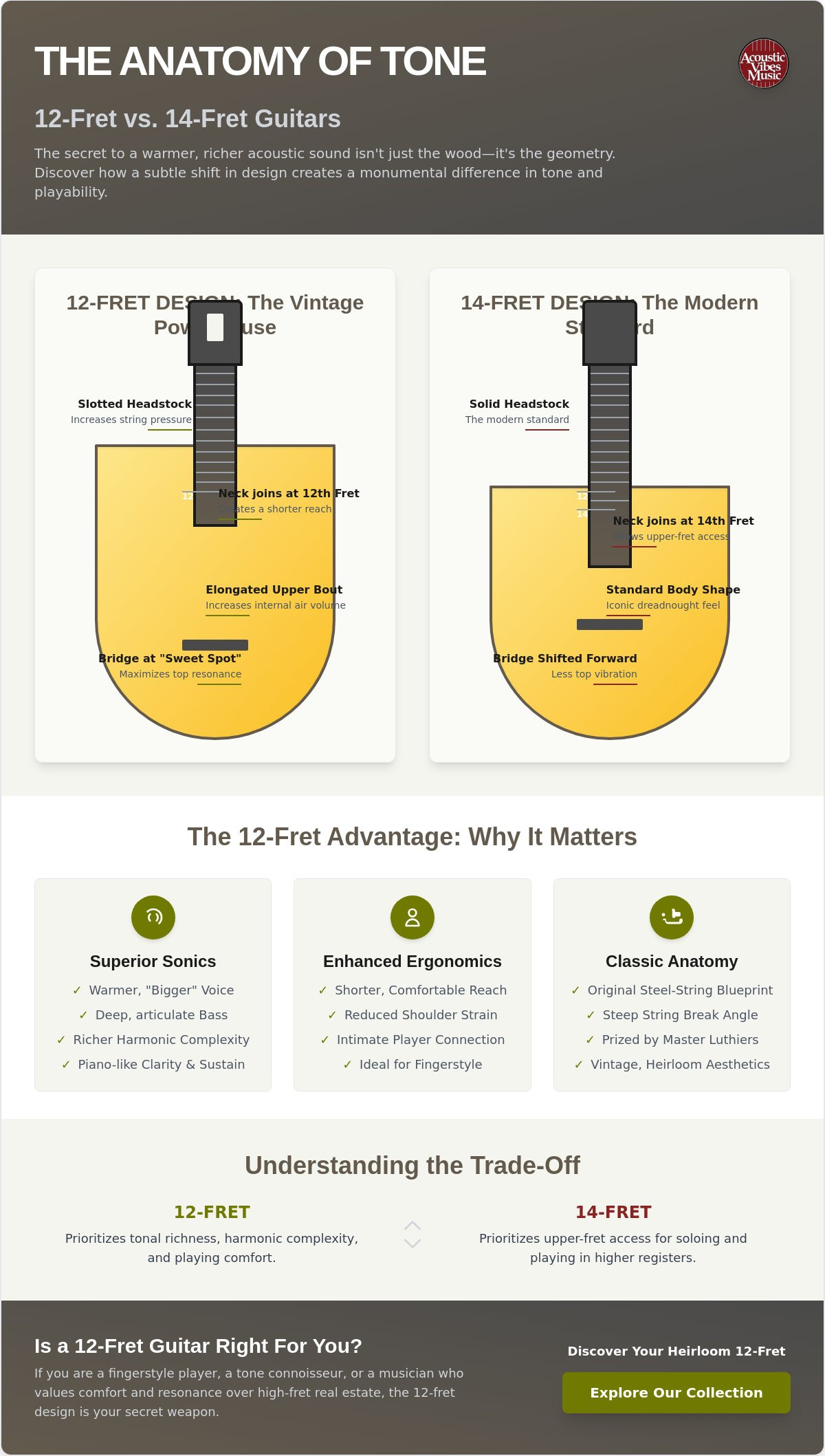
Choosing between these two designs often comes down to a balance of tonal preference and technical utility. When you ask what is a 12-fret guitar, you are looking at an instrument optimized for resonance and warmth. However, the 14-fret model was developed specifically to solve the physical limitations of that original layout. The most obvious trade-off is fretboard real estate. If your repertoire frequently takes you into the dusty end of the neck, the 12-fret join can feel like a physical barrier. Lead players who rely on high-register solos will find the 14-fret's extended reach indispensable for fluid performance.
The visual contrast is just as striking as the tonal one. The 12-fret often carries a regal, antique aesthetic with its slotted headstock and elongated body proportions. In contrast, the 14-fret profile represents the modern era of the acoustic guitar. It is sleek, familiar, and designed for the rigors of multi-genre versatility. While the 12-fret excels in solo fingerstyle and intimate folk settings, the 14-fret remains the workhorse for bluegrass flatpickers and ensemble players who need a tighter, more cutting sound.
If you are a lead player who frequently solos in the upper register, the 14-fret is your natural ally. It offers the clearance needed for high-octane runs and complex jazz voicings above the octave. Heavy strummers also tend to favor this design. The 14-fret construction often provides a tighter, more focused low-end that won't get muddy when you are digging in with a heavy pick. It is about precision and projection in a crowded mix. Many players also simply prefer the modern look and string-changing ease of a solid headstock found on most Gibson Acoustic Guitars and Yamaha models.
It is worth asking how often you actually play above the 12th fret in a typical acoustic session. For many roots and blues players, the answer is rarely. However, for those who want the sonorous depth of a 12-fret without the access restrictions, modern luthiers have perfected the cutaway solution. This allows you to enjoy the "sweet spot" bridge placement while still reaching those high notes for occasional accents. 12-fret models are also spectacular for alternative tunings. The increased resonance and soundboard efficiency provide a rich foundation for open D or DADGAD explorations. Ready to find your perfect match? Browse our full selection of premium acoustic guitars to compare these designs side-by-side.
Choosing an instrument of this caliber is a deeply personal journey. Now that you've explored the technical nuances of what is a 12-fret guitar, you can begin to narrow your search based on the specific voice you're looking for. The market for these instruments has never been more vibrant. In 2026, we're seeing a remarkable convergence of traditional craftsmanship and modern playability, giving collectors access to instruments that were once only available as vintage rarities. It's a golden age for the 12-fret design.
The Martin legacy remains the gold standard for many. Their 00 and 000 12-fret models define the traditional American sound with a dry, woody character that fingerstyle players have prized for generations. On the other end of the spectrum, Taylor has reimagined the design for the contemporary stage. Their 12-fret Grand Concert models provide a more modern, shimmering high-end while retaining that signature 12-fret warmth. It's a perfect example of how a vintage layout can be optimized with modern bracing and innovative neck designs.
For the player seeking something truly exceptional, the boutique market offers unparalleled artistry and material excellence. Boucher Guitars excels here, particularly with their use of master-grade Adirondack spruce tops. This tonewood provides incredible headroom, allowing a 12-fret body to roar when pushed while staying articulate during delicate passages. If precision is your priority, a Collings 12-fret build offers a level of clarity and note separation that is almost surgical in its perfection. Every note rings with crystalline authority. We also recommend exploring the unique, ethereal tonal palettes of Lowden or the soulful character of the latest 2026 centenary models from Gibson, such as the J-185 Century.
Reading about these instruments is helpful, but nothing replaces the tactile experience of playing them. We encourage you to visit our gallery and play 12-fret and 14-fret models side-by-side to feel the ergonomic shift for yourself. Our expert staff is here to help you navigate our collection of high end acoustic guitars for sale, ensuring you find a piece that resonates with your technique. Selecting an heirloom is about more than just specs; it's about finding that rare instrument that balances sophisticated construction with daily playability. Come discover your next great discovery in our curated collection.
Understanding what is a 12-fret guitar is the first step toward discovering a more intimate and resonant playing experience. You've seen how the strategic bridge placement unlocks a deeper, piano-like response and how the reduced reach can transform your physical comfort. Whether you're drawn to the vintage authority of a Martin or the modern precision of a Collings, this design offers a tonal richness that standard models simply can't replicate. It's a choice that favors soul and resonance over sheer fretboard real estate.
At Acoustic Vibes Music, we live for the pursuit of quality. Our expertly curated selection features the finest 12-fret instruments from legendary names like Martin, Collings, and Taylor. Every guitar in our gallery receives a professional luthier setup to ensure it plays perfectly from the moment it arrives. For high-end collectors across the country, we offer secure national shipping to bring these masterworks directly to your door. We're here to be your expert guide in finding an instrument that will be cherished for generations.
Explore our curated collection of premium 12-fret acoustic guitars and find the instrument that speaks to your soul. Your next great musical discovery is waiting.
Not necessarily. While the neck is shorter, the body is typically elongated to meet the fretboard at the 12th fret. This results in a similar overall length but a significantly larger internal air chamber. This increased volume is a core component of what is a 12-fret guitar, providing that signature resonance and depth. You gain a massive sound from an instrument that feels remarkably compact and intimate against your body.
You absolutely can play lead, though your physical range is restricted without a cutaway. Many legendary blues and folk leads stay within the first twelve frets, where this design truly thrives with punchy mids. For players who need high-register access, modern boutique luthiers frequently offer cutaway models. This provides the best of both worlds: the 12-fret's unique bridge placement and the freedom to reach the highest notes for your solos.
Slotted headstocks are a hallmark of traditional 12-fret design. Beyond the elegant, vintage aesthetic, they serve a functional purpose by creating a steeper break angle for the strings over the nut. This increased downward pressure improves sustain and adds a certain crystalline clarity to the tone. It's a sophisticated engineering choice that honors the 19th-century origins of the steel-string instrument while enhancing the tactile performance for the modern enthusiast.
No, they often produce more volume and projection than standard 14-fret models. By placing the bridge in the center of the lower bout, the soundboard acts as a more efficient pump for moving air. This creates a powerful, blooming sound that carries exceptionally well across a room. Many players are surprised to find that these "smaller" feeling guitars can easily out-project larger dreadnoughts while maintaining a richer, more orchestral bass response.
Yes, the ergonomics are often much friendlier for beginners or those with smaller frames. Because the nut sits closer to your torso, you don't have to overextend your arm to reach those first few chords. This significantly reduces shoulder fatigue and makes the initial learning curve feel less physically demanding. It's an inviting gateway for anyone who finds standard factory models a bit too cumbersome or hard to navigate during long practice sessions.
This principle of matching the right equipment to the individual's physical needs applies across many disciplines; if you apply the same care to your sports hobbies, you can discover Sturdy Racquets for gear that prioritizes performance and ease of use.
Phosphor bronze strings in light or medium-light gauges are typically the best fit for these instruments. They enhance the natural warmth and harmonic complexity of the 12-fret design without overpowering the delicate mid-range. Silk and steel strings are another fantastic option for those seeking an even mellower, vintage-inspired parlor sound. Always select high-quality strings to ensure the artisanal details of your guitar's construction and tonewoods can truly shine through every note.
These terms describe two different aspects of guitar geometry. A 12-fret guitar refers specifically to where the neck joins the body, whereas a short scale guitar refers to the total length of the vibrating string. You can find 12-fret models with full 25.4-inch scale lengths. Understanding what is a 12-fret guitar means recognizing that the bridge placement, not the string length, is the primary driver of its unique and powerful tonal character.
Fingerstyle players prize them for their exceptional balance and wider string spacing. The bridge placement creates a more responsive soundboard that reacts to a delicate touch, providing the sustain needed for complex melodies. Most 12-fret models also feature a wider nut, giving your fingers more room to navigate intricate passages without muting adjacent strings. It's a specialized tool designed for clarity, nuance, and the pursuit of tonal perfection in every performance.