My shopping cart
Your cart is currently empty.
Continue ShoppingWhat if you could increase your acoustic guitar's volume by 12 decibels without ever touching an amplifier? It's a bold promise, yet the Martin Super Dreadnought delivers exactly that by expanding the boundaries of traditional lutherie. Most serious players have felt that frustrating ceiling where a standard dreadnought starts to 'bottom out' during aggressive flatpicking. You're likely searching for the seismic power of a pre-war vintage model, but finding that level of projection in a modern instrument can feel like an impossible quest.
We're here to show you that the search is over. In this guide, you'll discover how the Custom Shop Super D uses a 13% larger body to provide the ultimate headroom and tonal depth. We will analyze the engineering of the SD-14 shape; compare the investment value of Guatemalan Rosewood versus High-Flame Koa; and explain how to navigate Custom Shop Expert availability. Whether you're anchoring a bluegrass ensemble or seeking a centerpiece for your collection, it's time to understand the true potential of Martin's largest body shape.
In an era where many acoustic builders are focusing on parlor-sized travel guitars, Martin chose to look back at the power of the pre-war era and then go even bigger. The Martin Super Dreadnought is not just a minor tweak to a classic design. It's a structural reimagining. By introducing the new SD-14 fret body size, Martin has created an acoustic colossus that offers 20% more internal air volume than its standard counterparts. This isn't merely about size for its own sake. It's about restoring the seismic projection that modern players demand for ensemble playing and aggressive flatpicking.
To understand the magnitude of this shift, one must look at the history of the Dreadnought (guitar type). While the original design was famously named after a battleship for its size and power, the Super D takes that philosophy to its logical conclusion. It merges the iconic silhouette we all love with a significantly expanded sonic architecture. The result is a guitar that feels familiar in your lap but sounds like nothing else in the room.
At a glance, you might mistake a Super D for a standard D-28, but the dimensions tell a different story. The body width stretches to 16.375 inches, compared to the 15.625 inches found on a standard model. This extra real estate creates a massive sound chamber. Engineering this larger footprint required Martin to utilize a full dovetail neck joint. This ensures that the increased tension and energy transfer remain stable over decades of play. You'll notice the difference immediately in the depth of the body and the sheer presence it commands on a stand. It's a wider, deeper footprint that redefines what a 14-fret guitar can achieve.
As of 2026, the Custom Shop Super D remains a pinnacle of artisan craftsmanship. These instruments are exclusively available through Custom Shop Expert dealers who specialize in high-end, limited-run models. Each guitar is a showcase of material excellence. The selection process for the tonewoods is rigorous. Whether it's the dense, dark Guatemalan Rosewood or the shimmering High Flame Hawaiian Koa, only the most resonant sets are chosen. This level of curation ensures that every Martin Super Dreadnought is an heirloom-quality investment. These models are designed to hold their value as well as they hold a tune, making them a top choice for serious collectors.
The real magic of the Martin Super Dreadnought lies beneath its Sitka spruce surface. It’s a matter of pure physics. By increasing the internal air volume by 20%, Martin has effectively enlarged the guitar’s "engine." This isn't just about making the instrument louder, though internal testing shows a massive 12dB increase in volume over standard models. It's about the quality of that volume. Larger chambers move more air. More air translates to a richer, more complex harmonic response that fills a room with ease.
Headroom is the holy grail for flatpickers. It’s the capacity of a guitar to handle aggressive strumming without the tone compressing or "bottoming out." In a standard dreadnought, there’s a limit to how much energy the soundboard can process before the notes lose their individual identity. The Martin Super Dreadnought moves that ceiling significantly higher. Cubic volume refers to the total three-dimensional space inside the guitar's body, which acts as the primary resonator for acoustic energy. This larger chamber allows the low-end frequencies to bloom with authority while maintaining a punchy mid-range that cuts through any ensemble. If you want to experience this massive projection for yourself, you can explore our latest arrivals in the Martin Custom Shop collection.
To manage this increased air pressure, the bracing had to be precisely engineered. Martin utilizes forward-shifted 5/16-inch scalloped Sitka spruce bracing. By shifting the "X" closer to the soundhole and scalloping the wood, the luthier allows the top to vibrate more freely. This creates a responsive instrument that doesn't feel stiff despite its size. It's a delicate balance between structural integrity and acoustic flexibility. This bracing pattern ensures that every ounce of energy from your pick is converted into pure sound.
The top itself features Martin's Vintage Tone System (VTS). This torrefaction process ages the wood at a cellular level, removing moisture and resins to simulate the response of a guitar that has been played for eighty years. You get that "played-in" sweetness immediately. Visually, the tricolor wood fiber herringbone purfling adds a touch of classic elegance that mirrors the instrument's functional excellence. These details ensure the Super D is as beautiful to look at as it is to play. It's a modern masterpiece with a vintage soul.
Comparing the Martin Super Dreadnought to the Standard Series D-28 or D-18 is like comparing a grand concert hall to a world-class recording studio. Both offer exceptional acoustic experiences, but the scale of the performance differs. While the D-28 remains the industry benchmark for balanced projection, the Super D pushes those boundaries into new territory. It takes the familiar dreadnought silhouette and expands the footprint to 16.375 inches at the lower bout. If you are debating between body shapes for your playing style, our guide on Dreadnought vs. Grand Auditorium for Strumming provides deeper context on how volume and body geometry interact.
The most immediate distinction is the "thump." A standard D-28 provides a sophisticated, balanced growl that sits perfectly in a professional mix. In contrast, the Super D produces a piano-like bass that feels sonorous and cavernous. It is a physical sensation as much as an auditory one. You might expect such a large body to sacrifice treble clarity, yet the engineering prevents this. The VTS top and forward-shifted scalloped bracing ensure the high-end remains crisp and articulate. The massive air volume doesn't just add bass; it extends the sustain. Notes ring with a shimmering decay that outlasts standard models, making it a dream for solo performers who need to fill every corner of a room.
Don't let the larger footprint intimidate you. Martin has thoughtfully paired this colossus with a modern neck design to ensure it remains accessible. The Modified Low Oval profile feels sleek in the hand, preventing the fatigue often associated with vintage, chunky necks. The High Performance Taper provides a comfortable transition as you move up the fretboard, ensuring that lead lines are as easy to execute as open chords.
Transitioning from a standard dreadnought to the Martin Super Dreadnought is a revelation in power. It is an instrument designed for those who find themselves reaching the limits of a traditional body size. It offers the headroom you've been missing without sacrificing the legendary Martin playability you've come to expect.
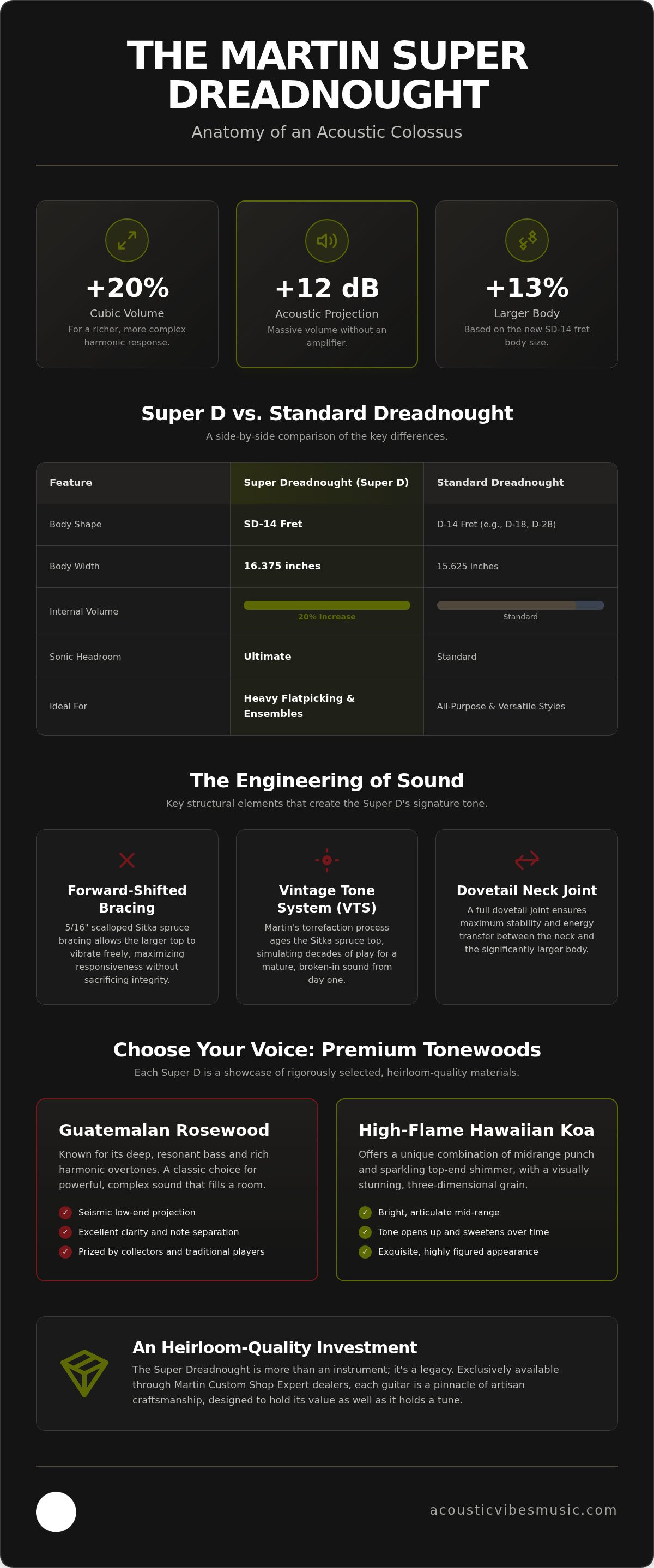
While the SD-14 body shape provides the architecture for power, the choice of tonewood defines the instrument's specific voice. For the Martin Super Dreadnought, the Custom Shop has curated two distinct paths: the dark, complex resonance of Guatemalan Rosewood and the shimmering, mid-range sweetness of High Flame Hawaiian Koa. Selecting between them isn't about quality; it's about matching a sonic signature to your personal playing style. For those curious about how these compare to more traditional pairings, our Rosewood vs. Mahogany Back and Sides guide offers essential technical context on wood density and response.
Guatemalan Rosewood has emerged as the premier alternative to the legendary Brazilian species. It is exceptionally dense. This density translates into rich overtones and a deep, reverb-like quality that sustains far longer than standard East Indian varieties. Visually, it is a masterpiece. The grain is often darker and more irregular than East Indian Rosewood, offering a "landscape" aesthetic that collectors crave. In the massive chamber of a Super D, this wood provides a thunderous low-end that remains articulate. It is the definitive choice for the bluegrass flatpicker who needs to anchor an ensemble with authority. Notes bloom with a sophisticated complexity that feels both vintage and modern.
If Rosewood is about power, Hawaiian Koa is about artistry and evolution. High Flame Koa is prized for its stunning visual figuring, but its sonic profile is equally compelling. It sits comfortably between the warmth of mahogany and the brightness of maple. Unlike rosewood, which sounds complex from day one, Koa "opens up" significantly over years of playing. It develops a rich mid-range focus that recording artists adore. The visual artistry of high-flame figuring makes each instrument a unique work of art. It’s a lustrous, golden wood that reflects the premium nature of the Custom Shop.
Choosing the right wood depends on your musical goals and how you intend to use the Martin Super Dreadnought:
Ready to hear the difference for yourself? You can browse our current selection of Martin Custom Shop Super D models and find the tonewood that speaks to your soul.
Acquiring a Martin Super Dreadnought is an intentional move into the highest tier of modern acoustic collecting. In 2026, Custom Shop Expert models have solidified their reputation as blue-chip investments. Because these instruments are produced in limited runs with the finest tonewoods, they tend to hold their value exceptionally well in the secondary market. Collectors recognize that the Super D represents a unique moment in Martin's history, a bold departure from the trend of smaller guitars that has redefined the "colossus" category for a new generation of players.
Ownership of such a significant instrument comes with a responsibility to its preservation. The Martin Super Dreadnought features approximately 20% more internal volume and an expanded surface area compared to standard models. This means there is more wood to react to environmental changes. Proper humidity control is not optional; it's a requirement for protecting your investment from cracks or structural shifts. We recommend a consistent environment of 45 to 55 percent relative humidity to keep the VTS top and premium back woods stable.
Regular check-ups with a professional luthier are essential for long-term health. Over years of heavy play, even the sturdiest instruments may require minor adjustments to the bridge or nut to maintain that perfect action. Understanding the potential maintenance needs, such as the Acoustic Guitar Bridge Repair Cost, helps you stay ahead of any issues and ensures your heirloom remains in peak performance condition for decades.
At Acoustic Vibes Music, we view ourselves as Passionate Curators rather than mere retailers. We understand that a national buyer seeking a rare Custom Shop model needs more than just a tracking number. You need a trusted advisor. Our team provides personalized consultations to help you navigate the specific tonal profiles of our inventory. Whether you're looking for the dark complexity of Guatemalan Rosewood or the shimmering sweetness of Koa, we help you find the exact voice you've been chasing.
Every Martin Super Dreadnought that leaves our shop undergoes a rigorous inspection and professional setup. We ensure it is performance-ready the moment you open the case. Our national shipping expertise means your instrument arrives safely, regardless of your distance from our gallery. We take pride in connecting serious players with the instruments that will define their musical legacy. It's time to experience the seismic power of the SD-14 body for yourself. We invite you to explore our curated Martin Custom Shop collection and discover the next centerpiece of your collection.
The Martin Super Dreadnought represents a seismic shift in modern lutherie, proving that sometimes bigger really is better. By harnessing 20% more internal air volume, this instrument delivers the massive projection and sonic headroom that standard dreadnoughts simply cannot match. Whether you're drawn to the dark, complex overtones of Guatemalan Rosewood or the shimmering sweetness of High Flame Koa, you're choosing a piece of craftsmanship designed to last generations. These aren't just guitars; they're heirlooms that command attention in any ensemble or collection.
As an authorized Martin Custom Shop Expert Dealer, Acoustic Vibes Music is dedicated to helping you find your perfect match. We ensure every instrument receives a professional luthier setup before it leaves our gallery, guaranteeing peak playability from the moment you first strum a chord. With our insured national shipping, your next high-value investment is in safe hands. It's time to elevate your sound and feel the resonance of a true colossus. Discover the Martin Custom Shop Super D at Acoustic Vibes Music today and start your next musical chapter with confidence.
The Martin Super Dreadnought won't fit into a standard dreadnought case due to its expanded 16.375 inch lower bout. It requires a dedicated, oversized hardshell case designed specifically for the SD-14 body shape. When you purchase one of these instruments from a specialist, it typically arrives with the correct factory case to ensure a secure fit. Standard cases often fail to accommodate the increased depth and width of this larger sound chamber.
While both are large, the Super D maintains the traditional square-shouldered silhouette of a dreadnought, whereas the Jumbo features a much narrower waist. This difference in geometry changes the air movement significantly. The Super D focuses on massive low-end "thump" and projection. In contrast, a Jumbo often provides a more balanced, "scooped" mid-range. The 16.375 inch width of the Super D makes it the largest single-necked guitar in Martin's current lineup.
Increased volume doesn't translate to increased physical difficulty. However, the larger body depth may require a slight adjustment in your seating or standing posture. To mitigate the size, Martin utilizes a Modified Low Oval neck profile and a High Performance Taper. These features ensure the fretboard remains accessible and fast. Most players find that the 12dB increase in volume is a tonal benefit that doesn't sacrifice the legendary playability of the brand.
Guatemalan Rosewood is significantly denser than East Indian Rosewood, offering a tonal profile that closely mimics the rare Brazilian species. On a Martin Super Dreadnought, this density results in richer overtones and a cavernous, reverb-like sustain. Indian Rosewood is known for its reliable balance and "growl," but it lacks the visual and sonic complexity found in the Guatemalan sets. Collectors often prefer the unique grain patterns and sophisticated bloom of the Guatemalan variety.
You can technically use light gauge strings, but medium gauge strings are recommended to fully drive the larger Sitka spruce top. The increased surface area of the Super D requires more energy to vibrate efficiently. Light strings may not provide enough tension to activate the 20% extra cubic volume, potentially resulting in a thinner tone. Most players find that medium strings maximize the instrument's massive headroom and projection without feeling overly stiff on the modern neck.
The Super D is a showcase of Martin's most advanced lutherie and premium material selection. Custom Shop Expert dealers are specifically chosen for their ability to curate and maintain high-value inventory. These shops provide the specialized knowledge required to help collectors navigate rare tonewood options like Koa or Guatemalan Rosewood. By limiting availability to these experts, Martin ensures that every buyer receives a personalized consultation and a guitar that has been professionally inspected.
While the Super D is a flatpicker's dream due to its incredible headroom, it's surprisingly well-suited for fingerstyle play. The 1.75 inch nut width provides the string spacing that fingerstyle players require for precision. The VTS top ensures that even a lighter touch can produce a resonant, "played-in" response. It excels in solo performance where the extra sustain and piano-like bass can fill the sonic space that a smaller guitar might leave empty.
The Vintage Tone System (VTS) significantly shortens the break-in period by torrefying the spruce top to a cellular state similar to an 80-year-old instrument. This process removes moisture and resins that typically take decades to dissipate. As a result, your Martin Super Dreadnought will sound "open" and resonant from the very first day. While the back and sides will still evolve over time, the VTS top provides that sought-after vintage sweetness immediately.