My shopping cart
Your cart is currently empty.
Continue ShoppingThe slight lift of a bridge on a vintage Martin or a boutique Collings is more than a minor nuisance; it's a structural emergency that can compromise the very voice of your instrument. You've likely noticed a change in action or a subtle loss of resonance and felt that immediate pang of anxiety. Finding a shop you can trust with a high-value investment is difficult, especially when quotes for acoustic guitar bridge repair cost seem to vary wildly from one bench to the next.
We understand that your guitar is a piece of art, not just a tool. It's frustrating to face fluctuating repair estimates while worrying that a "budget" fix might permanently devalue a rare tonewood top. This guide provides the clarity you need by exploring current restoration expenses and the technical nuances of professional bridge work in 2026. Gain a clear understanding of what to expect during the process. We've included a specialized checklist to help you vet a master luthier who possesses the precision and reverence your collection deserves.
The bridge is the heart of your instrument's vibration. It's the primary point of contact where string energy meets the soundboard. Because of this, any structural failure here isn't just a cosmetic flaw; it's a fundamental threat to the guitar's longevity. When calculating the potential acoustic guitar bridge repair cost, it's essential to look beyond the surface. In 2026, the market for specialized luthier services has evolved. Rising costs for rare materials like genuine ebony and the specialized adhesives required for high-end instruments have influenced labor rates across the country. Expert luthiers now command a premium for their ability to navigate these complexities without devaluing a collector's item.
Understanding Steel-string acoustic guitar construction helps reveal why these repairs are so intensive. A bridge is under roughly 160 to 180 pounds of constant tension. Factors like the type of finish, whether it's delicate nitrocellulose or a more modern poly, and the specific glue used in the original build dictate the complexity of the job. A master luthier must carefully heat and remove the bridge without scorching the surrounding finish or splintering the spruce top. It's a delicate dance that requires years of experience and specialized tools.
Sometimes a bridge merely lifts because the factory glue failed. In these cases, a luthier can carefully remove the bridge, clean the surfaces, and re-adhere it. Industry benchmarks for a standard re-glue often range between $150 and $350. However, if the bridge plate, the hardwood reinforcement inside the body, is chewed up or cracked, the scope expands. Replacing a bridge plate is a surgical procedure that requires mirrors, specialized lights, and immense patience. If the bridge itself is cracked or warped beyond saving, a full replacement can push estimates toward $600 or more. This is especially true when sourcing premium tonewoods to match the aesthetic of a boutique build. Intonation issues caused by a shifting bridge can also add to the final bill, as the saddle slot may need to be filled and recut.
A professional repair doesn't end when the glue dries. Removing a bridge often leaves "witness lines" or small finish chips that require expert touch-ups to remain invisible. This is particularly vital for vintage instruments where the lacquer has aged and yellowed over decades. Additionally, a bridge repair almost always necessitates a comprehensive setup. Once the bridge is re-seated, the saddle height and intonation must be dialed in perfectly to ensure the guitar plays as well as it looks. You might find that while the guitar is on the bench, other components need attention. For instance, understanding Acoustic Guitar Nut Replacement Cost is helpful. These two structural points work in tandem to define your guitar's action and playability. Expect a professional setup to add significant value to the restoration, ensuring your instrument returns in peak performance condition.
A masterfully crafted instrument is a delicate balance of tension and resonance. When you own a piece from Martin Guitars or Collings Guitars, you aren't just paying for a brand name; you're investing in specific construction techniques that require expert handling. High-end acoustic guitar bridge repair cost is often driven by the use of traditional protein glues. Many boutique builders prefer hot hide glue for its crystalline structure and superior tonal transfer. Unlike modern yellow glues, hide glue is brittle and difficult to apply. It requires a specific temperature and a lightning-fast work window. A luthier must be skilled enough to seat the bridge perfectly before the adhesive gels. This level of artisanal skill is exactly what separates a local shop from a high-end specialist.
Preserving the soundboard's natural geometry is another critical factor. Every quality guitar has a slight radius or dome built into the top. A common mistake in budget repairs is over-clamping, which can flatten this curve and stifle the instrument's voice. Professionals follow standards set by organizations like the Guild of American Luthiers to ensure the clamping pressure is distributed evenly across the bridge footprint. They use custom-made cauls that mirror the specific internal bracing of your guitar. This prevents the braces from cracking under pressure. If you live in a region with extreme seasonal shifts, humidity also plays a massive role. Wood shrinks and expands, often causing the bridge to shear away from the top. A premium repair includes assessing these environmental impacts to prevent future failure.
The rarity of bridge materials significantly impacts restoration. Sourcing a high-grade piece of Macassar ebony or figuring out a match for an older instrument's bridge footprint requires a curator's eye. A luthier might need to custom carve a bridge from a raw blank to ensure it matches the original vintage piece exactly. This is especially important when considering the tonal differences between woods. You can explore more about these characteristics in our guide on Rosewood vs. Mahogany. Using the wrong density of wood can drastically alter the sustain and clarity of your guitar.
For collectors, an invisible repair is the gold standard. A sloppy glue job or a poorly fitted bridge can slash the resale value of Boucher Guitars or Taylor Guitars by thousands of dollars. Expert luthiers take the time to match the finish and ensure no glue squeeze-out is visible under a blacklight. This attention to detail justifies the acoustic guitar bridge repair cost for anyone viewing their instrument as a long-term investment. If you are unsure about the state of your bridge, it is always wise to consult with a specialist who understands the nuances of fine acoustic instruments.
Entrusting your instrument to a stranger is a nerve-wracking experience for any collector. While the acoustic guitar bridge repair cost is a major consideration, the expertise of the individual at the bench is the variable that ultimately protects your investment. You must distinguish between a general retail technician and a master luthier. A technician often focuses on high-volume, basic maintenance like string changes or minor adjustments. In contrast, a master luthier possesses the deep anatomical knowledge required for invasive structural work. They understand how wood under tension behaves over decades, not just during the next gig.
Start your search by verifying factory certifications. Authorized service centers for brands like Martin or Taylor have undergone rigorous training and possess the specific jigs and proprietary tools required for those builds. Ask to see a portfolio of their structural work. A professional should be able to show clear, high-resolution photos of previous bridge removals and re-glues. They likely utilize professional luthier tools and resources to ensure precision that matches factory standards. Beyond technical skill, evaluate their environment. A shop without a dedicated, humidified acoustic room is a massive risk. Wood is hygroscopic; it constantly breathes. If a repair happens in an arid or overly damp room, the bridge will likely lift again once you return home.
Communication is the final pillar of trust. A master luthier won't give you a vague, verbal quote over the phone. They provide a detailed written estimate after a physical inspection. This document should outline the labor, any material costs, and potential contingencies like bridge plate reinforcement. If they can't explain the "why" behind their process, they aren't the right hands for your instrument.
Before handing over your case, ask these specific technical questions to gauge their proficiency:
Run the other way if a shop suggests using screws or bolts to "fix" a lifting bridge. This is a crude, outdated method that destroys the soundboard's integrity and value. Be wary of anyone who dismisses the importance of humidity or offers a price that seems too good to be true. Low acoustic guitar bridge repair cost estimates often hide a lack of experience or a "quick fix" mentality that ignores the long-term health of your guitar. Transparency and a reverence for the craft are non-negotiable traits for any professional restorer.
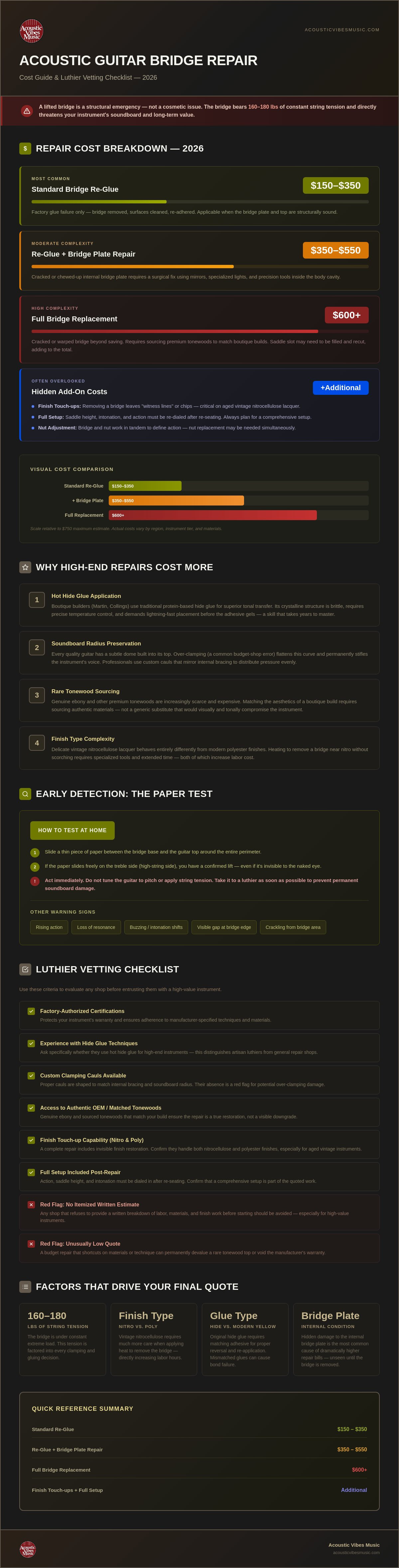
The discovery of a lifting bridge often brings a mix of frustration and urgency. Before committing to an acoustic guitar bridge repair cost, you must confirm the extent of the damage at home. Use the "paper test" by gently attempting to slide a standard piece of printer paper under the rear or side edges of the bridge. If the paper slides in even a few millimeters, the structural bond has failed. Your very next step is critical: loosen the string tension immediately. High tension acts like a lever, slowly peeling the delicate spruce fibers of the soundboard away from the bridge. Taking this simple action can prevent a minor re-glue from turning into a much more expensive top restoration.
Documenting your instrument is vital for both insurance and the luthier's assessment. Take high-resolution photos of the bridge from multiple angles, including a side profile to show the height of the lift. Note any other issues, such as bulging behind the bridge or a sunken area in front of it. These visual cues help a professional provide a more accurate preliminary quote. If you are shipping your instrument to a specialist, this documentation serves as your baseline for its condition before it leaves your hands. Choosing a carrier with experience in high-value musical instruments is essential for peace of mind.
Shipping a masterpiece requires more than just a box and some tape. You must use a high-quality hard-shell case; never ship a guitar in a gig bag for structural repairs. To prevent "headstock whip," a common cause of snapped necks during transit, pack the area around the headstock tightly with crumpled newspaper or bubble wrap so it cannot move within the case. Ensure the guitar is snug and doesn't shift when you gently shake the case. Finally, always opt for full-value shipping insurance. For boutique instruments, third-party shipping insurance often provides better coverage and easier claims processes than standard carrier-provided options.
Most master luthiers prefer a digital consultation before you ship your guitar. By reviewing your high-resolution photos, they can identify potential bridge plate issues or finish complications that might affect the final acoustic guitar bridge repair cost. Be prepared for lead times. The most respected benches in the country are often booked weeks or months in advance. This wait is a testament to their skill and the care they provide. Once your bridge is restored, you may want to learn How to Adjust Acoustic Guitar Intonation to keep your instrument in peak playing condition. If you are ready to begin the restoration process with experts who respect the heritage of your instrument, contact our team at Acoustic Vibes Music to schedule your professional assessment.
At Acoustic Vibes Music, we view every instrument that enters our shop as a living piece of musical history. Whether it's a pre-war heirloom or a modern masterpiece, our philosophy remains the same: restoration is about preservation, not just repair. We understand that the acoustic guitar bridge repair cost is an investment in the longevity of your instrument. Our team approaches every bridge re-glue and replacement with the same meticulous care we use when selecting instruments for our gallery. By treating each project as a surgical restoration, we ensure that the tonal integrity and structural stability of your guitar are protected for the next generation of players.
Our deep-rooted relationships with world-class builders provide a distinct advantage for our clients. We leverage our status as authorized dealers for Lowden Guitars and Yamaha Acoustic Guitars to source authentic factory parts and proprietary adhesives. This ensures that every repair meets the exact specifications of the original manufacturer. There is a unique synergy between our curated sales and our repair services. When you acquire a guitar from us, you gain a partner dedicated to its lifelong care. This holistic approach allows us to maintain the highest standards of playability and value for every instrument in our care.
Collectors from across the country send their prized instruments to our bench because they require more than a simple fix. They demand the specialized expertise that comes from decades of handling the world's finest acoustic instruments. We pride ourselves on transparent pricing and clear, expert communication throughout the entire process. Our luthier service is the recognized standard for boutique care, offering a level of precision that general retail shops simply cannot match. We treat your guitar with the reverence it deserves, ensuring that every detail is perfect before it returns to your hands.
Ready to restore your instrument's voice? The process begins with an in-depth evaluation by our master luthier. You can book an appointment to discuss your specific needs and receive a comprehensive estimate for your acoustic guitar bridge repair cost. If you are considering a transition, we also offer professional consignment services for fully restored instruments, helping you find the perfect new home for your piece. Beyond structural repairs, we provide a full suite of maintenance services. Explore our guide on Fret Dressing vs. Refret to learn how we can further enhance your guitar's performance. Schedule a consultation today and give your instrument the expert care it needs.
Your instrument is a vessel for your music and a testament to artisanal craftsmanship. Addressing a lifting bridge early prevents cascading structural issues that can silence its voice forever. While the acoustic guitar bridge repair cost is an essential consideration, the true value lies in the peace of mind that comes from professional restoration. Prioritize factory-authorized techniques and climate-controlled environments to maintain your guitar's integrity. It's about protecting a piece of history.
As a passionately curated high-end boutique and an authorized service center for Martin, Taylor, and Collings, we specialize in the delicate art of structural repair. We handle every instrument with reverence. We utilize expert national shipping and handling to serve collectors across the country. Don't let a minor lift compromise your playing experience or your instrument’s resale value. Consult with our Master Luthiers for your Bridge Repair today to begin the journey of restoration. We're excited to help your guitar reach its full potential once again.
The acoustic guitar bridge repair cost for a standard re-glue typically follows industry benchmarks for professional luthier services. You'll find that rates vary based on the instrument's construction, the type of finish, and the specific adhesives required, such as traditional hot hide glue. Premium restoration work on boutique instruments often commands a higher investment due to the surgical precision and specialized clamping jigs needed to preserve the soundboard’s radius.
Attempting a DIY bridge repair is a high-risk endeavor that often leads to permanent soundboard damage. Simply "squirting" glue into a gap doesn't address the underlying issue of old adhesive residue or wood fibers that have pulled away. A professional must completely remove the bridge, clean both surfaces to bare wood, and use specialized heating elements to ensure a structural bond that can withstand nearly 180 pounds of string tension.
A lifting bridge is a common structural issue and does not mean your instrument is beyond saving. In fact, most high-end acoustic guitars will require a bridge re-glue at some point in their lifespan due to natural wood movement and glue fatigue. When caught early and handled by a master luthier, the repair is a routine preservation step that restores the guitar to its original factory specifications and prevents further damage.
The actual repair process usually requires several days of bench time to allow for proper cleaning, gluing, and a 24 to 48-hour cure cycle under clamp pressure. However, total turnaround times are often longer because the most respected luthier shops are frequently booked weeks in advance. It's best to plan for a three to four-week window to account for the detailed setup and final play-testing that follows any structural restoration.
Bridge failure is usually the result of a combination of constant string tension and environmental fluctuations. Low humidity causes the spruce top to shrink and pull away from the bridge footprint, while excessive heat can soften the adhesive bond. Over decades, even the best factory glue can become brittle. This creates a shear point where the bridge begins to "creep" or peel away from the soundboard under the stress of the strings.
A professionally executed bridge repair often improves the tone of your instrument by restoring the critical energy transfer between the strings and the top. When a bridge is lifting, you lose resonance and sustain because the vibrations aren't being efficiently coupled to the soundboard. Re-establishing a perfect, wood-to-wood bond ensures that your guitar regains its full dynamic range and tonal clarity.
You likely only need a re-glue if the original bridge is still flat and structurally sound once it's removed from the guitar. Replacement becomes necessary if the bridge itself has warped, cracked through the pin holes, or been thinned down too much during a previous "budget" repair. A specialist will inspect the wood for stability to determine if a new piece of ebony or rosewood is required to maintain the instrument's integrity.
A bridge repair almost always requires a new or adjusted saddle to ensure proper intonation and action height once the bridge is re-seated. While the nut doesn't always need replacement, it's common practice to perform a full setup as part of the restoration process. This ensures that the entire geometry of the instrument is optimized, providing a seamless playing experience from the first fret to the last.