My shopping cart
Your cart is currently empty.
Continue ShoppingIf you assume the higher price tag on a rosewood instrument automatically makes it the "better" guitar, you might be overlooking the very wood that defines your unique musical voice. It's completely natural to feel overwhelmed by technical jargon when comparing rosewood vs mahogany back and sides, especially when all you really want is an instrument that resonates with your soul. The confusion often deepens when you see the narrowing price gap between these materials in 2026. This shift leaves many players wondering if the investment truly matches the sonic output, particularly as guitar prices have risen by up to 20 percent since 2017.
We're here to demystify this iconic rivalry by stripping away the noise and focusing on the pure physics of tone. You'll discover why mahogany is often called a "subtractive" wood that highlights your individual nuance, while rosewood acts as an "additive" wood to create a lush, orchestral landscape. This guide provides the clarity you need to choose a guitar based on your specific genre and playing style. We will examine the sonic signatures of each, how they age over decades of play, and the current market realities of sourcing these exquisite materials. By the end, you'll have the confidence to select a lifetime companion that speaks your language.
Think of the spruce or cedar top of your guitar as the vocal cords of the instrument. While the soundboard initiates the primary vibration, the back and sides serve as the lungs and throat, defining the volume, texture, and projection of every note. This interplay is exactly why the debate over rosewood vs mahogany back and sides remains so central to the luthier's art. The back wood doesn't just sit there; it acts as a reflective or absorptive surface that pushes air through the soundhole, creating the three dimensional quality we perceive as "tone."
When you strike a string, sound waves travel from the top, through the air inside the body, and strike the back wood. This energy then bounces back toward the soundhole to reach the listener's ears. The rigidity of the sides is equally vital; they act as a structural frame that supports the vibration of the top without soaking up too much energy. A tonewood is a material that shapes harmonic content through its unique cellular structure. When you play an expertly crafted instrument from Collings Guitars, you're experiencing the result of this precise acoustic engineering, where every curve of the chamber is designed to maximize resonance.
The physical experience of holding a guitar is dictated largely by its species. Dalbergia (Rosewood) is significantly denser and heavier than Swietenia (Mahogany). This weight isn't just about how the guitar feels against your ribs during a long set; it directly dictates the high-frequency response. Harder, denser woods generally provide more "sparkle" and brilliance because they don't dampen the high-end vibrations. Mahogany, being more porous and lighter, offers a more immediate, punchy response that many players find exceptionally comfortable for long practice sessions. You'll notice this tactile shift immediately when moving between different Martin Guitars in our collection, as the physical balance of the instrument shifts with the wood choice.
The velocity of sound within the wood itself determines how fast a note blooms and fades. Rosewood has a high velocity of sound but low internal damping, leading to a slower decay and a rich, "piano-like" quality. Mahogany has a higher internal damping factor. It stops vibrating sooner, which results in a "dry" sound with exceptional clarity between notes. This makes Mahogany an incredible choice for recording, as the notes don't bleed into one another, while Rosewood provides an orchestral wash of sound that fills a room with complex overtones.
Mahogany is the minimalist’s dream. While rosewood adds layers of harmonic complexity, mahogany strips the sound back to its essential core. This "dry" sonic profile is defined by a strong fundamental note. When you pluck a string, you hear the note itself with very few distracting overtones. It's direct. It's honest. For many enthusiasts, this clarity is the ultimate goal in the rosewood vs mahogany back and sides debate. It offers a sonic honesty that allows the player's unique touch to shine through without being masked by a wash of resonance.
The midrange dominance of this wood is its true superpower. It provides a punchy, focused response that cuts through a recording mix without the piercing harshness often found in brighter tonewoods. This "woody" character has made it the bedrock of blues, folk, and old-time music for over a century. If your technique is still developing, you'll find mahogany surprisingly forgiving. It doesn't amplify every tiny finger squeak or accidental harmonic with the clinical precision of denser species. Instead, it offers a warm, rounded texture to your playing that feels incredibly welcoming.
Singers often struggle to compete with a guitar's harmonic complexity. Mahogany solves this by leaving "space" for the human voice. Because it lacks those swirling, complex overtones, the vocal frequency range remains clear and unobstructed. The focused punch also prevents the low end from becoming "muddy" or boomy, which is essential for solo performers who need their lyrics to be heard. If you're looking for an instrument that balances professional performance with incredible value, explore our selection of Yamaha guitars, many of which feature legendary mahogany construction.
Over decades of regular play, mahogany undergoes a beautiful transformation. It "mellows" and develops a richer, more resonant character as the resins within the wood crystallize and the moisture content stabilizes. You can dive deeper into the science of opening up to understand why these instruments truly get better with age. Visually, the wood evolves too. The classic reddish-brown grain deepens in color, offering a simpler, understated aesthetic that radiates timeless quality. It's a look that reflects a deep respect for tradition and artisanal skill.
Experience this legendary punch for yourself by viewing our curated acoustic collection today.
Rosewood is the orchestral counterpart to mahogany's focused punch. While mahogany offers a direct fundamental, rosewood provides a lush, "piano-like" response characterized by deep, resonant lows and crystalline trebles. This frequency response is often described as "scooped." The midrange takes a backseat to the shimmering highs and thunderous bass. This creates a hi-fi, modern sound that feels expansive and luxurious. In the debate of rosewood vs mahogany back and sides, rosewood is the additive choice, contributing a complex harmonic wash that fills the room with every strum.
When you strike a single string on a high-grade rosewood guitar, you aren't just hearing one note. You're hearing a symphony of harmonic overtones that resonate sympathetically. It's as if the guitar is playing a ghostly chord behind every melody. This complexity creates a sense of depth that has made rosewood the gold standard for premium builds for centuries. It demands a certain level of control from the player, as the sheer amount of sound produced can be overwhelming if not managed with a precise touch.
Understanding the current market requires a look at sustainability and rarity. While East Indian Rosewood is the industry standard today, Brazilian Rosewood remains the "holy grail" of tonewoods. Due to its Appendix I CITES status, genuine Brazilian Rosewood instruments command significant premiums, with custom models in 2026 often exceeding $17,000. Fortunately, the 2019 CITES exemptions for finished musical instruments mean that traveling with or selling East Indian Rosewood guitars is now a straightforward process for the modern collector.
Soloists and fingerstylists gravitate toward rosewood for its incredible sustain. The wood's density allows notes to ring out for what feels like an eternity. This is perfect for slow, melodic passages where the space between notes is as important as the notes themselves. There is a natural "reverb" effect inherent to the wood, creating a sense of air and three dimensional space. For a masterclass in this tonal pairing, explore Lowden guitars; their use of rosewood paired with cedar tops creates a hauntingly beautiful, evocative voice.
Beyond the sound, rosewood is a visual masterpiece. High-grade sets feature dark, chocolatey hues and striking "ink lines" that follow the grain in mesmerizing patterns. Because the wood is so naturally oily and dense, it allows builders to apply thinner finishes that don't stifle the vibration. These stunning back and sides are often paired with rosewood fretboards, creating a cohesive aesthetic and a tactile experience that feels as premium as it sounds.
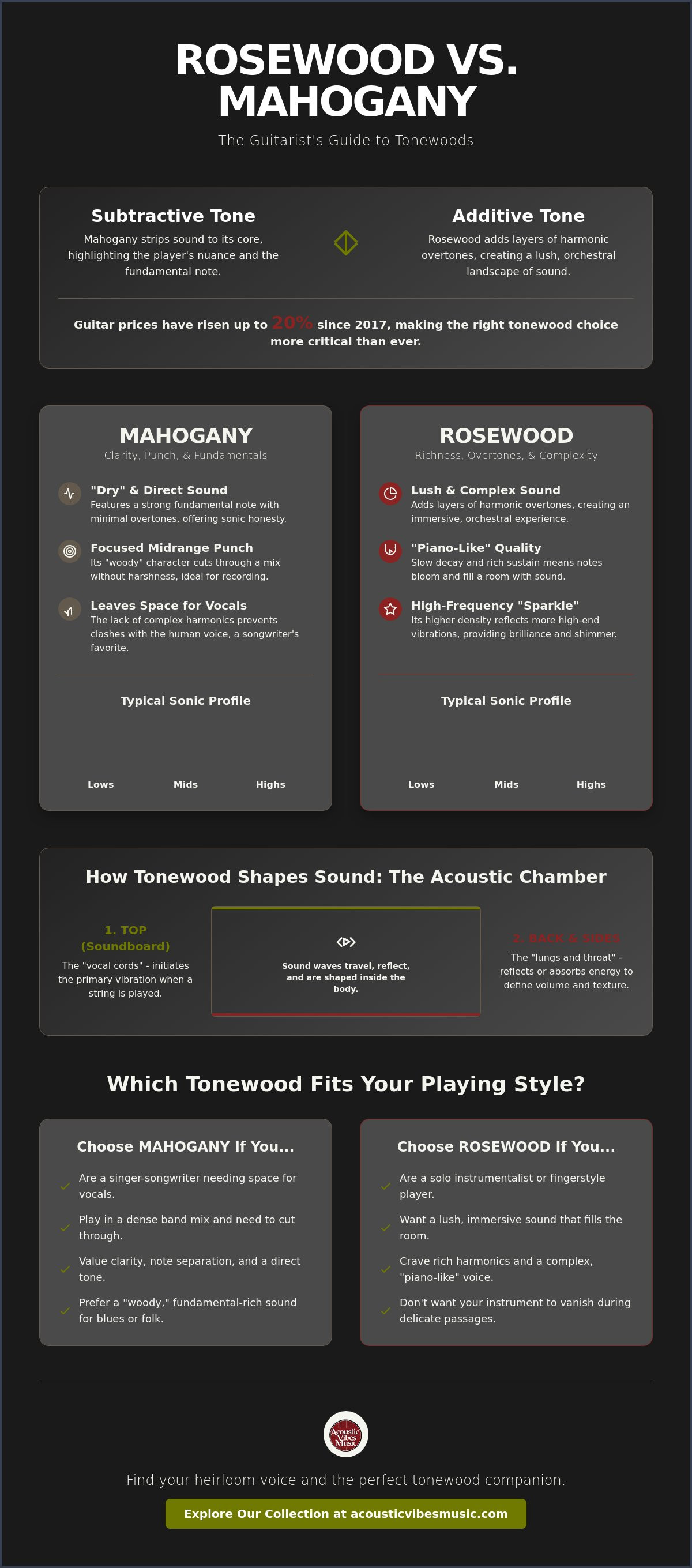
Choosing between rosewood vs mahogany back and sides often feels like deciding between a grand piano and a vintage upright. Both are masterpieces, but they serve different musical masters. Your playing style is the ultimate filter. If you're a bluegrass flatpicker who needs to cut through the roar of a banjo and fiddle, the immediate, punchy fundamental of mahogany is your best ally. Conversely, modern fingerstyle players often gravitate toward rosewood. Its complex harmonic wash and extended sustain provide a lush bed for intricate, slow moving melodies that need to hang in the air.
Consider how you attack the strings. Heavy strummers often find that mahogany handles a vigorous right hand with grace. It doesn't distort or become "blurry" when pushed hard. Rosewood, while capable of immense volume, can sometimes produce so many overtones during heavy strumming that the individual notes of a chord get lost in the resonance. For recording artists, mahogany is often called "EQ-ready." Its natural midrange focus means engineers don't have to spend hours carving out muddy low frequencies. It sits perfectly in a mix right from the start.
The "Vocalist Test" is perhaps the most personal metric. If you have a thin or airy voice, a rosewood guitar provides a rich, supportive foundation that fills in the sonic gaps. If you have a deep, powerful voice, mahogany's clarity ensures your lyrics remain front and center. It supports your performance without competing for the same frequency space.
The most famous battleground for these woods is the dreadnought body shape. When comparing iconic Martin Guitars, the choice usually falls between the D-18 and the D-28. The D-18 (Mahogany) is the ultimate workhorse; it's dry, loud, and exceptionally clear. The D-28 (Rosewood) is a "cannon" of sound, offering a thunderous bass and shimmering highs that feel massive in a solo setting. Body size amplifies these traits. A large rosewood guitar can feel like a force of nature, while a large mahogany guitar feels like a precision tool.
Wood choice can also compensate for body size. In a parlor or 00 body, rosewood creates a psychoacoustic illusion. It provides enough low end depth to make a tiny guitar sound much larger than it actually is. Mahogany keeps small bodies like a 000 or OM sounding crisp and intimate, which is why it's a favorite for traditional ragtime or blues. Builders like Collings Guitars excel at this, using master grade sets to ensure even their smallest designs have a commanding presence.
Ready to hear the difference for yourself? Explore our full inventory of premium acoustics to find your perfect match.
The species of wood provides the raw tonal ingredients, but the luthier’s hand is the final seasoning. While the physics of rosewood vs mahogany back and sides dictates the frequency response, boutique builders have mastered the art of "tuning" these wood sets to achieve a specific musical goal. At this level of craftsmanship, you aren't just buying a guitar; you're investing in a piece of functional art that has been voiced for maximum resonance. Builders like Collings Guitars select their sets for structural integrity as much as for beauty, ensuring that the instrument evolves gracefully over decades of play.
A "Master Grade" designation is the gold standard in tonewood selection. This label represents the top one percent of harvested timber. These sets are chosen for their perfectly straight grain, lack of run-out, and superior stiffness-to-weight ratio. While the visual appeal of a Master Grade set is undeniable, the true value lies in its stability. These premium cuts allow the builder to thin the wood to its absolute limit, creating a responsive instrument that vibrates with the slightest touch of a pick. Choosing such an instrument is a commitment to your own musical growth, as a highly responsive guitar will challenge you to refine your technique and explore new sonic textures.
Boutique manufacturers often employ proprietary techniques to manipulate the traditional characteristics of these woods. For example, Boucher Guitars are renowned for their use of Adirondack spruce bracing, which they hand-carve to complement either the punch of mahogany or the complexity of rosewood. This results in an instrument that feels incredibly "alive" in your hands. Similarly, Taylor Guitars has utilized their V-Class bracing to revolutionize the rosewood response. By changing the way the top vibrates, they've managed to bring more sustain and better intonation to a wood already famous for its orchestral depth.
In the current market, your choice should reflect both your aesthetic taste and your functional needs. Mahogany remains the undisputed king of clarity and traditional "woody" warmth. It's the perfect companion for the songwriter and the studio musician. Rosewood continues to be the choice for those who crave depth, modern shimmer, and a piano-like complexity that fills a room. Regardless of which path you take, the role of professional setups cannot be overstated. A master luthier can adjust the action and intonation to ensure the specific tonewood's true potential is fully realized.
We encourage you to visit our gallery and play several models side-by-side. Hear how the notes decay. Feel the vibration against your chest. Your heirloom voice is waiting to be discovered, and it will be a companion that grows with you for a lifetime. Trust your ears, enjoy the process of discovery, and choose the wood that makes you want to play just one more song.
The journey to finding your perfect instrument is a deeply personal pursuit of quality and inspiration. Whether you crave the honest, punchy clarity of mahogany or the lush, symphonic depth of rosewood, your decision shapes every note you play. Mastering the choice of rosewood vs mahogany back and sides is about more than just physics; it's about finding a partner that responds to your unique touch. Each wood offers a distinct path to excellence, from the dry precision of a recording workhorse to the piano-like resonance of a solo masterpiece.
As an authorized dealer for legendary brands like Martin, Taylor, and Collings, we hand-select every instrument in our collection for its superior construction and tonal brilliance. Expert luthier setups are included with every sale, ensuring your new guitar is perfectly voiced for your style. We provide professional instrument preparation and secure national shipping, so you can shop with absolute confidence from anywhere. Explore our curated collection of high-end acoustic guitars today and discover the heirloom quality you deserve. Your next musical chapter starts with a single, perfect chord.
Neither wood is objectively superior; the right choice depends entirely on your desired tonal outcome and playing style. Mahogany provides a dry, focused fundamental that many players find essential for clarity and midrange punch. Rosewood delivers a lush, harmonically rich experience often described as piano-like. You should choose based on whether you want the guitar to get out of the way of your voice or provide a massive, orchestral foundation.
Rosewood is generally more expensive due to its higher density and the complexities of international trade regulations. While the 2019 CITES changes eased trade for most species, the cost of high-quality East Indian Rosewood has reportedly tripled in recent years. This scarcity, combined with the difficulty of working with such a hard, oily material, naturally drives up the final price of the instrument compared to more abundant mahogany varieties.
Mahogany is often perceived as "warmer" because its frequency response is concentrated in the midrange rather than the extreme lows or highs. This creates a woody, intimate sound that feels very organic and vintage. Rosewood has a scooped midrange with more aggressive lows and crystalline highs, which can sometimes feel more modern or hi-fi. If you want a rounded tone that feels familiar and cozy, mahogany is usually the preferred choice.
Mahogany is widely considered the gold standard for studio recording because of its "EQ-ready" nature. Its lack of complex overtones prevents the low end from becoming muddy or overwhelming the microphone. This focused sound sits neatly in a mix without requiring extensive post-production. While the rosewood vs mahogany back and sides debate is subjective, engineers often prefer the predictable, clear fundamental that mahogany provides during a session.
The density of the wood determines how much energy is reflected back to the soundboard rather than absorbed. Rosewood is significantly denser than mahogany, which leads to lower internal damping and much longer sustain. This allows notes to ring out and bloom over time. Mahogany absorbs more energy, resulting in a quicker decay that provides the "snap" and "pop" favored by blues, folk, and ragtime players.
Most beginners can hear the difference between rosewood vs mahogany back and sides almost immediately when playing them side by side. The contrast between mahogany's punchy, direct note and rosewood's swirling, echo-like overtones is quite dramatic. You don't need decades of experience to feel how a guitar responds to your touch. We always recommend trying both in person to see which one inspires you to pick up the instrument more often.
Brazilian Rosewood is still available on high-end custom guitars, but it's strictly regulated under CITES Appendix I. Manufacturers must use old-growth stumps or pre-convention logs, which makes the material incredibly rare and costly. In 2026, a Brazilian Rosewood upgrade can add over $15,000 to the price of a boutique build. Most players find that high-grade East Indian Rosewood provides a similar aesthetic and tonal experience at a much more accessible investment level.
Your choice depends on your specific role in the ensemble. If you need to "cut" through the mix with sharp, clear lead lines, a mahogany dreadnought is the traditional favorite for its projection. It offers the clarity needed for fast flatpicking. If you want a "boomier" sound with a massive low-end for backing up other instruments, a rosewood dreadnought provides that legendary power and depth. Both are considered staples of the genre.