My shopping cart
Your cart is currently empty.
Continue ShoppingThe easiest instrument to start isn't always the one that keeps you playing through the years. Many adults assume the ukulele is the only logical entry point because of its soft nylon strings and approachable learning curve. However, if your heart beats for the driving chop of bluegrass or the complex resonance of folk, you might find your true voice in the bright, percussive chime of a mandolin. When weighing the mandolin vs ukulele for beginners, the choice isn't just about which fretboard is smaller. It's about which instrument resonates with your musical goals and physical comfort.
You likely worry about whether your hands will feel cramped on a compact neck or if you'll quickly outgrow a starter model that lacks tonal depth. We understand that adult learners seek more than a hobby; they seek a genuine connection to craftsmanship. This guide explores the mechanical differences in tuning, from the violin-style fifths of the mandolin to the cheerful fourths of the ukulele. You'll discover how build quality and a professional luthier setup can eliminate the physical strain often associated with learning. Let's find the instrument that transforms your practice into a daily pursuit of quality and joy.
Choosing between these two instruments often comes down to the sonic texture you want to inhabit. The Mandolin is a high-tension, steel-stringed marvel that offers a bright, percussive energy. It requires more finger strength but rewards the player with a precise, logical layout. Conversely, the ukulele provides immediate harmonic gratification through its soft nylon strings and re-entrant tuning. While the ukulele is frequently seen as the "easier" path, weighing the mandolin vs ukulele for beginners involves looking past the first week of practice.
Avoid the "Toy Trap" at all costs. Many entry-level instruments sold under $100 are little more than decorative objects. They suffer from poor intonation and high action that makes playing a chore rather than a joy. For an adult, starting with a professionally set-up instrument is the difference between a lifelong passion and a dusty closet relic. Mechanical frustration is the leading cause of quitting. A well-built instrument removes those barriers, allowing you to focus on the music.
Adult students bring a sophisticated ear to the table. You'll quickly tire of the "thin" or "boxy" sound found in mass-produced laminate instruments. Investing in a "forever" instrument ensures that every note you strike provides the tonal depth you expect. An heirloom-quality piece holds its value and inspires more frequent practice sessions through its sheer beauty and tactile response. You can explore similar levels of craftsmanship in our curated selection of High End Acoustic Guitars for Sale. Quality isn't just a luxury; it's a pedagogical tool. Understanding the nuances of the mandolin vs ukulele for beginners helps you avoid a purchase you might outgrow in six months.
Your choice should mirror the music you love. The mandolin is the heartbeat of bluegrass and folk, providing the essential "chop" or rhythmic backbeat that drives an ensemble. Its double-course strings allow for a shimmering tremolo and powerful melodic leads. The ukulele, while famous for its Hawaiian heritage, has evolved into a versatile tool for indie-pop, jazz, and folk. It offers a warm, rounded sustain that feels intimate and inviting. When playing with others, consider tonal projection. This is the ability of an instrument's sound to travel clearly through a space or an ensemble without losing its distinct character. A high-quality mandolin often excels here, cutting through the mix with authority.
Understanding the architecture of these instruments is essential for a successful start. Many adults fear their hands are too large for these compact fretboards. However, the mandolin vs ukulele for beginners debate often ignores the specific design features that accommodate larger fingers. While the ukulele uses soft nylon strings under lower tension, the mandolin utilizes double courses of steel. This creates a more tactile, high-tension experience that requires a bit more callousing but offers incredible precision. It's about finding the tactile response that suits your touch.
The mandolin is tuned in perfect fifths (G-D-A-E), mirroring the violin. This layout is remarkably symmetrical. Once you learn a scale pattern or chord shape, you can move it across the strings with predictable results. It's a logical system that makes music theory feel intuitive. Conversely, the ukulele is tuned in fourths (G-C-E-A), similar to the top four strings of a guitar. Most ukuleles feature "re-entrant" tuning, where the fourth string is tuned higher than the third. This gives the instrument its signature harp-like chime during a strum. For those moving between different acoustic body types, understanding these tonal differences is as vital as choosing between a Dreadnought vs Grand Auditorium for Strumming.
Ergonomics play a massive role in long-term playability. If you have larger hands, look for a mandolin with a 1-3/16" nut width. This slight increase provides extra room between the strings, preventing that "cramped" feeling often cited in online forums. A radiused fretboard is another premium feature to consider. By adding a gentle curve to the fingerboard, builders reduce the distance your fingers must travel to bar a chord, significantly lowering hand fatigue. These Mandolin vs. Ukulele Differences highlight how construction affects your physical relationship with the music.
Weight and balance also differ between styles. An A-style mandolin is often lighter and more balanced for lap playing, while the iconic F-style scroll adds a traditional aesthetic and a bit of weight that some players find stabilizing. Regardless of the shape, a high-quality strap is non-negotiable for maintaining proper posture. At Acoustic Vibes Music, we ensure every instrument is professionally adjusted for optimal action. If you're ready to feel the difference a professional setup makes, explore our curated collection of mandolins and ukuleles to find your perfect fit.
The sonic identity of an instrument is its most compelling feature. For those evaluating the mandolin vs ukulele for beginners, the contrast in voice is striking. A mandolin offers a signature "bark." This percussive "chop" serves as the rhythmic engine of bluegrass music, powered by a carved spruce top that projects with remarkable authority. In contrast, the ukulele provides a gentle "breeze." Its sound is defined by a warm, rounded sustain that feels restorative and intimate. While a soprano uke might struggle to be heard in a crowded acoustic jam, the mandolin’s high-frequency bite ensures you are never lost in the mix.
Solid wood construction remains the gold standard for discerning players. Professional mandolins typically utilize solid spruce tops paired with maple back and sides for maximum clarity and punch. You might choose Sitka spruce for a versatile, responsive tone; alternatively, Adirondack spruce offers increased headroom and volume for aggressive players. Ukuleles often lean into the lush, figured resonance of solid Hawaiian Koa or the earthy warmth of mahogany. Understanding how these materials interact is a foundational skill for any musician, much like learning the nuances of Rosewood vs. Mahogany Back and Sides in the guitar world.
Structural choices further refine the instrument's voice. On a mandolin, F-holes provide a focused, percussive "pop" ideal for lead lines and ensemble playing. Oval holes offer a sweeter, more blended sustain that suits solo celtic or classical pieces. Scale length also impacts the physical experience. A tenor ukulele offers a longer reach and higher string tension than a soprano, bringing it closer to the feel of a mandolin's double courses. Intonation, or the accuracy of pitch across the fretboard, is heavily influenced by the precise placement of the floating bridge on these small-scale instruments. Deciding Which Instrument is Right for You? often depends on whether you prefer the assertive projection of steel or the intimate resonance of nylon. High-quality construction ensures that regardless of the mandolin vs ukulele for beginners choice, the instrument remains a joy to hear and hold.
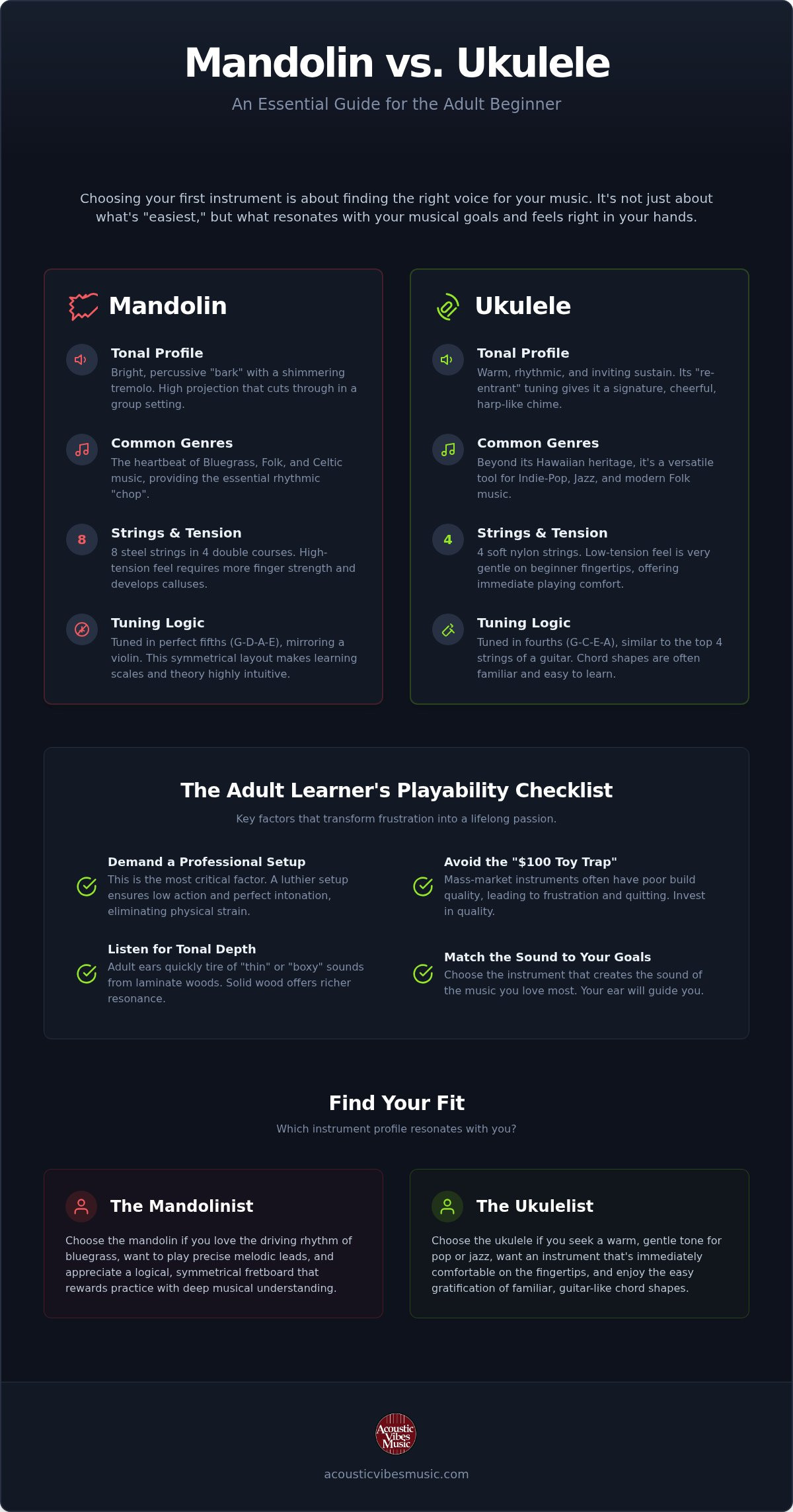
Adult learners deserve instruments that respect their musical ambitions. When you evaluate the mandolin vs ukulele for beginners, you must look beyond the aesthetic appeal and focus on technical precision. A high-quality instrument should feel like a natural extension of your hands; it shouldn't be a source of physical struggle. Before you commit to a purchase, verify these four critical components of build quality:
Many beginners assume a new instrument arrives ready to play. In reality, even premium instruments from world-class factories almost always require a final professional setup. Wood is a living material that shifts during transit. A luthier’s touch can make a massive difference; sometimes a mere 1/64" adjustment in string height determines whether a student succeeds or quits in frustration. If you've inherited an instrument or bought one that feels "stiff," you might need to investigate an Acoustic Guitar Bridge Repair Cost or general setup fee to restore its playability.
As your ear develops, you'll eventually crave a more complex tonal palette. Moving from a solid-topped entry model to a professional-grade instrument is a milestone in any enthusiast's life. If you find yourself leaning toward the double-course chime of the eight-string, consult our Best Intermediate Mandolin Guide to understand the nuances of upgrading. Remember that high-end instruments require protection. A humidified case is a non-negotiable investment for any solid wood instrument to prevent cracks and maintain the integrity of the build. To ensure your first step is the right one, explore our curated collection of professionally set-up instruments that are hand-selected for adult learners.
The choice between the mandolin vs ukulele for beginners is more than a technical comparison; it's an invitation to join a community of enthusiasts. Acoustic Vibes Music operates as a dedicated gateway to premium craftsmanship. We act as your Expert Guide, navigating the nuances of tonewoods and body shapes so you don't have to. Every instrument in our inventory undergoes a rigorous selection process. We prioritize tactile resonance and material excellence above all else. This Passionate Curator philosophy ensures that a beginner’s first purchase receives the same meticulous attention as a museum-quality 1940s Martin.
Curation matters because it removes the gamble from the buying process. You deserve to bypass the trial-and-error of mass-market bargains that often arrive with structural flaws or inconsistent tonality. Our collection features elite brands like Collings and Gibson, names synonymous with acoustic perfection. Starting with a vetted instrument provides an immediate psychological advantage. You'll hear the difference in every chord. Our professional setups further refine this experience, protecting your investment by ensuring the instrument is physically inviting to play from the moment you open the case.
Your next steps are about personal resonance. If you choose the mandolin, weigh the merits of the sleek, focused A-style against the iconic, percussive scroll of an F-style. If the ukulele is your path, immerse yourself in the sophisticated engineering of Taylor ukuleles or explore our rare boutique alternatives. We provide national shipping with expert-level care. Each instrument is packed with white-glove precision to ensure it arrives in perfect condition and ready for its first performance. Reach out to our team of specialists today. Discover the instrument that fits your hands and inspires your journey.
The choice between these two instruments isn't just about difficulty; it's about finding the voice that mirrors your musical soul. You now understand how the mandolin’s symmetrical fifths and the ukulele’s harp-like fourths offer distinct paths to creativity. When navigating the mandolin vs ukulele for beginners, remember that professional ergonomics and avoiding the "toy trap" are the keys to long-term success. Quality construction is the foundation of every great performance.
At Acoustic Vibes Music, we're more than a shop; we're your fellow enthusiasts. We take pride in our curated selection of world-class acoustic brands, ensuring every piece meets our high standards for tonality and beauty. Every instrument includes a professional luthier setup and arrives via expert national shipping. We're here to support you at every stage of your discovery. Discover Your Perfect Beginner Mandolin or Ukulele at Acoustic Vibes Music. Your new favorite hobby is just one chord away.
Learning the mandolin usually presents a steeper initial curve than the ukulele because of the higher string tension and double-course steel strings. While the ukulele’s nylon strings are gentler on the fingers, the mandolin’s tuning in fifths offers a symmetrical logic that many adults find easier to grasp for music theory. When deciding on the mandolin vs ukulele for beginners, consider whether you prefer immediate ease or long-term structural predictability.
You can certainly perform bluegrass melodies on a ukulele, but you will miss the characteristic "bark" and percussive "chop" that a mandolin provides. Bluegrass relies heavily on the driving, rhythmic pulse created by the mandolin’s steel strings and carved top. While a ukulele offers a cheerful, rounded tone, it lacks the high-frequency projection required to cut through a traditional bluegrass ensemble. It is better suited for folk or indie-pop arrangements.
Mandolins feature eight strings arranged in four pairs, known as courses, to produce a richer, more resonant sound with natural chorus. Striking two strings at once increases the instrument’s volume and sustain, allowing it to hold its own alongside louder instruments like banjos and fiddles. This design is essential for the shimmering tremolo and rhythmic punch that define the instrument’s heritage. It creates a tactile complexity that many enthusiasts find deeply rewarding.
A tenor or concert ukulele is typically the best choice for an adult beginner. These sizes offer a longer scale length and wider fret spacing than the traditional soprano, providing more room for larger fingers to navigate chord shapes comfortably. The tenor size, in particular, provides a deeper, more guitar-like resonance and higher string tension. This extra physical space reduces hand cramping and allows for a more expressive range of play.
A professional luthier setup is non-negotiable for anyone starting their musical journey. Even the finest instruments can arrive with high action or poor intonation due to humidity shifts during shipping. Our expert luthier services ensure that the nut slots are cut to the correct depth and the bridge is perfectly seated. This precision eliminates unnecessary physical struggle, allowing you to focus entirely on the joy of discovery and proper technique.
A truly playable, high-quality beginner mandolin typically starts in the few hundred dollar range for solid-topped models. When researching the mandolin vs ukulele for beginners, remember that the mandolin requires a higher initial investment due to its complex construction and eight strings. Investing in a vetted instrument from a reputable curator ensures you receive a piece with proper tonewoods and hardware. This protects you from the frustration of a sub-par starter instrument.
Most players avoid using standard plastic guitar picks on a ukulele because they can be too aggressive for the delicate nylon strings. Traditional ukulele technique involves using the flesh or nail of the fingers to produce a warm, organic tone. If you prefer the feel of a pick, specialized felt or leather picks are available. These provide a softer attack that preserves the instrument's rounded sustain without risking damage to the strings or the finish.
You should change mandolin strings every one to three months, as the steel strings accumulate oils and lose their percussive brilliance. Ukulele strings are more resilient; these nylon sets can last six months to a year, though they eventually lose their intonation and elasticity. Regularly refreshing your strings ensures your instrument maintains its tactile response and tonal clarity. It is a simple piece of maintenance that keeps your practice sessions feeling fresh and inspiring.