My shopping cart
Your cart is currently empty.
Continue ShoppingYour boutique dreadnought is a precision-engineered masterpiece, but the wrong choice in string tension can quickly turn a world-class instrument into a muffled box or a structural liability. It's a common dilemma for the discerning player: do you prioritize the effortless playability of a lighter set or the thunderous projection of a heavier gauge? When weighing light vs medium gauge acoustic strings, the stakes are higher than just finger fatigue. You're balancing the physical health of your guitar's soundboard against its ultimate sonic potential.
Most collectors agree that every high-end build has a unique "sweet spot" where the bracing reacts perfectly to the pull of the wire. This guide will show you how to find that perfect equilibrium to maximize your tone without risking the integrity of your instrument's top. We'll explore the technical trade-offs of modern 2026 string technologies, the specific needs of premium tonewoods like those found on a Boucher or Collings, and exactly when your guitar requires a professional luthier’s touch to handle a gauge change safely. Get ready to unlock the full voice of your collection with confidence.
Precision is the hallmark of any master-built instrument. When we discuss string gauge, we're measuring the diameter of the wire in thousandths of an inch. A standard Light set usually ranges from .012 on the high E to .054 on the low E, while a Medium set steps up to .013 and .056 respectively. These small increments might seem negligible on paper, but they fundamentally alter the physics of your guitar. Understanding String Gauge is essential because these measurements dictate the total tension exerted on your bridge and soundboard.
Heavier strings require significantly more tension to reach pitch. This often adds 20 to 30 pounds of extra pressure across the bridge compared to lighter sets. On high-end guitars from builders like Collings Guitars or Boucher Guitars, the tops are often meticulously graduated or scalloped to maximize resonance. This artisanal approach makes them far more sensitive to the choice of light vs medium gauge acoustic strings than a mass-produced factory model. A heavier set can choke the vibration of a lightly braced top, while a lighter set might fail to drive a stiff, Adirondack spruce soundboard to its full potential.
Tension is the engine that drives your guitar's voice. Medium strings provide the physical mass and energy needed to move the soundboard with authority, resulting in increased volume and a bolder low-end punch. However, this comes with a trade-off. The higher tension makes the strings feel stiffer under the fingers, which can complicate complex fingerstyle passages or long sessions. Light strings offer a more delicate response and increased harmonic complexity, allowing for effortless playability at the cost of some raw decibel output. Tensile strength in phosphor bronze strings refers to the maximum longitudinal stress the alloy can endure before reaching its breaking point or losing its elastic properties.
The spectrum of playability extends beyond a simple binary choice. While most boutique instruments ship with either Light or Medium sets, other configurations offer unique benefits:
Always consult the builder's specifications for your specific model. Many custom-built guitars are voiced for a specific tension, and straying too far can impact both the tone and the structural health of the neck and bridge over time.
The sonic profile of a masterpiece instrument is a delicate conversation between the luthier's bracing and the energy provided by the player. Selecting light vs medium gauge acoustic strings is the primary way you influence that conversation. Medium strings act as a high-performance engine for your guitar. They provide the physical mass required to generate a thunderous low-end punch and a commanding volume that fills a room. Conversely, light strings excel at revealing the harmonic complexity and shimmering overtones that can be lost under the heavy tension of a thicker wire.
Your choice of tonewood also dictates how a specific gauge will perform. A dense, overtone-rich Rosewood guitar might become muddy or "choked" if the string tension is too high for the top to move freely. A Mahogany instrument, known for its punchy fundamental note, often benefits from the added meat of a medium set to flesh out its mid-range. For a deeper look at how these woods react to vibration, explore our guide on Rosewood vs. Mahogany Back and Sides.
Large body shapes like Dreadnoughts and Jumbos are built with a larger soundboard area that requires significant energy to "drive." In an ensemble or bluegrass setting, the extra tension of mediums is vital for cutting through the mix. Traditional Martin guitars often reach their peak orchestral boom with a .013 set. If you find standard mediums too stiff but lights too thin, consider a Light-Medium hybrid set. These custom-gauge options provide the heavy bottom strings needed for rhythm and the lighter top strings for comfortable lead work, filling a gap that generic advice often ignores.
Sensitivity is the greatest asset of a lighter gauge. These strings respond to the lightest touch, making them indispensable for modern fingerstyle players who rely on nuance rather than raw power. They enhance the signature "air" and crystalline shimmer found in many Taylor guitars. Beyond volume, the reduced tension allows for more expressive vibrato and effortless string bending. This flexibility lets the player manipulate the pitch with a level of precision that is physically impossible on a heavier set. If you are looking to refine your sound, take a moment to browse our collection of premium acoustic guitars to see which body shapes best suit your preferred tension.
The physical connection between a player and their instrument is a deeply personal interface. While the tonal benefits of specific gauges are clear, the tactile reality of hand fatigue and string resistance often dictates the final choice. Even for the most seasoned professional, the "break-in" period for a new set of medium strings can be taxing on the musculature of the fretting hand. Choosing light vs medium gauge acoustic strings requires an honest assessment of your dynamic range. If you possess a heavy right hand and a aggressive strumming style, the resistance of a heavier gauge prevents the strings from "flopping" against the frets. Conversely, a player with a delicate touch will find that lighter strings offer a more immediate, effortless response.
This balance of feel and volume is particularly relevant when selecting a body shape for your primary playing style. For instance, understanding the nuances of a Dreadnought vs. Grand Auditorium for Strumming can help you decide if you need the heavy drive of mediums or the nimble playability of lights. Your technique should never feel like a struggle against the instrument; it should feel like a partnership.
Changing your string gauge fundamentally alters the geometry of your guitar. Heavier strings exert significantly more pull on the neck, which increases the "relief" or forward bow. This physical shift raises the action height, making the distance between the string and the fret larger and the guitar harder to play. Furthermore, the nut slots on a high-end instrument are often filed to a hair’s breadth of the intended string diameter. Forcing a .056 medium string into a slot cut for a .054 light string can cause the string to bind, leading to tuning instability and potential damage to the nut. Because string diameter and tension change how the wire stretches and vibrates, switching gauges without a professional setup ruins intonation by shifting the pitch accuracy of every note played up the neck.
Specific genres and techniques demand specialized tension. Blues players who rely on frequent whole-step bends often prefer the flexibility of light strings, or they compromise with Light-Medium hybrid sets to maintain some low-end "thump." For slide enthusiasts, medium strings are almost a requirement. The higher tension provides the necessary upward pressure to support the weight of a glass or steel slide, preventing it from clattering against the frets. Your preferred tuning also plays a vital role. If you frequently explore altered tunings like DADGAD or Open C, the reduced tension of the dropped notes often makes a medium set feel as supple as a light set in standard E-tuning. If your current setup feels restrictive, our expertly curated guitar collection features instruments setup for various playing styles to help you find your perfect match.
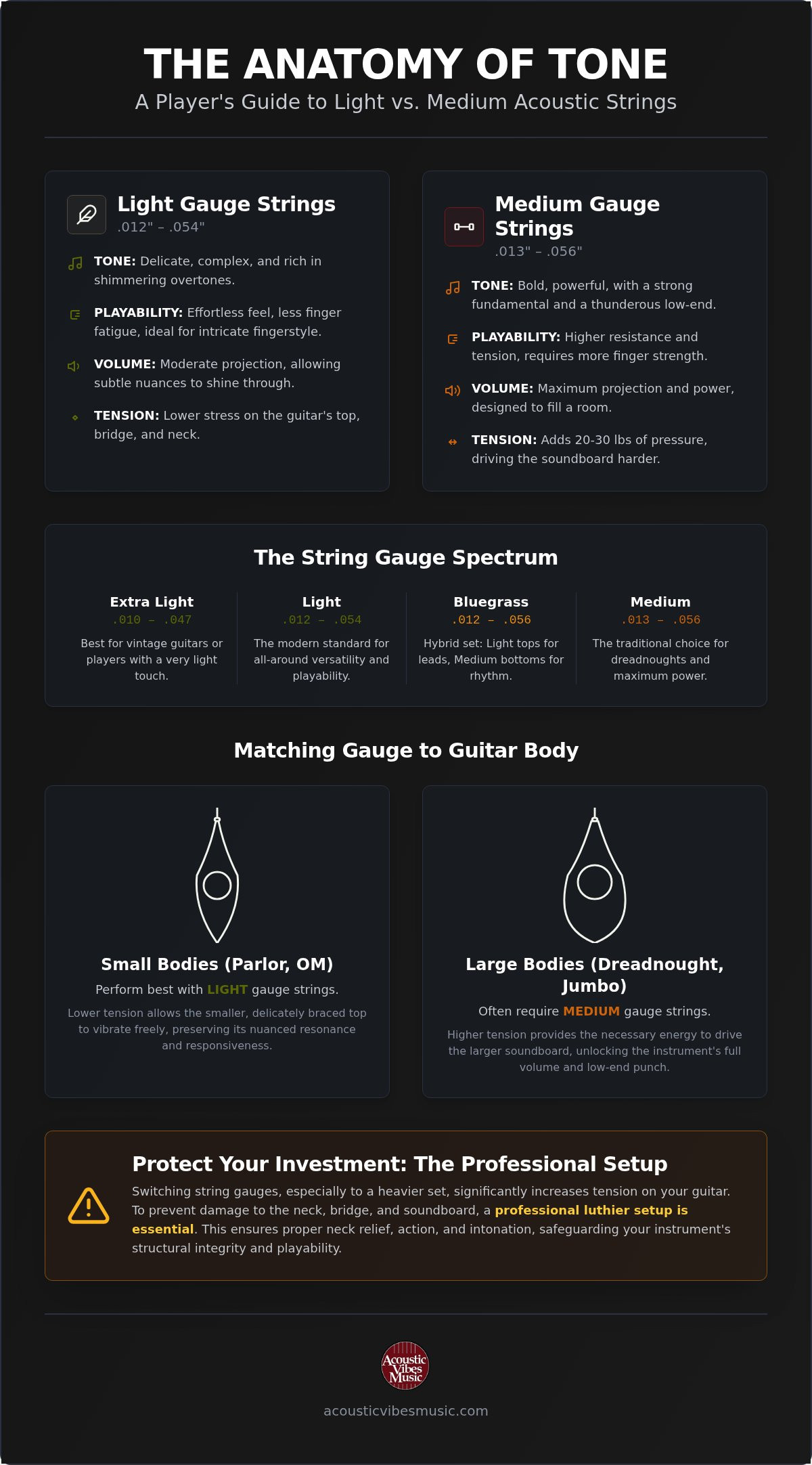
The architecture of your instrument is the ultimate arbiter in the debate of light vs medium gauge acoustic strings. Body volume and soundboard surface area dictate how much energy is required to move the air inside the box. Dreadnoughts and Jumbos are the powerhouses of the acoustic world, specifically built for the "heavy drive" that medium strings provide. Without that significant tension, these large bodies often fail to reach their full orchestral potential, resulting in a tone that feels hollow or under-powered.
Auditorium models, including 000 and OM body styles, offer much more versatility. These instruments are often the chameleons of a collection, responding beautifully to light strings for delicate fingerstyle work while possessing enough structural integrity to handle custom "Bluegrass" gauges. However, small body parlor guitars require a more cautious approach. Their diminutive soundboards are easily overwhelmed by excessive tension. Applying mediums to a parlor doesn't necessarily make it louder; it often stifles the top's ability to vibrate, leading to a compressed, "choked" sound that lacks harmonic breath.
Master luthiers use bracing as a tool to tune a top's responsiveness. Collings guitars are renowned for their incredible structural precision, often allowing them to handle various tensions with more grace than a standard factory build. When you factor in the Adirondack spruce tops found on many Boucher guitars, the equation changes again. Adirondack is exceptionally stiff and often requires the extra energy of a medium set to "wake up" the wood. You'll find that on these high-end builds, the line between over-driving a top and achieving maximum projection is razor-thin. If the tone becomes muddy or loses its separation, you've likely exceeded the tension limit for that specific bracing pattern.
Protecting your investment means staying vigilant for signs of physical stress. Excessive tension from a gauge that is too heavy for the build can cause "bellying," where the soundboard bulges noticeably behind the bridge. You might also see the back of the bridge plate beginning to lift away from the top. While modern boutique instruments are remarkably robust, vintage pre-war style guitars with delicate hand-scalloped bracing often have a strict limit at light gauges. Always consult the manufacturer's specifications before jumping to a heavier set. If you're ready to find an instrument perfectly voiced for your preferred tension, explore our curated collection of master-built acoustic guitars today.
Transitioning between string tensions is more than a simple swap; it's a structural recalibration of your instrument. Many players assume a quick turn of the truss rod is the only requirement when choosing light vs medium gauge acoustic strings. This is a common misconception. While the truss rod manages the neck's forward bow, or relief, it doesn't account for the intricate geometry at the nut and saddle. Precision is paramount. A high-end instrument is a balanced system of tension and resistance. Changing that balance requires a holistic approach to ensure the guitar remains both playable and tonally vibrant.
The "Nut Slot" problem is perhaps the most overlooked technical hurdle. A standard medium set features a low E string of approximately .056 inches. If your guitar was originally voiced and filed for a .054 light string, that heavier wire will not seat properly in the slot. It sits too high, which increases the action at the first fret and makes the guitar feel stiff. Worse, the string can bind in the narrow slot, causing frustrating tuning pings and instability. Proper saddle compensation is equally vital. Heavier strings vibrate with a different arc and require specific take-off points to maintain perfect pitch accuracy across the fretboard. Neglecting these adjustments can lead to bridge stress. For more on structural health, see our guide on Acoustic Guitar Bridge Repair Cost.
Don't take a DIY approach to nut filing on a boutique investment. Master-built guitars from brands like Boucher Guitars or Collings Guitars deserve expert care. A professional luthier understands how to balance the increased tension of a medium set while keeping the action low and inviting. They can transform a "hard to play" guitar into a responsive masterpiece. Regular maintenance checks protect your investment from the long-term effects of high tension, such as neck joint compression or soundboard deformation. Trust the hands that understand the artistry of the build.
The modern market offers an exciting array of middle-ground options. "True Medium" and "Light-Medium" sets provide a tailored tension profile that can bridge the gap for players who find standard gauges too extreme. In 2026, advanced coating technologies like D’Addario’s XS line or the latest polymer innovations have changed the game. These coatings extend the lifespan of your strings significantly without sacrificing the tactile, organic feel of uncoated wire. Finding your signature sound is a journey of discovery. Start with the manufacturer's recommendation, but don't be afraid to experiment under the guidance of a specialist. Your perfect "sweet spot" is waiting to be found.
Mastering the balance of light vs medium gauge acoustic strings is a defining step in your journey as a player. It's a choice that honors the specific architecture of your instrument, from the robust bracing of a dreadnought to the delicate responsiveness of a parlor. By aligning your string tension with your unique technique, you unlock the true harmonic potential of your tonewoods while ensuring your guitar remains structurally sound for decades to come.
Acoustic Vibes Music is your partner in this pursuit of excellence. As an authorized dealer for world-class brands like Collings, Martin, and Boucher, we understand the artistry behind every build. Our professional in-house luthier services provide the expert setups necessary for any gauge change, and we offer national shipping on all instruments and accessories. Don't settle for a generic feel when a bespoke setup can elevate your entire playing experience.
Explore our curated collection of premium acoustic guitars and accessories and discover the next masterpiece for your collection. Your perfect tone is just a set of strings away.
Medium strings are safe for most modern dreadnoughts built by premium brands like Martin or Collings. However, they can pose a risk to vintage instruments or those with delicate, hand-scalloped bracing. Excessive tension may lead to bridge lifting or soundboard belying over time. It's essential to consult the manufacturer's specifications for your specific model to ensure the structural integrity of your high-end investment remains intact.
Light strings are widely preferred for fingerstyle because they respond to a much lighter touch. These gauges allow for greater harmonic nuance and crystalline overtones, which are vital for intricate arrangements. While mediums provide more volume, lights offer the sensitivity needed for modern techniques. They make expressive vibrato and complex fretting much easier, allowing the artistry of your playing to shine through without physical strain.
Transitioning from light to medium sets typically increases the total pull on your guitar by 20 to 30 pounds. When comparing light vs medium gauge acoustic strings, this extra force is significant. It's the physical energy required to move a larger soundboard, but it also places more stress on the neck and bridge plate. Understanding this tension change is the first step in deciding if your guitar can handle a heavier set.
You absolutely need a professional setup when switching gauges to maintain playability and intonation. A heavier set increases neck relief and requires wider nut slots to prevent string binding. Without these adjustments, your guitar will likely be harder to play and may suffer from tuning instability. Our expert luthier services specialize in recalibrating high-end instruments to ensure they perform perfectly with your chosen string tension.
Using medium strings on a small body or parlor guitar is generally discouraged. These instruments feature smaller soundboards and lighter bracing that can be easily "choked" by excessive tension. Instead of increasing volume, the heavy pull can stifle the top’s vibration and lead to structural damage like bridge rotation. Stick to light or extra-light gauges to preserve the sweet, balanced voice these intimate instruments were designed to produce.
Medium gauge phosphor bronze strings are the traditional gold standard for a Martin Dreadnought. These guitars are engineered to be driven by the higher tension, which unlocks the signature low-end growl and orchestral projection collectors love. As an authorized dealer for the Martin Custom Shop, we often recommend medium tension to fully activate the Adirondack or Sitka spruce tops found on these iconic, large-bodied instruments.
String gauge directly impacts action by changing the amount of pull on the neck. Heavier strings exert more tension, which pulls the headstock forward and increases the relief of the neck. This physical shift moves the strings further away from the frets, resulting in higher action. A professional luthier can compensate for this by adjusting the truss rod and nut slots to restore a comfortable, low-action feel for your playing style.
Medium strings are often the superior choice for alternate tunings like DADGAD or Open C. When you tune strings down, they lose tension and can become floppy or buzz against the frets. The added mass of a medium set compensates for this drop in pitch, maintaining a firm feel and consistent projection. This allows you to explore lower registers without sacrificing the tonal clarity or structural stability of your boutique guitar.