My shopping cart
Your cart is currently empty.
Continue ShoppingThe most transformative upgrade for your acoustic guitar isn't found in a new set of strings or a boutique pickup. It's the small, often overlooked component that serves as the primary energy transducer between your strings and the soundboard. If you've struggled with a thin or 'tinny' high-end response or felt your sustain vanish during open chords, you're likely experiencing the limitations of a subpar saddle. This acoustic guitar saddle material comparison dives deep into how this single piece of hardware dictates the clarity and resonance of your instrument.
We understand the pursuit of the perfect tone. It's why world-renowned builders like Collings and Boucher obsess over material selection for every build. Whether you're looking to replicate the vintage warmth of hand-carved bone or the consistent precision of modern composites like TUSQ, choosing the right material is essential for peak playability. This guide provides the expert insight you need to select an upgrade with confidence. We'll break down the density, frequency response, and durability of every major material; this ensures your next luthier visit results in a guitar that sounds exactly the way you've always imagined.
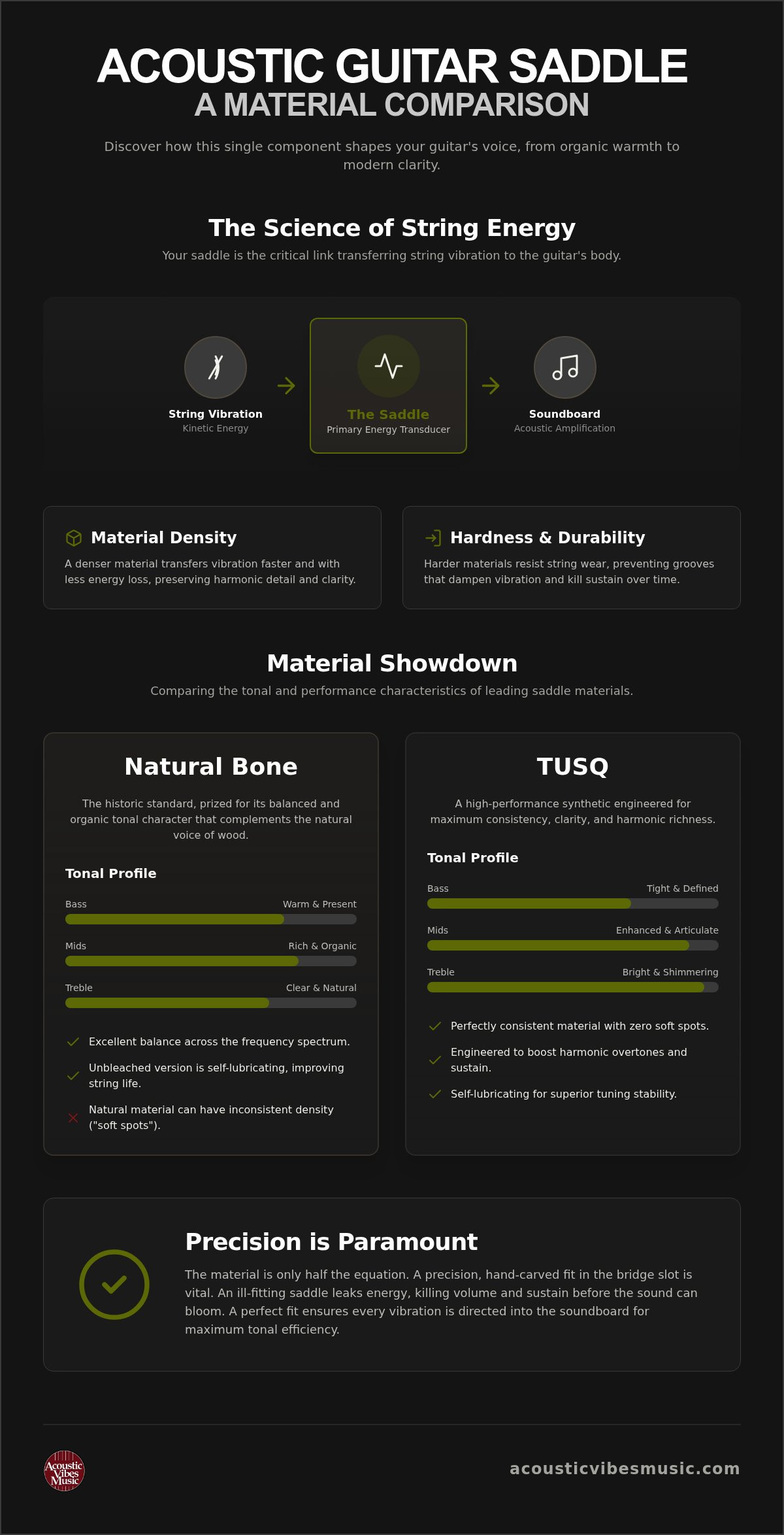
Think of your acoustic guitar as a sophisticated energy system rather than a simple wooden box. The strings generate raw kinetic energy, but they lack the surface area to move air on their own. This is where the saddle takes center stage. It acts as the critical gateway for vibration, determining exactly how much harmonic detail reaches the soundboard. In an acoustic guitar saddle material comparison, we see that material density is the primary driver of the speed of sound. A denser material allows vibrations to travel through the bridge with minimal loss. Conversely, softer factory saddles often act as a sonic bottleneck, absorbing the very frequencies that provide "shimmer" and complexity.
Hardness is equally vital for longevity and tone. Soft materials like cheap plastics or low-grade Micarta eventually develop deep grooves under string tension. These notches don't just cause annoying buzzing; they dampen the string's oscillation, killing sustain before the sound can bloom. High-end builders like Collings Guitars select specific materials because they resist this wear, ensuring the guitar saddle function remains efficient for years of heavy playing.
The journey of a note begins at the point of contact. When you pluck a string, the vibration passes through the saddle, into the bridge, and finally reaches the bridge plate and soundboard. Transduction is the process of converting the mechanical kinetic energy of a vibrating string into the acoustic energy of the guitar's top. If the saddle material is "dead" or inconsistent, it filters out the complex overtones of the wood. A high-quality material ensures that the energy transfer is immediate and transparent. This allows the guitar's natural voice to speak without interference from the hardware.
Efficiency depends on more than just the substance itself. The break angle, which is the steepness of the string as it travels from the saddle to the bridge pins, creates the down-pressure needed to "drive" the soundboard. A taller saddle provides more leverage, but it requires a material strong enough to withstand the increased torque without leaning. This is why premium builds demand precisely fit materials. A saddle that wiggles in its slot loses energy through friction. A perfect, hand-carved fit ensures that every ounce of string energy is directed downward, maximizing both volume and sustain.
Selecting the right component requires a nuanced acoustic guitar saddle material comparison. While the market offers everything from basic polymers to ancient fossils, three categories dominate the conversation for high-end instruments. Each material brings a distinct harmonic profile and tactile response to the bridge. Understanding these differences allows you to tailor your guitar's voice with surgical precision. Most enthusiasts begin their journey with bone, but modern engineering has introduced synthetics that challenge even the most storied traditions.
Bone is the historical gold standard. It offers a balanced, organic tone that synthetics often struggle to replicate perfectly. However, not all bone is equal. Bleached bone provides a clean, snowy white aesthetic that many players prefer for modern builds. Unbleached bone retains its natural yellowish tint and, more importantly, its natural oils. These lipids act as a built-in lubricant, which can reduce friction and potentially extend string life. While bone is prized for its clarity, low-quality blanks can contain internal air pockets. These "soft spots" lead to inconsistent vibration transfer, which is why hand-selecting a high-density blank is vital for premium performance.
Graph Tech's TUSQ has revolutionized the industry by providing a man-made alternative to ivory. It's designed to be completely consistent, meaning there are no hidden dead spots to dampen your sustain. This material is engineered to vibrate at specific frequencies that enhance mid-range and treble clarity. It's a primary reason why many Taylor Guitars ship from the factory with TUSQ saddles. These synthetics are also self-lubricating, which significantly improves tuning stability during aggressive play. For players who demand modern reliability without ethical concerns, high-performance composites are a formidable choice.
Beyond these leaders, you'll encounter mid-tier options like Micarta and Nubone. Micarta is a synthetic laminate often found on factory models; it's durable but tends to produce a softer, more "mellow" attack. On the exotic end, materials like Fossilized Walrus Ivory (FWI) or Mammoth bone offer incredible density and a bright, chime-like response. These rare materials are often reserved for heirloom-quality instruments where every micro-detail matters. If you're unsure which material suits your playing style, consulting with our expert luthier services can help you identify the perfect match for your instrument's unique bracing and tonewoods.
When performing an acoustic guitar saddle material comparison, you'll find that brightness exists on a spectrum. At the mellow end sits Micarta, a synthetic laminate often found on the Road Series from Martin Guitars. It provides a warm, rounded attack that tames harsh treble. Moving up the scale, Bone offers a crisp "snap" that highlights high-frequency overtones. This harmonic clarity is essential for fingerstyle players who need every note to bloom with detail. The material's density dictates how much energy is preserved; a denser saddle allows for longer string oscillation before the sound decays.
The choice of material also dictates how your instrument interacts with electronics. Under-saddle transducers (UST) rely on consistent pressure across the entire bridge slot. If a saddle has internal inconsistencies, your amplified tone will suffer from unbalanced string volumes. This is why many high-performance instruments use engineered materials to ensure a uniform signal. To help you evaluate your options, consider these performance characteristics:
Micarta’s warmth makes it ideal for brightening up a guitar that feels too aggressive. In contrast, the snap of a bone saddle provides the punch needed for bluegrass flatpicking on a Collings Guitars dreadnought. While bone offers an organic decay that many vintage purists adore, high-density synthetics provide a more uniform sustain across every string. TUSQ is particularly effective for modern players who use heavy effects or high-gain acoustic amplification, as it provides a predictable frequency response that is easier to EQ.
Longevity is a major factor in this acoustic guitar saddle material comparison. Over years of playing, strings can "saw" into softer materials, creating deep notches that kill vibration and cause buzzing. Bone is exceptionally hard and resists this wear better than most synthetics, though it requires more effort for a luthier to shape and polish. A well-polished saddle reduces friction at the contact point, which keeps your strings in tune longer. If your intonation has started to drift, check for string grooves; a material upgrade may be the simplest way to restore your instrument's accuracy.
Tone is a delicate ecosystem. Every component, from the internal bracing to the choice of back and sides, contributes to the final sonic output. An acoustic guitar saddle material comparison isn't just about finding the "best" material; it's about finding the one that balances your instrument's natural tendencies. A Sitka Spruce and Mahogany build, prized for its punchy mid-range and fundamental focus, often benefits from a warmer saddle to add low-end weight. Conversely, the lush, complex overtones of a Rosewood Dreadnought require a high-density material that maintains note separation without becoming muddy. For a deep dive into these specific wood profiles, explore our guide on Rosewood vs. Mahogany Back and Sides.
Premium builders like Martin Guitars frequently use unbleached bone to complement their vintage-voiced instruments. The organic density of bone provides a transparent window into the wood's character, especially for Adirondack Spruce tops that need headroom to breathe. If you're playing a brand-new Maple guitar, you might find the high-end "zing" a bit aggressive. In these cases, TUSQ acts as a sophisticated filter; it provides a smooth, consistent response that tames unruly frequencies while preserving the instrument's natural sustain. This thoughtful pairing ensures that the hardware never fights the tonewood.
Your guitar's physical architecture also dictates your choice. In a Dreadnought, the goal is often to maximize bass response and overall volume. A denser, harder saddle helps drive that larger soundboard more effectively, providing the power needed for bluegrass or heavy strumming. For smaller body shapes like a 000 or a Parlor, clarity and note separation are the priorities. Fingerstyle-focused Grand Auditoriums require a material that allows for immediate transduction, ensuring that delicate passages don't get lost in the mix. Whether you're playing a 12-fret design with a shifted bridge or a standard 14-fret workhorse, the saddle remains the final arbiter of your tone. Explore our curated selection of world-class instruments to see how these material pairings come to life in the hands of master luthiers.
Even the most thorough acoustic guitar saddle material comparison becomes irrelevant if the component isn't installed with surgical precision. The saddle is the final point of contact before string energy enters the bridge; its fit within the bridge slot is absolutely critical. If a saddle is too thin and leans forward, it creates a "dead" spot that saps sustain and ruins intonation. Conversely, a saddle that's too tight can crack the bridge under seasonal wood movement. While "drop-in" replacements are convenient, they rarely account for the minute variations found in high-end builds. For instruments of this caliber, seeking professional luthier repair services is the only way to ensure the material's harmonic potential is fully realized.
Intonation is the true test of a luthier's skill. Because strings vary in thickness and core tension, they require slightly different lengths to vibrate in tune across the entire fretboard. A custom-carved saddle allows for individual compensation. The peak for each string is carefully moved forward or backward, creating a staggered, angled appearance that ensures your open chords and high-fret melodies ring true. This level of artisanal detail separates a factory workhorse from a concert-ready masterpiece.
A master setup involves technical checkpoints that go beyond simple height adjustments. The luthier must match the saddle's top radius to the fretboard's curve with microscopic accuracy. This ensures that the action remains consistent across all six strings. Consider these essential steps in a professional installation:
Polishing the material is a vital final touch. A glass-smooth surface reduces friction, which is critical for tuning stability during aggressive strumming. If you're curious about the broader scope of bridge maintenance, explore our breakdown of the Acoustic Guitar Bridge Repair Cost for more insight into finding the right specialist.
Once the saddle is seated, the process moves into the listening phase. We perform rigorous tone testing to evaluate string-to-string balance. This ensures that no single string dominates the soundstage and that the bass-to-treble transition is seamless. We fine-tune the height to find the perfect "sweet spot" where the guitar feels effortless to play but retains its full dynamic range. This methodical approach reflects the Acoustic Vibes Music commitment to heirloom quality maintenance. We don't just install parts; we curate the instrument's performance to inspire the player's journey.
The pursuit of the perfect tone is a journey of fine margins. This acoustic guitar saddle material comparison reveals that the smallest hardware choices often yield the most dramatic results. Whether you're seeking the organic, vintage warmth of hand-carved bone or the modern, high-performance consistency of TUSQ, your selection dictates how your instrument's energy is translated into sound. Don't overlook the importance of a precision fit; a master-level setup is what allows these premium materials to truly sing.
As a passionate curator of world-class instruments, we're proud to be an authorized dealer for Martin, Taylor, and Collings. We offer expert luthier services by appointment to help you achieve the playability you've always dreamed of. With nationwide shipping on all premium instruments, your next heirloom is closer than you think. Explore our curated selection of high-end acoustic guitars and discover the artistry behind every build.
Your music deserves an instrument that responds to every nuance of your touch. Upgrade your saddle, refine your setup, and experience the joy of an acoustic guitar that finally speaks with its full, uninhibited voice.
Yes, for most players, a bone saddle offers a significant upgrade in clarity and sustain compared to standard plastic. Bone is denser and harder than the synthetic polymers found on entry-level instruments. This allows for a more efficient transfer of energy to the soundboard. You'll likely hear a "bloom" in the harmonics and a crisper attack. The organic, balanced tone of bone remains the industry standard for high-end craftsmanship and premium resonance.
The primary difference lies in consistency and tonal response. Natural bone can have hidden "soft spots" or internal air pockets that dampen vibration. TUSQ is an engineered material designed to be completely uniform, ensuring every string vibrates with equal intensity. In an acoustic guitar saddle material comparison, many find bone to be warmer and more organic; however, TUSQ offers a brighter, chime-like quality that modern players prefer for its predictable frequency response.
While you can purchase drop-in blanks, a professional luthier is essential for achieving optimal intonation and playability. Fitting a saddle requires precise sanding of the bottom for maximum contact and filing the top for individual string compensation. If the fit is loose or the radius doesn't match your fretboard, you'll lose sustain and experience tuning issues. For boutique instruments from brands like Collings or Boucher, professional installation preserves the instrument's value.
The cost of a professional saddle replacement depends on the material selected and the level of custom intonation required for your specific instrument. High-quality bone or synthetic blanks are relatively affordable, but the primary investment is the luthier's time for hand-carving and fitting. A professional setup ensures your bridge slot remains healthy and your action is perfect. We recommend consulting a specialist to discuss the specific needs and harmonic goals of your heirloom-quality guitar.
Yes, saddle material significantly impacts the performance of under-saddle transducers (UST). Pickups rely on consistent pressure across the entire bridge slot to translate string vibration into an electrical signal. Materials like TUSQ are popular for acoustic-electric models because their engineered uniformity prevents unbalanced string volumes. If you use a bone saddle with internal inconsistencies, your amplified sound might have "hot" or "dead" strings that are difficult to fix with EQ during a performance.
Unbleached bone is often favored by purists for its structural integrity and natural lubrication. The bleaching process uses chemicals that can slightly weaken the bone's density. Unbleached bone retains its natural oils, which act as a frictionless lubricant for the strings; this potentially improves tuning stability and string life. Tonal differences are subtle, but many enthusiasts find unbleached bone provides a slightly richer, more complex harmonic profile compared to the stark white aesthetic of bleached options.
You should consider a replacement when you notice deep string grooves or a loss of intonation accuracy. Over years of heavy playing, steel strings can "saw" into the material, creating notches that dampen vibration and cause buzzing. If your guitar no longer plays in tune at the higher frets, the saddle peak may have worn down. Most high-quality bone or TUSQ saddles last for several years, but a periodic inspection will identify when the material has reached its limit.
Many boutique manufacturers choose synthetic materials like TUSQ for their specific tonal characteristics and manufacturing precision. Brands like Taylor utilize high-performance synthetics because they want a consistent "factory voice" across their entire lineup. These materials are engineered to highlight modern treble clarity and mid-range punch. In a comprehensive acoustic guitar saddle material comparison, it's clear that synthetic options are intentional design choices made by master builders to achieve specific sonic goals and reliable electronic performance.