My shopping cart
Your cart is currently empty.
Continue ShoppingWhy does a perfectly tuned guitar still sound "off" the moment you move past the fifth fret? It's a jarring experience that leaves many players wondering if their ears are failing or if their prized instrument is fundamentally flawed. Mastering how to adjust acoustic guitar intonation is the secret to moving beyond basic tuning and achieving true harmonic accuracy across every single fret. We understand the hesitation that comes with touching a high-end bridge or saddle. It's a delicate balance of physics and craftsmanship that requires a steady hand and an expert eye.
You deserve an instrument that rings true from the open strings to the highest reaches of the fretboard. This guide will help you master the nuances of intonation, giving you the tools to diagnose issues and perform precise adjustments with confidence. We'll explore the critical differences between simple tuning slips and deeper structural needs. You'll learn to distinguish when a quick tweak will suffice and when it's time to trust a specialist with your boutique instrument's care.
At its core, intonation is the measure of how accurately your instrument maintains pitch as you move from the nut toward the bridge. While most players focus on getting their open strings to ring true, What is Intonation? actually refers to the relationship between those open notes and every fretted note on the fingerboard. It's the difference between a guitar that sounds "mostly right" and one that sings with surgical precision. Learning how to adjust acoustic guitar intonation is about mastering the geometry of your instrument to ensure that a G major chord at the third fret sounds just as pure as a voicing at the twelfth.
Acoustic guitars are marvels of engineering, but they are also inherently "imperfect" machines. Because strings have physical thickness and require tension to vibrate, the act of pressing a string down to a fret slightly stretches it, which sharpens the pitch. To combat this, builders use compensation at the saddle. Without this balance, the harmonic resonance of premium tonewoods becomes muddy. When notes aren't perfectly aligned, their overtones clash rather than bloom, robbing your instrument of its natural sustain and clarity.
Identifying a drift in accuracy is the first step toward restoration. You might notice that your open chords sound pleasant, but as soon as you slide into a barre chord at the 7th or 9th fret, the harmony sounds sour or "beating." Another classic diagnostic involves the 12th fret. If your 12th-fret harmonic is perfectly in tune but the fretted note at that same position is sharp or flat, your intonation is out of alignment. Sometimes, individual strings may even feel unusually "stiff" or "sharp" to the ear despite what your electronic tuner says about the open pitch.
The ultimate objective is to achieve a balanced "sweetness" across all positions. A perfectly intonated guitar allows the complex harmonic profiles of world-class instruments, such as those from Collings Guitars, to fully realize their potential. Every note should ring with authority, responding accurately to even the most delicate touch. By understanding how to adjust acoustic guitar intonation, you ensure that your instrument isn't just a tool, but a reliable partner that stays true in every key and every fretboard position.
Before you even pick up a file or a sanding block, you must understand that the saddle is merely the final punctuation in a complex sentence. Mastering how to adjust acoustic guitar intonation requires a holistic approach; you cannot fix at the bridge what is broken at the nut. Think of your guitar as a living, breathing ecosystem of tension and wood. If one element is out of alignment, the entire harmonic structure collapses. We start by looking at the invisible factors that often masquerade as bridge issues.
The Golden Rule of setup work is simple: never diagnose intonation on old strings. As strings age, they lose their uniform mass due to corrosion and microscopic kinks from fret contact. This unevenness causes the string to vibrate unpredictably, making accurate measurement impossible. Similarly, environmental shifts play a massive role. Humidity changes cause the solid wood top to swell or sink, which directly alters the bridge height and, consequently, the string's speaking length. If your workshop isn't climate-controlled, your intonation will wander with the seasons.
Switching from a light set to medium strings isn't just a matter of feel. It's a fundamental change in the physical forces acting upon the neck. To truly appreciate the complexity of this balance, one might look at The Physics of Saddle Compensation, which reveals how string length and tension interact to create perfect pitch. Coated strings can also behave differently than their uncoated counterparts during the break-in period. The diameter of a string's inner core determines its specific elastic limit and how aggressively it pulls sharp when fretted.
High action is a frequent culprit of sharp notes. When strings sit too high, you must stretch them further to reach the fret, which increases tension and raises the pitch. This is especially prevalent in the first three frets. If your open chords sound sour despite a perfect tuner reading, the nut slots are likely too shallow. For those struggling with persistent tuning issues, exploring our acoustic guitar nut replacement cost guide can provide clarity on professional solutions. Taking the time to address these variables ensures that when you finally learn how to adjust acoustic guitar intonation at the saddle, you're working with a stable, predictable instrument. If you're unsure about the state of your instrument's geometry, our team at Acoustic Vibes Music is always here to offer expert guidance.
The saddle is the final termination point of your guitar's speaking length. It is a masterpiece of micro-geometry. While a novice might see a simple strip of bone or synthetic material, an expert recognizes a carefully engineered landscape of peaks and valleys. This is known as compensation. Because strings have different thicknesses and core tensions, they don't all require the exact same length to vibrate at their intended frequency. Understanding the specific contact points on your saddle is essential when learning how to adjust acoustic guitar intonation for a truly professional result.
Take the B-string as a prime example. You'll notice it's almost always set further back than its neighbors. This offset exists because the B-string's solid core is actually thicker than the core of the wound G-string. This thickness creates "stiffness" at the bridge, which causes the string to ring sharp unless the speaking length is slightly extended. The low E string requires the most length of all for similar reasons. While many resources, including Fender's Guide to Intonation, provide excellent overviews of the process, the physical reality of your saddle's shape is where the real work happens. Choosing the right material, such as traditional dense bone or high-tech TUSQ, also impacts how consistently these contact points hold their shape over years of play.
Most premium instruments from Martin Guitars arrive with a "best fit" compensated saddle. These are designed to perform exceptionally well with standard light or medium strings in E-standard tuning. However, if you are a devotee of alternate tunings like DADGAD or C-standard, a factory saddle might fall short. A hand-carved, custom-compensated saddle allows for individual string adjustment, ensuring that every note remains pure regardless of your preferred tension or string brand. This mechanical precision is the foundation of how to adjust acoustic guitar intonation effectively.
Your saddle can be perfect, but if your frets are worn, your pitch will suffer. When a fret becomes flat or "pitted" from heavy use, the string's contact point shifts from a precise center to a broad, flat surface. This shift effectively changes the string length and ruins your intonation. Deciding between a fret dressing vs refret is often the first step in restoring a vintage instrument's voice. A sharp, well-crowned fret is the only way to ensure the string takes off at the exact mathematical point required for perfect pitch.
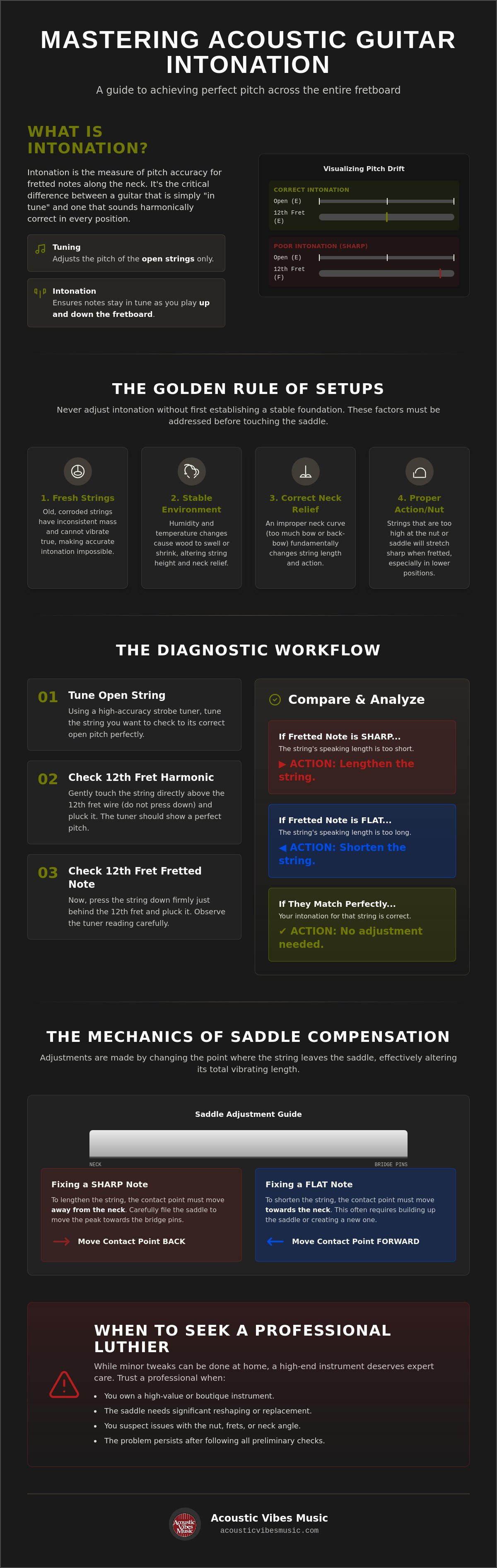
Mastering how to adjust acoustic guitar intonation requires a disciplined, chronological workflow. You cannot guess your way to perfect pitch. Every adjustment must be based on precise data collected from a stable instrument. Before you begin, ensure you have addressed the "Invisible Factors" discussed earlier, such as neck relief and string age. Once your guitar is stable, follow this professional diagnostic sequence to evaluate its harmonic accuracy.
Before you commit to any physical changes, understand that how to adjust acoustic guitar intonation is as much about observation as it is about action. Small errors in your testing technique can lead to permanent mistakes on your saddle. Always test in the "playing position" rather than with the guitar lying flat on a bench, as gravity slightly shifts the neck and changes the pitch readings.
A standard clip-on tuner lacks the resolution for this work. To achieve gallery-level accuracy, you need a strobe tuner with a resolution of 0.1 cents, such as the Peterson StroboClip HD. Standard tuners often have a "dead zone" where they show a note is in tune even if it is slightly off. You must also be mindful of playing pressure. Squeezing the string too hard against the fret will pull the note sharp, giving you a false diagnostic reading. Use the same light, consistent touch you use when performing.
For those brave enough to attempt minor corrections, the goal is to shift the "peak" of the saddle contact point. Using a small, fine-tooth file, you can move this peak forward or backward to change the speaking length of the string. Never sand the bottom of the saddle to fix intonation; this only changes the action. If a fretted note is sharp, move the contact point toward the back of the bridge; if it is flat, move the peak forward toward the neck. This "Sharp-Back, Flat-Forward" rule is the cornerstone of bridge compensation. If these adjustments feel beyond your comfort level, our experts at Acoustic Vibes Music can provide the precision setup your instrument deserves.
Owning a world-class instrument is a privilege that comes with a unique responsibility of care. While mastering the theory of how to adjust acoustic guitar intonation empowers you as a player, executing these changes on a boutique build requires a level of precision that only years of bench experience can provide. High-end instruments are often constructed with thinner finishes and more responsive, delicate bracing. A minor DIY error, such as a cracked bridge or a poorly fitted saddle, can compromise the structural integrity and resale value of your investment. For instruments from storied makers like Boucher Guitars or Lowden Guitars, the stakes are simply too high for guesswork.
Sometimes, intonation drift is merely a symptom of a deeper structural shift. If you find that you cannot achieve perfect pitch even after a saddle adjustment, your guitar may be signaling the need for a neck reset. This occurs when the pull of the strings slowly changes the angle of the neck over decades, a reality for many vintage and heirloom-quality pieces. A professional luthier can diagnose whether your issues are at the bridge or if the instrument requires a more significant intervention to restore its original geometry. Investing in expert care ensures your instrument remains a functional piece of art for generations.
A professional luthier does more than just move a contact point. They maintain the delicate balance of the entire instrument. When you commission a custom saddle carving, a specialist considers your specific playing style, preferred string gauges, and even the humidity of your local environment. This level of customization is essential for players who use non-standard drop tunings, as factory compensation is rarely designed for such low tensions. This expert touch provides peace of mind, knowing your instrument will perform flawlessly under the spotlight or in the studio.
True craftsmanship requires looking beyond the immediate problem. A specialized workshop takes a holistic view of the instrument, examining the bridge plate, internal braces, and neck joint as a single, interconnected system. This is particularly vital for the unique construction nuances found in Gibson Acoustic Guitars, where tradition and specific build techniques dictate the repair approach. Scheduling regular check-ups allows a luthier to catch seasonal shifts before they turn into permanent playability issues. By partnering with an expert guide, you ensure that the journey of learning how to adjust acoustic guitar intonation leads to a deeper appreciation of your instrument's potential rather than a costly repair bill.
Your journey through the mechanics of pitch accuracy shouldn't end with a simple understanding of saddle peaks. You now possess the specialized knowledge to distinguish between a minor string drift and a deeper structural need. Mastering how to adjust acoustic guitar intonation is about more than just technical skill; it's about honoring the craftsmanship of your instrument and ensuring its voice remains pure across every fret. Whether you're diagnosing first-fret sharpness or mapping the 12th-fret harmonics, your goal is a guitar that responds with surgical precision.
Remember that a perfect setup is a delicate conversation between strings, wood, and climate. While minor tweaks are possible for the seasoned enthusiast, heirloom-quality guitars deserve the touch of a master. As an authorized dealer for Martin, Taylor, and Collings, we bring a curator's eye to every repair. We invite you to explore our curated collection of world-class instruments or visit our workshop for expert luthier services. Book a Professional Luthier Setup for Your Premium Acoustic to restore the sweetness and sustain your music deserves. Let your instrument ring true in every position.
You can achieve subtle improvements by optimizing your neck relief or experimenting with different string materials. While these changes affect the string's tension and height, they don't replace the need for physical saddle compensation. Most significant pitch corrections eventually require a specialist to explain how to adjust acoustic guitar intonation through refined contact points at the bridge.
Sharpness at the 12th fret typically indicates that the string's speaking length is too short relative to the fret spacing. As you press the string down, the extra tension sharpens the note. This is a classic sign that the saddle contact point needs to be moved further back toward the bridge pins to restore harmonic balance.
While we don't list specific shop rates here, industry data from 2026 shows that a standard professional setup typically costs between $70 and $150. If your instrument requires more intensive labor like fret leveling or a hand-carved bone saddle, those premium services can range from $150 to over $350. These investments ensure your heirloom instrument maintains its value.
Switching your string gauge absolutely impacts how your instrument performs. Heavier strings exert more tension on the neck and bridge, which often pulls the pitch sharp in higher positions. Learning how to adjust acoustic guitar intonation becomes essential whenever you move from light to medium sets to ensure your chords remain sweet and balanced across the entire fretboard.
Check your pitch accuracy every time you install fresh strings or whenever the seasons change. Humidity shifts can cause the guitar's top to swell or sink, which alters the bridge height and neck angle. Regular monitoring prevents these environmental factors from turning into permanent playability issues that require a luthier's intervention to correct.
A strobe tuner with a resolution of 0.1 cents is your most vital tool for this delicate work. Standard clip-on tuners simply aren't precise enough to detect the micro-drifts that ruin your harmonic resonance. You'll also want a fresh set of your preferred strings to ensure you're measuring a consistent vibration rather than the irregularities of worn metal.
A truss rod adjustment can resolve pitch issues specifically caused by improper neck relief. If your neck has too much bow, the strings sit higher off the fretboard. This height forces you to stretch the string further to reach the fret, which pulls the note sharp even if your saddle is perfectly carved for a standard setup.
The B-string is physically stiffer than its neighbors because it lacks a wrap wire and has a relatively thick solid core. This stiffness prevents it from vibrating freely at the bridge, causing it to ring sharp. Most builders solve this by carving a specific offset into the saddle to extend its speaking length and compensate for its unique tension.