My shopping cart
Your cart is currently empty.
Continue ShoppingCould a single piece of hand-carved bone, no larger than a matchstick, be the only thing standing between your Martin and its true sonic potential? It's a question many enthusiasts face when a cherished instrument starts to lose its resonance. You've likely felt the sting of persistent open-string buzzing or a Taylor that simply refuses to stay in tune. These issues often stem from a worn or poorly slotted nut, making the acoustic guitar nut replacement cost a vital consideration for maintaining your instrument's value. It's not just a simple parts swap; it's a precision calibration of your guitar's entire geometry.
We share your reverence for fine craftsmanship and understand the desire to restore that effortless, factory-level playability. Discover the essential factors that influence repair costs, from the technical nuances of custom shaping to the sonic benefits of premium materials. This guide provides a clear look at how to balance the price-to-quality ratio of TUSQ and organic bone. You'll gain the confidence to choose a repair path that enhances tonal clarity and ensures your instrument remains a masterpiece of sustain and soul.
The nut is often overlooked by casual players, yet it serves as one of the two critical anchor points for every note you play. Think of it as the gatekeeper of your instrument's vibration. While the saddle handles the bridge end, the nut defines the string's starting point at the headstock. This small component dictates how energy transfers from the string into the neck, directly influencing the resonance of premium acoustic guitars. When you consider the acoustic guitar nut replacement cost, you aren't just paying for a part. You're investing in the precision calibration that makes a Martin or Taylor feel like a professional tool.
Precision slotting is where the artistry of a luthier truly shines. The depth of these slots determines the "action" at the first fret, which is the primary factor in ease of play. If the slots are too high, your guitar feels stiff and difficult to play in open positions. If they're too low, you'll encounter frustrating buzz. Beyond height, the spacing between strings must be exact. Proper spacing prevents string crowding, ensuring your fingers have the room they need for complex fingerstyle passages or fast flatpicking. A well-fitted nut also ensures consistent tuning. It allows strings to glide smoothly without binding; this is essential for players who demand stability during aggressive performances.
At its core, the nut is a small strip of hard material, typically bone or a high-quality synthetic, located at the junction where the headstock meets the fretboard. It functions as the "zero fret" for all open-string notes. This component establishes the take-off point for the strings and sets the specific angle as they head toward the tuning machines. To learn more about the technical history and variations of this part, you can explore the role of the guitar nut in stringed instrument design.
How do you know when it's time for a professional change? Listen for an audible "pinging" sound while tuning. This usually indicates that the strings are catching in the slots, causing sudden tension jumps. You might also notice excessive buzzing on open strings, even if your neck relief is perfectly set. Look closely at the material itself. Visible wear or deep, jagged grooves suggest the slots have lowered too far. These issues compromise your instrument's voice and indicate that evaluating the acoustic guitar nut replacement cost should be your next priority to restore factory-level performance.
The material of your guitar's nut isn't just a matter of durability; it's a fundamental choice in sound design. Material density directly affects the sustain and brightness of every open string you strike. High-end instruments deserve components that mimic or enhance the harmonic richness of natural ivory. While a soft plastic nut on a budget guitar may dampen vibrations, a premium material ensures that energy transfers efficiently into the neck. When evaluating the acoustic guitar nut replacement cost, the choice of material is the first step in tailoring your instrument's unique voice. Your guitar's specific tonewoods, whether it's a punchy Adirondack spruce top or a warm mahogany back, will react differently to various nut densities.
Organic bone remains the gold standard for many builders. It's the traditional choice found on Martin Guitars and Gibson Acoustic Guitars for its unmatched resonance and classic aesthetic. Unbleached bone is particularly prized for vintage-style instruments. It retains a higher natural oil content, which provides built-in lubrication for the strings. Conversely, TUSQ is a high-tech, man-made material favored by Taylor Guitars. It offers incredible consistency and is engineered to be self-lubricating. This ensures modern playability and eliminates the "dead spots" sometimes found in lower-quality organic samples.
Dense materials prevent energy loss. This results in longer-ringing open chords and a more "alive" feel under your fingers. The right nut can "tame" an overly bright guitar or "excite" specific frequencies in a darker-sounding instrument. Acoustic impedance is the measure of how much a material resists the transfer of sound energy from a vibrating string into the neck of the instrument. For a deeper dive into how these physics apply to your specific setup, this Frets.com luthier resource is an invaluable guide for technical enthusiasts. Choosing the right material ensures your acoustic guitar nut replacement cost translates into a tangible sonic upgrade. If you're ready to hear the difference a premium setup makes, explore our latest arrivals of artisan acoustic guitars to find your next inspiration.
Durability is the final piece of the puzzle. Soft plastics wear down quickly, creating deep grooves that lead to buzzing and poor intonation. Hard organic bone or high-grade synthetics like TUSQ resist this wear for years. They maintain the precise height of your action even under heavy touring or aggressive flatpicking. Investing in a superior material now prevents the need for frequent repairs later, keeping your instrument in peak performance condition.
Understanding the financial side of instrument maintenance starts with a clear view of where your investment goes. When calculating the total acoustic guitar nut replacement cost, you'll find that the physical component is surprisingly affordable. The majority of your bill reflects the specialized skill of a master luthier. It's a precision service that requires a steady hand and a deep understanding of string physics. Most professional shops won't just swap the part; they'll include a basic setup check to ensure the new nut integrates perfectly with your guitar's existing bridge and neck relief.
Labor is the primary driver of the final price. While a raw bone blank might only cost between $5 and $10, the process of shaping that blank into a functional nut takes significant bench time. An expert must file each slot to a thousandth of an inch. They also polish the material to a mirror shine to prevent string binding. This level of detail ensures that your fine acoustic instrument performs at its peak. Complexity also plays a major role. If you're bringing in a 12-string guitar, expect the labor time to nearly double. Each additional slot requires the same level of individual attention to height, width, and break angle.
You may encounter pre-slotted nuts made of synthetic materials like TUSQ. These are designed for speed and can be a cost-effective alternative for some players. However, they rarely offer the "perfect" fit required for high-end instruments. A pre-slotted part is a generalized solution. It doesn't account for your specific string gauge or your personal preference for action height. For heirloom-quality instruments like Collings Guitars or Boucher Guitars, boutique hand-carving is almost always the recommended path.
Hand-carving allows a luthier to bespoke the nut to your playing style. If you have a heavy attack, the luthier can leave the action slightly higher to prevent buzz. If you're a light-touch fingerstyle player, they can bring it down for effortless fretting. This level of customization is what separates a standard repair from a professional calibration. It ensures your instrument isn't just fixed, but evolved. Choosing a custom-carved blank is an investment in the long-term playability and tonal clarity of your instrument.
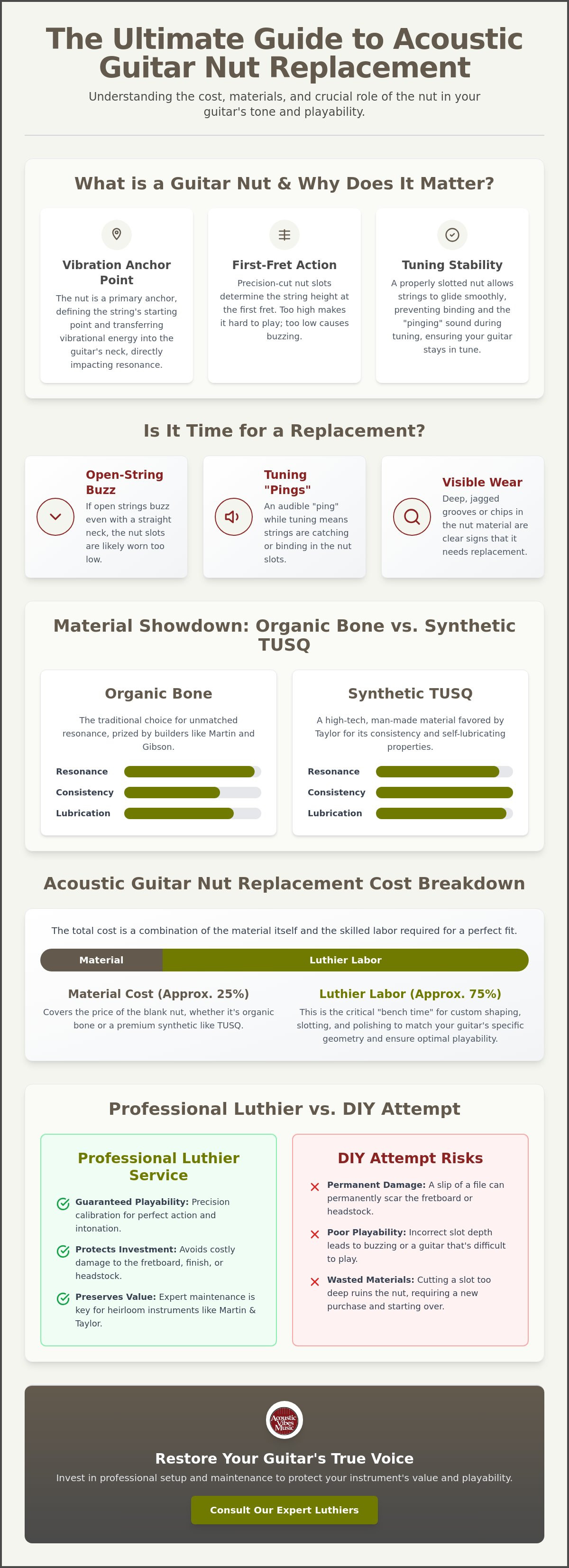
The allure of a weekend DIY project is strong for many enthusiasts. You might think that handling the work yourself is the best way to manage the acoustic guitar nut replacement cost, but the math often tells a different story. Professional-grade nut file sets, essential for a clean and precise job, typically cost between $65 and $90. For a one-off repair, you'll spend more on specialized tools than you would on a master luthier's bench fee. Beyond the hardware, you're paying for years of experienced intuition that prevents costly mistakes on your prized acoustic instrument. A professional install doesn't just fix a problem; it maintains the prestige and resale value of your investment.
Working on a nut involves a "point of no return" that can be nerve-wracking for the uninitiated. Once you file a slot even a fraction of a millimeter too deep, the nut blank is effectively ruined. You'll have to start over with a fresh piece of bone or TUSQ. There is also a significant risk of finish chipping when you're removing an old, glued-in nut. Without the proper heating and scoring techniques, you could pull up shards of lacquer or wood from the headstock. Poor intonation is another common pitfall. If the slot angles aren't filed correctly toward the tuners, your open strings will never sound truly in tune, no matter how much you turn the pegs.
When you choose an expert, you're getting a holistic evaluation of your guitar's health. A luthier won't just look at the nut in isolation. They examine the interaction between neck relief, saddle height, and nut action to create a unified playing experience. This often leads to catching subtle bridge or fret issues that the average player might miss. If your instrument requires more extensive work, understanding the difference between Fret Dressing vs. Refret services can help you decide on the best path for restoration. Your guitar will return to you with a factory-fresh aesthetic, featuring a hand-polished nut that shines with artisanal quality.
Trusting your instrument to a specialist ensures that every note rings with the clarity it was designed to have. If your guitar is struggling with tuning stability or uncomfortable action, it's time to seek expert care. Explore our luthier repair services to give your instrument the professional attention it deserves and restore its soulful voice.
Owning a world-class acoustic instrument is a journey of stewardship. It's about more than the music you make today; it's about ensuring the guitar remains a vibrant, heirloom-quality asset for decades. Regular maintenance is the heartbeat of this preservation. When a nut wears down from years of passionate playing, addressing the acoustic guitar nut replacement cost is a necessary step in protecting your instrument's long-term health. A guitar that receives consistent, professional care holds its value significantly better in the used and consignment market. Collectors and seasoned players look for the hallmark of expert luthier work when evaluating a pre-owned masterpiece.
We understand the unique soul of boutique and custom shop instruments. Our repair team specializes in the delicate technical needs of Martin, Taylor, and Gibson Acoustic models. We also provide bespoke services for rare builds from Collings Guitars and Lowden Guitars. Our commitment to excellence means we never use generic, mass-produced components. We utilize only the finest unbleached bone or specialized TUSQ blanks to ensure your guitar retains its original harmonic richness. Explore the caliber of instruments we service by browsing our curated Guitars collection.
Distance shouldn't limit your access to premium craftsmanship. We offer comprehensive guidance on safely shipping your instrument for professional repair, ensuring your guitar arrives at our shop in peak condition. Humidity control is a non-negotiable priority in our facility. We maintain a strictly climate-controlled environment to protect your tonewoods throughout the service duration. This stability is essential when managing an acoustic guitar nut replacement cost, as even minor wood movement can affect the precision of a new setup. Scheduling an appointment for a professional evaluation is simple. Contact us today to discuss your instrument's needs and secure its future as a high-performing work of art.
A precision carved nut is the gateway to your instrument's true potential. By selecting premium materials like unbleached bone or high performance TUSQ, you define the harmonic richness and sustain of every open note you strike. While the acoustic guitar nut replacement cost reflects the specialized bench time of a master luthier, it's a vital investment that safeguards your guitar’s geometry and long term resale value. Professional calibration ensures your instrument remains a joy to play, preventing the common pitfalls of DIY attempts.
As an authorized dealer for Martin, Taylor, and Collings, we bring a national reputation for excellence to every repair. Our expert luthier services are tailored to the world renowned brands you cherish. We treat every instrument with the same reverence we hold for our own curated gallery. Experience the difference that artisan skill makes in your tonal clarity and sustain.
Explore Our Professional Luthier Services and Schedule Your Appointment today to begin your instrument's restoration. Rediscover the effortless playability and crystalline resonance that first inspired your musical journey. Your guitar deserves the touch of a specialist.
A professional nut replacement involves a combination of labor for custom fabrication and the cost of the material blank. Most luthiers charge based on the bench time required to hand-carve a blank to your instrument's specific geometry. Complex guitars like 12-strings or instruments requiring specialized material like unbleached bone often require more intensive labor. The total acoustic guitar nut replacement cost is an investment in your instrument's long term playability and tuning stability.
Yes, upgrading from plastic to bone is one of the most effective tonal improvements you can make. Bone is significantly denser and more consistent than standard plastic, which often dampens string vibration. This upgrade results in improved sustain and a clearer, more resonant voice for your open strings. It also offers superior durability, resisting the deep grooves that cause buzzing over time.
While the actual hands-on labor for carving and fitting a nut takes several hours of focused bench time, most professional shops have a turnaround time of several days. This allows the luthier to monitor how the neck and strings settle under tension after the new component is installed. High-end shops prioritize precision over speed to ensure the action is perfect before the instrument returns to your hands.
A new nut primarily improves the clarity, sustain, and harmonic richness of your open strings. Because the nut serves as a primary anchor point for string vibration, a denser material like bone or TUSQ transfers energy more efficiently to the neck. You'll notice a more balanced tonal profile and a livelier feel, especially when playing in open positions or using a capo.
A poorly slotted nut is a frequent culprit behind premature string breakage. If the slots are too narrow or have jagged edges, they create excessive friction and pinch the string. This stress often leads to breaks at the headstock junction during tuning or aggressive playing. A professionally polished nut allows the string to glide smoothly, ensuring better tuning stability and longer string life.
A nut replacement is a specific hardware repair, while a setup is a comprehensive calibration of the entire instrument. A nut replacement focuses on fabricating and installing a new component at the headstock. In contrast, a full setup adjusts the truss rod, saddle height, and intonation to optimize playability across the entire fretboard. Most expert luthiers recommend a setup alongside an acoustic guitar nut replacement cost to ensure the new nut works in perfect harmony with the rest of the guitar.
You don't have to replace the saddle at the same time, but many players choose to upgrade both to ensure tonal consistency. If you're switching from plastic to bone at the headstock, a matching bone saddle at the bridge provides a unified resonance across the instrument. However, if your current saddle is already a high-quality material and in good condition, it can usually remain in place.
You can identify a worn nut by listening for buzzing on open strings or noticing that the action feels unusually low at the first fret. Another common sign is a pinging sound when tuning, which suggests strings are binding in deep or unevenly worn slots. If you see visible cracks in the material or if the strings sit too deep in the grooves, it's time for a professional evaluation from a specialist.