My shopping cart
Your cart is currently empty.
Continue ShoppingMaple is the world’s most honest tonewood, acting as a transparent sonic canvas that amplifies your technique rather than coloring it. While many collectors gravitate toward the dark resonance of rosewood, the true artist often seeks the immediate response and surgical precision that only a premium maple instrument provides.
You may have heard that maple sounds thin or brittle in certain settings. It's a valid concern if you've only encountered entry-level builds. However, when paired with the right body shape and master-grade craftsmanship, this wood delivers a sophisticated punch that cuts through any mix with authority and elegance. It's about finding the balance between projection and purity.
Discover why this wood is the choice of elite performers and how to select the perfect maple-backed instrument for your collection. We'll demystify the visual differences between flamed and quilted figures, analyze how premier brands like Taylor and Gibson utilize this material, and share professional secrets for preserving those stunning, high-gloss finishes. From understanding sonic transparency to identifying your next heirloom guitar, this guide is your expert roadmap to the artistry of maple.
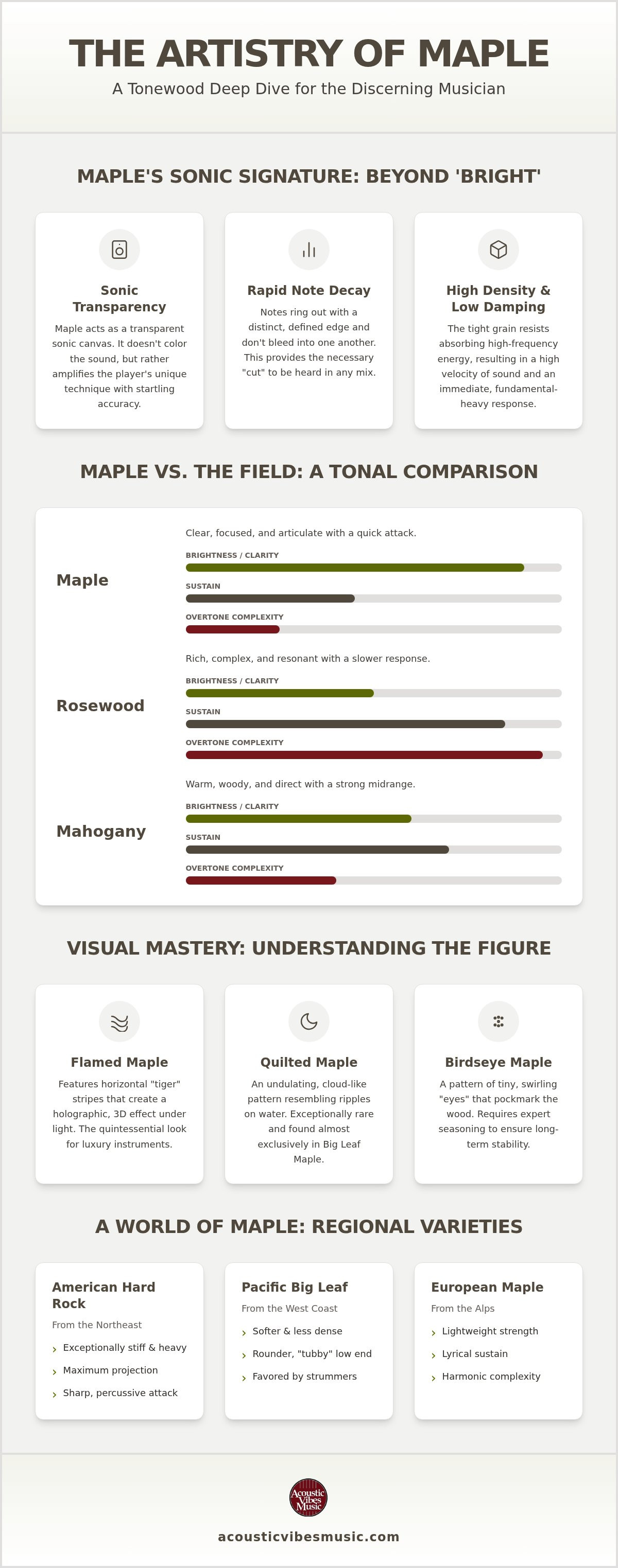
Maple is often reduced to a single adjective: bright. While it's true that this wood excels in the upper register, labeling it as merely "bright" ignores the sophisticated transparency that makes it a staple in professional studios. It's a high-density tonewood characterized by rapid decay and a crystalline clarity. This means the notes don't bleed into one another; instead, they ring out with a distinct, defined edge. In an ensemble or a dense recording mix, a maple instrument provides the necessary "cut" to ensure your melodies aren't lost beneath the bass and percussion.
Think of this wood as the most "honest" material a luthier can use. It doesn't hide mistakes behind a wash of overtones or muddy sustain. It reflects your specific picking and fretting technique with startling accuracy, rewarding players who have mastered their touch. While some fear this makes the guitar sound thin, modern builders at Taylor Guitars and Gibson Acoustic Guitars have perfected bracing patterns that pull a surprising warmth and balance from the wood. They've effectively transformed a potentially brittle sound into a rich, three-dimensional experience that remains articulate even under heavy strumming.
The secret lies in the density. Because the wood is so tightly grained, it resists absorbing high-frequency energy. It also features incredibly low internal damping, which is why you feel an immediate note response the moment your pick strikes the string. Maple possesses a significantly higher velocity of sound than mahogany, meaning the energy from your strings travels through the wood with exceptional speed and minimal coloration. This creates a fundamental-heavy profile that emphasizes the actual pitch of the note rather than complex, lingering "ghost" notes.
Not all trees are created equal. Hard Rock Maple from the American Northeast is exceptionally stiff and heavy, offering maximum projection and a sharp, percussive attack. In contrast, Big Leaf Maple from the Pacific Northwest is slightly softer and less dense. It provides a rounder, more "tubby" low end that many strummers prefer for solo performances. Then there is European Maple, often sourced from the Alps. This variety is prized in the classical world and high-end steel-string builds for its lightweight strength and lyrical sustain. Whether you are looking at a master-grade flame maple back or a subtle birdseye grain, the climate and growth rate of the tree dictate the final tonal output. Slower-growing trees in colder climates generally offer more structural focus and harmonic complexity.
The visual drama of a master-grade instrument often begins with a genetic mystery. Figure is a rare phenomenon where the wood grain deviates from its straight path, creating three-dimensional patterns that seem to dance under a high-gloss finish. These aesthetic variations aren't just for show; they represent the pinnacle of a luthier's art and the unique life story of the tree itself. Stresses from wind, weight, or genetic anomalies produce these shimmering effects that collectors cherish.
There's a common debate among enthusiasts regarding whether a heavy "flame" changes the sound. Scientifically, figure is a visual grain distortion and doesn't inherently alter the fundamental frequency of the wood. However, highly figured sets are often denser and more brittle than straight-grained pieces. This requires a master builder's touch to thin the wood perfectly without risking structural failure. Sustainability-minded industry leaders emphasize that while these rare figures are the "diamonds" of the forest, the expert handling of the material is what truly determines the final voice. A beautiful instrument often inspires a player to pick it up more often, which is perhaps the most significant tonal upgrade of all.
Luthiers use a grading scale from A to AAAAA to communicate the intensity and consistency of the figure. A three-A (AAA) set provides excellent coverage, but a five-A (AAAAA) set is a "museum grade" specimen with deep, unbroken ripples across the entire surface. Taylor Guitars has mastered the art of highlighting these patterns through proprietary staining techniques that "pop" the grain before the final clear coat is applied. Whether you prefer a subtle natural look or a dramatic sunburst, the grade of the wood sets the stage for the instrument's visual soul. If you're looking for a centerpiece for your collection, you can explore our curated gallery of premium acoustics to see these figures in person.
Choosing a tonewood is a study in sonic architecture. While rosewood is celebrated for its lush, reverb-like overtones and mahogany for its dry, woody mid-range, maple stands apart as the most transparent member of the family. It doesn't add the "darkness" or "color" that many players expect from traditional acoustics. Instead, it provides a crystalline focus on the fundamental note. If you've explored our guide on Rosewood vs. Mahogany Back and Sides, you'll recognize that maple fills the gap for players who demand precision over complexity.
The top wood plays a critical role in balancing this transparency. A Sitka spruce top is the classic choice, offering a versatile "all-rounder" feel that rounds off the sharpest edges of the wood's attack. For those seeking maximum volume and headroom, Adirondack spruce provides the stiffness needed to drive a maple-backed instrument without it becoming thin or "brittle" at high volumes. It's a partnership where the top provides the voice and the back provides the clarity.
Recording engineers often prefer this wood because of its remarkably flat frequency response. Unlike rosewood, which often features a "U-shaped" curve with scooped mids and heavy bass, maple stays consistent across the spectrum. This prevents "muddiness" during heavy strumming or when using lower tunings. Notes remain separated and distinct, making it much easier to sit the guitar in a dense studio mix without excessive EQ. It provides the "snap" and projection that ensures every nuance of your performance is captured with surgical detail.
The magic happens when you pair this wood with the right silhouette. The Gibson J-200 is perhaps the most famous example; its massive Jumbo body provides the bass response that naturally complements the wood's high-end clarity. It's the ultimate "Workhorse" for stage performers. Conversely, in a modern Grand Auditorium, the wood offers a balanced, intimate response perfect for fingerstyle. Deciding between a Dreadnought vs. Grand Auditorium for Strumming depends on how much raw power you need versus articulative detail. A larger body tames the brightness, while a smaller body highlights the wood's natural sparkle.
Selecting an heirloom instrument is a deliberate process. You aren't just buying a guitar; you're acquiring a specific sonic filter for your musical voice. Because maple is so transparent, the choices you make regarding body size and builder heritage will resonate more clearly than with almost any other wood. It's about matching the wood's rapid response to your physical touch and aesthetic preferences. Use the following framework to guide your search through our curated gallery.
Examine the back and sides for uniform grain and figure symmetry. A "bookmatched" set, where the two halves of the back are mirror images, is a hallmark of premium craftsmanship. Pay close attention to the presence of "aged" or torrefied wood. Torrefaction involves roasting the maple to remove moisture and volatiles, resulting in a more stable piece of wood that mimics the warm, played-in tone of a vintage instrument from the 1930s. Finally, ensure the instrument has received a professional setup. The fast response of this wood can feel unforgiving if the action is too high or the intonation is slightly off.
Don't buy for the "flame" alone. While a five-A quilted back is breathtaking, a "plain" piece of hard rock maple often provides a punchier fundamental and better structural integrity. Another common error is ignoring playability. Always check the nut width and neck profile to ensure the guitar feels as good as it looks. Lastly, remember that high-end finishes on dense woods are sensitive to climate. Failing to maintain a consistent 45 to 55 percent relative humidity can lead to finish checking or cracks in the figure. Protecting your investment is as vital as the initial selection. If you're ready to find your next masterpiece, explore our current collection of premium maple acoustics today.
The Gibson J-200, rightfully crowned the "King of the Flat-Tops," remains the ultimate maple showcase. Its oversized Super Jumbo body is the perfect partner for this wood, providing a deep, resonant chest that tames any potential high-end harshness. It’s a percussive powerhouse that has graced the world's largest stages for decades. For the serious collector, the Martin Custom Shop offers a different flavor of excellence. These rare, heirloom-quality builds utilize master-grade flamed sets to create a more balanced, traditional sound that isn't found in their standard catalog. These guitars are the "diamonds" of the acoustic world, offering a unique blend of heritage and crystalline focus. They represent a significant investment in both tone and artistry.
Taylor changed the industry's perception of this wood with the reimagined 600 Series. Under the direction of Andy Powers, Taylor Guitars introduced a torrefied Sitka spruce top that mimics the cellular structure of aged wood. This roasting process adds a sophisticated warmth and "sweetness" to the Big Leaf maple back and sides, making the 614ce a versatile choice for both delicate fingerstyle and aggressive strumming. It’s no longer just a "bright" guitar; it’s a three-dimensional instrument with a rich, complex voice that sits perfectly in any recording mix. The hand-rubbed Brown Sugar stain further highlights the visual drama of the grain, making it as beautiful to look at as it is to play. It's an accessible gateway to elite performance.
When you step into the world of boutique lutherie, the level of detail reaches a fever pitch. Collings Guitars approaches every build with surgical precision. They hand-voice each top to match the specific density of the maple back, ensuring the notes are always articulate but never thin. This results in a guitar with a lightning-fast response that rewards a player’s every nuance. Similarly, Boucher Guitars has gained a reputation for pairing their legendary Adirondack spruce with premium figured sets. This combination offers incredible headroom and a percussive "snap" that bluegrass and flatpicking enthusiasts adore. Each instrument feels like a custom selection from a curated gallery. Browse our full collection of premium maple instruments to experience this level of craftsmanship for yourself.
Choosing a high-end instrument is more than a purchase; it's a commitment to your artistic growth. We've explored how maple serves as a transparent sonic canvas, offering a level of honesty that rewards your unique technique. From the holographic depth of flamed figures to the surgically precise projection of boutique builds, these instruments represent the pinnacle of modern lutherie. The right guitar doesn't just play well. It inspires you to reach for new musical heights every time you open the case.
At Acoustic Vibes Music, we act as a curated gallery for the world's most prestigious builders. As an authorized dealer for Martin, Taylor, and Collings, we hand-select every piece for its structural excellence and tonal beauty. Every instrument in our collection receives an expert luthier setup to ensure flawless playability right out of the box. We provide national shipping with professional packing to ensure your new heirloom arrives in pristine condition. Don't wait to find the voice you've been searching for. Explore our curated collection of premium maple guitars and discover the difference that world-class craftsmanship makes.
Maple is an exceptional choice for musicians who value sonic transparency and immediate note response. It provides a crystalline focus that allows every nuance of your technique to shine without being obscured by heavy overtones. While rosewood offers a lush reverb, this wood is prized for its ability to cut through a dense mix. It’s an ideal material for professional recording and ensemble work where clarity is the highest priority.
Visual figure, such as the shimmer of flamed or quilted patterns, is primarily an aesthetic trait rather than a tonal one. A plain piece of hard rock maple can sound just as spectacular as a museum-grade flamed set if the density and stiffness are comparable. The true magic comes from how a master luthier voices the top to complement the specific back and sides. You should choose a figure that inspires you visually.
The massive internal air volume of a jumbo body naturally produces a deep, booming bass that can sometimes become muddy. Pairing this with the high-density and rapid decay of a maple back and sides provides the perfect counterweight. This combination creates a balanced, percussive sound that is both powerful and articulate. It's the reason why legendary builds like the Gibson J-200 have remained stage staples for nearly a century.
While mahogany is celebrated for its warm, woody mid-range and dry character, maple delivers a faster attack and more high-end sparkle. For fingerstyle players, this means every pluck has a defined edge and surgical precision. Mahogany tends to compress the sound slightly, creating a cozy, intimate feel. In contrast, a maple instrument projects with authority and crystalline detail, making it perfect for complex arrangements that require maximum note separation.
Solid maple instruments absolutely open up over time. As the wood is played, the natural resins within the cellular structure begin to crystallize, which allows the plates to vibrate more freely. This process results in a smoother high end and a more resonant low-frequency response. Many collectors now opt for torrefied models, which use a specialized roasting process to mimic the tonal maturity and stability of a decades-old vintage instrument.
Maple is a remarkably strong and stable wood, but its high density makes it sensitive to extreme shifts in relative humidity. Like any premium tonewood, it can develop finish checks or structural cracks if it becomes too dry. We recommend maintaining a consistent environment of 45 to 55 percent humidity. Utilizing professional luthier services for seasonal setups will also ensure that your instrument remains stable and plays beautifully for generations.
Phosphor bronze strings are the most effective way to introduce warmth and harmonic richness to a bright instrument. The copper and tin alloy provides a mellow, dark tone that beautifully balances the wood's natural high-frequency energy. If you find your guitar is too snappy, avoid 80/20 bronze strings, which emphasize brilliance. Heavier gauge strings can also help drive the top more effectively, resulting in a fuller, more robust sound across the spectrum.