My shopping cart
Your cart is currently empty.
Continue ShoppingThe difference between a haunting classical sonata and a fiery flamenco falsetta isn't just in the player's hands. It is carved into the very skeleton of the instrument. Choosing between flamenco classical guitars often feels like a high-stakes decision for any dedicated enthusiast. You might find yourself caught between the percussive, immediate snap of a cypress Blanca and the deep, introspective resonance of a traditional Rosewood classical build. It's natural to worry about ending up with an action height that fights your technique or a tonewood that doesn't quite capture the voice you hear in your head.
We're here to clear that confusion and help you find an instrument that feels like an extension of your own creativity. You'll discover the specific technical nuances and tonewood secrets that define the world's finest nylon-string guitars, including why the "Negra" model serves as such a powerful bridge between genres. We will break down the construction differences and CITES-compliant material choices used by legendary luthiers today. This guide provides a clear roadmap to help you choose a specific model from a curated collection with total confidence, ensuring your next guitar is a perfect match for your musical journey.
Behold the Spanish sound. It's a foundational baseline of warmth and wood that defines the world of flamenco classical guitars. At first glance, these instruments appear nearly identical. They share the same elegant silhouette, the same six nylon strings, and the same heritage of Spanish craftsmanship. However, don't let the visual similarities fool you. Beneath the French polish or lacquer, these guitars possess personalities that are polar opposites. One is a meditative soloist; the other is a rhythmic firebrand.
Your choice of instrument dictates the very techniques you can effectively execute. Trying to play a rapid flamenco falsetta on a heavy concert classical guitar often feels like running through water. Conversely, playing a delicate Bach fugue on a lightweight flamenco build can leave the music sounding thin and ephemeral. The internal architecture of the guitar serves as the filter for your musical expression, making it vital to match the build to your artistic intent. Explore the nuances of each style to find your perfect partner in our collection of premium acoustic guitars.
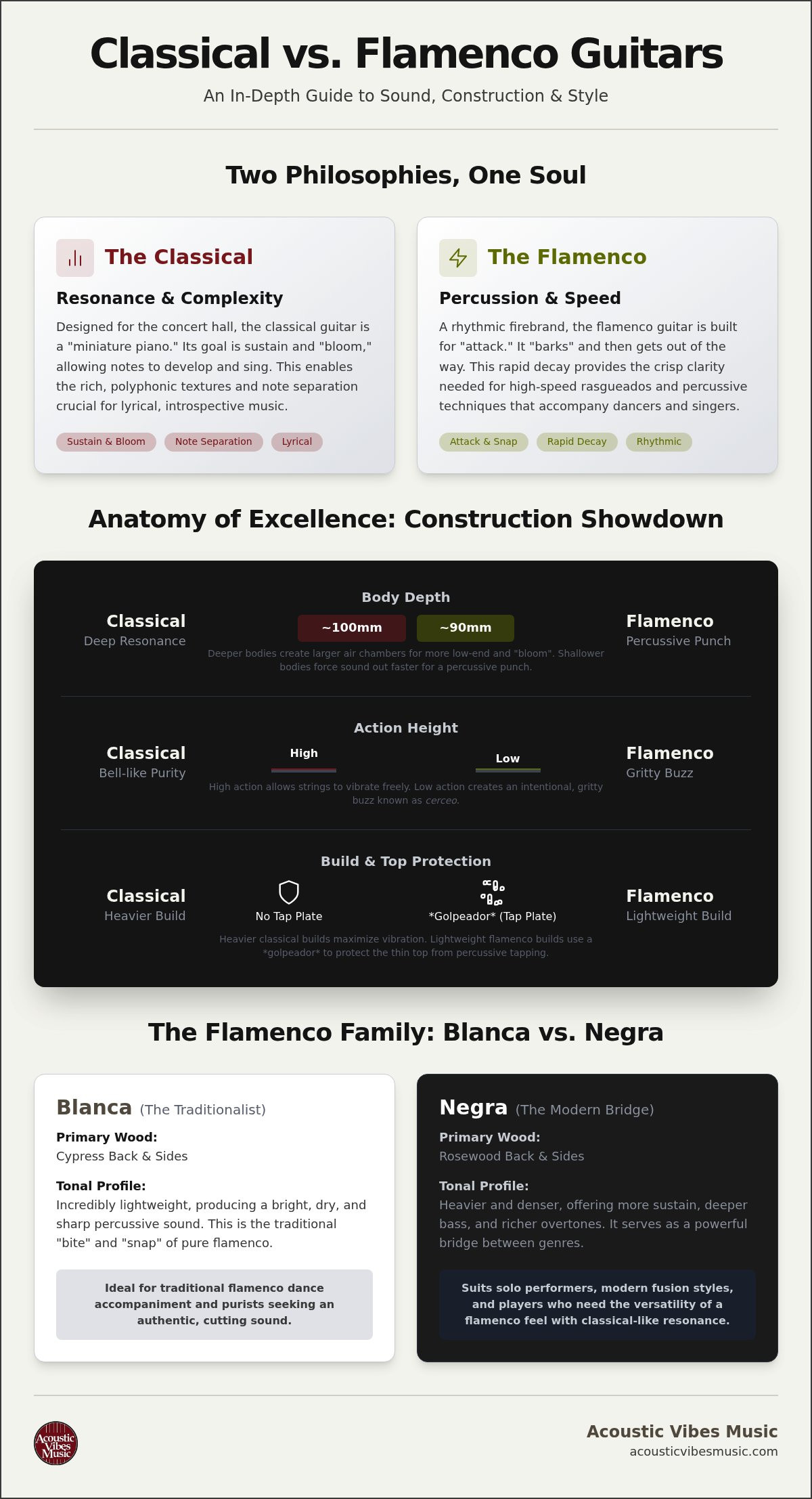
Think of the classical guitar as a miniature piano. It's an instrument designed for the quiet intensity of the concert hall. The goal here is sustain and "bloom." When you pluck a string, you want the note to develop, linger, and sing. This allows for the rich, polyphonic textures found in the works of masters like Tárrega or Sor. To achieve this, luthiers use a heavier build with thicker soundboards and specific internal bracing to maximize the duration of every vibration.
A high-quality classical build emphasizes note separation. In complex music where multiple melodic lines move at once, you need each voice to remain distinct. The Classical guitar history and construction has long prioritized this depth and clarity. It's a build that rewards a disciplined touch, offering a deep, rich bass and trebles that shimmer with complexity. It is the ideal choice for those who seek to explore the introspective, lyrical side of the nylon-string world.
Flamenco is about the immediate. It is an art form of "attack" and percussive snap. In this world, the guitar isn't just a melodic tool; it's a rhythmic partner to the dancer's feet and the singer's cry. The flamenco guitar is built to "bark" and then get out of the way. This is achieved through an incredibly lightweight construction. The woods are shaved thinner, and the bracing is minimal, allowing the energy to explode off the soundboard with a signature "growl" before decaying quickly.
This rapid decay is essential for clarity during high-speed techniques. If the notes lingered too long, aggressive rasgueados and thumb-heavy alzapúa passages would turn into a muddy wall of sound. The flamenco build ensures that every strike is crisp and percussive. It is an instrument of speed and fire, designed to cut through the noise of a crowded tablao. Whether you choose a traditional cypress model or a modern rosewood variant, the flamenco philosophy remains the same: immediate response and raw, rhythmic power.
The physical architecture of flamenco classical guitars defines how they feel against your ribs and how they respond to your fingertips. Construction is where the soul of the instrument is forged. Classical bodies are deeper, typically measuring around 100mm at the lower bout. This volume creates a massive air chamber for low end resonance and that characteristic "bloom" we discussed. Flamenco guitars are noticeably shallower, often shaved down to 90mm or less. This reduction in volume isn't about saving space; it's about kinetic energy. A shallower body forces the sound out faster, providing that percussive punch required for traditional dance accompaniment.
Action height is another critical tactile difference. A classical guitar demands a clean, high action to allow the strings to vibrate freely without touching the frets. This ensures every note is pure and bell like. In contrast, a flamenco setup intentionally lowers the action. This creates a controlled buzz known as cerceo, adding a gritty, aggressive texture to the sound. To protect the delicate spruce or cedar top from aggressive rhythmic tapping, flamenco models feature a golpeador, or tap plate. This clear plastic shield is the only thing standing between your fingernails and a hole in the soundboard.
Internal bracing also plays a silent but vital role. While traditional fan bracing remains the standard for that earthy Spanish voice, modern lattice bracing is gaining ground in the classical world for its incredible volume and sustain. Each luthier has a secret recipe for these internal struts, balancing the need for structural integrity with the desire for a responsive, vibrating top.
Spruce tops are the gold standard for clarity and longevity. Spruce is denser and stiffer than cedar, which provides the "headroom" needed for aggressive strikes without the sound compressing. These tops start bright and "open up" over years of playing. Cedar is the opposite. It offers a warm, mature voice from day one but lacks the percussive headroom of spruce. For the back and sides, Spanish Cypress is the undisputed king of the traditional "Blanca" flamenco guitar. It is exceptionally light and resonant, contributing to a dry, piercing tone that cuts through a room. If you are curious about how other woods behave, explore our Rosewood vs. Mahogany guide to see how these materials influence sustain and warmth.
A great flamenco guitar should feel like it's floating. The lightweight build makes the instrument feel "alive" and vibrating against the player's chest. Traditionalists often prefer friction pegs for their historical aesthetic and light weight, though modern geared tuners offer far better precision for the touring musician. Regardless of the hardware, the final playability comes down to the setup. You can always utilize professional luthier services to optimize your action and bridge height to suit your specific attack. If you are ready to feel these differences for yourself, browse our curated selection of premium guitars to find your next masterpiece.
The choice between a Blanca and a Negra isn't just about aesthetics. It's a fundamental decision about how you want your notes to decay. While both fall under the umbrella of flamenco classical guitars, they offer distinct sonic profiles that cater to different performance environments. The Blanca is the traditionalist's choice. Crafted with Spanish Cypress back and sides, it produces a bright, punchy, and cutting sound. In contrast, the Negra utilizes Rosewood back and sides. This choice of material introduces a darker tone and significantly more sustain. Legend Paco de Lucía famously popularized the Negra, proving that Rosewood could provide the depth of a classical instrument while retaining the aggressive "bark" of a flamenco build.
This construction creates a unique tonal "growl" known as mordente. When Rosewood is paired with the thinner soundboard and lower action of a flamenco build, it produces a gritty resonance that traditional classical guitars lack. For classical players looking for a more comfortable instrument, the Negra is often the perfect bridge. You get the familiar warmth of Rosewood but with the effortless playability of a lower action setup. It's an inviting gateway for those who find the high action of a standard concert guitar too demanding for their left hand. It offers a familiar sonority while unlocking a new level of technical freedom.
If you're playing for dancers or singers, the Blanca is your best ally. Its "dry" sound profile is essential for cutting through the percussive thunder of footwork and the raw power of the cante. The Cypress wood is incredibly light, which contributes to a sound that is immediate and transparent. Because the notes decay so quickly, the guitar never gets "muddy" during rapid-fire passages. It provides a crisp, rhythmic foundation that is as much about percussion as it is about melody. It is the sound of the old world: vibrant, sharp, and unapologetic.
Modern soloists often gravitate toward the Negra for its added "reverb" and robust bass response. The Rosewood back and sides act as a natural acoustic amplifier, providing a lushness that fills a room during solo recitals. This versatility makes it an exceptional tool for genres beyond flamenco. Jazz and Bossa Nova players often find the Negra to be the ultimate solution among flamenco classical guitars. It offers the warmth they crave with a faster, more responsive feel than a traditional classical build. It's a sophisticated choice for the player who wants one instrument to do it all, from intricate polyphony to high-speed improvisation.
Your hands are the ultimate judge. While tonewoods and construction provide the blueprint, the way your fingers interact with the fretboard determines if a guitar is truly yours. Finding the right balance among flamenco classical guitars requires an honest assessment of your technical habits. If you primarily play with heavy rest strokes (apoyando), you need an instrument that offers enough resistance and headroom to handle that downward pressure. Free stroke (tirando) players, conversely, might prefer a more delicate response that allows for nuanced, airy melodies without requiring a massive physical attack.
Don't overlook the "Comfort Factor." The standard nut width for most nylon-string instruments is 52mm. This provides the necessary spacing for complex polyphonic fingerings. However, the neck profile, whether it is a traditional thick "U" shape or a more modern, slim "D" profile, can be the difference between a four hour practice session and early hand fatigue. Scale length is another vital consideration. While 650mm is the industry standard, players with smaller hands often find that a shorter scale length (640mm or 636mm) makes those wide, horizontal stretches far more manageable. Reach is everything when you're tackling a demanding concerto or a rapid-fire falsetta.
When you test a guitar, listen for the "Snap." This is the speed of the note attack. A great flamenco guitar should feel like the note is exploding off the string the moment you touch it. A classical guitar should feel more deliberate, allowing the sound to bloom and develop after the initial strike. Testing for this speed of decay helps you understand if the instrument's personality matches your rhythmic needs.
Prioritize "headroom." You want to be able to play at fortissimo levels without the strings buzzing against the frets. A high quality classical build should also offer a vast palette of tonal color. You should be able to move your right hand from the bridge to the neck and hear a distinct shift from metallic brightness to woody warmth. For those seeking a reliable standard that honors these traditional requirements, Cordoba guitars provide exceptional value and consistent craftsmanship for the advancing soloist.
A low, fast setup is non-negotiable. The action must be low enough to facilitate effortless percussion and the signature "slap" of the strings against the frets. Always confirm the presence of a golpeador. This tap plate is essential to protect your investment from the aggressive rhythmic tapping inherent in the genre. Choosing a boutique dealer like Acoustic Vibes ensures that every instrument has been hand-selected and inspected for these specific playability nuances. Explore our full range of premium nylon-string instruments today to find a guitar that responds to your unique touch.
Every instrument in our gallery tells a story of artisanal skill and tonal dedication. We don't just stock shelves; we curate an experience for the discerning player. Our Acoustic Vibes Flamenco & Classical Collection represents the pinnacle of modern lutherie, featuring hand-selected models that meet our rigorous standards for projection, balance, and aesthetic beauty. Whether you are seeking your first professional-grade nylon-string or adding a rare masterpiece to a lifelong collection, our inventory serves as a trusted gateway to the world's finest flamenco classical guitars.
The Cordoba Luthier Series stands as a testament to exceptional value for the advancing player. These instruments bridge the gap between factory production and boutique craftsmanship, offering high-end features like all-solid tonewoods and traditional Spanish heel construction at an accessible price point. By choosing a hand-selected model from a specialist shop, you ensure that your instrument has been vetted by experts who understand the "Professional Edge." We inspect every guitar for neck straightness, fret dressing, and bridge integrity before it ever reaches our floor. This obsessive attention to detail means your high-end nylon-string arrives with a perfect setup, even after national shipping across the country.
For the player who seeks the ultimate "bloom," we often recommend our Cedar-top models. These guitars offer a warm, immediate resonance that feels mature from the very first chord. Look for instruments featuring intricate wood purfling and hand-carved rosette details; these are the hallmarks of heirloom quality that signal a lifetime of musical companionship. A great classical build must maintain a delicate balance between the deep, chocolatey bass and trebles that sing with crystalline clarity. Our curated selection focuses on instruments that provide this wide dynamic range, allowing you to explore the full spectrum of tonal color required for concert performance.
If your soul craves the rhythmic intensity of the Andalusian tradition, our traditional Cypress Blancas are designed to deliver that authentic Spanish "bark." These guitars are feather-light and incredibly responsive, ensuring your falsettas cut through any room with percussive authority. For the modern soloist who needs extra depth and soloistic power, our Rosewood Negras offer a robust alternative, providing the sustain of a classical build with the aggressive attack of a flamenco setup. We invite you to explore our full curated collection of Flamenco and Classical guitars today and find the instrument that resonates with your unique artistic voice.
Choosing between the meditative sustain of a concert build and the percussive snap of a traditional Blanca is more than a technical decision. It's an artistic commitment. Your instrument should be a seamless extension of your hands, whether you're drawn to the warmth of a Cedar top or the gritty growl of a Rosewood Negra. By understanding the nuances of action height, tonewoods, and internal bracing, you can finally move past the confusion and select a guitar that truly resonates with your unique playing style.
At Acoustic Vibes Music, we act as your expert guide through this sophisticated landscape. As an authorized Cordoba dealer, we hand-select every piece in our gallery and subject them to rigorous luthier inspections. This ensures that your investment meets the highest standards of playability and craftsmanship. With our professional national shipping, your next masterpiece arrives safely and ready to perform. Browse our hand-selected Flamenco and Classical Guitar collection today and discover the flamenco classical guitars that will define your sound for years to come. Your journey toward tonal excellence starts here.
The primary difference lies in the tonal intent: classical guitars are built for sustain and resonance, while flamenco guitars prioritize immediate attack and percussive decay. This is achieved through differences in body depth and action height. A classical guitar features a deeper body for complex "bloom," whereas a flamenco build is shallower and lighter to produce a sharp, biting "bark."
You can absolutely play classical repertoire on a flamenco guitar, though the resulting tone will be significantly drier and more aggressive. The lower action and quicker note decay might make delicate legato passages sound more staccato. Many players enjoy this gritty character for specific Baroque or Spanish nationalist pieces that benefit from a more percussive voice.
A "Flamenca Negra" uses rosewood back and sides instead of the traditional cypress found on "Blanca" models. It’s popular because it serves as a tonal bridge for flamenco classical guitars, offering the punchy attack of a flamenco build with the increased sustain and bass response of a classical instrument. It is the modern standard for soloists who need extra projection in larger halls.
Most flamenco and classical guitars share a standard nut width of 52mm to accommodate complex fingerstyle techniques. However, the neck profile often differs. Flamenco necks are frequently carved thinner to facilitate rapid thumb movements and high-speed soloing, while classical necks may feel more substantial to support traditional left-hand positioning and palm stability.
Tap plates are essential for protecting the delicate soundboard from the aggressive rhythmic strikes known as golpes. Without these clear plastic shields, the repetitive impact of fingernails would quickly wear through the thin spruce or cedar top. They allow the player to treat the guitar as a percussive instrument without risking structural damage to the soundboard.
Neither is objectively better; the choice depends on your desired tonal longevity and immediate response. Spruce tops are prized for their clarity and "headroom," opening up sonically over years of dedicated playing. Cedar tops provide a warm, dark, and mature voice from the very first pluck, though they lack the same percussive ceiling as spruce when played aggressively.
High-end nylon-string instruments require a consistent relative humidity between 45% and 55% to prevent wood cracking or bridge lifting. Always store your guitar in its case with a reliable humidifier when it's not in use. Use a digital hygrometer to monitor the environment, especially during seasonal shifts when indoor air becomes excessively dry.
Yes, Acoustic Vibes Music provides professional luthier services to ensure your flamenco classical guitars are perfectly optimized for your playing style. Our expert technicians can adjust action height, bridge saddles, and nut slots by appointment. This customized setup is vital for achieving the specific "buzz" or "cleanliness" required for your chosen musical genre.