My shopping cart
Your cart is currently empty.
Continue ShoppingA world-class guitar should be a masterpiece for the eyes long before the first chord rings out. When you look at a master-grade instrument, the shimmering ripples of a figured maple back or the deep, liquid waves of a quilted mahogany top tell a story of biological wonder. Witness the depth. Feel the grain. You aren't just looking at a guitar; you're witnessing a rare intersection of nature's artistry and human craftsmanship. It's easy to feel a deep sense of reverence when holding a piece of history that looks as vibrant as it sounds.
You likely appreciate that a premium instrument is an investment in both your art and your collection. However, the line between a stunning visual masterpiece and a structurally sound, world-class player can sometimes feel blurred. We'll help you bridge that gap. You're going to discover the artistry behind these rare materials and learn how to select a visually stunning instrument that sounds as good as it looks. We'll explore the terminology of master-grade patterns, address common fears about wood stability, and give you the tools to identify the specific aesthetics that speak to your personal style.
To understand the allure of a premium instrument, you must first look closely at the grain. Standard tonewoods typically feature straight, parallel lines. These are reliable and structurally sound. However, a figured instrument offers something far more complex. It's a natural phenomenon where the wood fibers grow in non-linear, distorted patterns. This deviation creates the stunning visual ripples we see on the back of a high-end Martin guitar or a boutique build. Understanding What is Figured Wood starts with recognizing that these patterns aren't just surface level; they're woven into the very structure of the timber.
These woods are significantly rarer than their straight-grained counterparts. Only a tiny fraction of harvested timber exhibits master-grade aesthetics. Because these patterns are unpredictable, luthier-grade suppliers must sort through thousands of board feet to find a single set worthy of a gallery-level build. The labor-intensive process of harvesting and matching these sets is why they command a premium price. You're paying for rarity, yes, but you're also paying for the expertise required to process such delicate materials.
Nature rarely follows a perfect blueprint. Figuring is often the result of environmental stressors that force the tree to adapt. Think of it as a "beautiful accident." When a tree grows on a steep incline or faces constant heavy winds, the wood fibers compress and stretch. This tension creates a rippled effect, much like waves on a pond. Genetics also play a role. Some species are simply predisposed to these anomalies. This rarity makes every figured instrument a biological one-of-a-kind. The growth environment, including soil mineral content and moisture levels, further refines these patterns into the shimmering masterpieces we admire.
It helps to have a clear vocabulary when browsing a curated collection. "Figuring" serves as the broad umbrella term for any wood that deviates from a straight path. One of the most sought-after traits in these woods is chatoyancy. This is a three-dimensional optical effect that makes the grain appear to shift and dance as you tilt the instrument in the light. It's often compared to the luster of a gemstone.
Don't confuse these natural growth patterns with "spalting." While both are visually striking, spalting is actually the initial stage of fungal growth. It creates dark, jagged lines that look like a map. It's beautiful, but it requires careful stabilization to ensure the wood remains solid. True figuring, on the other hand, is a permanent structural trait of the tree's growth. It remains stable and vibrant for the life of the instrument.
Step into any high-end guitar gallery and the visual diversity will immediately captivate you. While every tree is unique, figured patterns generally fall into a few legendary categories that have defined premium lutherie for centuries. These aren't just random marks; they're the result of specific growth conditions that change how the wood reflects light and vibrates. Researchers exploring the acoustic properties of tonewoods have found that these structural anomalies can subtly influence density, adding a layer of complexity to the instrument's voice.
Flame maple is all about movement. The horizontal stripes run perpendicular to the grain, creating a shimmering effect that changes as you tilt the guitar. It's highly prized for backs and sides because it combines traditional elegance with a 3D depth that feels alive. When a luthier applies a deep finish, these "stripes" pop with a holographic intensity. It's a classic look that never goes out of style. You'll find this stunning detail across our collection of master-built instruments.
If flame is linear, quilt is organic. Quilted maple usually comes from Big Leaf Maple trees in the Pacific Northwest. It looks tubular or blistered, resembling the surface of a pond during a light rain. "Large quilt" patterns offer bold, sweeping waves, while "small quilt" provides a tighter, more intricate texture. These patterns are exceptionally rare and typically reserved for boutique, one-of-a-kind instruments that prioritize visual drama.
Beyond maple, exotic woods offer their own figured treasures. Hawaiian Koa is perhaps the most famous, known for its golden hues and deep, rolling curls. It's a wood that sounds as warm as it looks. Premium Walnut also surprises with its "chocolate heart" centers and occasional flame patterns that rival the best maples. Brands like Lowden Guitars are masters at utilizing these exotic figured sets to create instruments that are true works of art. If you're looking for something that stands out from the crowd, explore our gallery of rare tonewoods to find your perfect match.
A common misconception among collectors is that a highly figured instrument is simply "eye candy." While the visual impact is undeniable, the physical reality of these woods goes deeper than the surface. The rippling and interlocking grain patterns that create such stunning visuals also alter the wood's density and stiffness. This structural shift changes how the wood vibrates, meaning your choice of aesthetic pattern can subtly refine the instrument's voice. You aren't just buying a look; you're selecting a specific mechanical profile that influences every note you play.
Density plays a critical role in projection. Because the fibers in these rare sets are compressed and distorted, they often create a harder, more reflective surface than standard straight-grained timber. This characteristic is a hallmark of master-grade builds. It's an intersection of biological anomaly and artisanal selection that provides a unique fingerprint for both the player's ears and eyes.
Figured maple is legendary for its "transparent" tonal quality. It offers a bright, crystalline high end and a very fast response. Unlike the warm, woody soak of mahogany, maple reflects sound with immediate clarity. If you're curious about how these characteristics stack up against other classics, our Rosewood vs. Mahogany guide provides broader context on back and side wood selection. Many players find that figured Koa or Maple provides a "compressed" and focused low end. This makes the instrument sit perfectly in a recording mix without becoming muddy or boisterous.
Is a rippled grain less stable? In the hands of a master luthier, the answer is no. Modern seasoning techniques and precision kiln-drying ensure that even the most complex grain patterns remain structurally sound. However, the irregular nature of the fibers does require specialized knowledge during the building process. The U.S. Forest Products Laboratory research on figured wood highlights the unique challenges in drying these irregular structures to prevent warping.
Ownership requires a commitment to proper humidity control. Because the grain runs in multiple directions, these woods can be more sensitive to extreme dry spells. Maintaining a consistent environment prevents finish checking and keeps the geometry of the instrument perfect. If you ever encounter a rare structural issue, our professional luthier repair services are available to ensure your masterpiece remains in world-class playing condition for decades to come.
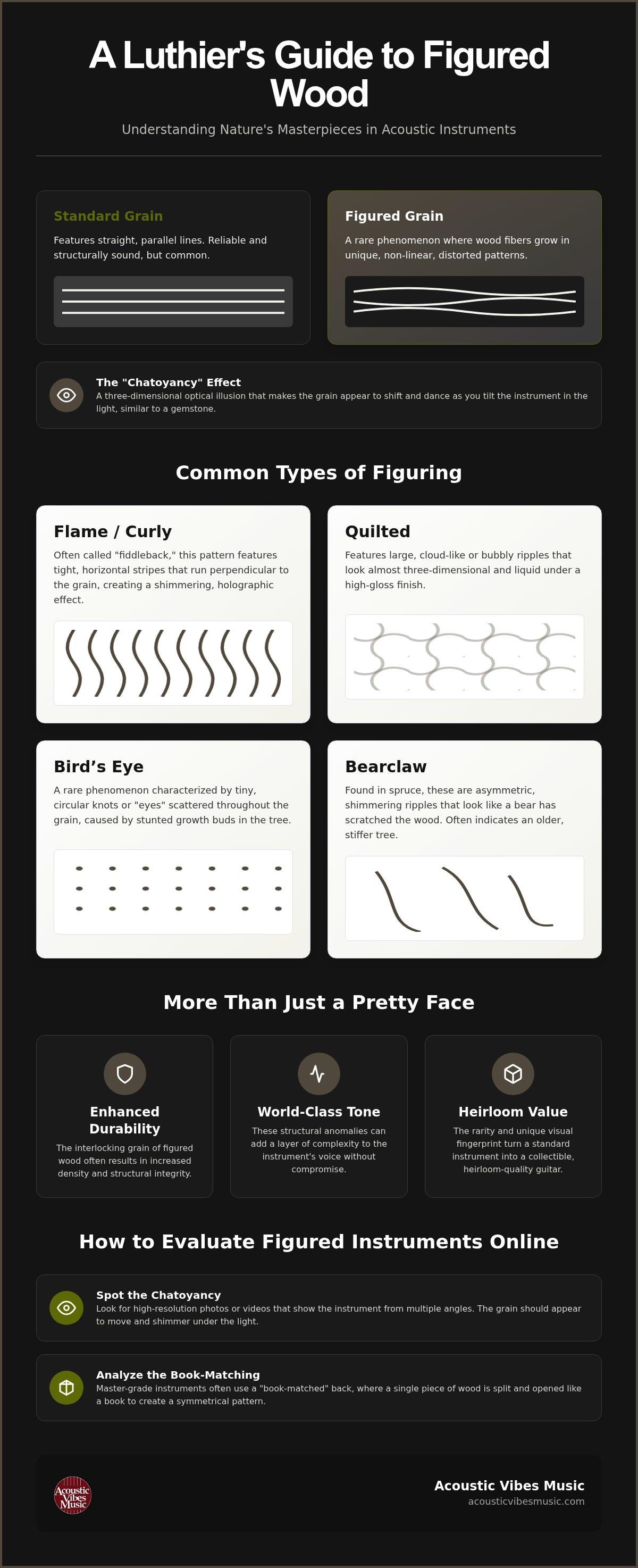
Buying a figured instrument online requires a keen eye and a bit of detective work. You aren't just looking at a flat image. You're trying to perceive three-dimensional depth through a digital screen. To ensure you're investing in a world-class piece, you need a reliable framework for evaluation. Start with the visuals. High-resolution, multi-angle photography is non-negotiable. You need to see the chatoyancy from different perspectives to understand how the wood will react to light in your own home. Look for shots that capture the "roll" of the grain. If the photos feel static, don't hesitate to request a video demo. Seeing the grain "dance" as the guitar moves is the only way to truly appreciate the life of the wood before it arrives at your door.
Grades are the industry's shorthand for visual intensity and rarity. While there isn't a single universal governing body, most premium builders follow a clear hierarchy that helps collectors understand what they are buying. "AAA" indicates high-quality figured patterns with strong, consistent ripples across the entire surface of the wood. This is the standard for many professional-grade instruments. "Master Grade" represents the absolute pinnacle, often the top 1% of all harvested timber. These sets are hand-selected for their flawless symmetry, overwhelming visual density, and a complete lack of "dead spots" where the pattern might fade. Grading is ultimately subjective. However, it accurately reflects the artisanal effort and the extreme rarity of the timber used in the build.
Look for perfect symmetry. This is the art of book-matching. A luthier takes a single thick block of wood, slices it down the middle, and opens it like a book. This creates a mirrored image across the center seam. It's a hallmark of high-end acoustic guitars. Pay close attention to the center seam on the back and the top. In a master-built instrument, the two halves should meet so seamlessly that the pattern flows uninterrupted from one side to the other. This level of precision shows a deep respect for the material and the craft. It's a sign that the builder has taken the time to align the grain perfectly. Ready to find your own masterpiece? Explore our gallery of hand-selected premium guitars to see these stunning wood grades in person.
Welcome to our curated gallery. We don't just stock instruments; we select masterpieces that celebrate the pinnacle of natural artistry. Our current collection features over 45 figured items, each hand-picked for its unique visual signature and world-class build quality. You'll find a diverse range that spans from traditional Flame Maple dreadnoughts to boutique Quilted Ukuleles. We've spent years fostering partnerships with legendary brands like Taylor Guitars and Collings Guitars to bring you the finest examples of modern craftsmanship. Explore the full visual gallery on our site and witness the shimmering ripples of these rare woods for yourself.
Take a moment to appreciate the detail in a Taylor 900 series or a Martin Custom Shop build. These instruments often feature "Highly Figured Koa" or master-grade maple that creates a liquid, three-dimensional effect under the light. We look for a specific visual character in every instrument we bring into the shop. It's about the way the grain flows and the intensity of the chatoyancy. Each piece is truly one-of-a-kind. We act as your expert guide, sorting through thousands of options to ensure the instrument you choose is a genuine heirloom that inspires you every time you open the case.
For those who wish to complement their collection of heirlooms with professionally presented fine art, you can learn more about bespoke framing services that highlight the same level of craftsmanship and detail.
Purchasing a high-value instrument online can be daunting. We've refined our national shipping process to ensure these fragile masterpieces arrive in perfect condition, no matter where you are in the country. Every instrument we sell undergoes a professional setup in our shop before it leaves. We want it to feel as good as it looks the moment you take it out of the case. We're passionate about these figured tonewoods and eager to share that knowledge with you. Reliability and respect for tradition are at the core of everything we do. Find your next inspiration in our curated selection.
You now understand that wood figuring is far more than a cosmetic upgrade; it's a structural and tonal signature that makes an instrument truly one-of-a-kind. From the shimmering chatoyancy of master-grade maple to the complex, reflective voice of highly figured Koa, these instruments represent the absolute pinnacle of acoustic craftsmanship. Choosing a master-built guitar is an investment in both your art and a legacy of natural wonder. These biological anomalies offer a unique fingerprint that enhances both collectible value and your pride of ownership.
At Acoustic Vibes Music, we act as your expert guide, maintaining a curated gallery of over 45 figured masterpieces from the world's most prestigious builders. We ensure every instrument is handled with the reverence it deserves. With our expert national shipping and a professional luthier setup included with every purchase, you can shop with total confidence from anywhere in the country. Your next great inspiration, a guitar that sounds as breathtaking as it looks, is just a discovery away. Explore the Figured Collection at Acoustic Vibes Music and find the instrument that speaks to your soul.
In the world of premium lutherie, figured describes a natural phenomenon where wood grain grows in non-linear, distorted patterns. Instead of standard straight lines, you see shimmering ripples, waves, or circular "eyes" that appear three-dimensional under a finish. It's essentially a beautiful biological accident caused by genetic traits or environmental stressors. This rare occurrence creates a unique visual fingerprint for every instrument, turning a standard piece of timber into a shimmering work of art.
Yes, instruments featuring rare grain patterns command a premium price due to extreme scarcity. Only a tiny percentage of harvested trees exhibit master-grade aesthetics, making the raw material difficult to source. Beyond the cost of the wood itself, these sets require specialized labor to harvest, dry, and match for a symmetrical look. You aren't just paying for the visual appeal; you're investing in a scarce natural resource that requires artisanal expertise to process correctly.
Flame maple is known for its transparent tonal profile, offering exceptional brightness and note separation. Unlike warmer woods like mahogany, maple reflects sound waves quickly, resulting in a fast response and a focused low end. This makes the instrument ideal for recording or performing in a mix where clarity is paramount. The increased density of the figured grain contributes to a crystalline high-end shimmer that many fingerstyle players and collectors find irresistible.
Bearclaw refers to asymmetric, shimmering ripples in a spruce top that look like a bear's claws have raked across the grain. This pattern usually occurs in older, slow-growth trees. Many luthiers prize bearclaw sets because the wood is often stiffer than straight-grained spruce, leading to better projection and a more robust voice. It provides a unique, rugged aesthetic that signals a high-performance instrument with significant tonal headroom and a very responsive feel.
Highly figured wood isn't inherently more prone to cracking if it has been properly kiln-dried and seasoned by a master builder. However, because the grain runs in multiple directions, it can be more sensitive to rapid humidity changes than straight-grained wood. Maintaining a consistent environment is vital. We recommend using a high-quality humidification system to prevent the wood from shrinking or expanding unevenly, which preserves the structural integrity and the finish for decades to come.
Grading is a visual assessment of the pattern's intensity, consistency, and rarity. AAA grade indicates high-quality figuring with strong ripples across the entire surface. Master Grade represents the absolute pinnacle, often the top 1% of all harvested timber, hand-selected for flawless symmetry and overwhelming visual density. While the industry doesn't have a single universal standard, these grades help collectors understand the rarity of the material used by elite brands like Collings or Taylor.
Absolutely. While guitars are the most common showcase for these materials, you'll find stunning visuals across our entire inventory. We carry mandolins, banjos, and ukuleles that feature the same master-grade maple, koa, and walnut. These instruments benefit from the same visual depth and tonal clarity as their larger counterparts. Whether you're a mandolinist or a ukulele enthusiast, choosing a figured model ensures your instrument is a unique piece of artisanal craftsmanship that stands out in any collection.
Proper care starts with strict humidity control, ideally between 45% and 55%. Use a soft, non-abrasive microfiber cloth to wipe down the finish after playing to prevent oil buildup. Avoid exposing the instrument to direct sunlight or extreme temperature swings, as the irregular grain can react more quickly to environmental stress. Schedule regular check-ups with a professional luthier. Our repair services are available by appointment to ensure your heirloom instrument remains in peak playing condition for years.