My shopping cart
Your cart is currently empty.
Continue ShoppingWhy do so many players view 12 string guitars as beautiful but ultimately unplayable museum pieces? It is a fair question. You likely crave that lush, choral shimmer that only a double-course instrument can provide, yet you are probably worried about the high string tension and the physical effort required to navigate a wider neck. You want the majestic sound of a full acoustic orchestra, but you do not want to fight the instrument every time you transition from your favorite 6-string. Many guitarists also worry that the immense pressure of twelve steel strings will lead to neck stability issues or a muddy, indistinct tone over time.
We believe that a truly premium instrument should feel as good as it sounds. You can find a 12-string that balances shimmering tonal complexity with the effortless playability required for modern performance. This guide will help you discover how to select an heirloom-quality guitar that defies the old stereotypes of high tension and difficult action. We will break down which body shapes support the added stress best, explore neck profiles designed for maximum comfort, and highlight the technical innovations from elite builders like Taylor and Martin that ensure long-term stability. From understanding bracing patterns to choosing the right tonewoods, you are about to find your perfect orchestral voice.
The sound of 12 string guitars is an invitation to explore a more expansive sonic landscape. It is a lush, swirling texture that fills a room with a presence no 6-string can match. We often describe it as the "orchestra of the acoustic world" because a single performer can generate a wall of sound that usually requires a small ensemble. While vintage models were frequently associated with a thin, folk-era jangle, today's high-end instruments prioritize a sophisticated clarity. The 12-string chorus effect is the result of slight pitch variations between paired strings. This subtle dissonance creates a natural modulation that feels alive, breathing with every chord you strike.
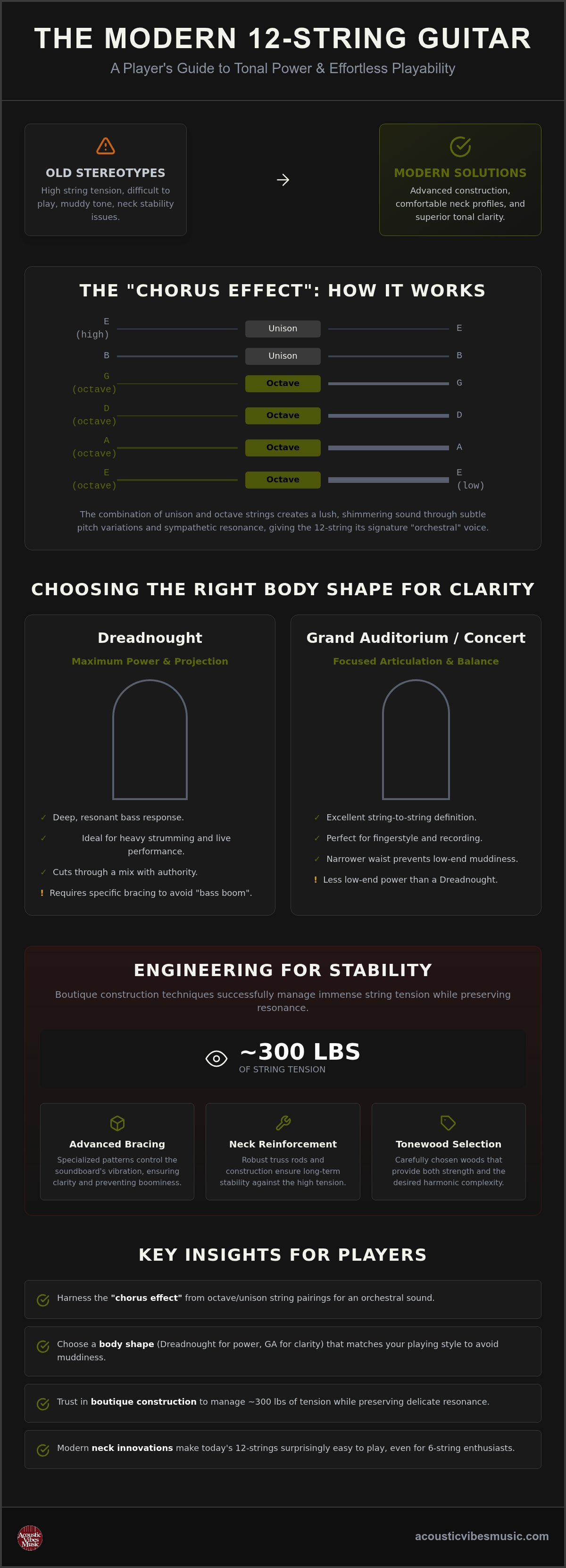
The magic lives in how the strings are paired across the fretboard. On a standard Twelve-string guitar, the high E and B strings are doubled in unison, meaning they're tuned to the exact same pitch. In contrast, the G, D, A, and low E strings are paired with an octave string. This configuration creates a massive frequency range within a single pluck. Premium builders like Taylor Guitars and Martin focus heavily on sympathetic resonance. This occurs when the vibration of one string triggers a harmonic response in its neighbor. In an heirloom-quality build, this resonance is meticulously controlled. It produces a shimmering harmonic balance instead of a chaotic wash of noise, allowing your individual notes to ring true even in dense chords.
Deciding when to reach for those extra six strings depends on the emotional weight your music requires. If you're performing solo fingerstyle or leading a folk-rock arrangement, the 12-string adds a layer of natural depth that anchors the performance. It fills the sonic space beautifully. Expect a brief transition period for your fretting hand. You'll need to adapt to the slightly wider neck and the physical pressure required to cleanly fret two strings simultaneously. In a recording environment, these guitars are essential tools. They provide a "doubled" track sound with perfect phase alignment. We often recommend Boucher Guitars for studio work. Their master-grade tops provide the crystalline highs and punchy mids needed to cut through a complex mix without losing that signature 12-string warmth.
Finding the right body shape is about controlling chaos. When you double the strings, you double the energy moving the soundboard. This often leads to the "muddiness" where the high-end shimmer gets lost in a swamp of low-end frequencies. 12 string guitars require a body shape that balances this massive input with surgical precision. The internal air volume of the guitar acts as an acoustic filter. If the body is too large without proper bracing, the notes blur together. If it's too small, you lose the majestic depth that makes a 12-string so alluring.
Your playing style should dictate your choice. Heavy strummers need the headroom of a larger body, while fingerstyle players benefit from the immediate response of a more compact design. For a deeper dive into how these shapes perform under heavy play, check out our Dreadnought vs Grand Auditorium for Strumming guide. Matching the silhouette to your technique is the first step toward finding your perfect orchestral voice.
The Dreadnought remains the heavyweight champion of projection. Models like the Martin D12-28 are industry standards because they offer a deep, resonant chest that supports the added tension. The challenge here is managing the "bass boom." High-end builders use specific bracing patterns to ensure the low-end frequencies don't swallow the delicate octave strings. It's the ideal choice for live performance or bluegrass where you need to cut through a mix with authority. These guitars provide a foundation of sound that feels like a full band in a single box.
If you value string-to-string definition, look toward a Grand Auditorium or Concert shape. Models like the Taylor 854ce offer a narrower waist that compresses the air inside the body. This creates a faster, more focused response. These shapes are often preferred by fingerstyle players who need each octave pair to ring out with individual clarity. There's also a significant ergonomic advantage. A narrower body makes the high-tension experience of 12 string guitars feel much more manageable during long sessions. It brings the instrument closer to your body, giving you better control over your fretting hand.
Explore our curated collection of 12-strings to find a shape that fits your posture and your playstyle perfectly.
A standard acoustic guitar lives under significant pressure, but 12 string guitars operate on an entirely different scale. When tuned to concert pitch, these instruments must withstand approximately 250 to 300 pounds of constant string tension. This is a massive structural challenge. This immense force acts like a slow-motion tug-of-war on the bridge and the soundboard. If a builder over-builds the top to resist this pull, the guitar sounds choked and dull. If they under-build it, the top will belly or the bridge will lift within years. Elite builders solve this by selecting premium tonewoods like Adirondack Spruce, which offers superior stiffness compared to Sitka. This extra headroom ensures the top stays flat while allowing the complex harmonics to bloom.
Choosing the right combination of materials is essential for long-term satisfaction. For a deep dive into the foundational characteristics of these woods, explore our Rosewood vs. Mahogany Tonewood Guide. Each selection changes how that massive tension translates into sound. Trust the engineering behind the artistry.
The internal bracing is the skeleton of the guitar. On high-end 12-strings, builders often modify traditional X-bracing to handle the extra load. Scalloped bracing involves shaving away wood to increase flexibility and bass response. While this creates an immediate, "broken-in" sound, it requires expert execution to maintain structural integrity under high tension. Many custom shop models use non-scalloped or "tapered" braces for 12-string builds. This provides the structural longevity needed to prevent warping over decades while still allowing for the shimmering resonance players expect from a boutique instrument.
The choice of back and side wood acts as the final EQ for your instrument. Rosewood is the traditional favorite for 12-string enthusiasts. It adds lush, metallic overtones that complement the natural chorus effect of the paired strings. If you find Rosewood too busy, Mahogany is the perfect alternative. It provides a focused, fundamental punch that helps the guitar cut through a mix with better note separation. For performers who need maximum stage presence, Maple is a secret weapon. It is incredibly bright and quick, preventing the low-end muddiness that can sometimes plague larger 12-string bodies. Explore these textures in our collection to find your signature sound.
The idea that 12 string guitars are inherently difficult to play is a lingering myth from an era of overbuilt, thick-necked instruments. Modern engineering has transformed the experience. Today's premium builders focus on ergonomic profiles that allow for hours of comfortable performance without hand fatigue. We see this most clearly in the innovative designs from Taylor Guitars and Martin. Taylor's NT neck design provides a stable, perfectly angled platform that remains adjustable over time. Martin's High Performance Taper offers a slimmer feel that transitions smoothly as you move up the fretboard. These aren't just guitars; they're precision tools designed for the modern player's touch. You'll find that the bulk of the past has been replaced by sleek, intuitive geometry.
The physical dimensions of the neck dictate your speed and accuracy. A traditional 1 7/8" nut width provides ample room for clean fretting, ensuring you don't accidentally mute adjacent strings during complex chord changes. However, many players now prefer a slightly narrower 1 3/4" nut for a feel that mimics their favorite 6-string. The fingerboard radius also plays a vital role in your comfort. A compound radius, which flattens out as you move toward the body, makes barre chords easier at the lower frets and soloing more fluid at the higher ones. It's often the spacing between the string pairs, rather than the total width, that defines how an instrument feels in your hand. Getting this spacing right is what separates a factory-standard model from a boutique masterpiece.
Because they carry so much tension, 12 string guitars are particularly sensitive to shifts in humidity and temperature. Even a minor change can cause the action to drift, making the instrument feel sluggish. This is why a professional luthier setup is non-negotiable for a premium instrument. Our experts focus on the fine details, especially the nut slots. If these aren't cut to the perfect depth, the guitar will feel stiff and go out of tune when you fret near the headstock. A professional setup can reduce the "action" to feel nearly as light as a 6-string. We take pride in ensuring every instrument in our gallery is ready for the stage the moment it leaves our hands. This specialized attention ensures your investment remains a joy to play for decades.
Browse our expertly set up 12-string collection to find an instrument that plays as beautifully as it sounds.
Choosing between the industry's titans and boutique builders is about finding the "house sound" that resonates with your musical identity. Every builder approaches the structural demands of 12 string guitars with a different philosophy. While some focus on the thumping bass of a heritage dreadnought, others prioritize the crystalline shimmer of modern engineering. Our collection is hand-selected to represent the pinnacle of these diverse tonal signatures. We act as your expert guide through this curated gallery of world-class instruments.
Martin is the definitive choice for those seeking a deep, resonant voice rooted in American music history. The classic Martin build emphasizes a rich low-end and a warm, woody midrange that feels incredibly substantial. The D12-28 remains a staple for heavy strummers because its large body can handle aggressive play without losing its composure. It offers a massive, authoritative sound that has defined folk and rock records for generations. If you value tradition and a "deep-chested" response, explore the full range of these iconic instruments in our Martin Guitars collection.
Taylor has redefined the modern 12-string experience through relentless technical innovation. Their V-Class bracing is a game-changer, specifically for intonation. By controlling how the top vibrates, Taylor ensures that the octave and unison pairs stay perfectly in tune with each other all the way up the neck. Models like the 352ce or the 852ce are exceptionally popular because they offer a bright, articulate chime with a neck profile that feels natural to any 6-string player. Discover the precision of the Taylor Guitars collection for a playing experience that is as effortless as it is inspiring.
For the player who demands maximum headroom and artisanal detail, boutique builders like Boucher and Atkin offer a specialized alternative. Boucher is particularly renowned for using master-grade Adirondack Spruce tops. This provides a level of power and clarity that Sitka simply cannot match. These instruments respond with incredible speed and sustain, making them a favorite for studio professionals who need their 12 string guitars to cut through a complex mix. The craftsmanship is palpable in every note. Visit our Boucher Guitars collection to experience this level of artistry firsthand.
Explore our full 12-string collection and find your voice today.
Selecting the perfect instrument is a journey of balancing structural integrity with tonal brilliance. You now understand how body shapes like the Grand Auditorium provide focused articulation, while master-grade Adirondack tops on boutique builds offer the headroom needed for 300 pounds of tension. Most importantly, you know that 12 string guitars don't have to be a physical struggle. With modern neck profiles and expert engineering, that lush, choral shimmer is more accessible than ever. It's time to bring your musical vision to life with an instrument that responds to your every nuance.
We invite you to explore our gallery of hand-selected instruments. As an authorized dealer for world-class brands like Martin, Taylor, and Collings, we ensure every guitar meets the highest standards of craftsmanship. Our professional in-house luthier performs a meticulous setup on every instrument to guarantee effortless playability right out of the case. With nationwide shipping and expert packing, your next heirloom is just a click away. Shop Our Curated Collection of Premium 12-String Guitars and discover the voice you've been searching for. Your audience is waiting for that shimmer.
It requires more physical effort but isn't "harder" in a technical sense. The increased string tension and wider nut width demand more finger strength and precision. However, a professional luthier setup can lower the action significantly. This makes 12 string guitars feel remarkably close to their 6-string counterparts. Most players find they adapt within a few weeks of consistent practice as their calluses and hand strength develop to meet the challenge.
You can, but we don't recommend it for long-term use. These instruments are engineered to stay stable under approximately 250 to 300 pounds of tension. Removing half the strings drastically reduces this pull, which may cause the neck to bow backward. Additionally, the nut slots and bridge pin holes are specifically spaced for pairs. Playing a 12-string as a 6-string often results in poor intonation and an unsatisfying, thin tonal response.
We recommend changing them every three to four months for casual players. If you play daily or have acidic sweat, you might need a fresh set every four to six weeks. Because 12 string guitars take twice as long to restring, many players wait until the tone becomes noticeably dull or "thuddy." Using coated strings can extend the life of your set, preserving that signature orchestral shimmer for a much longer duration.
Tuning down a half-step to Eb Standard or a full step to D Standard is a classic technique. This significantly reduces the load on the bridge and neck, which is especially helpful for vintage instruments or those with lighter bracing. You can use a capo on the first or second fret to return to standard pitch. This setup often results in a deeper, growling low-end that many solo performers find incredibly inspiring.
They are under more stress, but modern construction has largely solved these issues. High-end builders like Taylor and Martin use reinforced neck joints and specific bracing to handle the extra pull. Problems usually arise from poor humidity control rather than the strings themselves. Keeping your instrument in a stable environment between 40% and 50% humidity is the best way to ensure your neck stays straight and your bridge remains secure.
The "best" shape depends on your sonic goals. Dreadnoughts provide the traditional, booming projection required for heavy strumming and live vocal accompaniment. If you prefer fingerstyle or need more note separation, a Grand Auditorium or Concert shape is superior. These smaller bodies compress the air more efficiently, which prevents the octave strings from becoming muddy. Choosing the right silhouette ensures your instrument's voice remains articulate and balanced across every frequency.
Precision is key, so always use a high-quality chromatic tuner. Start with the standard strings (E, A, D, G, B, E) and then tune their octave or unison partners. Always tune "up" to the note to prevent the string from slipping in the nut slot. Because the added tension can cause the neck to move slightly as you go, you will likely need to make two or three passes before the entire instrument is perfectly stable.
They are generally better as a second instrument rather than a first. The physical demands of fretting two strings at once can be discouraging for someone who hasn't yet developed basic finger strength and calluses. However, for a beginner who is already comfortable with 6-string basics, a 12-string is a fantastic way to explore new textures. It encourages clean fretting technique and offers an immediate, rewarding wall of sound that keeps players motivated.