My shopping cart
Your cart is currently empty.
Continue ShoppingThe most powerful tone in your collection might actually be the smallest instrument on the wall. For decades, players assumed that massive volume required a massive dreadnought; however, 0 size guitars prove that focused projection and crystalline clarity are often found in more compact dimensions. If you've ever struggled with shoulder fatigue after a long session or felt that your larger acoustic sounded muddy in a recording mix, you aren't alone. Many enthusiasts are rediscovering the Single-O not as a travel companion, but as a primary tool for professional expression.
We understand the frustration of picking up a small-bodied guitar only to find it sounds thin or boxy. You deserve an instrument that offers physical relief without sacrificing the rich, tactile vibration of a premium build. In this guide, you'll discover why the 0 size is the ultimate choice for intimacy and professional recording. We'll explore how to choose a model that holds its value, which tonewoods maximize resonance in a smaller frame, and how to distinguish these gems from parlors or 00 models. Let's find the perfect heirloom-quality instrument for your specific playing style.
The 0 size guitar occupies a unique space in acoustic history. It is often called the "Golden Mean." It isn't a miniature toy; it is a sophisticated, focused instrument with a balanced voice. While larger guitars prioritize raw power, the Single-O focuses on the purity of the note. It’s a specialized tool for those who value clarity over sheer volume. Size doesn't dictate quality.
C. F. Martin & Company standardized this body shape in the mid-19th century. Originally, these instruments were designed for gut strings and intimate settings. As musicians began to demand more projection for public performance, the design evolved to accommodate steel strings. Today, the Single-O remains the smallest of the standard concert-sized guitars. This body style represents a pivotal moment in lutherie where portability met professional-grade resonance.
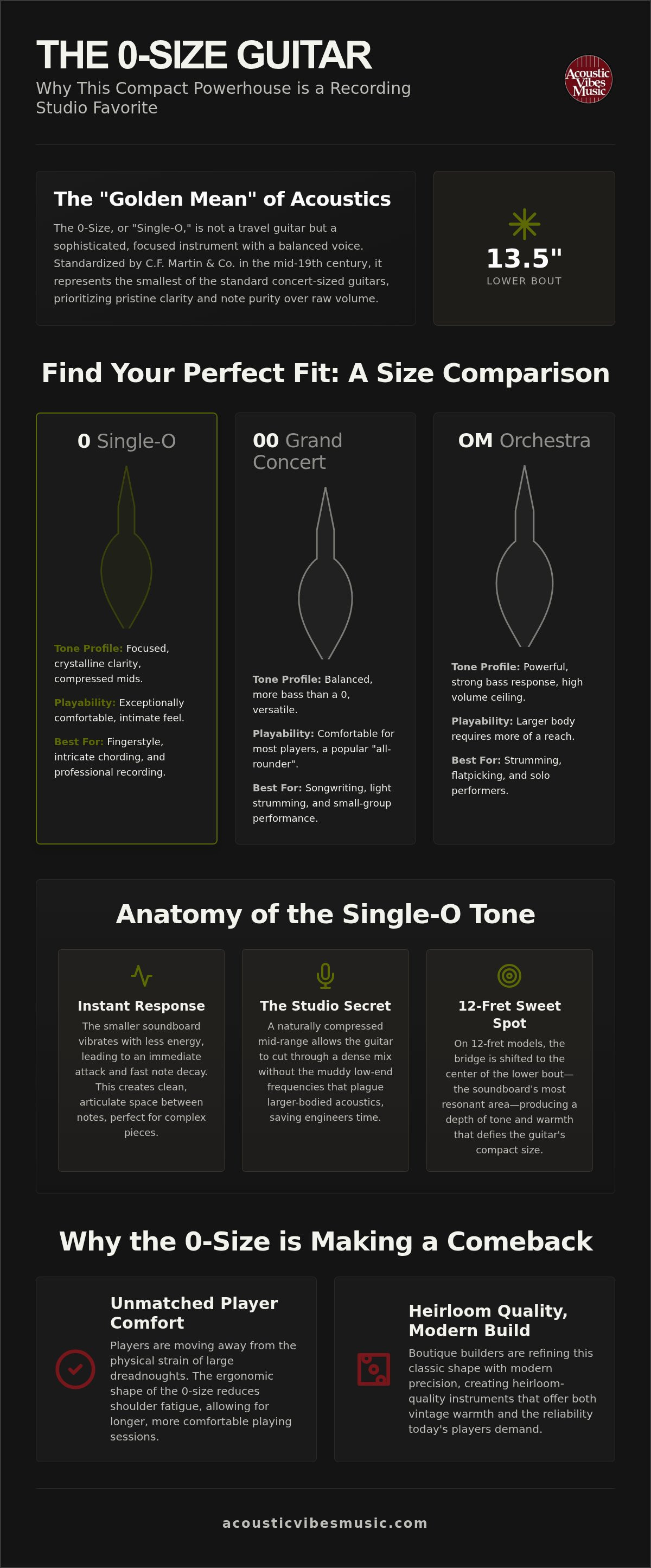
Dimensions are the key to its identity. With a lower bout measuring approximately 13.5 inches, it sits comfortably between the diminutive Parlor and the slightly larger 00. This specific footprint provides enough surface area for a resonant top while remaining exceptionally ergonomic. It fits the body naturally. You don't have to reach over a massive lower bout to find your rhythm.
While many people use the terms interchangeably, 0 size guitars offer a distinct advantage in internal air volume. A traditional Parlor often feels tight or "boxy" because of its narrow waist and small body. The Single-O provides more "air" around the notes, allowing for a more complex harmonic profile. You'll find these in both 12-fret and 14-fret configurations. The 12-fret versions often lean into that vintage, woody warmth, whereas 14-fret models like those from Martin Guitars offer the accessibility modern players expect. The 0 size serves as the bridge between Victorian-era intimacy and modern projection.
Comfort is the primary driver behind the current demand for smaller bodies. Many players are moving away from the physical strain of oversized instruments. In the national guitar community, the 0 size has become a "recording secret" for engineers. Its naturally compressed low end means you don't have to fight "muddy" frequencies in a mix. Boutique builders like Collings Guitars and Atkin are refining this shape for high-end collectors. They want heirloom quality in a package that's easy to play for hours. It's a return to form for the discerning enthusiast.
Don't let the compact frame fool you. 0 size guitars are tonal heavyweights in disguise. While a massive dreadnought moves air with brute force, the Single-O moves air with surgical precision. The smaller soundboard requires significantly less energy to vibrate, leading to an immediate response that larger bodies simply cannot match. Notes decay faster, leaving a clean, articulate space for the next strike. This makes them the ultimate tool for intricate fingerstyle or complex chord voicings where every note must stand alone. You get clarity, not just volume.
The standout feature of this body shape is a naturally compressed mid-range. In a professional recording environment, this frequency profile is pure gold. It allows the guitar to cut through a dense mix without the overwhelming low-end "woof" that often plagues larger acoustic guitar shapes and sizes. You receive a focused, punchy fundamental that highlights the nuance of your pick attack. It’s a common misconception that small bodies lack volume; in reality, they simply project their energy in a more efficient, directional way.
For players seeking maximum "sweetness," the 12-fret configuration is a revelation. By joining the neck at the 12th fret rather than the 14th, the bridge is shifted further down into the center of the lower bout. This placement sits right in the "sweet spot" of the soundboard's vibrating area. The result is a depth of tone and a rounded bass response that defies the instrument's physical footprint. If you are ready to hear this clarity for yourself, take a moment to browse our curated selection of premium acoustics.
Choosing the right top is critical for maximizing small-body resonance. Adirondack Spruce offers massive headroom and a bold, aggressive bark that rewards a heavy hand. Sitka Spruce provides a warmer, more versatile feel for players who prefer a lighter touch. When selecting back and sides, consider your desired EQ. Mahogany offers a dry, woody "thump" with great fundamental clarity. Rosewood, on the other hand, brings a lush, piano-like sparkle with complex overtones. For a deeper dive into these materials, explore our guide on Rosewood vs. Mahogany Back and Sides.
Scalloped bracing is the secret to making a small top move significant air. By strategically removing mass from the braces, builders allow the soundboard to flex more freely, which increases both volume and bass response in 0 size guitars. Scale length also plays a vital role in the physical experience. The 24.9-inch scale length contributes to the 'buttery' feel of many 0 models by reducing string tension. This shorter reach makes complex stretches easier and adds a rounder, warmer quality to the treble strings that's incredibly pleasing to the ear.
Understanding the acoustic hierarchy is essential for any collector looking to round out their sonic palette. While the Orchestra Model (OM) is often celebrated for its versatile balance and "do-it-all" reputation, the Single-O offers a level of intimacy that larger bodies simply cannot replicate. It is the specialist of the bunch. The 0 size represents the most compact footprint of the traditional concert shapes, providing a focused, punchy response that favors the nuance of the individual player. It doesn't try to fill a stadium; it tries to fill the room with character.
Physical ergonomics are where 0 size guitars truly shine as the gold standard. For many enthusiasts, the massive lower bout of a dreadnought causes significant shoulder strain during long seated sessions. The 0 size solves this. Its narrow waist and 13.5-inch lower bout allow the instrument to sit lower on your leg, bringing your picking arm into a more natural, relaxed position. You're no longer fighting the geometry of the wood. This physical ease translates directly into better technique and longer, more inspired playing sessions.
The choice between a 0 and a 00 often comes down to a mere half-inch of width. A 00 typically measures around 14.1 inches at the lower bout, offering a slight increase in bass response and overall headroom. However, many players find that the 0 remains the ultimate "couch guitar." It’s the instrument you reach for late at night because it feels like an extension of your own body. If you want to see how these compact shapes compare to the industry giants, check out our guide on Dreadnought vs. Grand Auditorium models to see the other end of the size spectrum.
Fingerstyle players often find their "forever" instrument in the Single-O. The tight soundboard provides exceptional string separation, ensuring that complex bass lines don't bleed into your melody notes. Every fingerpick is met with an immediate, crystalline chime. For light strumming, a 0 size mahogany guitar offers a percussive, rhythmic "thump" that sits perfectly under a vocal track without competing for space. In the studio, this size is a dream. It avoids the overwhelming low-end "boom" that often requires heavy EQ on larger instruments, giving you a track-ready sound the moment you place the microphone.
Finding the right instrument requires more than a casual glance at a spec sheet. You need to feel the vibration. In our curated gallery, we prioritize "Expert-Level" 0 size guitars that offer a unique tactile experience. These aren't just smaller versions of standard models; they are artisanal creations designed for specific tonal outcomes. From the historic foundations of the Single-O to the modern refinements of boutique luthiers, the options for 2026 are more exciting than ever. Every instrument we select must meet a rigorous standard of craftsmanship and sonic personality.
The 0 size guitar represents a specialized branch of lutherie where precision is paramount. Because there is less surface area on the soundboard, every bracing carve and material choice is magnified. We look for builders who treat these compact bodies with the same reverence as a concert grand. Whether you are a seasoned collector or a recording professional, these highlights represent the best of the current market. Heritage meets innovation in every one of these hand-selected pieces.
Martin Guitars created the blueprint for this shape, and their current offerings remain the gold standard. The 0-18, with its spruce and mahogany pairing, offers a dry, woody fundamental that songwriters adore. It cuts through a vocal track with ease. If you seek more harmonic complexity, the rosewood-backed 0-28 provides a lush, piano-like sparkle and deeper overtones. For national collectors, the Modern Deluxe and Custom Shop iterations represent the pinnacle of this lineage. They combine vintage aesthetics with modern playability. If you want the raw, unfiltered spirit of the pre-war era, the 12-fret "Authentic" series delivers that legendary resonance with stunning accuracy.
Beyond the traditional, boutique builders are pushing the boundaries of what 0 size guitars can achieve. Atkin Guitars, based in the UK, has mastered the "aged" feel. Their "baked" torrefied tops provide an instant vintage mojo that usually takes decades to develop. It's a warm, played-in sound right out of the case. On the other end of the spectrum, Collings Guitars 01 and 02 models offer a level of precision that is nearly unmatched. You get the signature "Collings shimmer"—a crystalline high-end clarity that makes every note pop. These are precision tools for the discerning musician. If you are ready to elevate your collection, browse our full selection of premium 0 size guitars today.
Investing in 0 size guitars is an act of stewardship. These aren't just tools; they're heirloom-quality pieces of art that require intentional care to maintain their unique voice. Because the soundboard of a Single-O is smaller and thinner than a dreadnought, it reacts more sensitively to environmental shifts. Maintaining a stable environment is the most critical step you can take. We recommend keeping your guitar in a room with a consistent humidity level between 45% and 55% to prevent top cracks or fret sprout. This simple habit preserves the structural integrity and the resonant sparkle you fell in love with. For more advice on protecting your investment, explore our collection of high-end acoustic guitars.
Professional maintenance ensures your instrument evolves with you. A boutique guitar should visit a luthier at least once a year for a checkup. Our in-house luthier services provide the specialized care these delicate instruments require. This annual visit ensures the bridge remains secure and the neck relief stays optimal. Small adjustments to the truss rod or saddle can make a world of difference in how an instrument responds to your unique touch. You'll feel the difference in your fingertips. It's about keeping the instrument in peak performing condition for decades to come.
Every instrument that leaves our gallery undergoes a professional luthier setup. We tailor the nut width and string spacing to suit your specific playing style. If you're a dedicated fingerstyle player, we might suggest a slightly wider spacing to allow your fingers more room to dance between the strings. Conversely, flatpickers often prefer a tighter action for faster rhythmic work. We generally recommend light-gauge strings for 0 size guitars. Heavier strings can choke the vibration of a smaller top, whereas light strings allow the soundboard to move freely and produce that signature chime. This balance is key to unlocking the instrument's full potential.
Sending a delicate, high-end instrument across the country requires more than just a box and some tape. Our "Passionate Curator" approach involves custom-packing every guitar to withstand the rigors of national transit. We use specialized materials and techniques to float the case within the shipping container, ensuring the headstock and body are protected from impact. We monitor weather patterns along the shipping route to ensure your new arrival isn't exposed to extreme temperatures. When your guitar finally arrives, patience is your best friend. Allow the box to sit unopened in your home for at least 24 hours. This permits the instrument to acclimate to your local climate slowly, preventing finish checking or structural stress. Once that time has passed, you're ready to experience the magic of a hand-selected acoustic. Explore our full selection and find your heirloom instrument today.
The 0 size guitar is far more than a compact alternative to larger bodies. It's a specialized instrument that offers a level of clarity and intimacy that defines professional expression. By choosing a Single-O, you're prioritizing the purity of each note and the physical ease of a perfectly ergonomic design. Whether you're drawn to the pre-war spirit of a Martin or the modern precision of a Collings, these instruments are built to be lifelong companions. You don't have to fight your guitar to find a great tone.
We take our role as your expert guide seriously. As an authorized Martin Custom Shop Expert dealer, we hand-select every piece in our gallery to ensure it meets our standards for rarity and superior construction. Every purchase includes a professional in-house luthier setup tailored to your touch, and our national shipping experts ensure your new heirloom arrives safely. It's time to experience the focused punch and crystalline chime that only 0 size guitars can provide. Your next great musical discovery is waiting to be played.
Shop Our Hand-Selected 0 Size Guitar Collection
Not at all; in fact, the 0 size is often the most comfortable starting point for a new player. Its compact dimensions prevent the shoulder strain common with larger bodies, allowing you to focus entirely on your technique. While some assume a massive dreadnought is required for a "real" sound, the ergonomic ease of a Single-O makes those first few months of practice much more enjoyable. It fits the body naturally, making it easier to maintain proper posture.
The primary difference lies in the lower bout width, where the 00 is roughly a half-inch wider than the standard 0 model. This slight increase in surface area gives the 00 a bit more bass response and overall headroom. However, 0 size guitars remain the gold standard for pure intimacy and focused note separation. Choosing between them usually comes down to whether you prioritize portable comfort or a slightly deeper low end for your playing style.
These instruments excel at light to medium strumming, particularly in a recording context. They provide a percussive, rhythmic "thump" that doesn't compete with a vocal track or other instruments in a mix. If you have a heavy hand and need massive volume for a loud bluegrass jam, a larger body might be better. For solo performers and songwriters, the Single-O offers plenty of projection without the low-end muddiness that often plagues larger acoustics.
Premium pricing reflects the artisanal skill and rare materials required to make a small body sound massive. In a boutique build, every shaving of the bracing and every millimeter of top thickness is hand-tuned to maximize resonance. You aren't just paying for wood; you're investing in the expertise of builders who know how to coax a complex, piano-like voice out of a compact frame. These instruments are designed to be heirloom-quality tools that hold their value over time.
Most modern 0 models are designed specifically for light-gauge strings to ensure the soundboard can vibrate freely. Using medium strings can place excessive tension on the bridge and bracing, potentially leading to structural damage over time. Always check the manufacturer’s specifications before changing gauges. Light strings actually help maintain the "buttery" playability and crystalline chime that define the Single-O experience without putting the instrument at risk.
Adirondack Spruce paired with Mahogany is a legendary combination for those seeking a dry, woody fundamental with plenty of punch. If you prefer a lush, complex sound with shimmering overtones, look for a Rosewood back and sides. The "best" choice depends on your ears, but we find that Mahogany often highlights the naturally focused mid-range of 0 size guitars most effectively. It creates a balanced, honest tone that records beautifully.
Neither is objectively better, but they offer distinct musical personalities. A 12-fret design shifts the bridge into the center of the lower bout, creating a warmer, rounder tone with surprising depth and "sweetness." The 14-fret version provides easier access to the upper register and feels more familiar to modern players. Your choice should depend on whether you value vintage-inspired resonance or contemporary versatility for your specific repertoire.
Successful national shipping requires a professional "double-box" method and climate-controlled transit. We ensure the instrument is immobilized within its case and the headstock is properly supported to prevent whiplash during handling. It’s vital to use a carrier experienced with high-value musical instruments. Once it arrives, let the package acclimate to your home’s temperature for at least 24 hours before opening to avoid finish checking or wood shock caused by sudden climate changes.