My shopping cart
Your cart is currently empty.
Continue ShoppingThe most iconic acoustic sound of the next decade isn't found in a vintage vault; it lives within the relentless innovation of a modern workshop. You already know that Taylor Guitars have redefined what it means to play a premium instrument with their signature clarity and effortless necks. However, choosing between a 314ce and a Builder's Edition 814ce often feels like solving a complex puzzle of numbers and specs. It's natural to worry that a specific bracing pattern or exotic top wood might not suit your fingerstyle technique or vocal range.
We're here to turn that uncertainty into total confidence. This guide masters the nuances of the 2026 lineup, from the revolutionary physics of V-Class bracing to the professional response of ES2 electronics. You'll learn how to navigate the 100 through 900 series hierarchy with the eye of a seasoned collector. We'll examine specific tonewood pairings and body shapes to ensure your next high-end investment perfectly captures your unique musical identity.
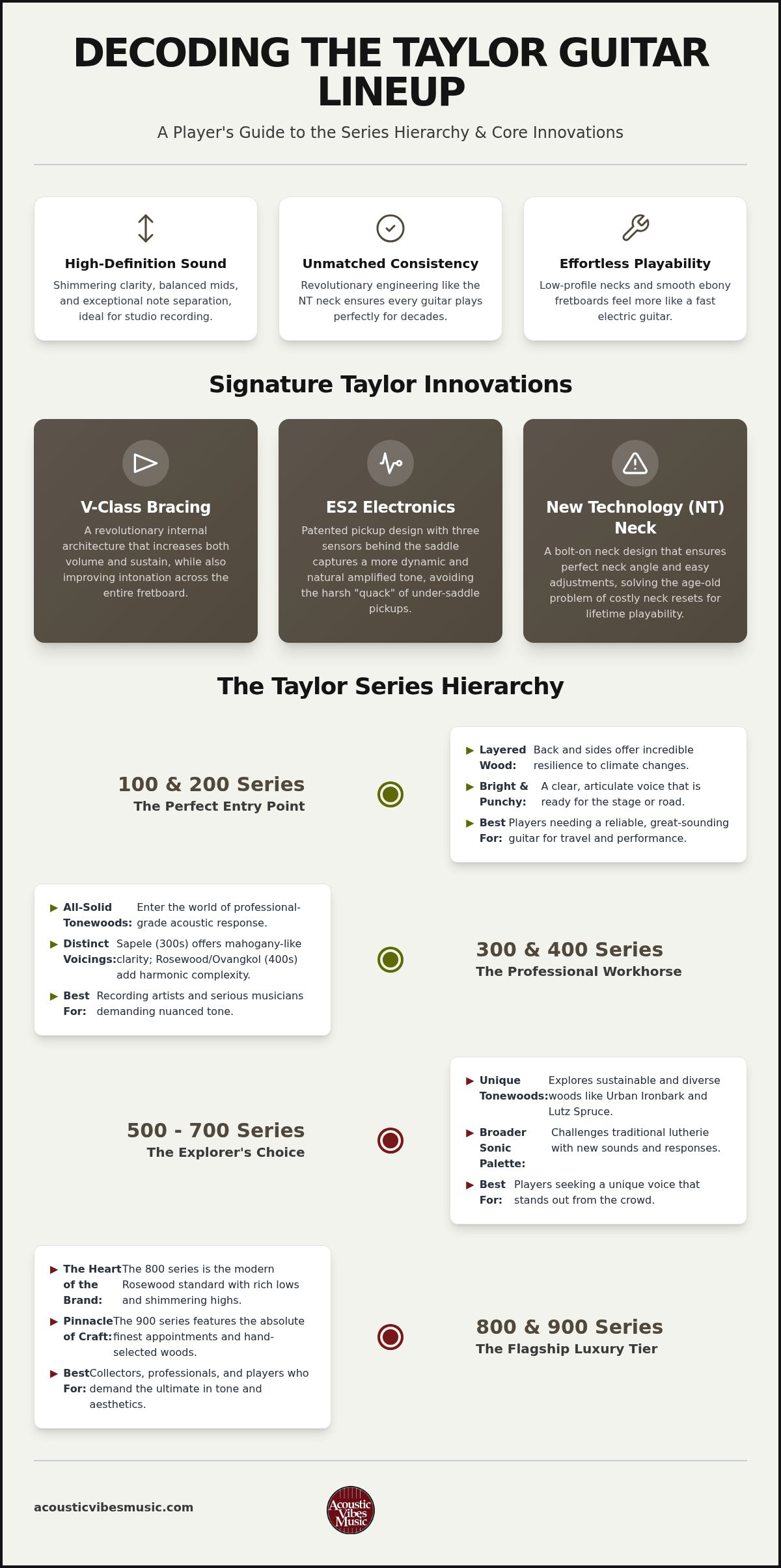
The Taylor sound is a masterclass in high-definition acoustics. While some brands lean on the dusty echoes of the past, Taylor looks forward. Every note rings with a shimmering clarity that traditional dreadnoughts often lack. This voice is characterized by balanced mids and exceptional note separation, making it the preferred choice for studio recording where every frequency must find its place. It's a modern standard that prioritizes precision over raw, unrefined power.
Consistency is the hallmark of the brand's production. Bob Taylor revolutionized the industry by introducing the NT neck design, a feat of engineering that solved the age-old problem of neck resets. Unlike traditional dovetail joints, this bolt-on architecture ensures your instrument remains perfectly playable for decades. You can explore the Taylor Guitars history to see how this engineering mindset shifted the industry toward a more reliable, player-centric manufacturing process. It's an approach that treats the guitar as a high-performance tool rather than a fragile relic.
As passionate curators, we believe every serious collection needs at least one Taylor voice. It provides a sonic contrast that sits perfectly in a mix, offering a crispness that complements darker, vintage-style instruments. Our curated selection of Taylor Guitars represents the pinnacle of this modern excellence, hand-selected to ensure every player finds their ideal match.
Taylor is famous for the "easy-to-play" neck. Their low-profile shapes feel more like a comfortable electric guitar than a bulky acoustic. This is achieved through consistent action and meticulous fretwork. On models like the Grand Concert, a shorter 24-7/8-inch scale reduces string tension, making complex chords feel effortless. Every fretboard features genuine West African ebony, providing a smooth, fast surface that invites your fingers to move without resistance. It's tactile luxury designed for hours of fatigue-free performance.
Innovation isn't just a buzzword here; it's the brand's DNA. Under the leadership of Master Guitar Designer Andy Powers, the company has pushed boundaries with V-Class bracing and sustainable sourcing. The Ebony Project in Cameroon stands as a testament to their commitment to the environment, ensuring the future of high-quality tonewoods. For the performing musician, the Expression System 2 (ES2) remains the gold standard. By placing sensors behind the saddle rather than under it, Taylor captures a natural, dynamic plugged-in tone that avoids the thin, "quacky" sound of traditional pickups.
Understanding the hierarchy of Taylor Guitars is like having a map to your own musical evolution. The numbering system isn't just a catalog tool; it's a logical guide to how the instrument responds to your touch. The 100 and 200 series serve as the perfect entry point, utilizing layered back and sides that offer incredible resilience to climate changes. These are punchy, bright, and ready for the road. They're built for the player who needs a reliable voice without the delicate maintenance of all-solid wood.
Step into the 300 and 400 series, and you've entered the world of professional-grade solid tonewoods. These are the true workhorses of the acoustic world. The 300 series typically features Sapele, providing a dry, mahogany-like clarity that's perfect for recording. The 400 series often moves into Rosewood or Ovangkol, offering more harmonic complexity and bass response. For those seeking something distinct, the 500 through 700 series explore unique pairings like Urban Ironbark and Lutz Spruce. In a recent interview with CEO Andy Powers, the focus on these sustainable and tonally diverse woods highlights a shift toward a broader sonic palette that challenges traditional lutherie.
The 800 and 900 series represent the flagship luxury tier. The 800 series is the heart of the brand, setting the standard for the modern Rosewood acoustic with its shimmering highs and rich lows. If you want the absolute finest aesthetics and tonal refinement, the 900 series delivers with premium appointments and hand-selected woods. To see these hierarchies in person, you can browse our current inventory of these exceptional instruments and find the one that speaks to you.
V-Class bracing changed the fundamental physics of the acoustic top. Traditionally, builders had to choose between stiffness for volume or flexibility for sustain. V-Class provides both by controlling the top's vibration in a whole new way. It also solves the "sour note" problem. Unlike the traditional X-bracing found on Martin Guitars, which offers a legendary low-end growl, V-Class ensures that every note stays perfectly in tune with itself as you move up the fretboard. The result is a more harmonious, pure sound that feels remarkably stable under your fingers.
The Builder's Edition models are where Taylor's R&D team truly flexes their muscles. These instruments prioritize the player's physical connection to the wood. You'll find Silent Satin finishes that eliminate incidental noise from your sleeve, along with chamfered edges that soften the feel of the body against your ribs. The double-carved cutaway is a standout feature, providing a seamless transition to the highest frets. These models aren't just guitars; they're ergonomic masterpieces designed for the most demanding performers who value comfort as much as tone.
Choosing the right Taylor Guitars model requires a deep look at the intersection of body geometry and material science. While the series hierarchy defines the level of appointment, the body shape and tonewood pairing dictate the fundamental character of your sound. It's the difference between a delicate whisper and a bold shout. To find your voice, you must first understand how the physical dimensions of the instrument shape the air moving inside it.
The top wood acts as the guitar's soundboard, providing the primary engine for projection. Sitka Spruce remains the industry standard for its incredible versatility and wide dynamic range. It handles everything from light fingerpicking to aggressive strumming with ease. In contrast, Adirondack Spruce offers a higher ceiling for volume. It's a stiff, powerful wood that rewards a heavy hand with massive headroom and clarity. When you pair these tops with specific back and side woods, the tonal profile becomes even more distinct. Rosewood is famous for its "scooped" mids and sparkling highs, while Mahogany provides a "dry" clarity with a punchy midrange focus. For a deeper analysis of these classic choices, see our Rosewood vs. Mahogany Tonewood Guide.
The Grand Auditorium, or the "14" body shape, is the most popular design in the Taylor lineup. It strikes a perfect balance between the smaller Grand Concert and the larger Dreadnought. This shape is the ultimate Swiss Army knife for the modern player. It's narrow enough to sit comfortably in your lap, yet deep enough to produce a satisfying low end. It excels in recording environments because its balanced output doesn't overwhelm a microphone. If you're deciding between this and a traditional shape, check out our guide on Dreadnought vs. Grand Auditorium for Strumming.
For players who value intimacy and precision, the Grand Concert (the "12" shape) is the gold standard. Its compact dimensions and shorter scale length make it incredibly responsive to a light touch, which is why it's the preferred choice for fingerstyle specialists. On the opposite end of the spectrum is the Grand Pacific (the "17" shape). This round-shoulder dreadnought was designed to produce a warmer, more blended sound that evokes a vintage aesthetic. It's Taylor's direct answer to the classic "workhorse" vibe of the Gibson J-45, offering a seasoned, played-in tone with modern intonation stability.
Finding the right instrument is a journey of matching sonic physics to your personal musical expression. While it's tempting to reach for the highest series number your budget allows, a true expert knows that a 300 series might actually outperform a 900 series in specific recording or performance contexts. The best approach is to categorize your needs based on your primary playing style and the "sonic space" you intend to occupy. Every model in the Taylor Guitars lineup is a precision tool, but even the finest tool must be matched to the right task.
For the touring professional, the Expression System 2 (ES2) is a game changer. Most acoustic pickups use under saddle piezos that produce a thin, "quacky" sound. Taylor's design places the sensors behind the saddle, capturing the natural movement of the bridge. This results in a dynamic, woody tone that feels authentic when plugged into a large PA. The onboard phase switch and tone controls allow you to make quick adjustments on the fly, making these instruments the definitive "plug and play" solution for the national stage.
A high end instrument deserves a high end start. While every Taylor is built to exacting tolerances, a professional setup tailored to your specific string gauge and playing style is essential. Our luthier services include adjusting the unique shims in the NT neck to achieve the perfect break angle and action. We meticulously prepare every instrument at Acoustic Vibes Music to ensure it arrives at your door ready for a lifetime of inspiration. If you are ready to invest in a precision tool for your craft, explore our hand selected Taylor collection and experience the difference of a curated instrument.
While the precision of Taylor Guitars defines the modern acoustic era, a complete collection often seeks the rugged, soulful contrast of a heritage brand. Guild Guitars provides that perfect counterpoint. If Taylor is a high-resolution studio monitor, Guild is a vintage tube amplifier. The current USA production in Oxnard, California, has seen a massive resurgence in quality, thanks largely to the Ren Ferguson legacy. As a legendary builder, Ferguson brought his obsessive eye for detail to Guild, refining their bracing and construction to reclaim that iconic American sound. It's a shift that has returned the brand to its rightful place among the elite builders of the West Coast.
The "Made in California" ethos connects both brands, yet they occupy different sonic territories. Taylor excels in shimmering note separation; Guild is famous for its sonorous "growl" and blended harmonic richness. This is most evident in all-mahogany models like the D-20 or the historic D-25. These instruments offer a unique vintage warmth that is darker and more utilitarian than a typical spruce-topped Taylor Guitars model. There is a personal resonance here for me. My own journey into high-end acoustics began with a 1975 Guild D-25 purchased in Glendale, AZ. Its arched back and mahogany top provided a haunting, woody depth that I still use as a benchmark for character today. It serves as a reminder that while innovation is vital, there is no substitute for the soul of an aged, heritage-built instrument.
Guild's move to Oxnard under the Cordoba Music Group has birthed a new golden age for the brand. These USA-made instruments are consistently some of the best-sounding guitars in our curated gallery. When you compare a Guild dreadnought to a Taylor Grand Pacific, you hear two different visions of the American West. The Guild feels rooted in the folk and rock boom of the 1960s, offering a thick, percussive response that anchors a vocal beautifully. This move back to California has allowed the brand to utilize local artisanal skill while maintaining the heavy duty construction that made them "made to be played" legends.
Owning both a Taylor and a Guild gives you a complete acoustic palette. You have the hi-fi clarity for modern arrangements and the vintage grit for traditional styles. Beyond the music, the investment value of these USA-made instruments remains exceptionally high. They are pieces of functional art that hold their value as they age. We invite you to explore our curated Guild USA-made collection alongside our Taylor inventory to find the pair that completes your sonic signature. Every instrument we stock is hand-selected to ensure it meets our standards for rarity, construction, and personal satisfaction.
Finding your ideal voice is more than a simple transaction; it's an investment in your artistic future. You now understand how the series hierarchy and bracing architecture of Taylor Guitars provide the precision needed for the modern stage. By aligning body geometry with your specific playing style, you ensure that every note resonates with intentionality and clarity. Whether you seek the hi-fi shimmer of a Grand Auditorium or the rugged, vintage growl of an American heritage dreadnought, the right instrument is waiting to be discovered.
We take pride in being your expert guide through this selection. Every guitar in our collection includes Expert Luthier Setups to guarantee perfect playability. With Insured National Shipping and a Curated Selection of Rare Tonewoods, we bring the world's finest acoustics directly to your door. Explore our full gallery at acousticvibesmusic.com or shop our hand-selected Guild USA-made Acoustic Guitars. Your next great musical chapter starts with an instrument that truly speaks your language.
V-Class bracing is a revolutionary design that increases sustain and volume simultaneously while improving the guitar's overall intonation. Unlike traditional X-bracing, which often forces a compromise between stiffness and flexibility, V-Class creates a stiffer center for sustain and flexible sides for projection. This architecture also solves the "sour note" problem by ensuring notes played high on the neck stay perfectly in tune with each other.
The 814ce justifies its investment for players who demand the complex harmonic profile of premium Indian Rosewood and high-end aesthetic refinements. While the 314ce is an exceptional professional workhorse featuring solid Sapele, the 814ce offers deeper lows and shimmering highs that define the brand's flagship sound. It's a choice between a reliable, dry-toned recording tool and a luxury instrument designed for maximum sonic versatility.
Taylor Guitars produces all models from the 300 series and above in their primary factory located in El Cajon, California. This includes their high-end Builder's Edition and Presentation series instruments. Their Academy, 100, and 200 series models are handcrafted in a state-of-the-art facility in Tecate, Mexico, which is owned and operated by the company to maintain their rigorous quality standards across all price points.
The NT bolt-on neck is an engineering choice that prioritizes long-term stability and ease of maintenance. Traditional dovetail joints are notoriously difficult and expensive to reset as the wood naturally shifts over decades. Taylor's unique design uses a precision shim system that allows a professional luthier to adjust the neck angle in minutes, ensuring your instrument always maintains perfect playability without invasive surgery.
The Grand Concert is the definitive choice for players with smaller hands or those who prefer an intimate, ergonomic feel. These models feature a shorter 24-7/8-inch scale length, which reduces string tension and makes complex chords much easier to fret. The compact body dimensions allow the guitar to sit comfortably against the player, making it a favorite for fingerstyle specialists and students alike.
The three-digit numbering system identifies the series, top wood, and body shape of the instrument. The first digit indicates the series and its primary back and side woods, such as the 800 series for Rosewood. The second digit tells you if the top is a soft wood like Spruce or a hardwood like Mahogany, while the third digit denotes the body shape, such as "4" for the Grand Auditorium.
The most effective way to protect your solid wood instrument is to keep it in its case with a dedicated in-case humidification system. You should always use a digital hygrometer to monitor the environment, aiming for a consistent humidity level between 45% and 55%. In extremely dry climates, check your humidifiers weekly to prevent the wood from shrinking, which can lead to cracks or sharp fret ends.
Medium gauge strings are only recommended for larger body shapes like the Dreadnought and Grand Pacific, which are braced to handle the higher tension. Most other models, including the popular Grand Auditorium and Grand Concert, are specifically voiced and braced for light gauge strings. Using heavier strings on these smaller models can impede the top's vibration and potentially cause structural damage to the bridge over time.