My shopping cart
Your cart is currently empty.
Continue ShoppingThat stiff, overly bright sound coming from your brand-new instrument isn't a defect; it's actually the starting line of a decades-long transformation. You've likely heard the legends of "pre-war" Martins or noticed the global vintage guitar market climbing toward a $1.75 billion valuation and wondered: do acoustic guitars get better with age, or is it all just clever marketing? It's a common frustration for players who invest in premium craftsmanship only to find the initial tone feels a bit tight or unresponsive. You want the certainty that your investment will eventually sing with that deep, harmonically rich voice that only time seems to provide.
The good news is that the "opening up" process is a legitimate physical phenomenon, not just folklore. In this guide, we'll explore the fascinating science of how wood resins crystallize and cellular structures shift to create a more resonant instrument. You'll discover the secrets behind the physical and chemical changes that transform tone over the years. We'll also provide practical tips to ensure your guitar ages gracefully, and we'll examine the modern technology behind "pre-aged" woods that give new instruments a head start on that coveted heirloom sound.
Walk into any high-end showroom and you'll feel it: that quiet reverence for instruments that have seen decades of play. It's more than just a love for history. Collectors and players alike often ask, do acoustic guitars get better with age, or are we simply chasing ghosts of the past? When you first pick up a brand-new, premium instrument, it can feel a bit rigid. The sound might be clear, but it often lacks the soul and "breath" found in a seasoned vintage piece. This isn't a flaw in modern manufacturing; it's the nature of wood itself.
An acoustic guitar is far from a static object. It's a living system of tension and vibration. Think about the physics involved. Your guitar's top is a thin membrane of wood supporting nearly 200 pounds of string tension while simultaneously trying to vibrate freely. This constant battle between structural integrity and acoustic flexibility is what creates the unique voice of your instrument. As the years pass, this system begins to harmonize.
A factory-fresh guitar is essentially a wooden box under immense stress. Initially, the fibers are tight and the internal resins are still relatively viscous. As you play, the energy from the strings forces the top to move in specific, repetitive patterns. This physical work changes the wood at a microscopic level. Over time, the guitar's dynamic range expands as the top becomes more responsive to your touch. We define opening up as the physical relaxation of wood fibers under constant string tension. This transformation turns a stiff assembly of parts into a cohesive, resonant system that reacts to every nuance of your pick attack.
Skeptics often argue that "opening up" is merely a psychological trick where the player's ear adapts to the instrument's quirks. While our ears do learn, the structural changes in Tonewood are objectively measurable. The legendary pre-war instruments of the 1930s serve as the gold standard for this theory, proving that the right materials only improve with time. Today, premier builders like Collings Guitars specifically engineer their instruments to facilitate this evolution from the very first strum. They select woods with ideal grain density and apply thin, breathable finishes that don't stifle the wood's natural vibration. This modern approach ensures that while the guitar sounds incredible today, its best years are still ahead. So, do acoustic guitars get better with age? The evidence suggests that with quality construction and proper care, the answer is a resounding yes.
To understand why an instrument’s voice matures, we have to look past the gloss and into the microscopic world of cellulose and sap. It's a common query among collectors: do acoustic guitars get better with age? The answer lies in the stabilization of the wood’s equilibrium moisture content. When a guitar is first built, the wood still contains volatile compounds and moisture that haven't quite settled. Over time, these elements reach a state of balance with the environment, leading to a more stable and predictable vibration. This isn't just about drying out; it's about the wood becoming a more efficient medium for sound.
The most significant chemical change involves lignin. This is the natural "glue" that binds wood fibers together. In a young guitar, lignin is somewhat flexible. As the years pass, the sap and resins within the wood cells slowly harden into a glass-like state. This crystallization process makes the wood both lighter and stiffer, which is the holy grail for acoustic performance. A better strength-to-weight ratio allows the top to vibrate more efficiently, producing greater volume and a faster transient response. It’s a process very similar to how a fine vintage wine matures. The chemical components stabilize, removing the "harshness" of youth and replacing it with a complex, refined character.
This isn't just theory. Major manufacturers have spent years trying to replicate this natural evolution through science. Yamaha’s research into Wood Reforming Technology demonstrates that by controlling temperature and pressure, they can manipulate the hemicellulose and lignin to mirror the structure of 50-year-old wood. This confirms that the "vintage" sound we crave is an objective result of chemical changes in the wood’s cellular walls.
While time handles the chemistry, playing handles the physics. A guitar that sits in a case for thirty years won't sound as good as one played every day. Regular vibration acts as a mechanical "break-in" for the instrument. It physically reduces the internal friction between the wood fibers and the glue joints. As the bridge, bracing, and top "learn" to move together as a single unit, the instrument's resonant frequency begins to shift. This shift usually moves toward a more balanced, open sound where the bass is tighter and the trebles are less brittle. Some enthusiasts even use "vibration aging" devices to simulate years of playing. While these can help, nothing replaces the organic bond formed by thousands of hours of actual music. If you're looking for an instrument that will reward your dedication, consider browsing our selection of world-class acoustic guitars to find your perfect partner for the long haul.
While the chemical and physical transformations of wood are fascinating, they don't manifest equally in every instrument. If you're asking do acoustic guitars get better with age, you must first look at the construction of the specific piece. The "opening up" phenomenon is almost exclusively the domain of solid-wood instruments. Many entry-level guitars utilize laminate wood, which consists of thin layers of wood pressed together with heavy synthetic glues. While these instruments are incredibly durable and resistant to climate changes, they're essentially frozen in time tonally. Those synthetic glues act as acoustic dampers. They don't crystallize or stabilize like natural lignin; instead, they remain a permanent barrier that stifles the maturation process.
In a high-quality instrument, the soundboard performs the heavy lifting. The top must be flexible enough to vibrate yet strong enough to withstand string tension. Solid wood features continuous longitudinal fibers that allow energy to travel unimpeded across the surface. Over decades, these fibers learn to move in sympathy with the music you play. This is why a solid-topped guitar will almost always outperform a laminate counterpart as the years go by.
The species of wood used for the soundboard dictates the pace and ceiling of its tonal evolution. Adirondack spruce, often found on premium heritage models, is famous for its high "headroom" and a break-in period that can take years of aggressive playing. Sitka spruce is more common and tends to find its voice a bit earlier. The way these tops interact with the back and sides is also critical. To understand how different combinations like Rosewood vs. Mahogany Guitar Tone mature over time, you have to consider the density and oil content of each species. Denser woods like rosewood may take longer to settle, but the payoff is a complex, harmonic richness that laminates simply cannot replicate.
For players who don't want to wait thirty years for that vintage "thump," modern luthiery offers a brilliant solution: torrefaction. This process involves heat-treating the wood in a specialized, oxygen-free kiln. By carefully "baking" the wood, builders can remove volatiles and harden the lignin instantly. This mimics the cellular structure of a 50-year-old instrument before the guitar is even assembled. Boucher Guitars has mastered this with their "Gold Touch" technology, producing new instruments that possess the dry, resonant, and responsive character of a pre-war heirloom. It's a scientific shortcut to the answer of whether do acoustic guitars get better with age, giving you the vintage soul with the reliability of a modern build.
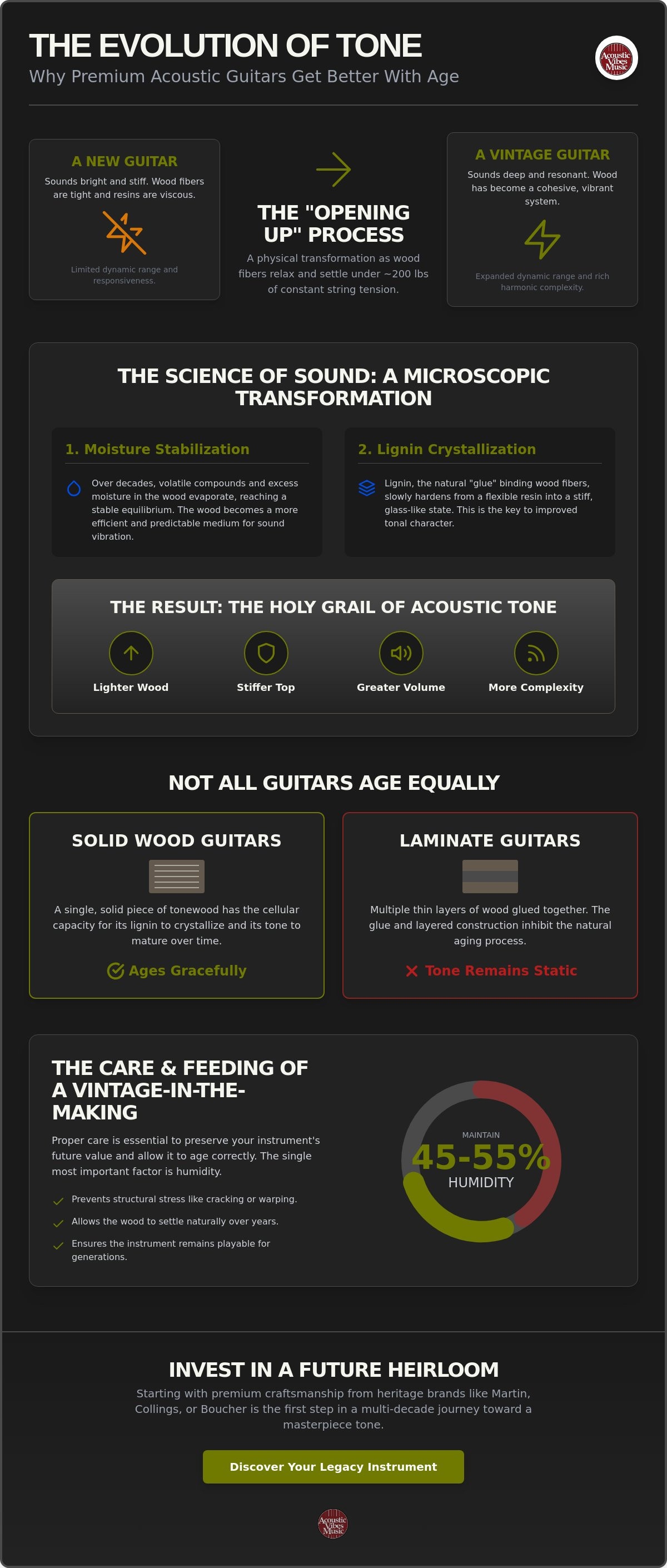
Aging a fine guitar is a deliberate act of stewardship. You aren't just waiting for the calendar to turn; you're curating a physical transformation that requires patience and precision. While the cellular structure of the wood naturally shifts, those changes only lead to a tonal masterpiece if the environment remains stable. If you wonder do acoustic guitars get better with age while leaving your instrument in a drafty room or a damp basement, the answer is a heartbreaking no. Neglect leads to structural failure, not the resonant soul you're chasing.
Maintaining a precise humidity level between 45% and 55% is your most vital task. Extreme dryness causes wood fibers to shrink, which can lead to sharp fret ends, bridge lifting, or catastrophic cracks in the soundboard. Conversely, high humidity causes wood to "bloat," creating a dull, muddy sound that masks the very resonance you want to improve. For high-end investments like Taylor Guitars, using a specialized in-case humidification system is essential to preserve the factory-spec geometry. A stable environment is the single most important factor in allowing a guitar to age tonally without failing structurally.
As the lignin crystallizes and the wood settles, the physical geometry of your guitar will inevitably shift. This is a sign of life, but it requires professional attention. Regular setups are mandatory. A skilled luthier can adjust the nut, saddle, and truss rod to ensure the instrument stays playable as it matures. If your guitar’s action feels like it's changing, our Luthier Repair Services can realign its physical structure with its evolving voice, ensuring it remains a joy to play for decades.
Vibration is the catalyst that wakes up the wood. Don't just stay in the first position. You need to activate the entire soundboard by playing across the full length of the fretboard, encouraging the bridge and bracing to respond to a wider spectrum of frequencies. Heavy strumming pushes the top to its limits, helping to develop volume and "punch." Delicate fingerstyle work, on the other hand, encourages sensitivity and harmonic detail. A well-rounded playing approach "voices" the aging top more completely. When enthusiasts ask do acoustic guitars get better with age, they often overlook the importance of the player's touch in that evolution. For more on maintaining the tactile elements of your neck and board, explore our guide on Ebony vs. Rosewood Fretboard care. Every hour you spend playing is an investment in the instrument's future voice.
Buying a high-end acoustic isn't just a transaction. It's the beginning of a multi-decade relationship. When you invest in premium craftsmanship, you're buying into a future of evolving tone. The question, do acoustic guitars get better with age, is answered every time you strum a vintage heirloom. These instruments are built with the foresight to handle the tension of time while blossoming into something truly spectacular. You aren't just purchasing a tool for today; you're securing a legacy that will sound more complex and resonant for the next generation.
Certain builders have mastered the art of creating instruments that thrive on the aging process. Martin Guitars and Collings are legendary for their "Pre-War" voicing. They use scalloped bracing and thin nitrocellulose finishes that allow the wood to breathe and move more freely as the years pass. This design philosophy ensures that the initial stiffness of a new guitar is merely a temporary phase. As the wood settles, the low end becomes more authoritative and the mids gain a vocal-like clarity.
In contrast, the unique bracing patterns found in Lowden Guitars offer a different aging curve. Their dolphin bracing and A-frame construction prioritize a clear, piano-like resonance that gains depth and warmth as the cedar or spruce tops mature. For those seeking a vintage-inspired masterpiece from day one, the work of M. Atkin captures that classic soul through meticulous hand-carving and material selection. These builders understand that the right start is essential for a graceful finish.
We see ourselves as more than just a retail outlet. We are a "Passionate Curator" of instruments with massive tonal potential. While we celebrate the organic process, we also embrace modern innovation. Yamaha's L-Series utilizes their proprietary A.R.E. technology to jumpstart the crystallization of wood cells. This provides a "broken-in" feel right out of the box, proving that do acoustic guitars get better with age even faster when science lends a hand. It’s the perfect solution for the player who wants vintage response without the decades of waiting.
If you prefer an instrument that has already done its growing, our selection of Used and Consignment Instruments offers a gateway to legendary, opened-up tone. There is no substitute for hearing the difference in person. We invite you to visit our showroom to compare a brand-new boutique build against a seasoned vintage piece. Feel the responsiveness. Hear the harmonic complexity. Explore our curated collection of high-end acoustics and find your forever guitar.
The transformation of a high-end acoustic is a beautiful intersection of chemistry and artistry. We've explored how lignin crystallization and moisture stabilization turn a stiff wooden frame into a resonant masterpiece. While the science proves that do acoustic guitars get better with age, the ultimate result depends on your stewardship. Don't just wait for the years to pass; play your instrument with passion and maintain it with precision to unlock its full potential.
We're proud to be an authorized dealer for the Martin Custom Shop and Collings, offering a curated gallery of instruments designed for the long haul. With an expert luthier on-site for maintenance and national shipping available for our investment-grade collection, we make it easy to secure your future heirloom. Your perfect guitar is waiting to grow with you. Discover Your Next Heirloom in Our Curated Acoustic Collection and start a musical relationship that will only deepen with time.
It typically takes between six months and two years of regular playing to notice the initial "opening up" of a high-quality solid-wood guitar. The most dramatic shifts occur within this early window as the wood fibers first relax under string tension. However, the maturation process continues for decades as the cellular structure stabilizes. Consistent play during this period is essential for the instrument to reach its full potential.
Laminate guitars generally do not improve with age because their construction relies on cross-grained layers and heavy synthetic glues. These materials lack the cellular ability to crystallize or move in sympathy with string vibrations. While they remain durable, their tonal profile is largely fixed from the day they leave the factory. Solid wood is required for the organic evolution players crave.
You can accelerate the maturation process through frequent, aggressive playing or by using mechanical vibration devices designed to simulate years of use. These methods help break down internal friction between fibers. Additionally, purchasing a guitar with a torrefied top provides an immediate scientific shortcut to a vintage, pre-aged sound. This heat treatment mimics decades of natural lignin crystallization in just a few hours.
Most luthiers agree that a guitar's tonal improvement eventually reaches a plateau, though it rarely stops entirely. While the most significant changes happen in the first 20 to 30 years, instruments continue to settle as long as they are maintained. Eventually, the focus shifts from "opening up" to maintaining the structural stability of the aged wood. A well-kept vintage piece remains a living, breathing instrument.
Thin nitrocellulose finishes are widely considered superior for aging because they allow the wood to breathe and vibrate more freely. Unlike thicker polyester or polyurethane finishes, nitrocellulose continues to thin and sink into the grain over time. This lack of restriction is a key factor in whether do acoustic guitars get better with age effectively. It ensures the soundboard remains as responsive as possible.
A guitar that sits unplayed often sounds "asleep" or stiff when first picked up again. The mechanical vibration of playing is necessary to keep the wood fibers flexible and the internal resins active. While the chemical aging of the wood continues, the physical responsiveness requires regular kinetic energy to maintain its peak performance. Think of it as a mechanical break-in that needs constant renewal.
A vintage guitar offers a specific, dry harmonic complexity, but modern high-end instruments often provide superior playability and structural reliability. Today's boutique builders use advanced engineering to ensure their new builds rival the resonance of the past. Whether do acoustic guitars get better with age to the point of surpassing a modern masterpiece is often a matter of personal tonal preference and historical appreciation.
You will notice an increase in sustain, a quicker response to light fingerstyle playing, and a more balanced frequency response across the strings. The "tightness" of the new wood disappears, replaced by a sense that the notes are jumping off the soundboard. If the bass feels deeper and the trebles lose their brittle edge, your instrument has successfully started its journey toward becoming an heirloom.