My shopping cart
Your cart is currently empty.
Continue ShoppingWhat if the most expensive wood on your guitar isn't actually the best choice for your specific playing style? It's a question that haunts many enthusiasts when they're ready to invest in a premium instrument. It's easy to feel overwhelmed by conflicting forum debates regarding the ebony vs rosewood fretboard choice. You might worry about a high-maintenance board cracking in the winter, or perhaps you're uncertain if a dark, glassy ebony surface is truly an upgrade over the traditional warmth of rosewood.
We share your passion for these artisanal details. The fretboard is the primary tactile bridge between your inspiration and the strings, making it a critical component of any fine acoustic build. This guide offers the definitive clarity you've been searching for. We'll explore the crisp, percussive snap of ebony and the smooth, oily resonance of rosewood. You'll discover which wood matches your sonic preferences, how they feel under your fingertips, and the simple steps required to keep these precious materials healthy for decades to come.
The fretboard is more than a stage for your fingers. It serves as a vital structural component, acting as a spine that helps the neck resist the immense tension of steel strings. While many woods have been tested throughout history, two titans reign supreme in the world of premium acoustic luthiery. Different fingerboard materials offer unique structural benefits, but the choice between an ebony vs rosewood fretboard remains the most significant decision for a player seeking a high-end instrument. This choice involves two primary species: Diospyros crassiflora, known as African Ebony, and Dalbergia latifolia, the celebrated East Indian Rosewood.
Luthiers rely on the Janka Hardness scale to determine a wood’s suitability for professional play. This scale measures the resistance of a wood sample to denting and wear. Ebony typically sits near the top of the list, providing a rock-hard surface that holds fret wires with incredible tenacity. Rosewood is slightly softer but offers a resilient, flexible foundation that has supported legendary builds for over a century. Visually, the contrast is striking. Ebony offers a deep, uniform inkiness that exudes modern sophistication. Rosewood provides a more organic aesthetic, featuring rich, variegated browns and purples that highlight the natural growth of the tree.
Ebony is prized for its extreme density and tight, closed grain. Historically, this wood was reserved for the finest orchestral instruments and top-tier guitars because of its durability and "glass-like" surface. In the modern era, brands like Taylor Guitars have led a shift toward using "smoky" or variegated ebony. This movement embraces the natural streaks of grey and tan found in the heartwood, ensuring sustainable harvesting while adding a unique, artisanal character to every instrument. It’s a dense, heavy wood that feels fast and precise under the fingertips.
Rosewood is the traditionalist’s choice, characterized by an oily nature and an open-pore grain structure. While the legendary Brazilian Rosewood (Dalbergia nigra) is now highly restricted and rare, East Indian Rosewood has become the gold standard for builders like Martin Guitars. Unlike the drier feel of ebony, rosewood’s natural oils create a slick, comfortable playing surface that requires very little finish. The variegated grain patterns offer a warm, inviting look that complements the complex overtones rosewood is famous for producing. It feels earthy and responsive, providing a tactile connection that many fingerstyle players find indispensable.
The physics of tone begins exactly where your finger meets the wood. While some argue that the fretboard is purely aesthetic, the ebony vs rosewood fretboard choice dictates the very speed of note decay and the clarity of your instrument’s voice. This interaction is a matter of energy transfer. Because ebony is remarkably dense and hard, it reflects energy back into the string with minimal absorption. This creates a fast, immediate attack that feels alive under your fingers. Rosewood, with its natural oils and porous structure, behaves like a gentle acoustic filter. It absorbs a fraction of the high-frequency transients, resulting in a softer, more rounded initiation of every note.
The ebony vs rosewood fretboard debate often centers on how overtones are managed. Ebony tends to emphasize the fundamental pitch of the note, providing a focused sound that cuts through a dense musical arrangement. In contrast, rosewood allows for more harmonic complexity. It encourages a "spread" in the frequency response, giving the guitar a sense of depth and resonance that many players find more forgiving. Whether you prefer a laser-focused fundamental or a lush, blooming chord, the wood beneath your frets is the silent director of that performance.
Ebony provides a percussive snap that is indispensable for articulate fingerstyle play. It offers a level of clarity that ensures every note in a complex chord is heard distinctly. This wood is a master of articulation, providing a clear, bell-like quality that many collectors prize in high-end Martin guitars. Because notes on an ebony board decay quickly without lingering harmonic "ghosts," it is the ideal choice for fast flatpicking. If you are playing an instrument with a mahogany body, an ebony board can add the perfect amount of top-end definition to balance the wood's natural mid-range focus.
Rosewood is beloved for its "bloom." This phenomenon occurs when the initial strike of the string is followed by a lush expansion of harmonic overtones. The oily pores of the wood tame harsh high-end frequencies, creating a supportive, velvety soundscape. This makes it a favorite for singer-songwriters. It provides a rich cushion for the voice rather than competing for the same frequency space. While it may lack the razor-sharp precision of ebony, it offers a resonant complexity that feels soulful and lived-in. You can hear these sonic differences for yourself by exploring our curated selection of premium acoustic guitars.
Beyond the sonic profile, the physical sensation of your fingertips against the wood defines your daily playing experience. Choosing between an ebony vs rosewood fretboard often comes down to the microscopic architecture of the wood. Ebony is famous for its exceptionally tight, closed grain. Under high magnification, it appears almost seamless, whereas rosewood features larger, open pores. This structural difference dictates how the wood interacts with the moisture on your skin and the pressure of your fretting hand. It’s the difference between a polished marble floor and a finely sanded hardwood deck.
Humidity and sweat play a significant role in "finger drag." On a porous surface, moisture can settle into the grain, sometimes creating a slight resistance as you move across the neck. Conversely, a non-porous surface stays slicker for longer. This interaction affects your technical execution, specifically during wide vibrato or heavy string bends where the skin of your fingertip makes direct contact with the wood. The choice isn't just about what looks better in the gallery; it's about which surface facilitates your unique technique without hesitation.
Professional players often describe ebony as "fast." Because it lacks visible pores, there’s less surface area for skin oils and environmental grime to accumulate, preventing that sluggish, sticky feeling during long sessions. It feels like playing on polished glass. This slickness is a boon for complex lead work and rapid position shifts. For heavy-handed players, ebony’s rigidity provides a stable, unyielding foundation. It doesn't compress under pressure, ensuring your intonation remains precise even during aggressive fretting. It’s a precision tool for the modern technician.
Many enthusiasts prefer the "earthy" connection of rosewood. Its open-pore structure provides a subtle tactile feedback that some find more expressive for nuanced vibrato. The natural oils in rosewood allow the wood to "breathe," reacting dynamically to the player's touch over time. Over years of play, a rosewood board develops a unique patina that feels specifically broken-in for the owner. This organic grip is a hallmark of many Collings guitars, where the choice of fretboard is carefully matched to the instrument's overall personality and tactile response.
There’s also a psychological dimension to the ebony vs rosewood fretboard debate. Ebony has long been associated with the highest tier of prestige instruments, often appearing on presentation-grade models. This visual inkiness can provide a boost in player confidence, making the instrument feel like a professional, high-stakes tool. However, the textured warmth of rosewood offers its own luxury, providing a sense of heritage and connection to the classic folk and blues eras. Whether you want the frictionless speed of a modern masterpiece or the textured soul of a traditional build, the tactile bridge of the fretboard is where your artistic voice finds its footing.
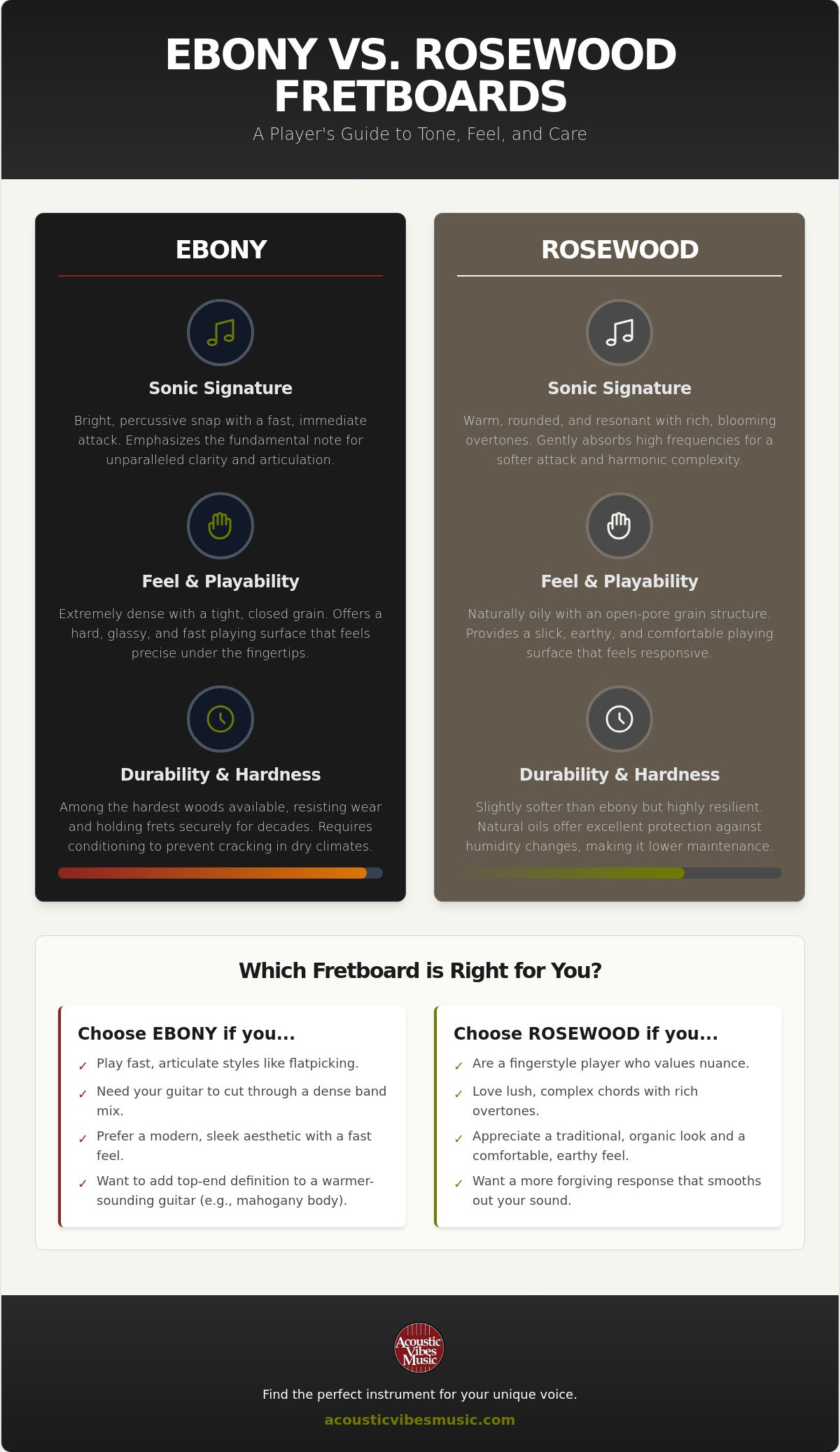
Preserving the artistry of a premium instrument requires a disciplined approach to maintenance. While the choice of an ebony vs rosewood fretboard impacts tone and feel, it also defines how you'll care for the wood over the coming decades. Many enthusiasts fall into the trap of over-conditioning, fueled by forum advice that suggests oiling the wood with every string change. This is a mistake. Excess moisture can migrate into the fret slots, softening the structural fibers and eventually causing the metal fret tangs to lose their grip. This leads to "popped" frets and inconsistent action that requires professional intervention.
True longevity begins with environmental control. Your fretboard is often the first part of the guitar to signal distress from humidity fluctuations. Invest in a high-quality case humidification system to maintain a consistent 45 to 55 percent relative humidity. This protects the entire build, ensuring the neck remains straight and the delicate soundboard doesn't crack. A well-maintained ebony vs rosewood fretboard should only require deep conditioning once or twice a year, depending on your local climate and how often you play.
Ebony’s high density makes it more prone to brittle fractures if allowed to dry out completely. Because the wood is so tightly grained, it doesn't expand and contract as gracefully as other species. Watch for a dull, grayish hue or "fret sprout," where the wood shrinks and leaves sharp fret ends protruding from the side of the neck. To prevent this, apply a small amount of high-grade, non-silicone conditioner to restore the deep-black luster. Avoid any products containing waxes or heavy silicones, as these can create a build-up that is nearly impossible to remove without scraping the wood.
The open-pore structure of rosewood is a natural magnet for "finger funk," which is a mixture of sweat, skin cells, and dust. Safely remove this buildup using a lightly dampened microfiber cloth. For stubborn grime, you can use ultra-fine 0000 steel wool, provided you move strictly with the grain and protect your guitar's finish and pickups. Because rosewood is naturally resinous and oily, it requires less frequent conditioning than ebony. For a deeper dive into how these organic materials compare in stability and resonance, see our guide on Rosewood vs. Mahogany Guitar Tone.
Check your instrument's hydration at every change of season. If you notice sharp fret ends or a changing neck relief during the dry winter months, it's time for a professional setup. Our expert luthier repair services are available to evaluate your instrument and ensure it remains in showroom condition for a lifetime of music.
Choosing your ideal instrument involves a delicate balancing act of tonewoods. The ebony vs rosewood fretboard decision is the final calibration of an acoustic guitar’s voice. Think of the fretboard as the EQ's high-frequency fader. If you've selected a guitar with a bright Sitka spruce top and maple back and sides, a rosewood board can provide a necessary "rounding" effect to prevent the tone from becoming brittle. Conversely, if you're looking at a warm, all-mahogany build, an ebony board provides the surgical precision needed to keep the low-mids from sounding muddy. It’s about creating a harmonious spectrum of sound.
Aesthetics also play a significant role in the selection of high-end acoustic guitars for sale. For many collectors, the deep, obsidian-like finish of premium ebony represents the pinnacle of luthier artistry. It provides a clean, modern canvas for intricate mother-of-pearl or abalone inlays. Rosewood offers a more rustic, soulful beauty with its visible grain and chocolate hues, appealing to those who appreciate the organic variations of the natural world. Both are heirloom-quality materials, but they project very different artistic intentions.
Precision is everything in modern fingerstyle. Solo performers often rely on the immediate transient response of ebony to ensure that fast, percussive techniques and intricate melodies remain distinct. This is why Taylor guitars utilize ebony across their entire line. It maintains their signature "modern" shimmer and supports the low-action setups that technical players demand. If your repertoire includes tapping, harmonics, or rapid-fire lead work, the glassy surface of ebony will facilitate your technique with minimal resistance.
Traditionalists often gravitate toward the classic "thump" associated with vintage-spec Gibson acoustics. Rosewood is the more forgiving companion for heavy strummers and singer-songwriters. It compresses the high-end slightly, allowing vocalists to sit "on top" of the guitar's mix rather than fighting against it. You can find exceptional examples of high-quality, dark rosewood on boutique instruments from builders like Boucher, where the wood is chosen specifically to enhance the rich, resonant overtones of their Adirondack spruce tops.
To make your final decision, consider this checklist:
The ebony vs rosewood fretboard choice is ultimately a personal one. Trust your ears and your hands. Whether you seek the crystalline clarity of an ebony board or the soulful resonance of rosewood, the right choice is the one that inspires you to pick up the guitar every single day.
The journey to find your ideal instrument is as much about the tactile response as it is the sonic output. Deciding on an ebony vs rosewood fretboard isn't about finding a "better" wood; it's about discovering the specific articulation or warmth that resonates with your musical soul. Ebony provides that crisp, modern precision favored by technicians. Rosewood offers the complex, blooming sustain that has anchored acoustic history for generations. Both are exceptional materials when sourced and crafted with care by master builders.
As an authorized dealer for Martin, Taylor, and Collings, we've curated an inventory that showcases the absolute finest examples of both tonewoods. Our expert in-house luthier team ensures every instrument is perfectly humidified and set up for your unique touch before it leaves our gallery. With nationwide shipping available on all high-end instruments, your next heirloom guitar is closer than you think. We take pride in acting as your expert guide through every nuance of construction and tone.
Ready to feel the difference for yourself? Explore our curated collection of premium acoustic guitars with master-grade fretboards and find the instrument that inspires your next masterpiece. We're here to help you navigate every detail of your discovery and ensure your investment brings joy for a lifetime.
Ebony typically commands a higher price point because it's a slower-growing species with immense density, making it more challenging to harvest and process. While standard East Indian Rosewood is widely available for premium builds, master-grade ebony remains a luxury hallmark. This cost difference is often reflected in the final price of high-end acoustic instruments where only the most uniform, dark heartwood is selected for the board.
Yes, ebony provides a noticeably brighter and more percussive response compared to the warmer character of rosewood. Because the wood is so hard and dense, it reflects string energy quickly rather than absorbing high-frequency overtones. This results in the "snap" and "clarity" that fingerstyle players prize, making the ebony vs rosewood fretboard choice a critical decision for your desired tonal profile.
Ebony is considered more demanding because its extreme density makes it less flexible and more prone to cracking in dry environments. Unlike rosewood, which contains more natural oils and a more resilient grain structure, ebony can become brittle if the humidity drops significantly. It requires vigilant environmental control to prevent "fret sprout" or hairline fractures in the wood's surface during dry winter months.
Swapping a fretboard is a major structural surgery that involves heat-treating the neck to soften glue joints and potentially damaging the finish. While a master luthier can perform this task, it's rarely cost-effective and can alter the instrument's structural integrity. It's almost always better to choose the correct wood during the initial purchase or trade for an instrument that meets your specific tactile and sonic requirements.
Sustainability has improved for both species through strict international regulations and ethical harvesting initiatives. Since November 26, 2019, finished musical instruments containing most rosewood species are exempt from CITES permit requirements, making them easier to trade globally. Ebony sustainability has also advanced, particularly through the use of variegated wood that was once discarded but is now celebrated for its unique beauty and eco-friendly sourcing.
Professional preference is entirely subjective and depends on the specific musical application. Bluegrass flatpickers and traditional blues players often gravitate toward rosewood for its earthy "thump" and supportive resonance. Modern soloists and classical performers frequently choose ebony for its articulate fundamental notes and fast, glassy feel. Neither is objectively superior; they're simply different tools for different artistic expressions and performance needs.
Striped or smoky ebony features natural light-colored streaks and is identical in quality and durability to pure black ebony. Historically, luthiers only used the jet-black heartwood, leading to significant waste in the forest. Today, these variegated patterns are highly sought after by collectors for their unique, artisanal look. They represent a more responsible and sustainable way to utilize the entire tree without sacrificing any performance characteristics.
You should only oil your fretboard once or twice a year to avoid saturating the wood and loosening the frets. Over-oiling is a common mistake that can lead to a soft surface and structural issues over time. A tiny amount of high-quality conditioner applied during a seasonal string change is usually sufficient to keep the wood healthy, prevent cracking, and maintain its deep, rich luster.