My shopping cart
Your cart is currently empty.
Continue ShoppingWhat if the reason your chords sound slightly sour isn't your ear, but a hidden geometric flaw in your instrument? It's a frustrating reality for many enthusiasts. You invest in a beautiful, solid-wood instrument, yet you find yourself battling sore fingers from high action or notes that drift out of tune the higher you climb the fretboard. You're not alone in feeling that your instrument deserves a professional ukulele setup to achieve the resonance and ease it was designed for.
Precision calibration is the bridge between a manufactured object and a truly responsive musical tool. By investing in a master luthier’s touch, you can transform a standard instrument into a high-performance masterpiece characterized by perfect intonation and effortless playability. This guide explores how expert adjustments to nut heights, saddle contours, and fret levels create that coveted "plays like butter" feel. We will walk through the specific technical refinements that protect your instrument's value while ensuring every note rings true across the entire fretboard. Discover how the right adjustments can finally unlock your ukulele's true voice and give you the confidence to play your best.
Think of a professional ukulele setup as a master-level calibration of your instrument's physical geometry. It is far more than a simple inspection; it is a surgical refinement of every component that touches the strings. While a factory-made instrument is built to a specific set of blueprints, a professional setup is the final stage of craftsmanship that bridges the gap between a manufactured object and a truly responsive musical tool. The primary goal is to achieve a perfect balance between effortless playability, tonal clarity, and mechanical structural integrity.
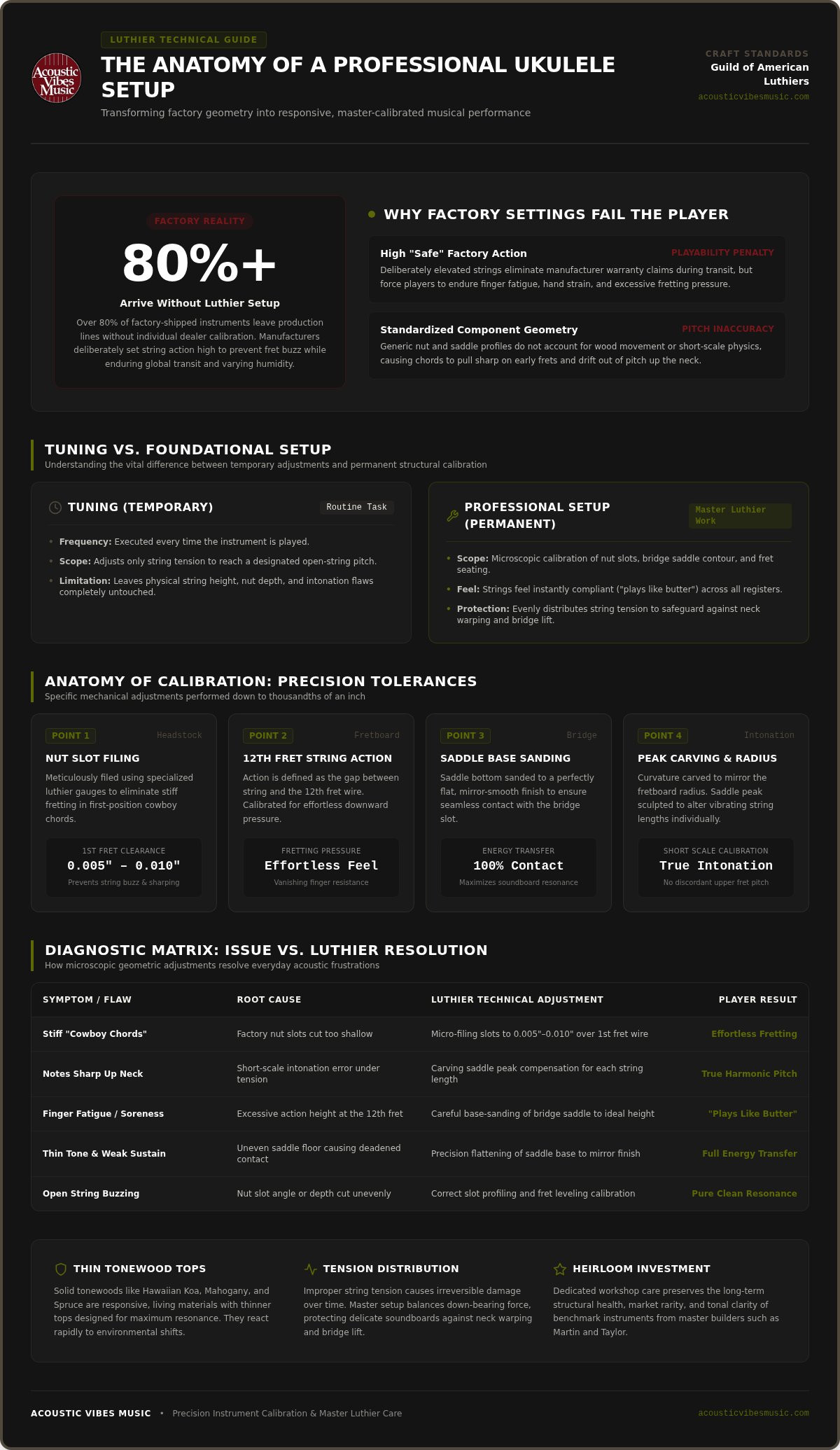
Many enthusiasts are surprised to learn that even premium instruments often leave the factory with "safe" configurations. Research indicates that over 80% of factory-shipped instruments arrive without an individual dealer luthier setup. Manufacturers intentionally set the string action higher than necessary to prevent fret buzz while the instrument travels through varying climates and humidity levels. A professional setup removes these generic tolerances, tailoring the instrument to its peak performance state. This creates a seamless player-instrument connection, where the physical effort required to fret a note vanishes, leaving only the music.
It's vital to distinguish between tuning and a foundational setup. Tuning is a temporary adjustment of string tension to reach a specific pitch, a task performed every time you play. In contrast, a professional ukulele setup is a permanent structural adjustment. It involves precision filing of nut slots and the careful contouring of the bridge saddle to optimize how the strings interact with the frets. These adjustments change the physical feel and tension of the strings, making the instrument feel significantly more "compliant" under your fingers. Beyond immediate comfort, a proper setup ensures that string tension is distributed correctly, which helps prevent long-term neck warping or bridge lift.
Boutique instruments crafted from solid tonewoods like Hawaiian Koa, Mahogany, or Spruce are living, breathing entities. They are highly sensitive to changes in tension and environmental conditions. High-end brands such as Martin or Taylor benefit immensely from bespoke adjustments that respect their unique construction methods. Because these instruments are built with thinner, more resonant tops, a luthier acts as an expert guide; ensuring that the instrument is optimized for performance without compromising its structural health. This specialized care preserves the rarity and value of heirloom-quality instruments while unlocking their full harmonic potential.
Precision is the hallmark of a professional ukulele setup. It isn't a mere check-up; it's a sequence of technical refinements that demands an intimate understanding of physics and woodcraft. A luthier approaches your instrument with specialized gauges and files, measuring tolerances in thousandths of an inch to ensure every component works in harmony. This level of detail follows the rigorous standards established by organizations like the Guild of American Luthiers, transforming a generic factory build into a high-performance musical tool.
The nut is the most critical point for initial playability. If the slots are too high, "cowboy chords" in the first position feel stiff and often pull sharp. A luthier meticulously files these slots to a clearance of 0.005" to 0.010" over the first fret, ensuring effortless fretting without the dreaded open-string buzz. Action is the distance between the string and the 12th fret. To lower this action, the bridge saddle must be adjusted with extreme care. This involves sanding the saddle base to a perfectly flat, mirror-smooth finish. This flatness is essential for maximizing energy transfer into the soundboard, particularly on high-end models where every vibration counts. The saddle's top curvature must also perfectly mirror the fretboard's radius for a consistent feel across all four strings.
Ukuleles are notoriously difficult to intonate because their short scale lengths leave very little room for error. Even a microscopic inaccuracy in string length can cause notes to sound discordant as you move toward the body. Luthiers solve this through "compensation," which involves carving the peak of the saddle to slightly lengthen or shorten the vibrating portion of each individual string. This science ensures that a C major chord sounds just as pure at the 10th fret as it does at the 3rd. Wood density plays a significant role here; higher density woods like rosewood transmit vibrations differently than mahogany. You can explore these nuances further in our Rosewood vs. Mahogany tonewood guide to understand how your instrument's material impacts its setup requirements.
Beyond the nut and saddle, fret leveling is the final step in eliminating "chatter" and dead notes. A luthier identifies high frets using a precision rocker and levels them to a uniform plane before recrowning and polishing them to a high luster. This comprehensive approach ensures your instrument is mechanically perfect. If your ukulele feels like it's fighting you, it might be time to consult with a specialist to restore its true playability.
A high-end instrument shouldn't feel like a struggle. If you find yourself fighting "stiff" action, where the strings feel unyielding at the 12th fret, your technique isn't the problem. High action forces you to press harder, which inadvertently stretches the string and causes notes to go sharp. This is particularly noticeable on short-scale ukuleles where tension is already light and sub-millimeter inaccuracies have a massive impact. A professional ukulele setup recalibrates this height, allowing for advanced fingerstyle techniques and complex jazz chords without hand fatigue.
Fret buzz is another common grievance that disrupts the purity of your tone. While players often blame their own finger placement, buzz is frequently a mechanical issue caused by uneven fret wear or a shifting neck. During the professional setup process, a luthier distinguishes between player technique and these mechanical inconsistencies. Beyond physical adjustments, we prioritize sensory refinement. Hydrating a thirsty Koa or Mahogany fretboard and polishing frets to a mirror finish doesn't just look beautiful; it creates a tactile smoothness that makes your slides and vibrato feel effortless.
Many collectors assume a high price tag guarantees a perfect out-of-the-box experience. In reality, manufacturers intentionally leave saddles high. They do this to accommodate different climates and playing styles, knowing that a "safe" setup prevents buzz during global shipping. Think of your new instrument as a fine suit that requires custom tailoring for your specific hands. A professional ukulele setup is that final bespoke adjustment, moving beyond generic factory tolerances to meet your personal touch and ensure the instrument responds to your unique attack.
A setup also serves as "preventative medicine" for your collection. High-end tonewoods are sensitive to humidity, and a luthier's inspection can reveal early signs of bridge lifting or loose internal bracing that a casual observer might miss. Identifying these issues early protects the long-term value of your heirloom. For instruments requiring more intensive care, Acoustic Vibes Music provides comprehensive Luthier Repair Services to address structural concerns and restore tonal brilliance. We ensure every instrument in our gallery performs at its absolute peak, regardless of its age or origin.
The allure of a DIY tutorial is strong, but a professional ukulele setup is fundamentally a subtractive process. Precision is paramount. Once you file away material from a bone nut or a saddle, you cannot put it back. This "point of no return" is where many well-intentioned enthusiasts find themselves facing the cost of total component replacement. A luthier doesn't guess; they use gauged nut files and radius gauges to ensure every cut is intentional and accurate to the thousandth of an inch.
Beyond the risk of over-filing, the instrument must be viewed as a unified mechanical system. Adjusting the action at the saddle isn't an isolated change. It alters the string's break angle and tension, which directly impacts intonation and resonance. A professional understands these systemic interdependencies, ensuring that a change in one area doesn't create a new problem elsewhere. This holistic approach protects the structural integrity and tonal purity of your instrument.
Common mistakes often start with the wrong tools. Using hardware store sandpaper or generic files on a delicate bone nut often results in V-shaped slots that pinch the strings, causing tuning instability. Even more dangerous is the attempt to remove a stubborn saddle without specialized bridge tools. One slip can crack the bridge or mar the soundboard finish, turning a simple adjustment into an expensive structural repair. A professional luthier serves as an expert guide, applying years of tactile experience to avoid these pitfalls and preserve your investment.
A premier workshop is defined by its environment and its process. Look for a facility that maintains strict climate control, as high-end tonewoods require a stable 45% to 55% relative humidity to be accurately calibrated. A quality luthier will also perform a thorough intake interview. They should ask about your playing style, your preferred string gauge, and whether you have a heavy or light strumming attack. This ensures the setup is tailored to your hands. For a deeper look at choosing the right partner for your instrument's care, explore our Guide to Finding the Right Luthier.
Documentation of professional care is also a significant asset for collectors. A receipt from a reputable shop proves your boutique instrument has been maintained by experts, which directly supports its resale value. If you want your instrument to perform at its absolute peak, book a consultation with our expert luthier team today.
Our philosophy is simple: every instrument deserves to perform at its absolute zenith. At Acoustic Vibes Music, we view ourselves as both passionate curators and expert guides. When you acquire an instrument from our collection, it doesn't just arrive in a box; it arrives as a fully realized musical partner. Every piece undergoes a rigorous professional ukulele setup that respects the unique heritage of world-class builders like Martin and Taylor. Our team understands the technical nuances required to make these premium tonewoods sing.
Because we serve a national audience, we specialize in preparing instruments for safe transit across varied climates. We ensure each ukulele is stabilized within the optimal 45% to 55% relative humidity range before it leaves our care. This meticulous preparation prevents top sinkage or fret sprout during shipping, ensuring your instrument arrives ready for the stage. The final polish isn't just about aesthetics; it's a sensory celebration of the wood's tactile beauty and harmonic resonance.
A professional ukulele setup is never one-size-fits-all. We tailor the action to your specific attack. Fingerstyle players often prefer a lower, more delicate action for intricate melodies, while aggressive strummers require slightly more clearance to prevent string slap. We also guide you through string selection, matching specific gauges and materials to your instrument's tonewood profile. This bespoke approach ensures a welcoming experience from the first chord, providing an instrument that feels familiar the moment you pick it up.
For those who curate collections of high-end acoustic guitars and ukuleles, long-term maintenance is essential for preserving value. Beyond the initial setup, we emphasize the importance of strict climate control and proper case storage. High-end instruments are investments in artistry. By maintaining a stable environment and seeking regular professional check-ups, you protect the structural health of your heirloom for generations. Experience the difference a master's touch makes and let us help you unlock your instrument's true potential.
Precision calibration is the final step in the journey from a fine instrument to a truly responsive musical companion. You've seen how expert refinements to the nut, saddle, and frets eliminate the physical barriers between your inspiration and your performance. By choosing a professional ukulele setup, you ensure your instrument plays with the effortless grace it was designed for while protecting its structural integrity for years to come. It's a transformative process that turns every practice session into a moment of pure discovery.
As an authorized dealer for world-renowned builders like Martin, Taylor, and Collings, we bring a level of expertise that respects the heritage of your collection. Whether you're visiting us for expert luthier services by appointment or relying on our nationwide shipping expertise for a new acquisition, we handle every detail with reverence. Don't let high action or poor intonation hold back your creativity any longer. Explore our curated collection of professionally set-up ukuleles and find the instrument that truly speaks to you. Your music deserves the clarity and comfort of master craftsmanship.
Most instruments benefit from a professional check-up once a year. Wood is a dynamic material that breathes and shifts with seasonal changes in humidity. If you live in a climate with dramatic weather swings, a bi-annual adjustment ensures your instrument remains stable. Regular maintenance is the best way to protect your heirloom investment and keep the playability feeling like "butter" throughout its life.
A professional setup is the most effective way to eliminate fret buzz. Our luthiers use precision gauges to determine if the issue is caused by a high fret, a flat neck, or a saddle that has been sanded too low. By leveling the frets and recalibrating the instrument's geometry, we restore tonal purity. This mechanical refinement ensures that every note on the fretboard sounds clear and resonant.
Switching string gauges will likely affect your instrument's calibration. Heavier strings exert more tension, which can pull the neck forward or cause the action to rise. Conversely, lighter strings may cause buzzing if the neck relief isn't adjusted. To maintain the integrity of your professional ukulele setup, it's best to choose a gauge you love and have the luthier calibrate the nut slots and saddle specifically for that tension.
While the actual labor involves several hours of precision bench work, the total turnaround time depends on our current schedule. Because we treat each instrument with the reverence of a curated gallery piece, we operate by appointment for all luthier services. This organized approach allows us to give your ukulele the focused attention it deserves. We recommend contacting us to secure a slot for your instrument's refinement.
This issue indicates a problem with intonation, often caused by excessively high action. When the distance between the string and the fretboard is too large, you must stretch the string significantly to make contact. This extra tension pulls the note sharp. A luthier resolves this by adjusting the saddle's peak to compensate for the string's behavior, ensuring perfect pitch accuracy from the nut all the way up the neck.
Yes, a setup is essential even for elite instruments. Manufacturers often ship instruments with higher action to prevent buzzing during transit through different climates. A professional ukulele setup is the final bespoke adjustment that tailors the instrument to your hands. It ensures that your boutique Martin or Taylor isn't just a beautiful object, but a high-performance tool that responds perfectly to your unique playing style and attack.
A standard setup provides a balanced feel suitable for most playing styles. A low-action setup pushes the boundaries of playability, bringing the strings as close to the frets as possible for effortless fretting. This is a favorite for fingerstyle players with a light touch. However, low action demands perfect fret leveling to prevent buzzing. We consult with you during the intake interview to match the calibration to your strumming attack.
Humidity is the primary force that changes your instrument's physical shape over time. Solid tonewoods are highly sensitive; they expand in high humidity and contract in dry air. This movement directly impacts the neck relief and action height. To preserve your setup, we recommend maintaining a stable environment between 45% and 55% relative humidity. Consistent climate control is the best way to ensure your instrument remains at its peak performance.