My shopping cart
Your cart is currently empty.
Continue ShoppingThe most expensive part of a boutique guitar is often the wood the luthier chooses to throw away. While we often obsess over exotic tonewoods, the real magic happens in the architecture hidden beneath the soundboard. Understanding the nuance of scalloped vs non-scalloped bracing is the key to unlocking why some instruments feel like a lush, modern orchestra while others deliver a focused, vintage punch. It's the difference between a top that moves with every breath and one that stands firm to provide maximum projection.
It's completely normal to feel overwhelmed by terms like "fundamental" or "overtones," especially when you're worried about the structural longevity of a more delicate build. You want a guitar that sings, not one that sounds thin or lacks character. This guide will provide the technical confidence you need to navigate these choices. We'll break down how internal carving defines your sound, why boutique builders like Collings or Boucher invest so much time in hand-scalloping, and which style will ultimately elevate your unique playing style.
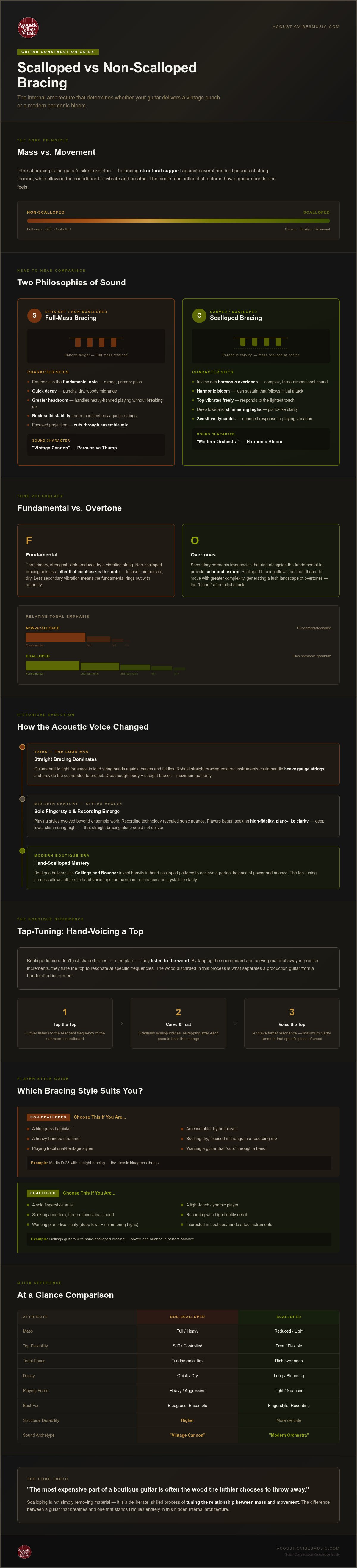
The internal bracing of an acoustic guitar is its silent skeleton. It performs a high-stakes balancing act, supporting the soundboard against several hundred pounds of string tension while allowing that same piece of wood to vibrate and sing. This structural framework dictates everything you hear. When we discuss scalloped vs non-scalloped bracing, we are really talking about the relationship between mass and movement.
Scalloped bracing involves a luthier delicately carving away wood from the center of the braces, creating a parabolic shape. This reduces the weight of the internal structure, which allows the top to flex more freely. Conversely, non-scalloped or straight bracing retains the full mass of the wood. These braces are typically taller and consistent in height, prioritizing structural stiffness and a controlled response. This extra mass acts as a dampener, preventing the top from vibrating excessively while providing a rock-solid foundation for heavy handed playing.
The fundamental is the primary, strongest pitch produced by a vibrating string, while overtones are the secondary harmonic frequencies that ring out alongside it to provide color and texture. Non-scalloped bracing acts as a filter, emphasizing that strong fundamental note for a focused, dry sound. Because the top is stiffer, it doesn't sustain as many secondary vibrations. Scalloped bracing, however, invites the soundboard to move with greater complexity. This creates a lush landscape of overtones, often described as a bloom that follows the initial attack of the note. This harmonic richness is what gives modern high-end instruments their signature three-dimensional quality.
In the unamplified world of the 1930s, guitars had to fight for space in loud string bands. Builders often utilized robust bracing to ensure instruments could handle heavy gauge strings and provide the cut needed to be heard over banjos and fiddles. These traditional designs prioritized projection and a punchy midrange. You can still hear this heritage in many Martin guitars that utilize straight bracing for that classic bluegrass thump.
As playing styles evolved toward solo fingerstyle and modern recording techniques, the demand shifted. Players began seeking high-fidelity, piano-like clarity with deep lows and shimmering highs. Bracing remains the single most influential factor in this responsiveness. It determines whether a guitar feels like a vintage cannon or a modern, sensitive instrument that reacts to the lightest touch. Boutique builders like Collings guitars have mastered this art, using hand-scalloped patterns to achieve a perfect balance of power and nuance.
Straight bracing remains the standard for players who crave the legendary Bluegrass punch. While we've discussed how mass affects movement, the specific appeal of non-scalloped bracing lies in its ability to produce a dry, woody midrange and a quick decay. This isn't a limitation; it's a deliberate stylistic choice. It creates a powerful "thump" in the low end that feels immediate and physical. It's the sound of heritage, providing a percussive quality that defines the golden era of acoustic music.
Iconic models like the Martin D-28 often rely on this non-scalloped architecture to achieve a focused projection. When weighing the merits of scalloped vs non-scalloped bracing for a traditional build, the decision often comes down to how much force you put into your playing. Because the braces are full mass, they provide incredible headroom. You can drive the top with a heavy pick without the sound breaking up or becoming muddy. This structural stiffness ensures that the guitar remains stable under the tension of medium-gauge strings, which are often preferred by flatpickers for their volume and tension.
The Dreadnought body shape was born to be loud. When paired with straight braces, the sound is pushed forward with authority. This makes these instruments the ultimate tools for ensemble playing. They don't get lost in the harmonic wash of other instruments. Instead, they provide a rock-solid rhythmic foundation that cuts through the mix. To truly understand how this structural choice interacts with your wood, explore our guide on Rosewood vs. Mahogany Back and Sides to see how tonewoods complement this focused fundamental.
Vintage guitars from the golden era sound incredible partly because their wood cells have crystallized over decades. This makes the top more resonant even with the stiffness of straight braces. Modern builders simulate this through torrefaction, or "baking" the wood. This process removes moisture and volatiles, creating a "dry" tone that mimics a pre-war instrument. It's a way to get that heritage soul in a brand new build. A dry tone is often preferred for bluegrass and traditional folk accompaniment because it doesn't compete with the singer's voice. It provides a clear, percussive backdrop that stays out of the way of the lyrics.
If you're looking for that classic, punchy response, you can explore our curated collection of dreadnoughts to hear the difference for yourself.
While the vintage fundamental has its place in history, many contemporary players seek a voice that feels more three-dimensional and expressive. This is where the debate of scalloped vs non-scalloped bracing takes a turn toward the modern aesthetic. Scalloped bracing is often described by enthusiasts as "hi-fi" or "lush." By removing mass from the braces, builders allow the soundboard to move with significantly less resistance. This results in a bell-like clarity that rings out with a shimmering harmonic tail, providing a sensory experience that feels both premium and intimate.
Pioneers of this modern sound, such as Taylor Guitars and Lowden Guitars, have refined these techniques to create instruments that feel incredibly alive. Unlike the stiff, focused projection of straight bracing, a scalloped top reacts to the lightest touch. It’s an inviting experience for players who want their instrument to breathe and sustain without needing a heavy pick to "wake up" the wood. Every hand-carved curve in the bracing is a gateway to a more responsive musical experience.
Modern builders use precision scalloping to eliminate "dead spots" across the fretboard. It’s an exercise in surgical accuracy. By strategically thinning specific areas of the internal skeleton, they ensure every note has equal weight and resonance from the low E to the highest frets. This engineering often pairs beautifully with unique tonewoods like Koa, which enhances the modern shimmer unlocked by the reduced mass. For those exploring how these internal choices pair with specific body styles, our guide on Dreadnought vs. Grand Auditorium provides deeper insight into the modern shape evolution.
Solo instrumentalists almost exclusively prefer the overtone-rich environment of a scalloped guitar. When you aren't competing with a banjo or a drummer, you want those secondary frequencies to fill the room and create a sense of atmosphere. Note separation is vital here, especially in complex alternate tunings where every string needs to be heard distinctly within a chord. This leads to a phenomenon enthusiasts call "harmonic bloom." Harmonic bloom is the way a note expands in complexity and color after the initial pluck, creating a sense of depth that straight-braced guitars simply cannot replicate. It turns a single note into a journey, making the guitar feel like a solo orchestra in your hands.
The most discerning players often find themselves caught between two worlds. They crave the dry, percussive soul of a pre-war instrument but demand the crystalline clarity and reliable playability of a modern build. This is the territory of the boutique builder, where the technical choice of scalloped vs non-scalloped bracing is just the starting point for a much deeper artistic process. These artisans don't just follow a blueprint; they treat every soundboard as a unique variable that requires individual attention.
To achieve this balance, high-end builders employ a process known as "tap-tuning." This involves hand-shaving the braces while listening to the top's natural pitch and flexibility. By removing tiny slivers of wood at a time, the luthier can optimize the resonance for that specific set of wood. This results in an instrument that offers the best of both worlds: the strong fundamental punch of a vintage guitar with the shimmering harmonic complexity of a modern masterpiece. It’s a hybrid approach that provides a level of responsiveness factory-built instruments can rarely match.
Collings guitars are legendary for their "vintage-inspired" designs that often exceed the precision of the originals. Their bracing patterns provide a "pop" and immediate response that feels incredibly energetic. Similarly, Boucher guitars leverage their proximity to the world's finest Adirondack Spruce. This wood choice provides massive headroom, allowing for a scalloped bracing design that still feels powerful and authoritative. These heirloom-quality instruments are the primary choice for professional collectors who refuse to compromise on tone or build quality.
Beyond the braces, other construction choices dictate the final voice. For example, the choice between a bolt-on neck joint and a traditional dovetail affects the "snap" and "warmth" of the instrument. When combined with a thin nitrocellulose finish, the wood is allowed to "breathe" and vibrate more like a vintage instrument from the 1930s. These details ensure the guitar will age gracefully and open up over time. If you are looking for investment-grade options, our guide on High End Acoustic Guitars for Sale explores these heirloom features in greater detail.
Ready to experience the nuance of a hand-voiced top? Explore our curated gallery of boutique acoustic instruments today.
Deciding between scalloped vs non-scalloped bracing is less about finding a "winner" and more about identifying your specific musical application. Your role as a performer defines the structural requirements of your guitar. Are you leading a high-energy bluegrass ensemble, or are you weaving intricate solo melodies in a quiet studio space? The answer to that question dictates the internal architecture you need to succeed.
Straight-braced guitars are the unsung heroes of the recording world. Because they emphasize the fundamental note and offer a quicker decay, they "sit" perfectly within a dense mix. Recording engineers often favor this focused projection because it requires less surgical EQ to make room for vocals or other acoustic instruments. The sound is contained, punchy, and predictable. Conversely, scalloped bracing is designed to "fill the room." It provides a lush, immersive experience that makes a single instrument sound like a much larger ensemble. Beyond the audible frequencies, the ultimate test is the tactile response. A scalloped top often vibrates more vigorously against your chest, offering a physical feedback loop that many soloists find deeply inspiring.
For bluegrass and country enthusiasts, the dry, punchy midrange of a Martin style straight-braced tone is the gold standard. It provides the "cut" needed to be heard over banjos and fiddles. If your musical path leads toward New Age or contemporary fingerstyle, you'll likely gravitate toward the sparkling, lush overtones found in a Taylor or Lowden. For the modern singer-songwriter, a boutique hybrid like Collings offers a balanced warmth. It creates a supportive bed of sound that enhances the vocal performance without masking the lyrics.
Buying a high-end instrument is a significant personal journey. When you are purchasing from a distance, you need a trusted advisor who can go beyond the spec sheet to describe the specific "voice" of a guitar. No two pieces of wood are identical, and the way a luthier has voiced a specific top can vary even within the same model line. A professional luthier setup is also vital to ensure the playability matches the tonal potential of the bracing. We invite you to explore the curated collection at Acoustic Vibes Music, where we hand-select every instrument for its unique character and artisanal excellence. Let us help you find the voice that resonates with your soul.
Choosing between scalloped vs non-scalloped bracing is a pivotal moment in your journey as a player. It's the decision that determines whether your instrument delivers the focused, percussive punch of a vintage icon or the lush, harmonic bloom of a modern masterpiece. This internal architecture is the true engine of your guitar's personality, dictating how it responds to your unique touch and musical genre. We've explored how straight bracing provides the headroom needed for heavy flatpicking, while hand-scalloped tops offer the sensitivity required for delicate fingerstyle.
As an authorized dealer for world-class brands like Martin, Taylor, and Collings, we hand-select every instrument in our inventory for its exceptional character and artisanal excellence. Our expert team provides professional luthier setups and reliable national shipping to ensure your new instrument arrives ready to inspire. Explore our curated collection of Modern and Vintage-Voiced Masterpieces and discover the artistry behind every note. We're excited to help you find the perfect companion for your musical journey.
The primary difference lies in how the internal wood is shaped to balance strength and vibration. Scalloped bracing involves carving out the center of the braces to increase top flexibility and harmonic complexity. Non-scalloped bracing uses full-mass, straight wood to prioritize structural stiffness and a focused fundamental note. Choosing between scalloped vs non-scalloped bracing essentially determines whether your guitar has a lush, modern bloom or a punchy, traditional projection.
Scalloping reduces internal mass, which makes the top more flexible but isn't a sign of weakness when engineered correctly. High-end builders carefully calculate wood removal to ensure the instrument remains stable under string tension for decades. While a scalloped guitar might be slightly more sensitive to extreme humidity shifts than a heavily braced model, modern craftsmanship ensures these instruments are durable, professional tools built for a lifetime of music.
Bluegrass players value the "thump" and focused projection that straight bracing provides. In an ensemble featuring banjos and fiddles, a guitar needs a strong midrange fundamental to cut through the mix without being lost in a wash of overtones. Straight braces allow for higher headroom, meaning you can drive the top with a heavy pick without the sound becoming muddy. It's the classic, percussive voice that defined the golden era of acoustic music.
You can certainly nudge the tonal profile, but strings and pins won't fundamentally rewrite the guitar's internal architecture. Heavier gauge strings can drive a stiff, straight-braced top more effectively, while lighter sets benefit from the responsiveness of a scalloped build. Bridge pins made of bone or brass can add sustain or brightness. However, the primary voice remains a product of the bracing and top construction, which define the instrument's core resonance.
While "better" is subjective, many fingerstyle artists prefer a modern voice for its sensitive responsiveness and crystalline clarity. Scalloped bracing allows the top to move with even the lightest touch, which is ideal for intricate melodies and complex alternate tunings. This high-fidelity response ensures that every note has a distinct harmonic tail. While vintage tone has its charm, the three-dimensional bloom of a modern build often provides the orchestral depth soloists crave.
Taylor and Lowden are industry leaders in the modern acoustic movement. Taylor is celebrated for its shimmering clarity and consistent playability across the entire fretboard. Lowden offers a unique, piano-like resonance that feels incredibly lush and expansive. These brands utilize innovative bracing techniques to maximize sustain and harmonic complexity. If you're seeking an instrument that breathes with modern sophistication, these builders provide a standard of excellence that defines the contemporary high-end market.
Tonewood provides the "color" of the sound, but the bracing is the "engine" that determines how that color is delivered. You can think of wood as the ingredients and bracing as the recipe. A masterfully braced guitar made of modest woods will often outperform a poorly braced instrument using the rarest exotics. While Adirondack spruce or Brazilian rosewood adds undeniable prestige, the internal architecture remains the single most influential factor in how the guitar actually responds.
Not always, though hand-scalloping is a hallmark of many boutique builders seeking maximum resonance. Some high-end luthiers specialize in traditional, straight-braced designs to recreate the authentic pre-war experience for collectors. Brands like Collings or Boucher often use a hybrid approach or "hand-voicing" to optimize every brace, regardless of the specific pattern. The goal in the boutique market is intentionality; every sliver of wood is removed with the specific goal of perfecting that individual instrument's voice.