My shopping cart
Your cart is currently empty.
Continue ShoppingWhat if the acoustic guitar you've been dreaming about sounds magnificent in isolation, but completely fights your natural playing style? Trying to decode descriptors like "dry," "woody," "sparkling," or "overtone bloom" can feel dizzying when evaluating modern vs vintage guitar tone. When you're ready to invest in an exceptional, heirloom-grade instrument, you need absolute clarity, not vague collector jargon or the lingering anxiety that true vintage character only exists in fragile, high-maintenance antique boxes.
You're not alone in wanting a reliable roadmap before making that commitment. Acoustic tone isn't a contest between eras; it's a dynamic spectrum stretching from focused, fundamental dry warmth to lush, high-fidelity harmonic complexity. Each has a dedicated purpose on stage and in the studio. In this guide, you'll discover the distinct sonic signatures behind both schools of voicing, see which premier makers champion each sound, and gain the confidence to choose the exact acoustic companion that brings your personal voice to life.
Acoustic tone begins with the physical conversation between vibrating strings, carved spruce, and sculpted bracing. Because every ear perceives sound differently, describing an instrument's character often descends into vague poetry. Understanding modern vs vintage guitar tone requires cutting through the mystique to examine the physics of resonance. Vintage tone centers on dry, direct projection where the core note punches forward with immediate authority. Modern tone, by contrast, embraces lush acoustic architecture, offering sustained decay, blooming harmonics, and a broad frequency spectrum that sounds polished straight out of the case.
Every time you pluck a string, your instrument generates two distinct sonic elements:
Vintage voicing prizes a heavy ratio of fundamental to overtone. When traditionalists describe an instrument as "woody" or "dry," they mean the fundamental note explodes off the soundboard with startling speed, unencumbered by lingering harmonic clouds. In standard historical contexts, such as the classic pre-war designs highlighted in historical overviews of What is a Vintage Guitar?, this lack of harmonic clutter creates an unmistakable purity. Modern voicing flips this dynamic, encouraging rich secondary harmonics that wrap around each fundamental note like a built-in reverberation chamber.
This shift wasn't an accident of taste. It was an engineering answer to how acoustic musicians perform and record. In the 1930s, acoustic flat-tops had to compete against banjos, fiddles, and brass in unamplified dance halls. Builders voiced instruments for maximum midrange punch and cutting power so players could carve out space across an entire ensemble. Microphones were crude, and stage amplification didn't exist.
Tonal transparency is the acoustic ability to hear every individual note distinctly within a dense, six-string chord without the voices blurring together.
As studio condenser microphones improved and solo fingerstyle took root, player requirements changed. Modern guitarists no longer need an acoustic canon just to be heard over a horn section. Instead, contemporary builders optimize for intimate, piano-like clarity, lightning responsiveness to light touch, and broad dynamic headroom. Grasping this acoustic lineage is the first step toward finding your ideal voice across today's acoustic guitars.
The traditional acoustic voice remains anchored to the Golden Era of guitar building during the 1930s and 1940s. Instruments from this epoch deliver an unmistakable sonic profile: a warm, percussive bass thump, a focused midrange, and a rapid decay that clears sonic space for the next strike. This response stems directly from traditional construction practices. Featherweight scalloped X-bracing, hot hide glue, and thin nitrocellulose lacquer allow soundboards to pump air with minimal dampening. Heritage builders like C.F. Martin & Co. and Gibson established this benchmark, setting the historical baseline in the modern vs vintage guitar tone discussion.
Golden Era Dreadnought and Orchestra Model (OM) body profiles remain industry standards due to pure acoustic efficiency. Dreadnoughts provide potent low-end projection, while OM designs deliver clean string-to-string balance across the fingerboard. Traditional light construction maximizes initial string energy, favoring instantaneous dynamic attack over prolonged ringing. To see how species selection interacts with these traditional fundamentals, review our guide to Rosewood vs. Mahogany Back and Sides.
Time transforms tonewood on a cellular level. As wood cures over decades, volatile resins crystallize and moisture content stabilizes, creating an ultralight, rigid soundboard that vibrates effortlessly. Modern builders replicate this phenomenon through torrefaction, a thermal curing process that bakes the wood in an oxygen-deprived kiln. Industry studies and vintage acoustic analysis show that baked spruce tops reliably mimic the structural elasticity and dry voice of century-old instruments.
That trademark dryness gives players distinct performance advantages:
Bluegrass flatpickers, folk strummers, and traditional rhythm players depend on this unencumbered fundamental. If you want to experience how Golden Era voicing responds under your own fingers, visit acousticvibesmusic.com to audition pre-war inspired instruments side by side.
Modern acoustic design challenges the idea that traditional voicing is the only standard for fine tone. Contemporary players often seek an expansive, three-dimensional acoustic experience, commonly described as "hi-fi," "lush," and "bell-like." Rather than cutting decaying frequencies quickly to leave a dry fundamental, modern guitars celebrate string sustain, producing an extended harmonic tail that rings long after the pick strikes. Pioneering builders like Taylor Guitars and Lowden Guitars re-engineered the acoustic soundbox to emphasize balanced response across every register, radically broadening the scope of modern vs vintage guitar tone.
Precision manufacturing and computer-aided design allow modern makers to control soundboard thickness and brace geometry down to microscopic tolerances. Structural advancements like Taylor's V-Class bracing align top vibration along the string path, maximizing sustain while virtually eliminating stubborn fretboard dead spots. Contemporary builders also experiment with tonewood pairings beyond standard Sitka and Honduran mahogany. Dense hardwoods like Hawaiian Koa or Cocobolo inject top-end chime and glassy, singing trebles. Modern waistline geometry plays an equally vital role. For an in-depth breakdown of how contemporary curves balance low-end rumble with articulate treble, review our comparison of Dreadnought vs. Grand Auditorium body silhouettes.
The rise of progressive fingerstyle, ambient instrumental compositions, and dropped tunings fueled this sonic transformation. Solo players require an instrument that behaves like an entire string quartet or grand piano under their fingertips.
Harmonic bloom is the sonic phenomenon where a plucked note gradually opens and expands in harmonic complexity as it sustains, rather than immediately dying away.
This lush bloom gives soloists several musical advantages over traditional voicing:
When an acoustic guitar functions as a solo showcase without backing vocals or accompanying instruments, modern overtone complexity provides a captivating, full-spectrum wall of sound.
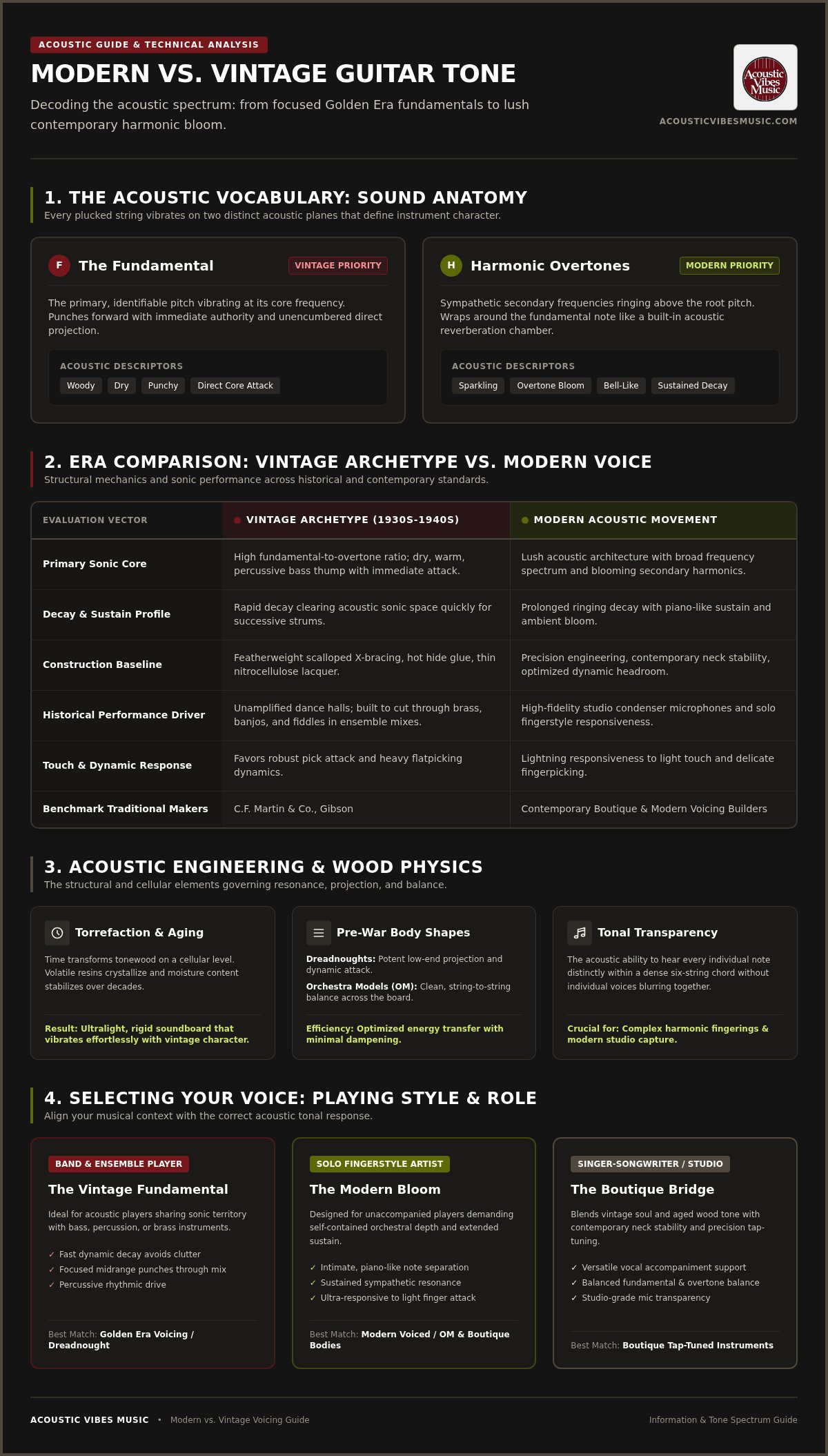
Many guitarists find themselves caught in a dilemma. They crave the dry, woody authority of an aged pre-war dreadnought, yet they depend on modern intonation, ergonomic neck profiles, and road-ready structural stability. Boutique bench luthiers resolve this tension entirely. By merging historical blueprint geometries with obsessive modern engineering, small-shop builders deliver instruments with vintage soul and modern operational reliability. This category bridges the divide in modern vs vintage guitar tone by executing tap-tuning, where builders hand-plane and tap each individual soundboard to locate its ideal resonant frequency before final assembly. Master workshops like Collings Guitars and Boucher Guitars lead this hybrid movement.
Collings instruments are renowned for taking classic pre-war designs and supercharging their clarity. A Collings flat-top keeps the dry, fundamental thump of the 1930s, but adds an explosive treble response and instantaneous string separation that traditional factory originals rarely achieved. Boucher approaches this balance from their home territory in Quebec, utilizing high-grade Adirondack spruce harvested directly from their backyard forests. Adirondack provides exceptional stiffness-to-weight ratios, delivering immense dynamic headroom that lets players dig in forcefully without tone compression. These heirloom-grade builds provide lifetime instruments for collectors who want pre-war sonic character paired with flawless, modern CNC precision.
The boundary between vintage warmth and modern clarity often comes down to precise joinery and finish application:
You no longer have to risk purchasing a temperamental vintage artifact to obtain deep, articulate projection. Explore our curated selection of High End Acoustic Guitars for Sale to secure an instrument that delivers Golden Era warmth alongside cutting-edge playability, or visit acousticvibesmusic.com to audition our boutique inventory today.
Selecting an acoustic guitar isn't about identifying an objectively superior instrument. It's about matching acoustic physics to your performance role. When evaluating modern vs vintage guitar tone, the core question is whether you need your instrument to sit neatly within a multi-instrument mix or fill an entire room on its own. Vintage voicing acts as a focused percussive anchor, slotting effortlessly beside vocals, mandolins, and drums. Modern voicing acts as a self-contained orchestra, radiating broad frequency bandwidth that envelops an audience in intimate acoustic arrangements.
Your musical context dictates which side of the tonal spectrum serves your arrangements best:
Evaluating an instrument's character requires more than reading tonewood specifications. Every soundboard brings individual stiffness, weight, and harmonic resonance to the table. When purchasing remotely, partnering with a knowledgeable specialist who understands how an instrument pushes air makes all the difference. An experienced ear can articulate whether a specific top leans dry and snappy or deep and shimmering.
Dialing in your sound also depends heavily on fine setup work. A skilled luthier can tailor string height, nut relief, and saddle density to accentuate either the snappy fundamental of a pre-war flat-top or the fluid sustain of a modern acoustic design. Whether you lean toward historic heritage or contemporary acoustic brilliance, take the time to audition instruments side by side. Explore the curated collection at Acoustic Vibes Music to find the precise voice that elevates your playing today.
Your musical identity deserves an instrument that responds effortlessly to your touch. Navigating modern vs vintage guitar tone isn't about deciding which era built the superior flat-top. It's about deciding whether your songs demand the dry, punchy focus of a pre-war fundamental or the lush, orchestral sustain of contemporary acoustic engineering. Both sonic worlds offer profound inspiration for players who value true craftsmanship.
At Acoustic Vibes Music, we treat acoustic selection as a personalized journey. As an authorized dealer for Martin, Taylor, and Collings, our hand-selected inventory brings together the finest expressions of both traditions. Every instrument receives meticulous care, backed by expert luthier setups and secure national shipping to guarantee peak playability from the moment you open the case. Explore our curated collection of Modern and Vintage-Voiced Masterpieces and discover the guitar that truly speaks your language.
The fundamental difference in modern vs vintage guitar tone centers on how sound decays and resonates. Vintage tone focuses on a dry, percussive fundamental note that speaks quickly and fades cleanly, avoiding muddy resonance. Modern acoustic tone prioritizes lush, three-dimensional harmonic overtones, long sustain, and an even, piano-like response across all six strings. This gives players two distinct acoustic textures for different performance environments.
Yes, modern guitars built with torrefied tonewoods and traditional bracing capture much of the authentic vintage voice. Torrefaction bakes away volatile resins and moisture, mimicking the cellular structure of aged spruce. When luthiers combine baked tops with hot hide glue and lightweight scalloped braces, a brand-new instrument can deliver the immediate, dry low-end thump typically found in pre-war originals without decades of waiting.
Bluegrass musicians favor vintage tone because its punchy, fundamental midrange cuts cleanly through loud acoustic ensembles. Fiddles, banjos, and mandolins produce dense high-frequency energy that easily overwhelms guitars with heavy sustain. The quick decay and focused low-end attack of a traditional flat-top, such as a pre-war mahogany dreadnought, establish precise rhythmic drive while preventing the mix from turning muddy during fast tempos.
Modern tone often suits contemporary fingerstyle better because it provides natural reverberation, rich sustain, and balanced touch sensitivity. Solo instrumentalists rarely share sonic space with other instruments, so they benefit from complex harmonic overtones that fill the room. Modern soundboard voicing allows gentle fingerpicking to bloom into expansive chord textures without demanding heavy right-hand force to extract tone and dynamic expression.
Yes, string alloy choices dramatically shift your acoustic voice toward either vintage warmth or modern brilliance. Nickel-bronze or monel strings reduce lingering overtones and emphasize a dry, woody fundamental that leans vintage. Phosphor bronze strings provide warm sustain and harmonic depth, while 80/20 bronze strings deliver bright, sparkling chime and immediate articulation that accentuates a modern acoustic profile.
Taylor Guitars and Lowden Guitars represent the quintessential modern acoustic sound. Taylor pioneered bright, articulate projection, precise note separation, and innovative V-Class bracing that extends sustain. Lowden crafts instruments with deep, airy three-dimensional overtones and unique tonewood pairings like cedar and walnut, making them world-renowned benchmarks for contemporary fingerstyle players who desire rich, orchestral complexity under their fingers.
Construction geometry and soundboard voicing actually shape an instrument's character more decisively than wood species alone. While rosewood adds warmth and mahogany offers punch, the builder's bracing pattern, top thickness, and joinery dictate how energy moves through the box. A modern-braced mahogany guitar will still produce more harmonic chime and sustain than a pre-war braced rosewood dreadnought voiced for dry projection.
Many boutique acoustic instruments purposefully bridge the modern vs vintage guitar tone gap. Master builders like Collings and Boucher pair traditional pre-war shapes and torrefied Adirondack spruce with modern neck reinforcement and precision tap-tuning. This hybrid approach produces the dry, authoritative fundamental of a vintage guitar alongside flawless intonation, balanced string separation, and long-term structural stability that touring players require.