My shopping cart
Your cart is currently empty.
Continue ShoppingIs it possible that the industry standard is actually just the baseline for what a world class guitar can achieve? When you compare the Martin OM-28 vs Collings OM2H, you aren't just looking at two instruments; you are weighing two distinct philosophies of lutherie. You likely already recognize that both of these models are legendary benchmarks for the Orchestra Model shape. Still, the choice is often paralyzing. You might worry that the Martin lacks that modern boutique sparkle, or conversely, that the Collings feels too clinical compared to the warm, woody heritage you have always craved.
We understand that an heirloom purchase requires more than just a spec sheet. It requires a deep connection to the instrument's tactile response and tonal character. This comparison reveals the nuanced differences in resonance and craftsmanship between these two icons. We will explore Martin's refreshed 2025 Standard Series features, including those comfortable rolled fingerboards, alongside the piano like clarity that defines the Collings OM2H. By the end, you will have total confidence in which neck profile and nut width suits your style, ensuring your next investment is one you will cherish for a lifetime.
The Orchestra Model changed everything. Born from a request to accommodate banjo players seeking more frets and higher tension, the OM became the ultimate Swiss Army knife for acoustic musicians. This body shape offers a 000-sized depth paired with a full 25.4-inch scale length, creating a balanced, punchy response that cuts through any mix. Understanding the Martin OM-28 vs Collings OM2H requires a deep dive into the DNA of these two powerhouses. While one represents the ancestral line of the American acoustic guitar, the other represents a relentless pursuit of modern refinement. Exploring the C. F. Martin & Company history reveals how this blueprint became the industry standard for Sitka spruce and East Indian rosewood construction.
The Martin OM-28 is the foundation. It's the instrument that defined what a versatile, high-performance guitar should be. As part of the refreshed Standard Series for 2025, the current OM-28 honors its legacy while embracing modern player needs. You get the classic herringbone trim and the iconic "CF Martin" headstock, but it's the internal architecture that truly sings. The 1/4-inch scalloped X-bracing provides that unmistakable "woody" thump and rich harmonic resonance. Traditionalists love this model because it feels like home. It offers a familiar, warm compression that rewards a light touch and stands up to aggressive flatpicking. You can explore our current selection of these Martin guitars to see how the 2025 updates, like the rolled fingerboard edges, have elevated this classic.
Bill Collings didn't set out to reinvent the wheel; he set out to perfect it. The "2H" designation identifies this model as a rosewood body with herringbone purfling, but the similarities to the Martin end at the spec sheet. Collings takes the pre-war Martin design and applies a level of precision that feels almost surgical. Every top is individually voiced, with luthier-shaved braces that maximize the potential of each specific piece of wood. This results in a "piano-like" clarity and exceptional note separation. While a heritage factory produces high-quality instruments with consistency, a boutique builder like Collings focuses on extracting the absolute maximum headroom and frequency response from every build. Browse our Collings guitars to witness this obsession with material excellence firsthand.
Deciding between the Martin OM-28 vs Collings OM2H often comes down to your investment philosophy for 2026. The Martin offers a connection to history and a tone that has defined thousands of recordings. The Collings represents a long-term investment in precision engineering and artisanal skill that many collectors believe justifies the price jump. Both are heirloom-quality instruments, but they serve different musical souls.
Choosing between the Martin OM-28 vs Collings OM2H is ultimately a choice between two distinct sonic fingerprints. While both instruments utilize the classic pairing of Sitka spruce and East Indian rosewood, the way they move air is fundamentally different. Martin leans into a "woody" heritage. It delivers a low-end growl and a percussive "thump" that feels grounded and earthy. This response is deeply tied to The history of the OM guitar, where Martin established the benchmark for a balanced but warm frequency response. It's a sound that feels lived-in from the first strum.
Collings takes those same raw materials and pushes them toward a "Hi-Fi" aesthetic. Imagine the clarity of a grand piano. Every note in a complex chord rings out with individual authority. There is no muddiness here. The Collings voicing emphasizes brilliant trebles and a flat frequency response across all six strings. This precision is achieved through meticulous top voicing, where luthier skill ensures that the Sitka spruce top remains stiff enough for power but thin enough for shimmering overtones. It's an exhilarating, modern sound that rewards technical accuracy.
The Martin OM-28 often exhibits a slight mid-range scoop. This creates space for the warm bass to bloom and the sweet trebles to sit just above the mix without sounding harsh. In contrast, the Collings OM2H provides a more immediate, "in your face" projection. Its overtones are crystalline and harmonically dense, filling the room with a lush, metallic ring that rosewood enthusiasts crave. Tonal headroom represents the maximum volume and intensity a top can handle before the sound begins to compress or distort, with Adirondack typically offering a higher ceiling than the more responsive Sitka. If you are curious how these woods compare to other combinations, our guide on Rosewood vs. Mahogany Back and Sides offers deeper insight into these foundational materials.
Dynamics are where these two truly diverge. The Martin responds beautifully to a light touch. It's a fingerstylist's dream, offering a soft compression that smooths out your attack. However, the Collings OM2H often wins for aggressive strummers. It has a significantly higher volume ceiling. You can dig in with a heavy pick and the guitar just gets louder without losing its composure. It's built for the player who needs to command a stage. Experience this power for yourself by exploring our side-by-side comparison of these world-class instruments.
The internal architecture of these instruments defines their soul. When examining the Martin OM-28 vs Collings OM2H, the most critical differences are often hidden beneath the Sitka spruce top. Martin utilizes a 1/4-inch scalloped X-bracing pattern, a design that has become the gold standard for creating a responsive, open sound. This technique involves carving away wood from the braces to allow the top to vibrate more freely, particularly in the lower frequencies. It's a heritage approach that prioritizes a lush, resonant bloom right out of the case. In contrast, Collings employs a "voiced" approach. Rather than following a rigid factory template, Collings luthiers hand-shave the braces for every specific guitar, tuning the top to its own unique resonant frequency. This results in a stiffer, more disciplined top that offers incredible projection and note separation.
The finish application also plays a vital role in vibration. Both builders use nitrocellulose lacquer, but their philosophies differ in execution. Collings is legendary for an ultra-thin, high-gloss nitro finish that is meticulously sanded to a mirror-like sheen. This thinness allows the wood to breathe and vibrate with minimal dampening. Martin's finish on the Standard Series is also high-quality nitro, but it leans toward a slightly more traditional application that feels substantial and classic. Both guitars feature professional-grade hardware, including open-gear tuners for a vintage aesthetic and genuine bone nuts and saddles to ensure maximum energy transfer from the strings to the bridge.
Martin's use of scalloped bracing is central to the history of the Orchestra Model. This structural choice balances the tension of the full scale length with a flexible top, giving the OM-28 its famous "scooped" and warm character. While some worry about the long-term structural integrity of lighter bracing, Martin's centuries of experience ensure these instruments remain stable for generations. Collings responds with a fit and finish that is often described as flawless. Their internal joinery is as clean as the external binding, reflecting a level of boutique precision that few heritage factories can match.
Visually, both instruments celebrate the "Style 28" aesthetic. You will find beautiful herringbone purfling and ivoroid binding that frame the East Indian rosewood back and sides perfectly. However, the grading of materials often differs. In a boutique environment, Collings selects from the top tier of "AAA" Sitka spruce, ensuring tight grain and exceptional stiffness-to-weight ratios. This obsession with material excellence makes these instruments highly sought after by serious players. If you are looking for High End Acoustic Guitars for Sale, understanding these build nuances is essential for choosing an heirloom that fits your specific playing style.
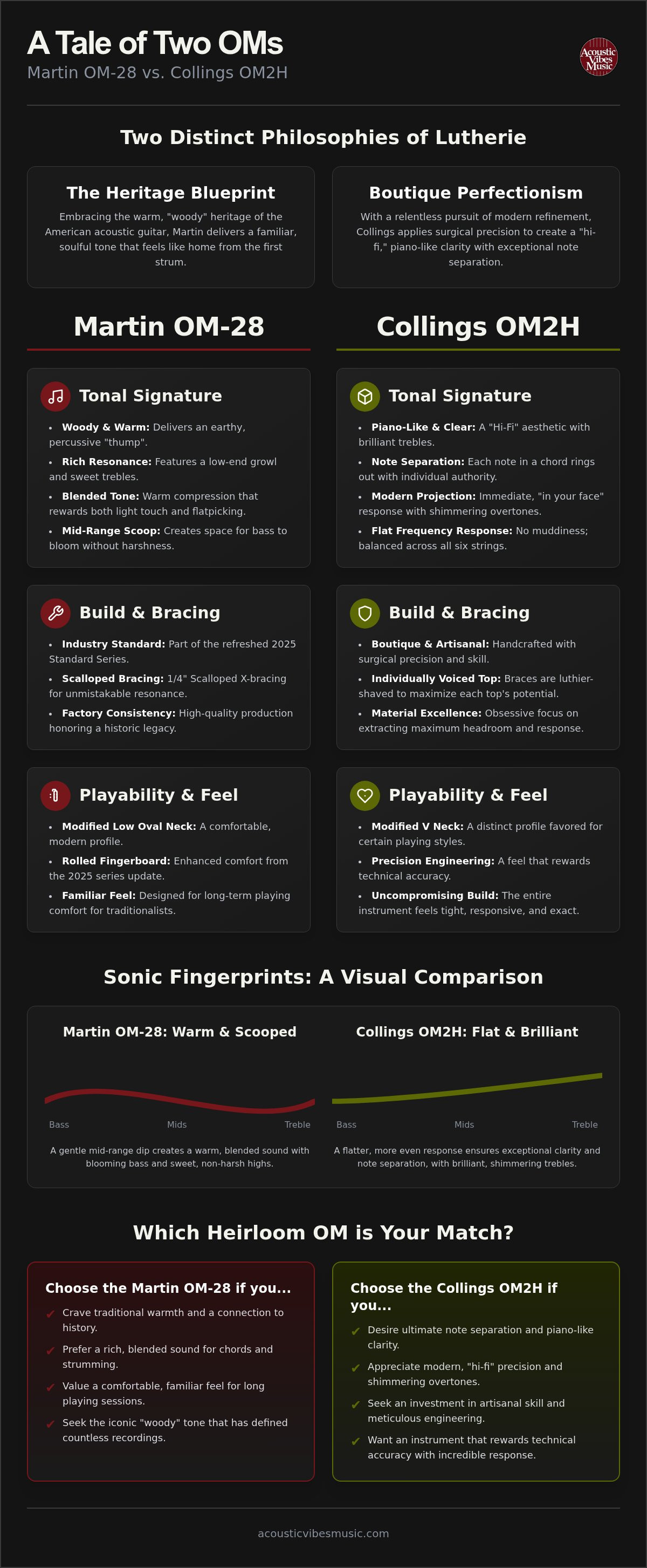
Tone might capture your heart, but playability determines how long you actually keep an instrument in your hands. When weighing the Martin OM-28 vs Collings OM2H, the tactile experience is where the two brands diverge most sharply. Both instruments utilize a 1 3/4" nut width, which has become the gold standard for the modern Orchestra Model. This width provides enough string spacing for clean fingerstyle work while remaining narrow enough for comfortable flatpicking and chordal transitions. However, the shape of the wood behind those strings tells a different story.
Martin's current OM-28 features the Modified Low Oval neck with a High Performance Taper. It's slim, fast, and designed to disappear in your hand. For the 2025 refresh, Martin added rolled fingerboard edges, a detail that significantly reduces "hand fatigue" during long sessions. If you prefer a neck that feels modern and effortless, the Martin is hard to beat. Collings takes a more traditional approach with their Modified V profile. It's a vintage-inspired shape that fills the palm more substantially than the Martin, yet it tapers beautifully as you move up the fretboard. It provides a solid anchor for your thumb, making it a favorite for players who find slim necks too "cramped" for complex chord voicings.
The finish on the neck also impacts your speed and comfort. Martin typically employs a satin finish on the back of the neck, which stays smooth even as your hands get warm. Collings uses a high-gloss nitrocellulose finish. While gloss can sometimes feel "sticky," the Collings application is so thin and expertly buffed that it feels remarkably fast. Fretwork is another area where the boutique nature of Collings shines. Every fret is leveled and crowned with surgical precision, often exceeding factory standards. Of course, even the finest instrument benefits from professional luthier maintenance to dial in the action to your specific touch. You can browse our current inventory to find an OM that has been expertly vetted for peak playability.
The OM body shape is beloved for its seated comfort. Unlike larger guitars, the narrow waist of an Orchestra Model allows it to sit lower on your leg, reducing shoulder strain. This makes it an ideal choice for songwriters and home players. If you are debating between body sizes, our guide on Dreadnought vs. Grand Auditorium for Strumming explains how these dimensions affect both sound and posture. In terms of weight, Collings builds tend to feel exceptionally light and balanced due to their meticulous wood grading, whereas the Martin OM-28 feels solid and dependable, like the heritage tool it is.
The choice between the Martin OM-28 vs Collings OM2H isn't about which guitar is better; it's about which luthier's vision aligns with your musical identity. If you are a "Traditionalist," the Martin OM-28 remains your benchmark. It provides that foundational, woody thump that has powered acoustic music for nearly a century. With the 2025 updates to the Standard Series, you get a vintage soul with modern playability that feels instantly familiar. This is the right choice for the player who wants their guitar to feel like a comfortable extension of their own history. It's a reliable, soulful companion that rewards rhythmic strumming and soulful leads alike.
Conversely, the "Precisionist" will find their home with the Collings OM2H. This instrument justifies its premium through a level of hand-voiced accuracy that large-scale production simply cannot replicate. If you demand crystalline note separation, immense headroom, and a "hi-fi" response that highlights every nuance of your technique, the Collings is the superior tool. It's a modern masterpiece designed for those who view lutherie as an art of obsessive refinement. Every strum feels like a high-definition experience, offering a projection that can command any room. Explore our Collings collection to see these precision instruments firsthand.
In the 2026 market, both instruments represent secure financial and musical assets. Martin’s unmatched brand recognition ensures a deep pool of buyers and consistent demand, protecting your investment through sheer legacy. However, the rarity factor of Collings adds a different layer of value. Because they produce a limited number of instruments per year, their boutique status often results in exceptional value retention within specialized collector circles. When exploring the pre-owned market, prioritize instruments with documented luthier maintenance. This ensures the structural integrity of the hand-shaved bracing remains exactly as the builder intended, preserving the instrument's long-term worth.
The "Woody" vs "Hi-Fi" debate ultimately ends at your fingertips. We act as your expert guide, but your ears must make the final call. We encourage every serious collector to experience these instruments in a curated environment where side-by-side comparison is possible. Hearing the low-end growl of a Martin against the shimmering trebles of a Collings in the same room provides a clarity no spec sheet can match. Take the next step in your journey toward owning a true heirloom instrument. Explore our curated collection of Martin and Collings guitars today and discover the sonic signature that finally speaks your language.
Selecting your next instrument is about more than just specs; it's about finding a partner for your creative expression. Whether you crave the historical resonance of Martin's scalloped bracing or the surgical clarity of a hand-voiced Collings top, you are investing in a lifetime of inspiration. The Martin OM-28 vs Collings OM2H debate highlights two different paths to the same goal: absolute musical excellence. One offers the comforting thump of heritage, while the other provides the crystalline headroom of modern boutique lutherie.
As an authorized dealer for both Martin and Collings, we provide the expert guidance you need to navigate this high-end investment. Every instrument in our curated gallery includes a professional luthier setup to ensure it performs perfectly from the moment you open the case. We offer nationwide shipping with expert packing, ensuring your heirloom arrives in pristine condition. Ready to experience these benchmarks for yourself? Shop our full collection of heirloom-quality acoustic guitars and discover the instrument that feels like a true extension of your voice. Your perfect tone is waiting.
"Better" is a matter of tonal preference rather than an objective ranking. The Collings OM2H is a boutique instrument featuring hand-voiced tops and a higher level of individual attention during construction. This often results in superior note separation and headroom. However, the Martin OM-28 offers the quintessential "woody" heritage tone that many players find more soulful and traditional. Both are professional-grade heirloom instruments built to the highest standards.
Both models excel at fingerstyle due to their balanced Orchestra Model body shape. The Martin OM-28 provides a warm, compressed response that rewards a delicate touch with rich harmonic bloom. Conversely, the Collings OM2H offers incredible clarity and string-to-string definition; this makes it ideal for complex arrangements where every note must ring out clearly. Your choice depends on whether you prefer a lush, blended sound or a precise, "piano-like" articulation.
No, both the Martin OM-28 and the Collings OM2H typically feature a 1 3/4" nut width as their standard specification. This width is widely considered the ideal compromise for modern players, providing ample room for fingerstyle techniques without feeling overly bulky for flatpicking or rhythm work. While custom options may exist through the Martin Custom Shop or Collings special orders, the standard production models are identical in this specific measurement.
The feel in your hand is one of the most distinct differences in the Martin OM-28 vs Collings OM2H comparison. Martin utilizes the Modified Low Oval profile with a High Performance Taper, which feels slim and modern. Collings employs a Modified V profile that is more substantial and vintage-inspired. While the Martin is designed for effortless speed, the Collings provides a solid anchor for the thumb that many traditionalists find more supportive.
Both brands offer exceptional resale value, though they appeal to different segments of the market. Martin benefits from massive brand recognition and a global secondary market, making their guitars very liquid assets. Collings guitars are produced in much smaller numbers; this creates a "rarity factor" that maintains high prices in boutique circles. As long as you maintain the instrument with professional luthier services, both will hold their value well over many decades.
The "Style 28" and "Style 2H" designations both refer to the classic combination of a Sitka spruce top, East Indian rosewood back and sides, and herringbone purfling. While the aesthetic blueprint is the same, the execution differs. Collings Style 2H features an ultra-thin nitrocellulose finish and hand-selected AAA-grade woods. Martin Style 28 focuses on the heritage appointments and "woody" tonal character that have defined the brand’s Standard Series for generations.
Yes, the Martin OM-28 is a highly versatile instrument that handles flatpicking with ease. Its 1/4-inch scalloped bracing allows the top to move efficiently, providing a punchy mid-range and a warm "thump" that works well for bluegrass or folk. While it may have a slightly lower volume ceiling than the more rigid, hand-voiced Collings top, it remains a favorite for flatpickers who value a traditional, blended ensemble sound over sheer projection.
No, Collings guitars do not require more maintenance than Martin guitars. All high-end acoustic instruments are crafted from solid tonewoods and are sensitive to changes in temperature and humidity. Regardless of the brand, you should schedule regular professional luthier maintenance to ensure the neck relief and action remain optimal. Protecting your investment requires consistent humidity control and periodic setups to account for the natural movement of the wood over time.