My shopping cart
Your cart is currently empty.
Continue ShoppingSelling your vintage acoustic on a public marketplace might look like the most profitable move, but it is often the most costly mistake a collector can make. You shouldn't have to choose between your personal safety and the true market value of your instrument. If you're wondering how to trade in a guitar without the headache of low-ball offers or sketchy parking lot meetups, you're in the right place. Respect the craft. Your current acoustic isn't just gear; it's a piece of artistry that deserves a professional, respectful transition.
It's natural to feel protective of your guitar's legacy while you simultaneously crave the superior resonance and tactile response of a new boutique build. This guide will show you how to secure a fair, expert valuation that honors the craftsmanship of your current piece. We will explore how to leverage tax-efficient trade-ins to maximize your budget and walk you through a technical appraisal process that ensures total peace of mind. From evaluating luthier-certified condition to selecting your next heirloom-quality Martin or Boucher, prepare to upgrade your sound with absolute confidence. Seek better tone. Explore the possibilities.
Trading in a guitar is more than a mere transaction; it's a strategic pivot in your musical journey. Think of it as liberating the equity trapped in your current instrument to fund your next sonic obsession. While a direct sale involves the uncertainty of finding a buyer and a consignment requires patience, a trade-in offers an immediate gateway to a superior build. At its core, every musical instrument carries a specific market weight that can be leveraged. When you understand how to trade in a guitar through a specialist, you move beyond the "gear for cash" mentality of big-box retailers. You enter a partnership where your instrument's heritage is respected. Consider these fundamental differences:
Timing is the primary variable here. A trade-in is the path of least resistance for those ready to walk away with a new Taylor or Lowden today. It provides instant gratification and removes the stress of a lingering sale. Conversely, How to Sell a Vintage Guitar on Consignment outlines a process that might yield a higher final payout but requires the instrument to sit in a showroom until the perfect buyer arrives. For the collector eager for a fresh voice and immediate inspiration, the trade-in is the definitive choice.
One of the most compelling reasons to choose a trade-in is the potential for significant tax savings. In many jurisdictions, sales tax is only calculated on the "boot," or the difference between your trade-in value and the price of the new guitar. Imagine you've set your sights on a $5,000 Martin. If you provide a trade-in valued at $2,000, you are only taxed on the remaining $3,000 balance. Depending on your local tax rate, this move can save you hundreds of dollars in out-of-pocket costs. This financial efficiency often bridges the gap between a shop's offer and the price you'd hope to get in a private sale, especially after accounting for marketplace fees and shipping insurance.
Boutique shops prioritize high-quality, well-maintained acoustics because they understand the soul of these instruments. They aren't looking for volume; they are looking for excellence. This is where the "Expert Guide" becomes essential. A specialist curator doesn't just look at a spreadsheet. They evaluate the wood, the luthier's work, and the instrument's potential. They help you transition from a guitar you've outgrown to a Collings or Boucher that will define your sound for decades. Respect the craft. Seek better tone. Your upgrade starts with a professional valuation.
Presentation is paramount. When you are researching how to trade in a guitar, it's easy to focus solely on the market price, but the physical condition of your instrument often dictates the final offer. A well-curated presentation signals to a curator that the instrument hasn't just been owned, it's been cherished. High-end tonewoods are living materials that respond to their environment. If your guitar is "thirsty" due to low humidity, it may exhibit a sunken top or sharp fret ends. This suggests neglect. Ensure your instrument is stabilized at a consistent 45 to 50 percent humidity for at least two weeks before your appraisal to ensure the wood is supple and resonant.
Provenance adds layers of value that go beyond the wood and wire. Gather every piece of documentation you have. This includes the original hardshell case, the certificate of authenticity, and even the original hangtags. These items verify the instrument's history and make it far more attractive to the next collector. Before the meeting, perform a light aesthetic cleaning. Use a high-quality microfiber cloth to remove surface oils and dust from the finish and fretboard. Avoid heavy waxes or silicon-based polishes. You want the tactile experience of the instrument to be clean and inviting, highlighting the artisanal skill of the original builder without masking it under layers of chemicals.
A professional appraiser looks past the surface shine to assess structural health. They will inspect for bridge lift, where the tension of the strings begins to pull the bridge away from the soundboard. They also check for "top belly," a slight bulging behind the bridge that can indicate internal bracing issues. The neck angle is perhaps the most critical factor for a high-end acoustic. A neck reset is a labor-intensive luthier service where the neck is detached and its heel is recut to correct the playing angle, a process that represents a major maintenance milestone and impacts an instrument's market price. If you notice high action that can't be fixed with a simple saddle adjustment, a reset may be on the horizon.
In the specialty market, original parts almost always command a premium. While you might view a new set of tuners or an aftermarket pickup as an "upgrade," a purist often sees it as a departure from the builder's intent. If you have replaced any components, try to include the original parts in the case. Modifications can be polarizing, especially on vintage pieces where every original screw matters. If you're concerned about how a specific repair or mod might affect your valuation, you can consult The Ultimate National Guide to Instrument Repair for a deeper look at professional standards. For those seeking the most accurate estimate, it is often wise to seek a professional luthier appraisal before finalizing your trade-in plans.
Understanding the financial mechanics behind an appraisal is vital for any serious collector. When you investigate how to trade in a guitar, you'll likely encounter the industry-standard "60-70% Rule." This means a shop typically offers between 60 and 70 percent of the instrument's anticipated resale price. This margin isn't just profit. It covers the overhead of a physical showroom, the cost of a professional setup, and the inherent risk of holding a high-end instrument in inventory until the right buyer arrives. Respect the market. A shop must balance its passion for craftsmanship with the practicalities of a sustainable business.
Market demand plays a decisive role in the final number. A Martin D-28 represents a liquid asset in the acoustic world; its legendary status ensures it will find a new home quickly. Conversely, a niche luthier brand might offer superior artisanal skill but appeal to a much smaller pool of buyers. This "Boutique Premium" also accounts for rare tonewoods and custom shop specifications. Master-grade Adirondack spruce, genuine mahogany, or rare rosewood back and sides change the math significantly. These materials aren't just features. They are investments in tone that a professional curator will recognize and reward.
Professional shops rely on concrete data rather than intuition. They utilize historical sales figures from high-end auction houses and specialized marketplaces to determine current value. There is a critical distinction between "asking prices" found on community forums and "sold prices" recorded in professional databases. Asking prices are often inflated by emotional attachment. A curator looks at what buyers actually paid in the last ninety days. Current inventory levels also matter. If a shop's gallery is already stocked with dreadnoughts, they may offer a different value than if they are actively seeking that specific body shape.
A luthier-led appraisal is a methodical journey through the instrument's health. It begins with a playability test to check for buzzes, dead spots, or fret wear. Next comes an internal inspection using mirrors and lights to ensure the bracing is secure and the bridge plate is intact. Finally, the finish is examined for checking, dings, or signs of previous repair. If you are unsure of your instrument's current standing, you can read Is My Old Guitar Worth Anything? Expert Evaluation for a deeper look at the criteria. A specialist shop provides a level of technical accuracy that general retailers simply cannot match. They see the potential in the wood. They understand the heritage of the build.
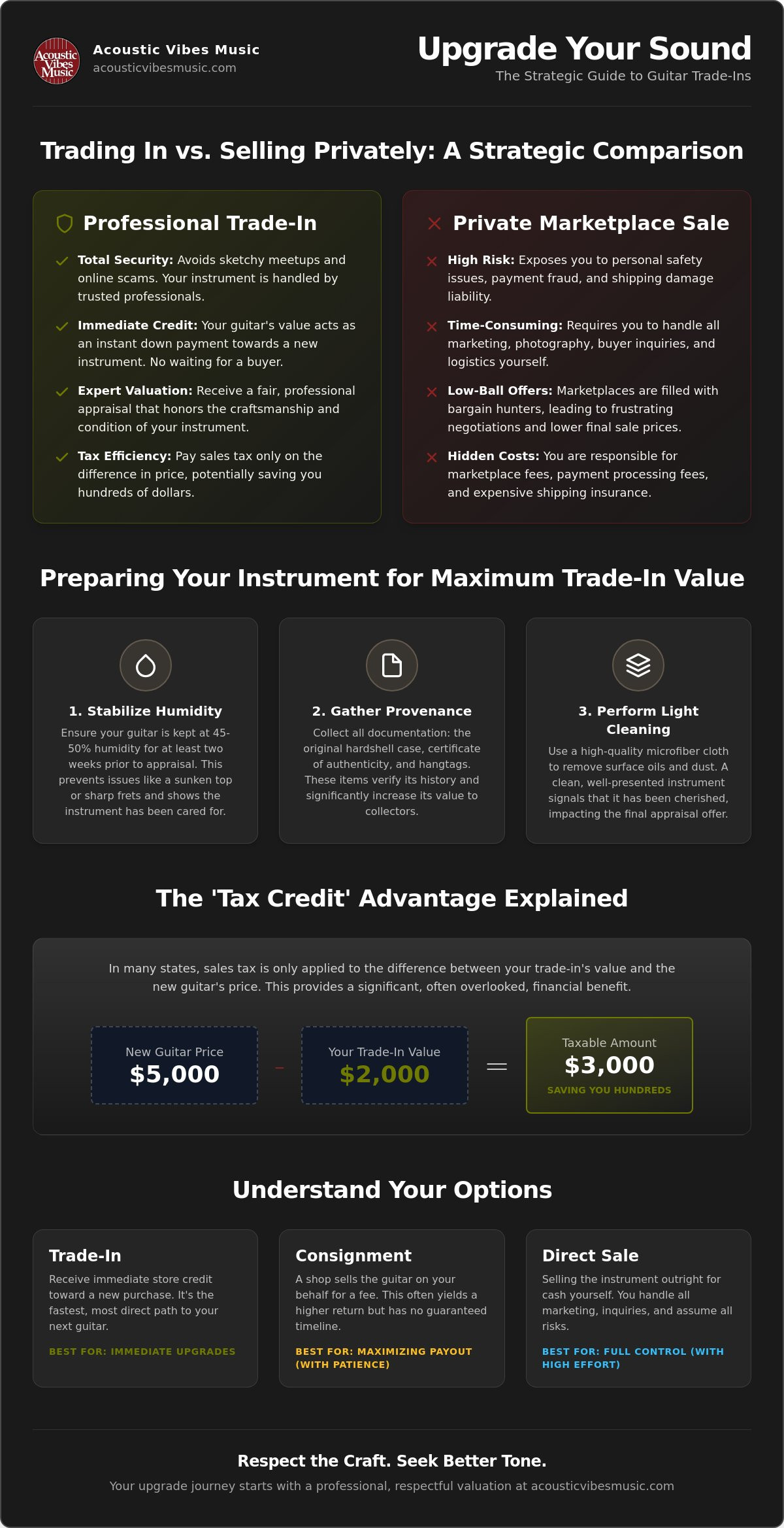
The allure of a higher price tag on a private marketplace is tempting. However, the gap between an online "asking price" and the cash that actually hits your bank account is often wider than it appears. Determining how to trade in a guitar effectively requires a cold look at the true costs of a private sale. Beyond the simple math, you must weigh the value of your time and the preservation of your peace of mind. A boutique trade-in isn't just a transaction. It's a professional transition that eliminates the volatility of the open market. Respect your schedule. Value your security.
Safety is a paramount concern that many collectors overlook until they're meeting a stranger in a parking lot with a five-figure instrument. The rise of "porch pirates" and sophisticated payment fraudulent schemes adds a layer of anxiety to private sales that simply doesn't exist in a showroom environment. Shipping a high-end acoustic yourself is equally fraught with risk. Professional packing materials, specialized insurance, and the constant fear of climate-related damage during transit can turn a DIY sale into a logistical nightmare. When you trade with a specialist, these burdens vanish. You walk in with your current guitar and walk out with a new masterpiece, often in the same hour.
A private sale rarely nets the full amount you see on the screen. Major online marketplaces typically command fees between 5 and 10 percent, with additional payment processing charges eating further into your margin. Then there is the "tire-kicker" factor. You will likely spend hours answering repetitive questions, providing additional photos, and defending your price against low-ball offers. For a busy professional or a serious enthusiast, those hours have a distinct monetary value. When you account for the cost of a professional-grade shipping box and the time spent managing the listing, the "profit" of a private sale begins to evaporate.
The trade-in route is the superior strategic choice when you are moving up the ladder of quality. If you are trading a standard model for an heirloom piece from a builder like Collings or Lowden, the tax advantages and immediate credit provide a seamless financial bridge. It is also the wisest move if your current instrument requires luthier work that you don't wish to manage yourself. A shop with an in-house luthier can absorb those repair costs more efficiently than a private seller can. If you are looking to acquire your next piece from a distance, understanding the nuances of Buying a Guitar Sight Unseen can help you navigate the process. To begin your own upgrade, view our latest acoustic arrivals and see what your next sound could be.
At Acoustic Vibes Music, we view the trade-in process as a rite of passage for the serious musician. We don't see your instrument as a SKU or a generic asset. Instead, we see it as a story told in wood and wire. Our philosophy centers on reverence. Every guitar that enters our gallery undergoes a meticulous evaluation by specialists who live and breathe acoustic architecture. If you've been wondering how to trade in a guitar while ensuring its legacy is respected, you've found your home. We bridge the gap between your current companion and your next heirloom.
Our inventory is a hand-selected collection of the world's finest builds. We provide a direct, expert-led path to legendary names like Collings and Lowden. You won't find a sterile retail environment here. Instead, you'll find fellow enthusiasts who can discuss the nuance of a specific bracing pattern or the tactile response of a rare tonewood. Learning how to trade in a guitar doesn't have to be a cold, clinical transaction. We help you navigate the transition with the confidence and passion of a dedicated specialist.
Distance shouldn't be a barrier to quality. Our national trade-in program is designed to bring our boutique expertise to your doorstep, regardless of where you live in the country. We facilitate remote appraisals with a level of precision that mirrors our in-person experience. We provide detailed guidance on professional shipping and secure evaluation, ensuring your instrument is protected every mile of the way. Our team possesses specialized expertise in handling and valuing world-class brands like Boucher and Taylor, recognizing the unique characteristics and artisanal skill that define their market value.
The search for "the one" is a personal journey. It's about finding that specific resonance that speaks to your playing style and aesthetic sensibilities. Whether you're a seasoned collector or a newcomer to the premium market, we're here to act as your trusted advisor. Start the conversation with our expert staff today. We take the stress out of the process, allowing you to focus on the joy of discovery and the pursuit of superior tone. Contact us today to discuss your trade-in and explore our current collection. Your next level of acoustic excellence is waiting. Explore the possibilities. Seek better sound.
Your journey to a superior acoustic shouldn't be defined by the stress of private sales or the uncertainty of generic retailers. You now understand the strategic advantages of professional trade-ins, from leveraging tax credits to ensuring your instrument receives a luthier-certified appraisal. By focusing on structural integrity and provenance, you can maximize your credit and move closer to that heirloom-quality build. If you've been researching how to trade in a guitar to reach that next level of performance, the path is clear. Trust the experts.
Acoustic Vibes Music acts as your dedicated guide in this transition. As an authorized dealer for the Martin Custom Shop Expert program, we offer unparalleled access to rarity and craftsmanship. Our national shipping experts handle every high-end instrument with precision, while our in-house luthier ensures every valuation respects the soul of the wood. Don't settle for a sound that no longer inspires your creativity. Explore our curated collection of world-class acoustic guitars and start your trade-in today. Discover your next masterpiece. Seek better tone.
You can typically expect an offer between 60% and 70% of the instrument's current market resale value. This industry-standard margin accounts for the shop's overhead, the cost of professional luthier work, and the risk of holding the item in inventory until it finds a new home. While this is less than a private sale price, the immediate credit and significant tax benefits often bridge the financial gap for collectors.
You aren't required to change the strings, but fresh strings can significantly improve the first impression during a playability test. Bright, new strings allow the curator to hear the true resonance and harmonic potential of the tonewoods. If the strings are corroded or dead, it might mask the guitar's quality and lead to a more cautious valuation during the technical appraisal process.
Yes, consolidating multiple instruments into one heirloom-quality piece is a common strategy for serious collectors. This approach allows you to trade in several mid-tier acoustics to fund a single masterpiece from world-renowned builders like Collings or Boucher. It's an efficient way to clear space in your gallery while significantly upgrading your overall sonic palette and investing in superior craftsmanship.
Most professional shops will accept instruments with repaired cracks, provided the work was performed by a skilled luthier and the repair is stable. A well-cleated and sealed crack doesn't disqualify a guitar, though it will impact the final market value compared to a mint-condition specimen. Full transparency about the instrument's history ensures a smooth and fair appraisal when you are learning how to trade in a guitar.
In many states, you only pay sales tax on the "boot," which is the price difference between your new purchase and your trade-in. If you're researching how to trade in a guitar, this is a major financial advantage to consider. By reducing the taxable total of your new instrument, you can often save hundreds of dollars that would otherwise be lost in a private cash transaction.
Established legacy brands and high-end boutique names are the most desirable for trade-ins due to their high market liquidity. Instruments from Martin, Taylor, Gibson, and Collings maintain their value exceptionally well over time. Specialized curators also seek out artisanal builds from Lowden and Boucher because their rarity and superior construction consistently attract discerning buyers who value material excellence and artisanal skill.
You can absolutely facilitate a trade-in remotely through a professional national shipping program. Expert shops provide detailed instructions for secure packing and coordinate the logistics for a safe arrival at their facility. Once the instrument is received, a luthier performs a physical inspection to finalize the valuation, allowing you to upgrade your sound from anywhere in the country without the need for a local visit; however, for those who prefer the hands-on experience of a showroom, E-Tours d.o.o. can assist with your travel arrangements.
The choice depends on your specific timeline and financial goals. A trade-in offers immediate gratification and instant credit toward your next purchase, which is ideal if you've already found your next dream guitar. Consignment might net a higher final payout, but it requires the patience to wait for the right collector. For those ready to move into a new sound today, the trade-in path provides the most seamless experience.