My shopping cart
Your cart is currently empty.
Continue ShoppingWhat if the most exquisite acoustic guitar you'll ever own is currently sitting in a humidity-controlled vault halfway across the country? The prospect of buying a guitar sight unseen often feels like a high-stakes gamble, especially when you're pursuing the heirloom quality of a Collings or a Boucher. You worry about the neck profile feeling wrong or the nightmare of a cracked soundboard during transit. It's a natural hesitation for any serious player who values the tactile response of premium tonewoods and artisanal craftsmanship.
We understand that apprehension because we share your reverence for these instruments. This guide transforms that uncertainty into a masterclass on remote acquisition. You'll learn the specific technical questions to ask about saddle height and fret wear; how to navigate return policies from makers like Taylor or Gibson; and the exact steps to take when that box arrives on your doorstep. We'll cover the latest 2026 shipping insurance standards and CITES rosewood updates to ensure your investment is protected from the moment it leaves the gallery until it's safely in your hands.
We’ve entered a golden age for guitar collectors. While traditionalists once insisted you must feel the neck and hear the resonance in person before committing, the modern market has evolved. Today, online music retailers have replaced the local corner shop for those seeking truly exceptional, heirloom-quality instruments. Buying a guitar sight unseen isn't just a convenience; it's often the only way to secure a world-class build that meets your exact tonal requirements. This shift has turned the entire country into your personal showroom, provided you know how to vet the curator holding the keys.
There is a massive difference between purchasing a production-line model and a boutique, hand-built instrument. In previous decades, players feared the "dud" because manufacturing tolerances were wider. In 2026, precision technology has made high-end production models from builders like Taylor and Martin remarkably consistent. The "individual character" myth, which suggests every acoustic is wildly different, has been tempered by modern CNC precision. While tonewoods still possess unique voices, the variation is no longer about quality, but about subtle tonal colors. When you step into the world of Collings or Boucher, you aren't just buying a brand. You're buying a specific, hand-voiced masterpiece. Your goal is to find a seller who acts as your proxy, providing the ears and eyes you can't use in person.
Finding a specific tonewood combination often requires a national search. If you’re hunting for a specific sinker redwood top paired with master-grade walnut, you won't find it at a local chain. Specialized dealers bridge this gap. High-resolution audio samples and 4K video demos have revolutionized the process, allowing you to hear the overtones and see the grain detail from your living room. You can now analyze the sustain and decay of a Lowden with more clarity than you might find in a noisy, untreated showroom. Explore the inventory. Listen to the resonance. The digital sensory experience is now incredibly sophisticated.
The allure of a "steal" on a private auction site is strong, but these deals often carry hidden costs. A private seller rarely has the tools or expertise to verify neck relief, humidity damage, or structural integrity. A boutique shop provides a safety net. Every instrument should undergo a professional luthier inspection before it's even listed. This ensures that when you receive your Gibson or Yamaha, it’s not just "as described," but optimized for playability. A professional setup tailored to your picking style is the ultimate insurance policy when buying a guitar sight unseen.
When you're buying a guitar sight unseen, the dealer's technical prowess is your only real safeguard. High-end instruments are living, breathing objects made of organic materials. They react to their environment. A trusted curator doesn't just pull a box from a warehouse; they act as a vigilant gatekeeper. Start by scrutinizing the listing itself. If you see copy-pasted manufacturer specifications and stock photography, move on. A premier shop provides "In-Hand" descriptions that detail the specific resonance, weight, and neck feel of the exact serial number you’ll receive. You should be looking at the actual grain of the wood, not a generic representative image.
Verify that the shop maintains an on-site luthier or a dedicated professional repair department. This is a non-negotiable requirement for high-stakes acquisitions. Salespeople can be enthusiastic, but a luthier provides the objective technical verification you need. Ask about the "Phone Test." A five-minute conversation with a knowledgeable specialist often reveals more than a dozen emails. They should be able to describe the tonal headroom or the subtle V-shape of a neck profile with the passion of a fellow player. This level of engagement is what separates a world-class gallery from a high-volume warehouse. While you're at it, review the FTC guidelines for online shopping to ensure you understand your basic consumer protections regarding shipping and delivery.
Detailed documentation is the hallmark of a professional. Look for comprehensive spec sheets that include precise nut widths and string spacing at the bridge. These measurements dictate playability. Don't hesitate to request "natural light" photos. Studio lighting can sometimes mask finish nuances or grain character that only becomes apparent under the sun. A truly transparent dealer will even provide a bespoke video demo of that specific instrument to showcase its unique voice. If you're ready to start your journey, explore our current selection of hand-selected acoustic guitars.
Does the dealer truly understand the fundamental differences between Martin Guitars and Collings Guitars? It's about more than just the logo on the headstock. It's about understanding the heritage of the bracing and the philosophy behind the build. You want to speak with an enthusiast who knows why a certain luthier chose Adirondack spruce over Sitka for a specific model. A specialist shop focused exclusively on acoustic instruments will always offer a deeper level of insight than a general music store that treats guitars like any other commodity. Successful buying a guitar sight unseen hinges on this shared passion for excellence.
Precision is your best friend. When buying a guitar sight unseen, don't settle for vague descriptions like "it plays great." You need data. Ask for specific action height measurements at the 12th fret. A fingerstyle player might prefer a low, fast 5/64 of an inch on the low E string. A heavy strummer usually needs more clearance, perhaps 6/64 or 7/64, to prevent buzzing during aggressive play. Check the saddle height too. You want to see plenty of "meat" left on that bone. If the action is already low but the saddle is shaved down nearly flush with the bridge, you'll have no room for future adjustments as the guitar naturally moves over time.
Verify the truss rod functionality before committing. Ask the dealer if the neck is currently under proper tension and how much travel is left in the rod. A "maxed out" truss rod is a significant red flag. Check for humidity history as well. Run your fingers along the edge of the fretboard. Do the fret ends feel sharp? This "sprouting" indicates the wood has shrunk due to dry conditions. While often fixable with a professional setup, it’s a telling sign of how the instrument was stored. Taking these technical steps is a vital part of protecting your online purchase and ensuring your investment remains structurally sound for decades.
Request a "straight edge" test. This involves placing a long, precision level along the frets to see where it lands relative to the bridge. If the edge falls significantly below the top of the bridge, a costly neck reset might be in your future. Inspect the area behind the bridge. A slight "belly" is normal for a responsive, lightly braced acoustic, but actual bridge lift, where you can slide a business card under the wood, indicates a structural failure. For used or consignment pieces, ask for macro photos of the first five frets to check for divots or significant wear that might require a level and crown.
Sound is subjective, so use specific vocabulary to bridge the gap. Are you looking for the "woody and dry" fundamental of a mahogany Martin or the "modern and lush" overtones of a rosewood Lowden? Consider how body shapes influence the voice. Choosing between a Dreadnought vs Grand Auditorium will radically change the projection, bass response, and overall comfort. Finally, ask about the specific weight of the instrument. A lighter guitar often indicates better resonance and more responsive tonewoods, which is a hallmark of premium craftsmanship.
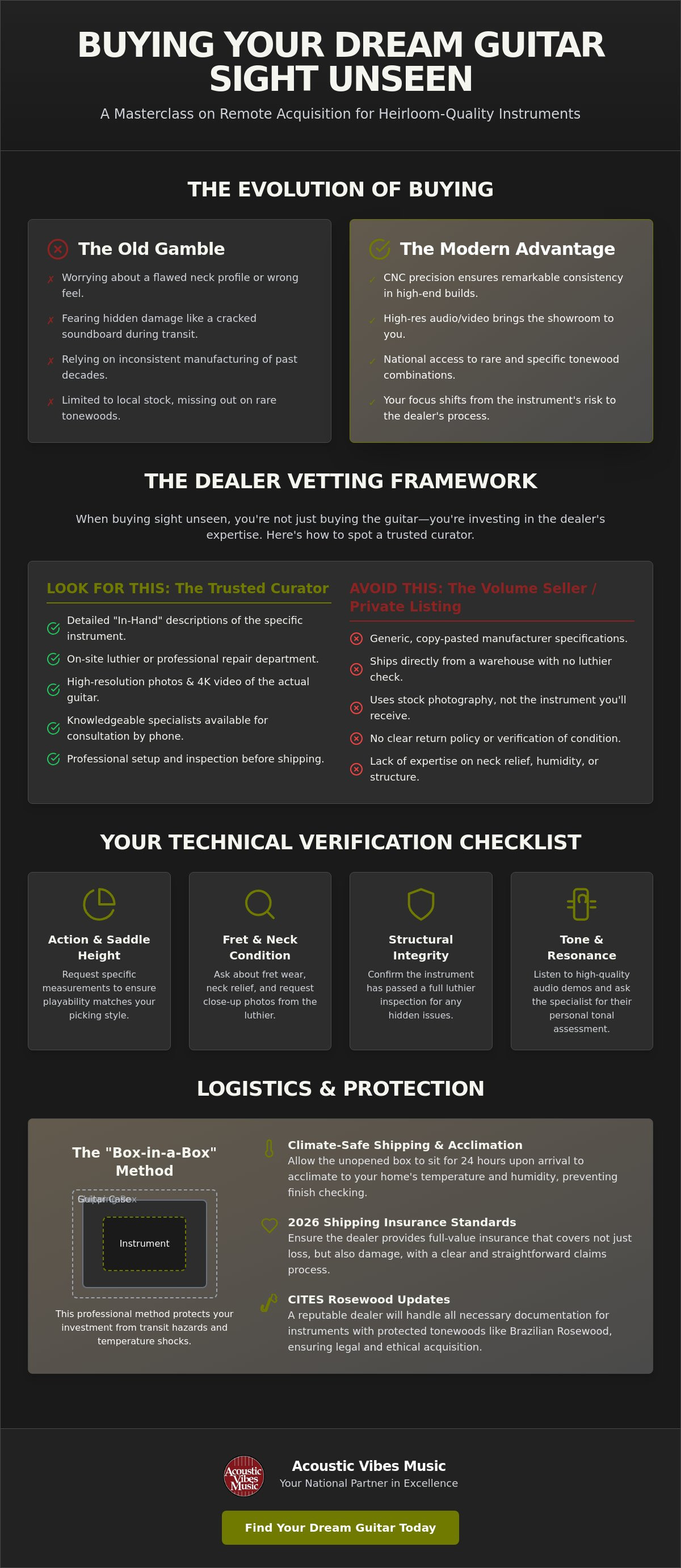
The logistics of high-end instrument acquisition are just as critical as the selection process. When buying a guitar sight unseen, the transition from the dealer’s vault to your front door is the moment of highest vulnerability. Professional curators mitigate this risk through the "box-within-a-box" method. This involves suspended packing within a heavy-duty outer carton, providing a protective crumple zone that absorbs transit shocks. Headstock support is equally vital. A properly packed Boucher or Collings should have no internal movement. If the case can shift within the box, the packing has failed.
Climate variability poses the greatest threat to fine tonewoods. Shipping a master-grade acoustic during a February freeze or a July heatwave requires tactical planning. We often recommend holding shipments if extreme weather is forecasted along the transit route. Insurance is your final safety net. Ensure the dealer provides full-value coverage that includes transit damage. Most reputable galleries handle the claim process themselves, but you must document everything. Photograph the box before you even cut the tape. If you see a puncture or a crushed corner, record it. This evidence is crucial for a successful claim.
Choose the fastest transit time your budget allows. While ground shipping is economical, "Overnight" or "2-Day" services minimize the time an instrument spends in unconditioned warehouses. Rapid transit also reduces exposure to extreme altitude and pressure changes that can stress delicate acoustic bracing. If you’re ready to bring a world-class instrument home, browse our current inventory of premium acoustics and let us handle the logistics with expert care.
Patience is the most difficult part of the process. Follow the "24-Hour Rule" without exception. If a guitar arrives in a cold climate, the finish and wood are contracted. Opening the case in a warm room causes the materials to expand at different rates, often resulting in "finish checking" or spiderweb cracks in the lacquer. Keep the box sealed for at least four hours. Then, open the box but keep the case closed for the remainder of the day. Once the case feels room-temperature to the touch, you can safely reveal your new treasure. Check for bridge integrity and neck relief immediately. If you notice a "transit-related" buzz, it’s often just the wood settling into a new humidity environment. Give it 48 hours to stabilize before requesting a luthier adjustment.
At Acoustic Vibes, we view ourselves as a bridge between master luthiers and discerning players. Buying a guitar sight unseen shouldn't feel like a compromise; it should feel like an invitation to excellence. Our curation process is notoriously rigorous. We reject more instruments than we accept, ensuring that only those with exceptional tonal character and structural integrity make it into our gallery. Whether you're eyeing a precision-engineered Taylor or a meticulously crafted Yamaha, you aren't just getting an instrument out of a box. You're receiving a piece that has been vetted, played, and approved by enthusiasts who live for these details.
Every high-end purchase includes a professional luthier setup tailored to your needs. This isn't a cursory check. Our technicians refine the action, inspect the nut slots, and ensure the intonation is perfect before the guitar is even considered for packing. We offer an "In-Hand" guarantee that goes far beyond a standard spec sheet. We describe the soul of the instrument, focusing on the way the mid-range blooms or how the top reacts to a light touch. This level of intimacy ensures that your expectations aren't just met; they're exceeded. We want you to feel the instrument's personality before you even strike the first chord.
Our appointment-based repair shop is the heart of our operation. It serves as a testament to our technical authority and our commitment to the long-term health of your collection. We handle national shipping with obsessive care, utilizing the same protective strategies discussed earlier to ensure a safe arrival. This dedication is why serious collectors trust us when searching for Investment Grade Acoustics. We don't just ship boxes. We deliver legacies that will be passed down through generations.
Ready to find your next voice? Start a conversation with our expert guides today. We're here to answer the technical questions that matter to you, from bridge spacing to tonewood density. We even offer personalized video demos of your specific instrument, allowing you to hear its unique resonance and see its grain character in high definition. Buying a guitar sight unseen is a journey of trust, and we’re honored to be your guide. Browse our curated collection of world-class acoustic guitars and discover the difference that expert curation makes to your playing experience.
The journey to finding your perfect acoustic voice doesn't have to be limited by geography. By shifting your focus toward rigorous dealer vetting and precise technical verification, you transform the process of buying a guitar sight unseen into a sophisticated, low-risk acquisition. You now have the tools to demand "In-Hand" descriptions, verify neck geometry, and manage the critical acclimatization period with professional precision. The fear of the unknown is replaced by the thrill of discovery.
As an authorized dealer for legendary names like Martin, Taylor, and Collings, we're dedicated to maintaining the highest standards of instrument care. Our on-site professional luthier services and national shipping expertise ensure that every guitar arrives in peak playing condition, regardless of the distance. We're ready to act as your expert eyes and ears in the gallery. Don't let distance stand between you and an instrument that inspires your best work.
Explore our hand-selected inventory of premium acoustic guitars and start a conversation with us today. Your next heirloom is waiting.
It is absolutely safe when you partner with a specialized curator who prioritizes technical transparency over high-volume sales. Modern precision manufacturing and climate-controlled shipping have minimized the risks that once plagued the industry. Success in buying a guitar sight unseen depends on the dealer’s ability to act as your expert surrogate. Look for shops that provide detailed in-hand reports and high-resolution media to ensure the instrument meets your specific standards.
Ask for the specific action height at the 12th fret and the remaining saddle height. This single data point reveals more about the guitar's current health and future longevity than any subjective description. A healthy neck angle and a tall saddle ensure you have room for adjustments as the wood moves over time. If a dealer cannot provide these measurements, they aren't providing the level of technical scrutiny required for a high-end acquisition.
Wait a full 24 hours before opening the case to allow the instrument to acclimate to your home’s climate. Rapid temperature shifts cause wood and lacquer to expand at different rates; this often results in spiderweb-like cracks known as finish checking. Keep the shipping box sealed for the first few hours, then move the case into your playing room while keeping it closed. This patience protects the pristine aesthetic of your new heirloom.
Most premier dealers include a professional setup before the instrument leaves the shop, but wood is organic and reactive. Your new guitar may require minor adjustments to the truss rod or saddle after it stabilizes in its new environment. Give the instrument at least 48 hours to settle before making changes. A reputable shop will have already optimized the playability, so any necessary tweaks should be very subtle rather than structural.
Reputable galleries provide full-value insurance and take responsibility for the instrument until it reaches your hands. If you notice box damage upon delivery, document it immediately with photos before opening the package. Most professional curators will handle the claim directly with the carrier, offering you a full refund or a replacement. This safety net is a primary reason to choose an authorized dealer over a private seller on an auction site.
Verify that the dealer lists the specific serial number and provides "In-Hand" photos of that exact unit. High-end acoustics have unique grain patterns in the tonewoods that act like fingerprints. If the images look like generic manufacturer stock photos, ask for natural light shots of the actual guitar. A dedicated specialist will always be happy to provide bespoke photography or video to confirm you are receiving the specific masterpiece you've selected.
Most elite dealers offer a trial period, often ranging from 48 hours to 7 days, specifically to ensure the tone meets your expectations. Because sound is subjective, this window allows you to experience the instrument’s voice in your own acoustic space. Always review the return policy before purchasing, as you may be responsible for return shipping and insurance costs. This policy provides the ultimate peace of mind when buying a guitar sight unseen.
Pricing reflects the rarity of materials, the builder’s artisanal reputation, and the level of service provided by the dealer. A master-grade Adirondack spruce top or a rare set of rosewood will command a significant premium over standard materials. Additionally, shops that include professional luthier setups and climate-controlled shipping may have different pricing structures than warehouse retailers. You are paying for the technical expertise and the curation process that ensures a world-class playing experience.