My shopping cart
Your cart is currently empty.
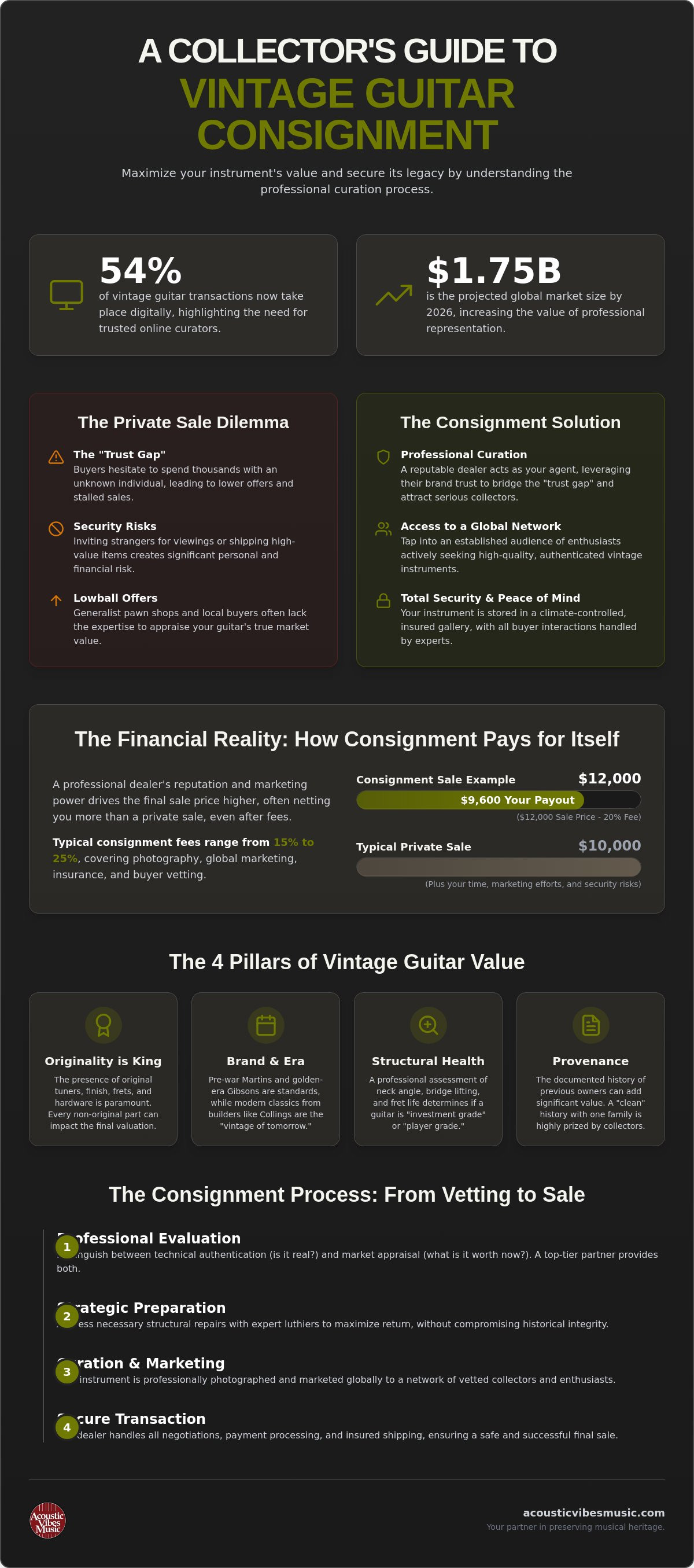
Continue ShoppingDid you know that 54% of vintage guitar transactions now take place digitally? While the global market is projected to reach $1.75 billion by 2026, the prospect of shipping a $10,000 instrument to a stranger or being lowballed by a local generalist shop still keeps many collectors awake at night. You've spent years caring for a piece of musical history, so it's natural to feel protective of its value and its legacy. Learning how to sell a vintage guitar on consignment is the most effective way to turn that anxiety into a premium result.
We understand that you aren't just looking for a transaction; you're looking for a partner who reveres fine craftsmanship as much as you do. This guide will show you how to navigate the consignment process to secure the highest market price while ensuring your instrument stays safe. We'll cover everything from accurate condition grading to choosing a curator who can place your acoustic or classical masterpiece in the hands of a serious collector.
Your vintage instrument is more than just wood and wire; it's a piece of musical heritage with a unique voice and story. When you're ready to pass that legacy to a new owner, understanding What is Vintage Guitar Consignment is your first step toward a successful sale. Simply put, consignment is a collaborative arrangement where a specialized dealer acts as your agent, leveraging their expertise and audience to sell your instrument in exchange for a percentage fee. It's a strategy designed for the patient collector who values a higher final payout over an immediate, often lower, cash buyout.
The "Trust Gap" is the primary reason high-end collectors flock to reputable shops. A private buyer on a mass-market platform often feels uneasy spending five figures on a guitar they haven't held. They worry about hidden repairs or inaccurate descriptions. A reputable gallery bridges this gap with professional authentication and a trusted brand name. This is why a vintage Martin or a pre-war Gibson consistently commands a higher price in a curated environment than it does on a standard auction site. When you learn how to sell a vintage guitar on consignment, you're essentially hiring a professional to handle the "trust" aspect for you.
In the 2026 market, boutique curation has become the gold standard. While 54% of transactions are digital, serious buyers are moving away from faceless platforms in favor of experts who can speak to the specific resonance and tactile feel of a piece. This shift favors the consignor. By choosing this path, you tap into a network of enthusiasts who are searching for the specific artistry found in builders like Collings.
Industry fees typically range from 15% to 25%. While that might seem like a significant slice, consider what it covers. You're paying for high-fidelity photography, global marketing, and the vetting of serious buyers. The math often favors the shop. A dealer might sell your instrument for $12,000, netting you $9,600 after a 20% fee. In contrast, a private sale might struggle to reach $10,000 because you lack the shop's authority and reach. The professional backing effectively pays for itself by driving the final sale price higher.
Selling a high-value heirloom from your home is risky. It invites "tire kickers" and potential scammers to your door. Consignment eliminates this threat entirely. Your instrument lives in a secure, climate-controlled gallery, protected by professional shop insurance. Experts handle every interaction, ensuring your guitar is treated with the reverence it deserves while it awaits its next home. This peace of mind is invaluable when dealing with instruments that are often irreplaceable.
Before you decide how to sell a vintage guitar on consignment, you must look beyond the serial number to understand how the current market perceives your instrument. A guitar isn't just a tool for music; it's a tangible asset whose value fluctuates based on global demand and historical significance. Identifying where your piece sits in the hierarchy of "investment grade" versus "player grade" is the first step toward a successful partnership with a gallery.
Collectors still chase the "Big Three" with fervor. Pre-war Martin Guitars and golden-era Gibson acoustics remain the gold standard for many. However, the 2026 market shows a sophisticated appetite for modern classics from boutique builders like Collings. These instruments are often viewed as the "vintage of tomorrow," holding their value remarkably well due to their superior construction and limited production runs. Understanding these nuances helps you set a realistic expectation for your final payout.
Originality is the currency of the vintage world. Every detail matters. The presence of original tuners, the specific pattern of finish checking, and the remaining life in the frets all tell a story. Even the provenance, or the documented history of previous owners, can add thousands to a valuation. A guitar that stayed in one family for fifty years often carries a "clean" aura that collectors will pay a premium to acquire. If you're curious about your own instrument's history, you can browse our current collection to see how similar pieces are positioned.
Market value is the intersection of rarity, condition, and current buyer sentiment. While traditional American brands lead the way, we're seeing increased interest in international artistry. Brands like Lowden and Boucher are carving out significant niches in the vintage acoustic market. This diversity means your instrument might appeal to a specific subset of collectors looking for a particular tonal profile or artisanal method of creation.
There's a critical difference between an insurance appraisal and a fair market value appraisal. One protects you against loss, while the other determines what a buyer will actually pay today. A professional appraisal provides the data needed to set a "consignment floor price," ensuring you don't leave money on the table. For a deeper look at this process, read our guide on Is My Old Guitar Worth Anything? Expert Evaluation. Having this documentation in hand clarifies the path forward and builds immediate trust with potential buyers.
Choosing the right gallery is the most critical decision you'll make when learning how to sell a vintage guitar on consignment. It's about finding a specialist who understands the difference between a mid-century Martin and a modern boutique build. A generalist shop might see a used instrument; a passionate curator sees a legacy. Start by vetting their reputation within the collector community. Look for a partner who offers in-house luthier services, as this ensures your guitar is in peak playing condition before it ever hits the sales floor.
The consignment agreement is your roadmap. It should clearly state the percentage fee, the duration of the listing, and who pays for insurance while the instrument is in the shop's care. Pay close attention to "approval periods." Most high-end sales include a 48 to 72-hour window where the buyer can evaluate the instrument. Understanding how this affects your payout timeline prevents surprises later. A professional agreement protects your asset and sets the stage for a seamless transaction.
Anxiety over shipping a high-value heirloom is real. Reputable dealers often provide pre-paid, fully insured shipping labels and specific packing instructions. Using a specialized courier and overnight transit minimizes the time your instrument spends in a truck. This logistical precision is part of the service you're paying for. Once the guitar arrives, the shop should provide an immediate confirmation of its condition, giving you peace of mind that your piece is safe.
The payout window is where transparency matters most. While some marketplaces leave you waiting weeks for funds to clear, a professional gallery typically settles accounts shortly after the buyer's approval period ends. This structure protects both parties. It ensures the transaction is finalized with total confidence and that you receive your maximum value without unnecessary delays.
Before signing any paperwork, use these questions to gauge if a dealer truly understands how to sell a vintage guitar on consignment with the expertise your instrument deserves:
In 2026, local foot traffic is only a small fraction of the story. A premier shop uses 4K photography and high-fidelity audio samples to reach collectors in New York, London, or Tokyo. This digital excellence is what allows a buyer to feel confident Buying a Guitar Sight Unseen. When your instrument is presented as a work of art, it attracts a higher caliber of buyer. This global visibility is the key to maximizing your final payout.
The difference between a quick sale and a listing that lingers often comes down to the final five percent of preparation. When you're figuring out how to sell a vintage guitar on consignment, you shouldn't overlook the tactile experience a buyer expects. A professional cleaning is the first step. This isn't a deep scrub; it's a methodical removal of decades of skin oils and dust that allows the natural grain and vintage patina to shine. You want the instrument to look cared for, not refinished. Collectors value the "vibe" of an old instrument, but they won't pay a premium for neglect.
Structural health is even more critical. A thorough luthier evaluation is non-negotiable. We check for common age-related issues like loose braces, bridge lifting, or a shifting neck angle. Addressing these before the guitar hits the gallery floor is a high-yield investment. In fact, a vintage acoustic with a perfect setup and comfortable action can often command 15% to 20% more than an identical model that's difficult to play. Buyers want an instrument they can enjoy immediately, not a project that requires a visit to the shop.
Gathering your documentation is the final piece of the puzzle. If you have the original hard-shell case, hang tags, or even the original sales receipt, include them. These items act as a pedigree for your instrument, providing the provenance that serious collectors crave. Every piece of paper adds a layer of certainty to the sale, making the transition from your collection to the next one feel official and secure.
Some structural issues are "invisible" repairs that stabilize the guitar without devaluing it. A professionally glued crack or a neck reset on a 50-year-old instrument is often seen as necessary maintenance rather than a flaw. However, aesthetic refinishing is almost always a mistake that can slash the value in half. Any structural repair should only be performed by a luthier experienced in vintage hide-glue construction to ensure the historical integrity remains intact.
High-end buyers need to hear the soul of the wood. This is why a professional tone demo is essential for premium acoustics from builders like Taylor Guitars or Yamaha Acoustic Guitars. Combined with 360-degree photography and a detailed spec sheet, these tools remove the fear of the unknown for distant buyers. If your instrument is ready for the spotlight, contact our curators today to discuss how we can showcase your piece to our national network.
Choosing a partner to represent your heirloom is a decision that requires both trust and strategic alignment. At Acoustic Vibes Music, we don't view your instrument as a SKU in a warehouse; we see it as a masterpiece of artisanal skill. Our "Passionate Curator" approach means we treat every vintage piece with the reverence it deserves, ensuring its story is told with the same depth and detail that went into its construction. When you're deciding how to sell a vintage guitar on consignment, you deserve a team that acts as a trusted advisor rather than just a retail outlet.
Our national network is a powerful engine for your sale. With 54% of vintage guitar transactions now taking place digitally, our curated online galleries are designed to capture the imagination of serious collectors across the United States. We bridge the distance with high-fidelity media that allows a buyer in another state to feel the resonance of your instrument. This global visibility is paired with our expert luthier support. Before any listing goes live, we ensure the guitar is performing at its absolute peak, maximizing the value-multiplier effect discussed earlier.
Transparency is the foundation of our partnership. You'll receive regular updates on market feedback, serious inquiries, and offers. We believe that clear communication eliminates the anxiety often associated with high-end sales, allowing you to stay informed and confident throughout the entire process. We treat your legacy as our own.
Our reputation as a premier destination for Martin and Collings attracts a specific caliber of high-intent buyer. These enthusiasts visit our physical showroom specifically to experience premium craftsmanship in person. By positioning your instrument alongside other world-class builds, we elevate its perceived value. This curated environment ensures that your guitar isn't just seen; it's appreciated by those who understand its rarity and superior construction.
Your instrument’s legacy is important to us. We make it simple to begin. You can submit your instrument for a preliminary evaluation by sharing its history and current condition with our team. We're committed to finding the right home for every vintage piece we represent, ensuring it continues to inspire for generations to come. Explore our process and contact us today for a professional evaluation of your vintage instrument to discover how to sell a vintage guitar on consignment with total peace of mind.
Your vintage guitar is a testament to musical history and artisanal excellence. It deserves more than a standard listing; it deserves a spotlight that reflects its true rarity and condition. By mastering how to sell a vintage guitar on consignment, you ensure that your instrument bypasses the risks of private marketplaces and reaches the serious collectors who value its unique heritage. Professional preparation and expert curation aren't just minor details. They're the essential components that bridge the trust gap and maximize your final payout.
We invite you to Partner with Acoustic Vibes Music to sell your vintage instrument. Our team provides expert-level curation and expansive national marketing reach to find the perfect home for your piece. Every instrument in our care receives a professional luthier evaluation to ensure it performs at its absolute peak for its next owner. Let's work together to preserve the legacy of your collection while securing the premium value it has earned over the years. Your masterpiece is ready for its next chapter.
Industry standard fees generally range from 15% to 25% of the final sale price. This percentage covers the dealer's overhead, including expert authentication, premium marketing, and the curation of a global buyer network. While specific rates vary by shop and instrument value, the fee ensures your piece is presented as a work of art rather than just used inventory.
Reputable galleries provide comprehensive shop insurance to cover your instrument while it is in their physical possession. This protection safeguards your heirloom against theft, fire, or accidental damage during the listing period. You should always verify the specific coverage limits in your consignment agreement to ensure total peace of mind for your high-value assets.
The timeline varies significantly based on rarity and demand, but most vintage pieces sell within three to six months. Understanding the timeline for how to sell a vintage guitar on consignment helps you manage expectations for your final payout. Highly sought-after models move faster, while niche builds might require a patient search for the right collector.
Most professional consignment agreements grant the dealer exclusive rights to sell the instrument for a set period, typically 90 to 180 days. This exclusivity allows the shop to invest in high-fidelity photography and national marketing without the risk of a competing listing. If you find a private buyer, you'll usually still owe the consignment fee to the shop for their promotional efforts.
If damage occurs while the instrument is in the shop's care, the dealer's insurance policy typically covers the cost of professional repair or the loss in market value. Specialized shops use climate-controlled environments and professional handling to prevent such issues. A clear contract will outline the specific steps for resolution and how the luthier team will restore the piece to its peak condition.
You don't necessarily need a prior appraisal, as the dealer will perform a thorough evaluation to determine the fair market value. However, having your own documentation or a recent insurance appraisal can be a helpful starting point for negotiations. When learning how to sell a vintage guitar on consignment, trust the dealer’s expertise to set a floor price that reflects the 2026 market sentiment.
Yes, the dealer manages all aspects of logistics, including professional packing and fully insured shipping to the final buyer. This service removes the burden of risk from you and ensures the instrument arrives safely at its new home. They use specialized couriers and climate-monitored transit to protect the delicate construction of vintage acoustics during their journey.
You can generally request the return of your instrument, though most contracts require a minimum listing period or a small administrative fee to cover initial luthier prep and photography costs. If you decide to withdraw the piece early, you'll be responsible for any return shipping expenses. Always review the early termination clause in your agreement to understand the specific terms and conditions.