My shopping cart
Your cart is currently empty.
Continue ShoppingThat "stiff" feeling in your fingertips isn't a sign you need more practice. It is often a cry for help from a guitar whose geometry has drifted out of alignment. We've all felt the frustration of fighting against high strings, but many owners aren't sure how to lower action on acoustic guitar without risking the value of a cherished heirloom like a Martin or a Taylor. You want that buttery playability back, but the fear of over-sanding a saddle or stripping a truss rod is real. It is a delicate balance between achieving a perfect setup and risking the structural integrity of a premium instrument.
True craftsmanship demands a professional eye for the instrument’s artistry and its original builder's intent. In this expert guide, you'll discover the precise methods used by master luthiers to diagnose high action and determine if your instrument needs a simple seasonal adjustment or a more intensive structural neck reset. We will explore the specific risks of home adjustments on boutique instruments and provide a clear diagnostic framework so you can proceed with confidence, ensuring your guitar remains a joy to play for decades to come.
An acoustic guitar is a living, breathing sculpture of tonewoods held in a state of delicate tension. To understand What is Guitar Action?, simply measure the vertical gap between the top of your frets and the bottom of your strings. When this distance increases, the instrument feels stiff and unresponsive. Learning how to lower action on acoustic guitar begins with recognizing that your instrument is under constant physical stress. This isn't a static object; it's a dynamic system of wood and steel.
A standard set of light-gauge bronze strings exerts over 160 lbs of pull. This relentless force acts like a slow-motion lever, trying to fold the guitar in half over time. Over years, or even decades, the wood begins to "creep." This isn't a failure of craftsmanship; it's the inevitable result of physics acting on organic material. While a simple setup might address minor seasonal shifts, a true change in the neck angle is a structural evolution. You must distinguish between "neck relief," which is the curve of the fretboard, and "neck angle," which is the pitch at which the neck meets the body. One is a routine adjustment; the other requires professional intervention to restore the builder's original geometric intent.
Wood is hygroscopic, meaning it constantly exchanges moisture with the surrounding air. When humidity drops, your guitar's soundboard loses moisture and physically shrinks. This causes the arch of the top to flatten or "sink," which pulls the bridge downward. Paradoxically, this can actually lower the action to the point of buzzing, while high humidity swells the top and raises the strings. Before you research how to lower action on acoustic guitar, you must stabilize its environment. For a deeper dive into protecting your investment, consult our Collector’s Guide to Humidity.
Not every playability issue can be fixed with a truss rod wrench. You're likely facing a structural neck angle shift if your action remains high even when the neck is perfectly straight. Look closely at your bridge. If the "saddle reveal," the amount of white material visible above the bridge wood, is less than 1/16 of an inch, there's no room left to sand. Another red flag is "bellying," where the area behind the bridge pins noticeably bulges upward due to the bridge rotating under tension. These aren't just setup quirks; they're clear indicators that the instrument's geometry has shifted. This necessitates the expertise of a master luthier to preserve its heirloom value and prevent the "temporary fix" traps that can devalue a premium instrument.
Precision diagnostics are the hallmark of a true master luthier. While some enthusiasts suggest you can simply "eyeball" your instrument’s geometry, high-performance instruments like Collings Guitars demand a more rigorous, specialized approach. To understand how to lower action on acoustic guitar with absolute accuracy, you must first verify the neck angle using the industry-standard 24-inch straight edge. This tool reveals the structural truth that a casual visual inspection often hides, providing a clear window into the instrument's geometric soul.
Begin by ensuring your guitar is tuned to pitch. Measuring geometry under the 160 lbs of real-world tension we discussed earlier is non-negotiable. Wood is a flexible medium, and its shape changes significantly once those strings are pulled to frequency. Next, carefully adjust the truss rod until the neck profile is perfectly flat. This step is vital because it eliminates any "noise" from neck relief, allowing the straight edge to represent the actual plane of the frets as it extends toward the bridge. Lay the straight edge along the center of the fretboard, ensuring it spans from the nut down toward the body.
In an ideal scenario, the straight edge should rest exactly on top of the bridge wood, just skimming the surface without being blocked by it. This indicates the neck is perfectly pitched to allow for a healthy saddle height and optimal string energy transfer. However, if the straight edge hits the side of the bridge wood well below the top, you've identified a "Reset Required" case. Even a 1/64-inch deviation at this junction can fundamentally alter the instrument's tactile response, making the strings feel unnecessarily stubborn under your fingers.
For those who seek the highest level of precision, feeler gauges are essential for measuring the specific gap between the straight edge and the bridge top. We define the "Playability Limit" as the point where this gap exceeds 1/32 of an inch. At this stage, attempting to lower the action by sanding the saddle usually results in a shallow break angle, which robs the guitar of its volume and harmonic complexity. The bridge line is the critical diagnostic marker for luthier evaluations, serving as the definitive baseline for all structural decisions. If your measurements suggest the geometry has drifted, it may be time to consider a professional luthier assessment to restore that effortless, boutique feel.
Lowering the strings at the saddle is the most common approach when researching how to lower action on acoustic guitar. However, this process is governed by a strict mathematical law: the 2:1 ratio. To reduce your action by 1/64 of an inch at the 12th fret, you must remove exactly 2/64 of an inch from the bottom of the saddle. This mechanical reality means that small adjustments at the bridge have a halved effect at the midpoint of the string. Before you reach for the sandpaper, evaluate your "Saddle Reveal." This is the visible height of the saddle above the bridge wood. A healthy reveal typically sits between 3/32 and 1/8 of an inch. If you have less than 1/16 of an inch of material showing, you've reached the limit of what a simple setup can achieve.
Preserving the "Break Angle" is just as critical as the height itself. Strings need a steep downward slope from the saddle into the bridge pin holes to create enough downward pressure to drive the soundboard. If this angle becomes too shallow, the guitar loses its punch and clarity. Some may suggest "shaving the bridge" to create more reveal, but this is a destructive red flag for collectors. It thins the bridge wood, weakens the structural integrity of the top, and significantly devalues heirloom instruments. A bridge that has been sanded down is a permanent scar that often signals a guitar in need of a much more serious intervention.
A tall saddle provides the mechanical leverage needed to fully drive the Adirondack spruce top of a Boucher Guitar. While ultra-low action feels effortless, it often leads to the "Thin Sound Trap." This happens when the reduced break angle robs a dreadnought of its low-end authority and sustain. Your choice of materials also matters. Our guide on Rosewood vs. Mahogany Tonewoods explains how different densities react to bridge pressure. Rosewood guitars often require that extra downward force to maintain their complex overtones, whereas mahogany might be slightly more forgiving of a lighter touch.
Sometimes, the problem isn't the saddle at all. Use a small mirror to inspect the internal bridge plate for "ball-end creep." Over years of use, string ball-ends can chew through a wooden bridge plate, allowing the strings to sit higher than intended. This wear can cause the top to "belly" and distort your measurements, making it seem like the neck angle is the culprit. If you suspect internal damage, consult our Acoustic Guitar Bridge Repair Cost guide to understand the scope of professional restoration. Addressing a worn bridge plate is often the secret to restoring playability without compromising the saddle height.
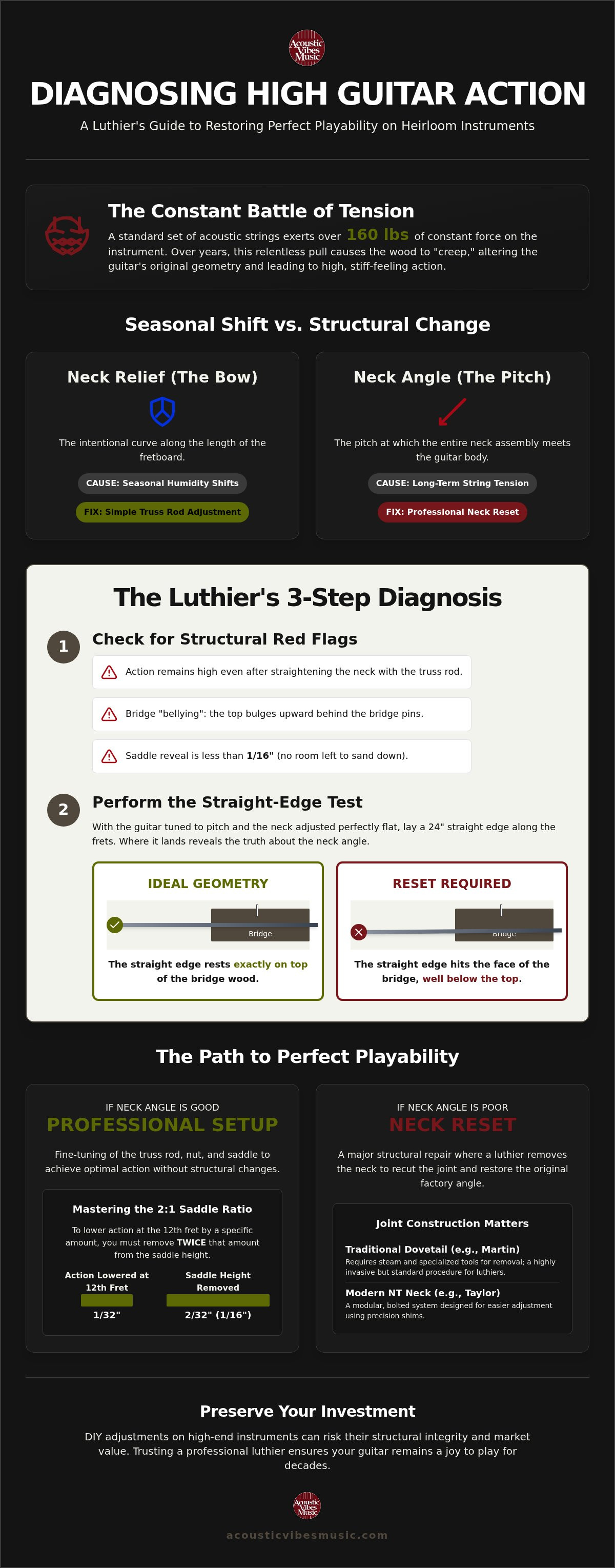
The decision to modify a high-end instrument should never be taken lightly. When exploring how to lower action on acoustic guitar, you'll eventually face a crossroads: a non-invasive setup or a significant structural reset. These two paths represent vastly different levels of intervention. A traditional dovetail neck joint, found on a classic Martin Guitar, requires a specialized process of steaming and hand-fitting to alter the neck angle. Conversely, the modular Taylor Guitars NT neck system allows for precision adjustments using laser-cut shims. Both methods aim for the same goal, but the technical execution varies based on the heritage of the build.
We establish a "Mandatory Reset" threshold when the action remains high despite having less than 1/16 of an inch of saddle reveal remaining. At this point, the geometry is fundamentally compromised. There's a common misconception that a neck reset devalues a fine instrument. For an heirloom-quality piece, a professional reset is actually a value-add. It restores the original playability and ensures the guitar can perform for another fifty years. Finding the "Setup Sweet Spot" occurs when the neck angle is still healthy, but the nut slots are too shallow or the truss rod needs refinement to eliminate mid-neck stiffness.
A setup is often all that's required if your straight edge still hits the very top of the bridge and you have 1/8 of an inch or more of saddle height to work with. In these cases, we focus on the finer details of playability. Nut slot depth is a frequently overlooked factor. If the strings are too high at the nut, the first three frets will feel unnecessarily difficult to press. Intermediate players should always start with a comprehensive professional setup. It is the most cost-effective way to improve feel without committing to structural woodworking.
Structural intervention becomes inevitable when the straight edge hits 1/16 of an inch or more below the bridge top. If your saddle has been sanded flush with the bridge wood and the action is still uncomfortably high, you've run out of room for "quick fixes." This is especially critical for a high-value Gibson Acoustic. These instruments require heirloom-level preservation to maintain their iconic voice and market value. If your diagnostics confirm a structural shift, don't settle for temporary measures. You can contact our expert luthier team to discuss a precision restoration for your instrument.
A neck reset is the pinnacle of acoustic restoration. It is often described as "major surgery" for a reason. The process requires a master’s touch to inject live steam into the neck joint, softening century-old hide glue or modern adhesives without compromising the surrounding tonewoods. This delicate application of heat and moisture allows the neck to be separated from the body, enabling the luthier to hand-carve the heel to a precise new angle. This isn't just about how to lower action on acoustic guitar; it is about reclaiming the instrument's structural soul. Every shaving of wood is a permanent decision that affects the guitar's geometry for the next half-century.
Preservation is the guiding light of professional luthier care. A successful reset should be invisible. This means the luthier must possess the artisanal skill to match vintage finishes and ensure the fingerboard extension remains perfectly flat against the soundboard. At Acoustic Vibes Music, our philosophy centers on restoring the builder's original intent. We evaluate the instrument as a complete, interconnected system. We don't just look at a single measurement; we analyze how the bridge, saddle, nut, and neck angle work in harmony to produce that signature boutique voice you fell in love with.
Entrusting a five-figure instrument to a local generalist is a risk few collectors are willing to take. Authorized service centers for brands like Martin and Taylor have access to proprietary specifications and specialized tools that ensure a factory-standard result. This expertise is even more vital for boutique brands like Lowden Guitars, where the construction methods differ significantly from American standards. Before you commit, ask your luthier specific questions. Inquire if they use traditional steam or heat lamps, and ask how they plan to address the fingerboard extension to prevent the dreaded "hump" at the body joint.
Your search for the best way how to lower action on acoustic guitar shouldn't be limited by geography. We specialize in national-level luthier services, handling the logistics of transporting high-value instruments with the reverence they deserve. Safely packing an acoustic for transit involves stabilizing the headstock, loosening string tension, and using a hardshell case with proper internal padding. Sending your guitar to a specialist ensures it receives the attention of a craftsman who sees heirloom instruments every day. Don't settle for a "good enough" local fix when you can have a master restoration. Explore our professional luthier services and restoration options to give your instrument the elite care it requires.
Understanding the delicate geometry of your instrument is the first step toward effortless performance. We've explored how a simple straight-edge test can reveal whether your guitar needs a seasonal setup or a more significant neck reset. By measuring your saddle reveal and respecting the 2:1 adjustment ratio, you can make informed decisions about how to lower action on acoustic guitar without compromising its tonal authority or long-term value. Every boutique instrument deserves a diagnostic approach that honors its unique construction and heritage.
As an authorized Martin and Taylor service center, we specialize in the meticulous care required for heirloom and boutique restorations. Our team treats every instrument with the reverence it deserves, ensuring that structural repairs are virtually invisible. Whether you need local expertise or our proven national mail-in repair services, we are here to guide your guitar back to its peak potential. Your instrument was built to be played and cherished for a lifetime. Let's make sure it feels as inspiring as it sounds. Schedule a Professional Evaluation with Our Luthier Team
The investment for a neck reset varies based on the instrument's construction and the complexity of the joint. Traditional dovetail joints require extensive labor, including steaming and hand-carving, while modular systems are generally less intensive. Factors like finish touch-ups and fret work also influence the final total. While industry ranges exist, we recommend a personalized evaluation to determine the specific needs of your heirloom instrument and ensure its structural integrity remains intact.
Most premium acoustic guitars require a neck reset every 20 to 30 years as the wood naturally "creeps" under 160 lbs of string tension. However, this timeline depends heavily on environmental factors like humidity and temperature stability. Some vintage pieces may last longer with meticulous care, while others might shift sooner. Regularly checking your neck angle with a straight edge helps you identify when the geometry has fundamentally changed beyond a standard setup's reach.
No, the truss rod is designed to manage neck relief, which is the slight curvature of the fretboard, rather than overall action height. While a truss rod adjustment can subtly change the feel, it isn't a solution for how to lower action on acoustic guitar when the problem is structural. Attempting to fix high action by over-tightening the rod can cause unwanted buzzing or even permanent damage to the neck's internal components.
Lowering the action increases the risk of fret buzz if the frets aren't perfectly level or if the strings lack the clearance to vibrate freely. Your playing style also dictates the "buzz threshold." A heavy strummer needs higher action to accommodate wide string excursions, while a light fingerstyle player can enjoy a much lower profile. A professional setup balances these factors, ensuring the strings are as low as possible without sacrificing clarity or projection.
Dovetail neck resets are traditional, invasive procedures found on brands like Martin, requiring steam to soften the glue before the joint can be separated. Bolt-on systems, such as the Taylor NT neck, are modular and much more efficient to adjust. Instead of carving wood, a luthier uses precision-cut shims to change the neck angle. Both methods achieve the same geometric goal, but the dovetail requires a higher level of artisanal woodworking and finish preservation.
A professionally executed neck reset actually preserves and often increases the value of a vintage Martin or Gibson by restoring its playability. Collectors value instruments that can be played comfortably without fighting high action. As long as the work is performed by a master luthier who maintains the original finish and structural integrity, the reset is considered essential maintenance. It is a vital step in ensuring your heirloom piece remains a functional musical tool.
A neck reset is a meticulous process that typically requires several days of active labor, though the total turnaround time depends on the shop's current queue. The procedure involves carefully heating the joint, allowing the wood to dry after steaming, and performing a full setup once the neck is reattached. We suggest contacting our team to verify our current luthier schedule and lead times for these specialized, high-priority structural restorations.
Sanding a saddle is a common DIY task, but it is risky for owners of boutique instruments. It's incredibly easy to sand the bottom unevenly, which ruins the contact with the bridge and kills your tone. Furthermore, you must understand how to lower action on acoustic guitar without destroying the break angle. If you remove too much material, you'll lose the downward pressure needed to drive the soundboard, resulting in a thin, lifeless sound.