My shopping cart
Your cart is currently empty.
Continue ShoppingThe highest price tag in the room doesn't always guarantee the best sound for your specific playing style. You might feel stuck between the technical jargon of "harmonic overtones" and "fundamental notes" while trying to settle the rosewood vs mahogany guitar tone debate for your next purchase. It's a frustrating hurdle for many enthusiasts. No one wants to invest in a premium instrument only to find it sounds too muddy for fast flatpicking or too thin for delicate ballads. Even the narrowing price gap between Indian Rosewood and Honduran Mahogany adds a new layer of complexity to your decision.
I'm here to help you master the sonic differences between the lush, orchestral complexity of Rosewood and the punchy, tactical clarity of Mahogany. We'll break down the frequency response of each wood so you can find your perfect acoustic voice with total confidence. You'll learn which wood suits genres like Bluegrass or Fingerstyle and see how master builders at Martin and Collings harness these materials. Let's dive into the heritage and physics of these iconic tonewoods to find the one that truly resonates with your soul.
Discover how the back and sides of an acoustic guitar act as a natural equalizer, shaping the "engine" of the spruce top into a refined musical voice.
Master the rosewood vs mahogany guitar tone distinction by exploring the "hi-fi" depth of rosewood versus the focused, "woody" punch of mahogany.
Find your perfect match for any playing style, whether you need the fundamental clarity of a flatpicking machine or the harmonic richness of a fingerstyle masterpiece.
Gain a specialist's perspective on how heritage brands like Martin and Collings balance tradition with modern innovations like torrefaction.
Build your collection with confidence by understanding the current market value and the long-term sonic benefits of these premium tonewoods.
Choosing the right instrument begins with understanding The Fundamentals of Tonewood. In the specialized world of lutherie, we often describe the guitar's top as the "engine." It's the primary source of volume and initial vibration. However, the back and sides act as the "amplifier" and "equalizer." They color the raw energy of the top, adding specific textures and tonal frequencies. This interaction is the absolute heart of the rosewood vs mahogany guitar tone debate. Without the right back and side wood, even the finest spruce top can sound unfinished or unbalanced.
To truly appreciate these woods, you have to distinguish between the fundamental note and harmonic overtones. The fundamental is the pure, direct pitch of the string you just plucked. Overtones are the sympathetic frequencies that ring out above that note, creating a "halo" of sound. Mahogany is prized for its focus on the fundamental, resulting in a clear, dry, and direct voice. Rosewood, by contrast, invites a symphony of overtones to the party. It produces a lush, metallic ring that lingers long after the pick has left the string. Understanding the rosewood vs mahogany guitar tone helps you predict how an instrument will behave in a recording studio or on a quiet stage.
These two species have remained the gold standard for over a century for good reason. They are reliable, beautiful, and offer two distinct sonic philosophies. Whether you are looking at a pre-war Martin or a modern masterpiece from Collings, these woods provide the essential canvas for musical expression. They aren't just building materials; they're the DNA of your acoustic identity.
Density dictates how fast sound waves travel through a guitar's body. Rosewood is incredibly dense and heavy, which results in low internal damping. It doesn't "soak up" energy. Instead, it reflects it back with high velocity, creating that famous sustain and "hi-fi" depth. Mahogany is more porous and lighter. Its grain structure provides a natural damping effect that suppresses some of those ringing overtones. This results in a quicker decay and a "woody" sound that cuts through a dense mix without becoming muddy.
Guitars are living things that evolve as you play them. Over decades, the resins within the wood cells crystallize, changing the stiffness and weight of the timber. This is why a vintage mahogany guitar can eventually develop a complexity that rivals a brand-new rosewood model. The wood becomes more responsive to a light touch. If you're curious about this transformation, read our deep dive on whether acoustic guitars get better with age. It's a fascinating journey from raw timber to a seasoned musical partner.
Rosewood is often the first choice for players seeking a sound that feels larger than life. It provides a distinctive "scooped" midrange, which means the bass and treble frequencies are more prominent while the middle frequencies are slightly recessed. This creates a sonic profile often described as "hi-fi" or "piano-like." When you pluck a string on a Rosewood instrument, you aren't just hearing the fundamental note; you're hearing a complex wash of harmonic overtones that follow closely behind. This "lush" factor is a primary differentiator when analyzing rosewood vs mahogany guitar tone, offering a depth that fills the room. This is the essence of The Rosewood Profile.
If you're comparing rosewood vs mahogany guitar tone, think of Rosewood as having a natural, built-in reverb. The wood's high density allows it to reflect sound waves with incredible efficiency. This results in deep, resonant lows that you can feel in your chest and crystalline highs that sparkle without being harsh. While East Indian Rosewood is the modern industry standard for its stability and rich color, Brazilian Rosewood remains the "holy grail" for collectors due to its unparalleled clarity and glass-like ring. It's a rare, artisanal material that turns a guitar into a legacy piece.
Visualizing the EQ of Rosewood looks like a smile. The strong bass and sparkling trebles frame a dip in the middle. This profile is a dream for solo performers. It leaves plenty of room for a vocalist's voice to sit right in that recessed midrange "pocket." Beyond the sound, there is a tactile satisfaction to Rosewood. It's a heavy, oily wood. That physical weight contributes to a sense of premium craftsmanship and stability that many players find reassuring during a long performance.
Legendary manufacturers have spent decades perfecting this wood's potential. Martin Guitars utilized Rosewood to create the D-28, an instrument so iconic it's often called the "sound of acoustic music." Its thunderous bass and rich sustain set the bar for dreadnoughts everywhere. In contrast, Taylor Guitars takes a modern approach. They use their innovative V-Class bracing to manage Rosewood's massive overtones, ensuring the guitar stays perfectly in tune with itself across the entire fretboard. If you want to experience this harmonic depth firsthand, explore our curated selection of Rosewood masterpieces from the world's finest luthiers.
Mahogany stands as the definitive antithesis to the dark, complex landscape of Rosewood. While Rosewood is celebrated for its lush "halo" of overtones, Mahogany is prized for its "dry" and "fundamental" focus. When you strike a chord on a Mahogany instrument, the sound is immediate, direct, and remarkably transparent. It doesn't clutter the sonic space with excessive sustain or metallic ringing. This transparency is exactly why seasoned session players and recording engineers often prefer Mahogany. It provides a clean canvas that sits perfectly in a mix without competing with other instruments. This directness is a pivotal element in the rosewood vs mahogany guitar tone debate.
The term "woody" is the most common descriptor for this species. It refers to a warm, earthy character that feels organic and uncolored by artificial brightness. It is an "honest" tonewood. It reflects the nuances of your technique with surgical precision. If you have a heavy hand, Mahogany barks. If you play with a delicate touch, it purrs with a sweet, compressed warmth. Because Mahogany is less dense and lighter than its counterparts, it possesses a high velocity of sound. The energy from your pick translates into sound almost instantly, giving the guitar a "snappy" attack that feels alive in your hands.
Choosing between rosewood vs mahogany guitar tone often comes down to how much "help" you want from the wood. Mahogany doesn't hide mistakes behind a wash of reverb. It demands better technique but rewards the player with a punchy, mid-forward voice that has defined American roots music for over a century.
Mahogany excels in the frequency range where the human voice lives: the midrange. This makes it the preferred choice for blues, folk, and country music. Its clean decay ensures that individual notes don't bleed into one another, providing superior note separation even during rapid-fire flatpicking. You can hear every distinct voice in a complex chord. Additionally, the lighter physical weight of Mahogany makes these guitars incredibly comfortable for long performances or casual practice sessions on the couch.
Few instruments carry the heritage of the Gibson J-45. Known as "The Workhorse," its signature low-end "thump" and midrange growl defined the sound of early rock and roll and Americana. It is a sound that is both humble and authoritative. For the player seeking boutique refinement, Collings Guitars crafts Mahogany instruments with incredible headroom and power. They prove that this "simple" wood can achieve a level of sophisticated clarity that rivals the most expensive Rosewood builds. Whether it is a vintage icon or a modern masterpiece, Mahogany offers a tactical, focused clarity that is impossible to replicate.
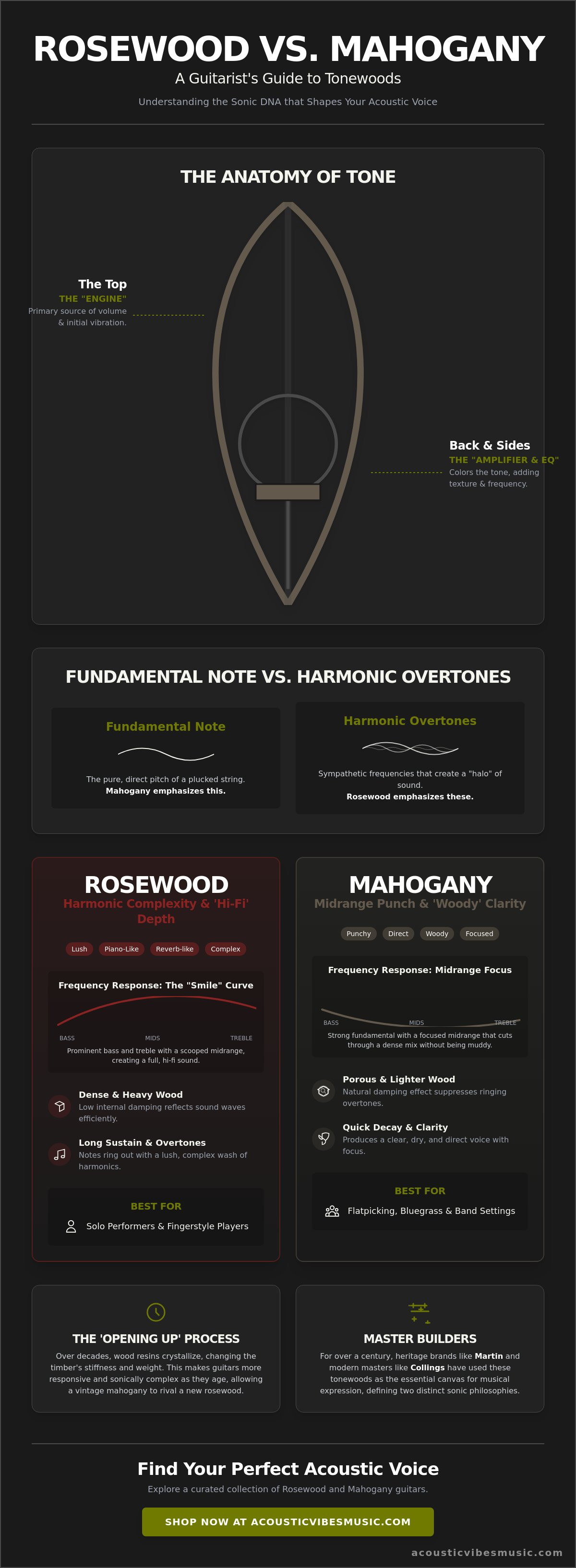
Theoretical knowledge is vital, but the true test of rosewood vs mahogany guitar tone happens when the pick hits the strings. Your choice should align with your specific musical goals and technical approach. For bluegrass players and flatpickers, mahogany is often the definitive industry standard. Its fundamental punch and rapid decay allow fast, intricate runs to remain distinct. You won't find your notes bleeding into a muddy wash during a high-speed solo. It provides the clarity needed to cut through a dense ensemble of banjos and fiddles without losing its composure.
Solo fingerstyle guitarists often lean toward rosewood for its orchestral quality. The rich sustain and complex overtones act as a natural accompaniment, filling the silence between notes with a lush texture. This wood supports slow, melodic passages by providing a "halo" of sound that lingers beautifully. If you're a singer-songwriter, rosewood offers a unique advantage. Its "scooped" midrange creates a natural sonic pocket. This allows your voice to sit comfortably in the middle of the frequency spectrum without competing with the guitar's output. It's like having a built-in sound engineer inside your instrument.
In the recording studio, the rosewood vs mahogany guitar tone debate takes a technical turn. Engineers frequently reach for mahogany instruments because they're remarkably easy to mic. The wood's focused low-end and lack of excessive ringing make it much easier to sit in a track. It avoids the "low-end clutter" and "woofiness" that can sometimes plague dense rosewood dreadnoughts in a small room. Mahogany is the tactical choice for a clean, professional recording that requires minimal EQ.
The marriage of body size and timber is crucial for your final sound. A rosewood dreadnought is a sonic cannon, perfect for massive volume and deep resonance. Conversely, a mahogany OM (Orchestra Model) is a precision tool for balance and responsiveness. Boucher Guitars excels at this optimization. They select specific grades of Adirondack spruce to pair with these woods, tailoring the "attack" to suit either heavy strummers or light-touch players. Finding that synergy is the key to owning an instrument that feels like an extension of your body.
Consider where you'll spend most of your time playing. In a quiet living room, rosewood provides an immersive, "inspiring" feedback that feels incredibly rewarding. It sounds like a complete production on its own. On a loud stage, mahogany’s fundamental focus is a massive benefit. It often offers better feedback resistance when plugged into a high-volume PA system because it lacks those wild, ringing overtones. Before you make your final decision, browse our curated collection of premium acoustic guitars to see which voice speaks to your soul. Use this checklist for your next test-drive: listen for note separation, feel the physical weight, and notice how much "space" the sound occupies in the room.
Price tags often lead newcomers to believe that mahogany is merely a budget alternative to rosewood. This is a significant misconception. In the world of heirloom-quality instruments, a high-end mahogany guitar often represents the pinnacle of lutherie. Consider the Martin D-18 Authentic. These instruments can command a higher investment than many standard rosewood models because of their hide-glue construction and specialized bracing. It's about the specific musical application and the rarity of the build, not just the species of timber. When evaluating rosewood vs mahogany guitar tone, remember that you're choosing a voice, not a tier of quality.
Modern innovation has further blurred the lines between these two icons. The rise of torrefaction, a process where spruce tops are thermally treated to mimic decades of aging, has changed the game. A torrefied top on a mahogany body can produce a level of complexity and "dry" resonance that was previously only found in pre-war vintage instruments. European builders like Lowden Guitars take another approach. They utilize rosewood to create an "airy," crystalline Celtic voice that feels entirely different from the American dreadnought tradition. It's a reminder that the builder's philosophy is just as important as the wood itself.
Boutique builders have elevated these woods to new heights. Collings Guitars is famous for infusing mahogany with a level of headroom and crystalline clarity that rivals the complexity of rosewood. Their instruments don't distort under a heavy pick. Instead, they sing with authority. For those seeking a vintage soul, M. Atkin recreates the dry, fundamental "bark" of early 20th-century guitars while providing the stability of modern craftsmanship. Investing in these premium tonewoods is about more than sound; it's about owning a piece of functional art that will only improve with time.
Tone is ultimately a deeply personal, subjective experience. There are no wrong answers in the rosewood vs mahogany guitar tone debate. Some players crave the lush, reverby wash of a rosewood back, while others require the surgical precision of mahogany. We invite you to step into our gallery and experience these differences for yourself. Pick up a guitar, strike a chord, and listen to how the wood responds to your touch. To deepen your knowledge before your visit, explore our High End Acoustic Guitars for Sale: The Collector’s Guide. Your perfect acoustic voice is waiting to be discovered.
Choosing between the lush, orchestral sustain of Rosewood and the tactical, fundamental clarity of Mahogany is a defining milestone in your musical journey. You now understand that the rosewood vs mahogany guitar tone debate isn't about finding a superior wood; it's about matching a specific frequency response to your unique playing style. Whether you crave the "woody" punch for a crowded bluegrass mix or "piano-like" depth for solo fingerstyle, the right timber serves as the essential foundation of your artistic expression.
We invite you to experience these nuances firsthand. As an authorized dealer for legendary names like Martin, Collings, and Boucher, we pride ourselves on curating only the most exceptional examples of these tonewoods. Every instrument in our gallery receives an expert luthier setup to ensure it performs at its absolute peak. For collectors across the country, we provide nationwide climate-controlled shipping to guarantee your new acquisition arrives in pristine condition. Your pursuit of quality deserves an instrument that truly resonates.
Explore our curated collection of Rosewood and Mahogany Masterpieces today and find the heirloom-quality voice you've been searching for. It is time to discover the instrument that will define your sound for years to come.
Neither wood is objectively better; they simply offer two distinct sonic philosophies. Rosewood provides a rich, complex landscape of overtones and deep, resonant bass that feels orchestral. Mahogany offers a focused, punchy midrange with a clean fundamental note. Your choice depends on whether you want a lush, reverby backing or a direct, tactical voice that cuts through a mix with ease.
Scarcity and international trade regulations are the primary drivers of cost. Many Rosewood species take longer to mature and are subject to stricter environmental protections, including CITES Appendix II listings. While Indian Rosewood is widely available, rarer varieties like Madagascar or Cocobolo require a larger investment due to limited supply and the artisanal skill required to harvest and season them correctly.
Mahogany is the traditional favorite for studio recording because of its "dry" character and lack of low-end clutter. Its focused frequency response makes it incredibly easy for engineers to mic and place in a mix without heavy EQ. While Rosewood sounds massive in a quiet room, its complex harmonic overtones can sometimes become difficult to manage in a dense, multitrack production.
Scooped mids refer to a frequency response where the bass and treble are prominent while the middle frequencies are slightly recessed. This creates a sonic "pocket" that is perfect for vocalists. The guitar's output stays out of the way of the human voice, resulting in a hi-fi sound that feels wide and deep. It is the opposite of the mid-forward "bark" found in Mahogany.
The top wood is the primary "engine" of the instrument, contributing roughly 70 to 80 percent of the overall volume and tone. However, the back and sides act as the "equalizer." They shape and color the raw energy from the top into the specific rosewood vs mahogany guitar tone profiles that players love. You need both working in harmony to create a truly professional sound.
Mahogany is often the best choice for beginners because its "honest" response highlights exactly what your fingers are doing. It doesn't hide technical mistakes behind a wash of sustain. Intermediate players often move toward Rosewood when they begin exploring solo fingerstyle. They find the extra harmonic complexity and sustain more inspiring for slow, melodic pieces played in a quiet practice environment.
Experienced ears can usually detect a distinct difference in clarity and "ring." Brazilian Rosewood is often described as having a glass-like transparency and a faster response than Indian varieties. It offers a bell-like chime that lingers longer. While Indian Rosewood is a warm and reliable standard, Brazilian Rosewood remains the holy grail for its unparalleled harmonic depth and rare, artisanal beauty.
Both woods are exceptionally durable when kept in a stable environment, but Mahogany is generally more stable. It is less dense and oily than Rosewood, making it slightly less prone to dramatic shrinking or cracking during sudden humidity shifts. Regardless of the species, you must maintain a consistent humidity level between 45 and 55 percent to protect the integrity of your high-end instrument.