My shopping cart
Your cart is currently empty.
Continue ShoppingWhat if you could capture the haunting, velvety resonance of a Spanish classical guitar without struggling against a neck that feels like a heavy block of timber? For many steel-string players, the transition to nylon often feels like a frustrating compromise between beautiful tone and actual playability. You want that signature warmth, yet the traditional wide, flat fretboards often feel clumsy and alien in your hands. It’s a common hurdle, especially when you are searching for high-end crossover nylon string guitars that offer professional-grade electronics rather than just entry-level specs.
We believe your instrument should be an extension of your artistry, not a hurdle to overcome. Our expert-curated guide is designed to help you discover the perfect blend of classical heritage and modern ergonomics. You'll learn how to identify the finest radiused fretboards and slim neck profiles that make these hybrids a genuine joy to play. We’ll preview the standout 2026 releases from masters like Cordoba, Taylor, and Yamaha; moving beyond the basics to find boutique-level craftsmanship that shines both unplugged and under the stage lights. From the tactile response of premium tonewoods to the nuances of advanced pickup systems, we are here to guide you toward an instrument that truly resonates with your personal style.
The guitar world is witnessing a fascinating shift. More performers are stepping away from the bright, metallic chime of steel to embrace the rich, textured warmth of nylon. This isn't a move toward the rigid world of the traditional classical guitar. Instead, it’s the era of crossover nylon string guitars. These instruments are precision hybrids. They marry the haunting resonance of Spanish heritage with the sleek, familiar ergonomics of a modern acoustic. For the multi-instrumentalist, it’s a revelation. You gain a new sonic palette without the steep learning curve of a wide, flat neck.
Modern fingerstyle, jazz, and even indie-folk artists are leading this charge. They seek the expressive "bloom" that only a nylon string provides. Finger fatigue often ends a recording session early, but nylon strings operate under significantly lower tension than steel. This softness allows for hours of effortless play. It’s about more than just comfort; it’s about expanding your creative endurance. Whether you are tracking a delicate ballad or practicing complex jazz voicings, the physical ease of a crossover keeps the inspiration flowing.
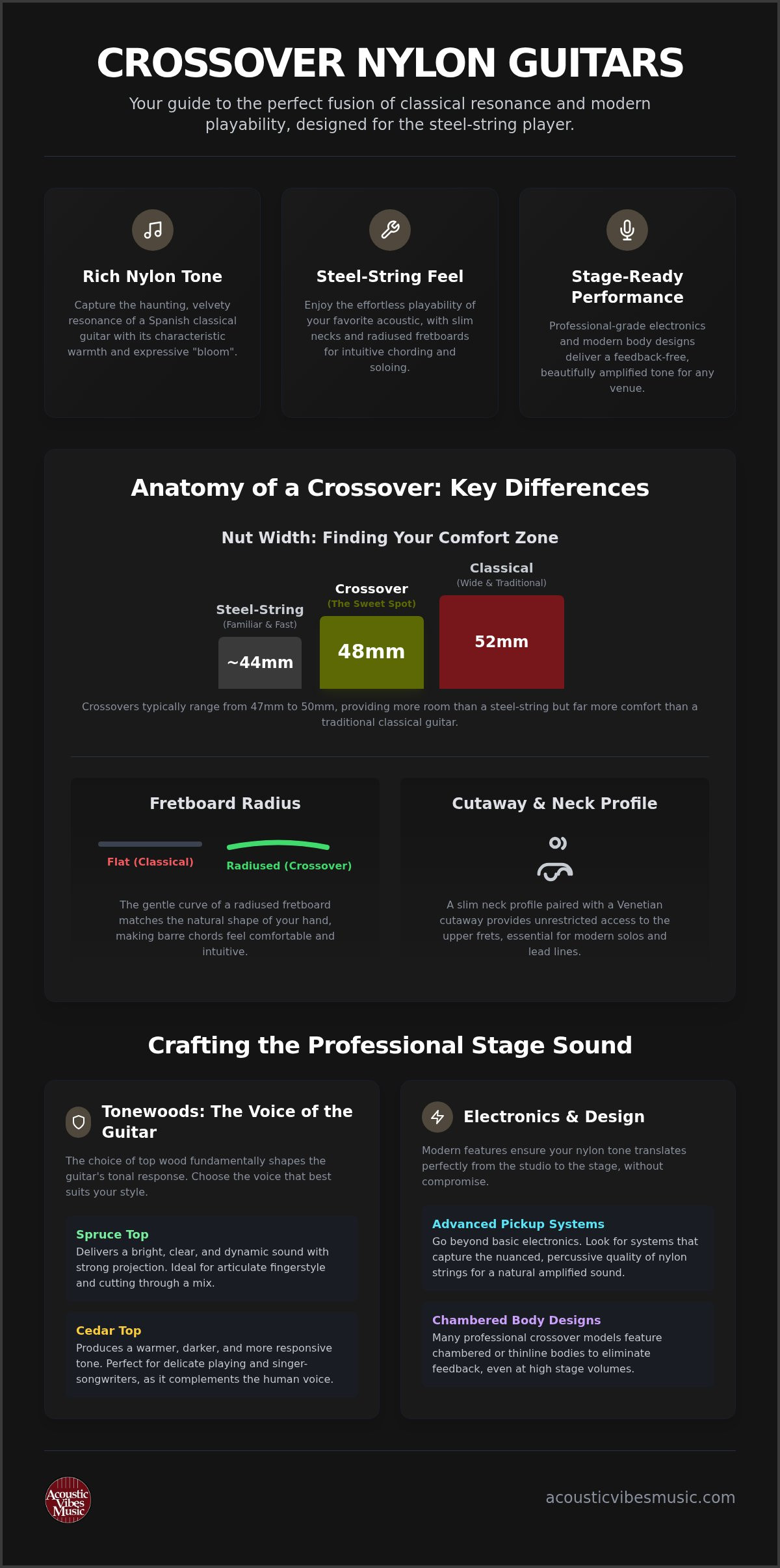
Standard classical guitars typically feature a 52mm nut width. For a player used to a Taylor or Martin, that width feels like a barrier. It makes complex chord shapes and thumb-over techniques nearly impossible. Crossover models solve this by narrowing the nut and introducing a radiused fretboard. This slight curve allows your hand to wrap naturally around the neck, making barre chords feel intuitive. Add a Venetian cutaway, and you suddenly have access to the upper registers. These are frets often ignored in traditional repertoire but essential for modern lead lines and soloing.
There is a specific "snap" to a nylon string that adds a percussive layer to any arrangement. It provides a warmer, darker frequency response compared to the booming projection of steel-string dreadnoughts. This sonic profile creates a perfect pocket for the human voice. Singer-songwriters find that the mellow sustain of nylon doesn't compete with their vocals. Whether you are exploring the intricate rhythms of Bossa Nova or adding a delicate layer to a pop track, the tonal depth is unmatched. Choosing between Rosewood vs Mahogany back and sides further refines this voice. It allows you to tailor the instrument to your specific performance needs with the precision of a specialist.
Understanding the technical architecture of crossover nylon string guitars is the first step toward finding your ideal companion. While traditional classical instruments favor a flat, wide landscape, crossovers embrace contemporary features borrowing from steel-string designs. This shift isn't just about aesthetics; it's about how the instrument responds to your existing muscle memory. By prioritizing specific ergonomic measurements, you can enjoy the lush texture of nylon without relearning your entire fretboard technique. It is a precision-engineered transition designed for the modern player.
The 48mm nut width is often hailed as the "sweet spot" for transitioning players. It offers enough space to prevent string-crowding during complex fingerstyle passages while remaining narrow enough for comfortable thumb-over chords. For context, a standard classical nut sits at 52mm, which can feel like a vast, unmanageable expanse. If you're coming from a 1 11/16 inch or 1 3/4 inch steel string, a 48mm neck, like that found on the Furch GNc4-CR, feels remarkably familiar. Wider string spacing at the bridge provides the necessary room for articulate fingerpicking without the cramped sensation often found on hybrid electrics.
Perhaps the most critical feature for comfort is the fretboard radius. Traditional classical guitars are flat, but most modern crossovers feature a 16-inch or 20-inch curve. This radius mirrors the feel of a Taylor or Martin, allowing your hand to form barre chords with significantly less tension. When you pair this with a shorter scale length, you reduce the "reach" required for wide intervals, making the entire playing experience more fluid and forgiving. If you're ready to feel these ergonomic advantages for yourself, we invite you to explore our meticulously curated crossover selection.
Shape and depth play a vital role in how the guitar projects. Many players prefer the Grand Auditorium shape because its larger lower bout and increased body depth compensate for the naturally lower volume of nylon strings. This design often utilizes a 12-fret-to-body join. This placement moves the bridge further into the center of the lower bout, maximizing the top’s resonance and providing a deeper, more piano-like bass response. A Venetian cutaway is almost standard here, ensuring that your melodic explorations aren't cut short at the 12th fret. It allows for a technical freedom that traditional Spanish shapes simply cannot offer.
High-end crossover nylon string guitars demand a tonal architecture that bridges the gap between traditional Spanish warmth and modern acoustic projection. It’s not just about the feel of the neck; it’s about how the wood vibrates and how that vibration is translated to an audience. Choosing the right combination of tonewoods and electronics ensures your instrument sounds just as sophisticated through a PA system as it does in a quiet room. We hand-select instruments that prioritize this sonic transparency, ensuring every nuance of your technique is preserved.
The choice of a soundboard is the most critical decision in your tonal journey. Spruce tops, featured on masterpieces like the Jose Ramirez 140 CWE-S, are prized for their crystalline clarity and massive dynamic headroom. They offer a "snappy" response that cuts through a mix, making them ideal for ensemble playing or aggressive fingerstyle. Conversely, cedar tops, such as those found on the Furch Grand Nylon series, provide immediate warmth and lush overtones right out of the case. They possess a "played-in" feel that rewards a lighter touch with deep, dark complexity. Many modern builders now utilize torrefaction, a specialized heat-treatment process, to give these woods the resonant stability of a vintage instrument from day one.
The foundation of your sound is further refined by the back and sides. This is where the classic Rosewood vs. Mahogany debate takes on a new life in the nylon world. Rosewood provides a bell-like chime and complex harmonic "bloom," while Mahogany offers a punchy, fundamental-focused tone that records beautifully. Both materials work in harmony with the top wood to create a balanced, professional voice.
Capturing the delicate resonance of nylon strings requires more than a standard piezo pickup. Cheap systems often produce a harsh, plastic "quack" that destroys the instrument's natural character. Professional-grade crossovers solve this with sophisticated integration. The Yamaha Atmosfeel system is an industry leader, utilizing a three-way sensor array to capture lows, mids, and highs with startling accuracy. Similarly, the Jose Ramirez 140 CWE-S employs LR Baggs technology to provide a transparent, microphone-like quality without the feedback issues of a traditional external mic.
When performing live, EQing is your best friend. We recommend a slight mid-cut to remove any boxy frequencies and a subtle low-end roll-off to prevent stage rumble. These small adjustments, paired with a high-quality preamp, allow your nylon-string voice to soar over a band without losing its soul. It's about achieving a sound that is both powerful and authentically acoustic.
The search for a perfect instrument is a journey through nuance and craftsmanship. We’ve curated a collection that spans from accessible stage tools to heirloom-quality masterpieces, ensuring every player finds their unique voice. Our selection of crossover nylon string guitars represents the absolute pinnacle of current design. These instruments offer the tactile comfort you need with the sophisticated, professional tone you crave. Every guitar in our gallery is hand-selected for its resonance and build quality, reflecting our passion for the art of lutherie.
For the electric guitarist making their first foray into nylon, the Yamaha NTX1NT ($549.99) is an unbeatable entry point. Its thin-body design and narrow neck profile feel like home, while the onboard electronics make it a reliable companion for any gig. If you desire deeper aesthetics, the Cordoba Fusion 12 Rose II ($999.99) delivers stunning Rosewood back and sides paired with a comfortable 12-fret body join. Those seeking a modern, sleek look will gravitate toward the Taylor 212CE-N Black Plus LTD ($1499.00). It combines Taylor’s legendary playability with a striking black finish that commands attention on any stage.
Explore the boutique world where Furch redefines the hybrid market with their Grand Nylon series. The Furch GNc4-CR EAS ($3366.00) features a 48mm nut width and an exquisite Spruce top, providing incredible dynamic range. For a warmer, more immediate response, the Cedar top variant ($2621.00) offers lush overtones at a different price point. What truly sets these crossover nylon string guitars apart is the CNR System (Composite Neck Reinforcement). This high-tech carbon casing ensures the neck remains perfectly stable, guarding against the environmental shifts that often plague traditional nylon instruments. It’s a masterclass in modern acoustic engineering.
Owning a Ramirez is about more than just music; it’s about Spanish history. The 140 CWE-S ($3999.00) celebrates 140 years of luthier excellence. This isn't a mass-produced hybrid. It features a master-grade Spruce top that offers unparalleled projection and a complex, aging voice that only improves with time. Integrated with the LR Baggs system for professional transparency, it bridges the gap between the concert hall and the modern stage. It is quite simply the pinnacle of the crossover world, designed for the player who refuses to settle for anything less than perfection.
Ready to feel the difference of a hand-selected instrument? Browse our complete collection of professional crossover guitars today.
Selecting a lifetime instrument is a deeply personal endeavor that balances technical requirements with emotional resonance. Whether you are a dedicated stage performer, a bedroom songwriter, or a discerning collector, your choice defines your creative future. The best crossover nylon string guitars act as a bridge between your existing skills and a new world of tonal complexity. We invite you to explore our full collection of Crossover Nylon String Guitars to find the one that speaks to your unique artistry. Every instrument in our gallery is chosen for its ability to inspire, ensuring you invest in true heirloom quality rather than a temporary hybrid.
A professional setup is absolutely non-negotiable for nylon strings. Because nylon operates under lower tension, even a slight misalignment can lead to frustrating intonation issues or unwanted fret buzz. Our in-house luthier repair services specialize in optimizing these delicate instruments. We ensure the action is low and fast, mirroring the feel of your favorite steel-string while preserving the guitar's natural resonance. It’s this attention to detail that transforms a good guitar into a masterpiece that feels like an extension of your own hands.
We are more than a retail outlet; we are a curated gallery for the world’s finest acoustic instruments. Our commitment to quality begins in our climate-controlled storage and extends to our specialized national shipping protocols. We understand the anxiety of shipping a high-end instrument. That’s why we use proven expertise to ensure your guitar arrives in perfect, performance-ready condition. You aren't just buying from a salesperson; you are consulting with fellow enthusiasts who play, record, and live for these instruments.
Don't settle for a generic experience. If you are torn between two models, reach out for a personalized video demo. We’ll play the exact instruments you’re considering, allowing you to hear the subtle differences in bloom and sustain before you make your decision. We are here to act as your expert guide in the pursuit of the perfect tone.
Finding the right instrument is about more than just matching specs; it's about discovering a voice that resonates with your musical identity. You now understand how refined nut widths and radiused fretboards bridge the gap between steel-string familiarity and classical warmth. By selecting crossover nylon string guitars with professional-grade electronics and hand-selected tonewoods, you ensure your artistry shines on any stage. High-end hybrids are no longer a compromise. They are precision tools for the modern creator.
As an authorized dealer for Yamaha, Taylor, and Furch, we take pride in our role as passionate curators. Every purchase includes an expert luthier setup to guarantee perfect playability from the moment you unbox. We also provide secure national shipping for all high-end instruments, giving you peace of mind throughout the delivery process. Your next creative breakthrough is just one chord away. Browse Our Curated Collection of Crossover Nylon String Guitars and find the instrument that truly speaks to you.
The primary differences lie in the neck ergonomics and body features. Traditional classical guitars feature a wide, flat 52mm nut and no cutaway, while crossovers offer narrower, radiused fretboards and cutaways for upper-fret access. These instruments are designed to feel familiar to steel-string players while providing the specific warmth and texture of nylon strings.
A 48mm nut width is not too narrow; it is actually the preferred standard for players who find the 52mm classical neck too bulky. This width provides enough space to prevent string crowding during fingerstyle passages while feeling much closer to a standard acoustic neck. It is the ideal middle ground for comfort and technical precision.
You must never use steel strings on any nylon-string instrument. The internal bracing and bridge design are not built to withstand the significantly higher tension of steel. Doing so will likely warp the neck or cause the bridge to lift off the soundboard. Always use high-quality nylon or fluorocarbon strings to protect your instrument’s structural integrity.
A radiused fretboard features a slight curve that mirrors the feel of electric and steel-string acoustic guitars. This design makes executing barre chords and lead lines much easier on your fretting hand. While traditional classical players prefer a flat surface, the radius is a key feature that makes crossover nylon string guitars feel like home for modern performers.
The better choice depends entirely on your desired tonal response. Spruce provides a bright, snappy clarity with plenty of projection, making it excellent for lead lines and ensemble playing. Cedar offers immediate warmth and lush overtones, which is often preferred by singer-songwriters for its mellow, intimate character. Both woods provide professional results depending on your playing style.
Many crossover nylon string guitars sound exceptional unplugged, especially those with solid tops and Grand Auditorium body shapes. While thin-line models are optimized for feedback resistance on stage, boutique crossovers still offer a rich, resonant acoustic experience for home practice. They may have slightly less volume than a concert classical, but the tonal complexity remains professional and inspiring.
The Yamaha NTX series is widely considered the best entry point for electric players due to its slim body and familiar neck profile. Its dimensions are specifically engineered to minimize the learning curve, allowing you to focus on the new nylon textures rather than struggling with a wide neck. It is a reliable, stage-ready tool that bridges the gap between genres perfectly.
You should always use a high-quality in-case humidification system to maintain a relative humidity level between 45% and 55%. High-end acoustic instruments are sensitive to environmental shifts, and dry air can lead to cracks or fret sprout. Keeping your guitar in its case with a humidifier is the most effective way to protect its resonance and long-term health.