My shopping cart
Your cart is currently empty.
Continue ShoppingThe finest Adirondack spruce in the world doesn't come from a massive factory. It originates from a specialized workshop in Quebec where the wood is treated with the reverence of a rare vintage wine. If you've been searching for an instrument that balances raw power with crystalline clarity, you've likely encountered Boucher guitars. These instruments represent the pinnacle of North American lutherie, yet many players find themselves hesitating. You might wonder if the premium for genuine Adirondack spruce is truly justified or feel overwhelmed by technical talk of torrefaction and custom bracing. It's natural to feel a bit lost when navigating the nuances of such high-level craftsmanship.
We believe that choosing a legacy instrument should be an exhilarating journey, not a chore involving spreadsheets and specs. This guide promises to demystify the Boucher lineup and explain why these guitars are the undisputed gold standard for Adirondack spruce. We will break down the "Goose" series naming conventions and help you identify the perfect voice for your style, from thunderous bluegrass cannons to intimate fingerstyle gems. By the end, you'll understand the construction secrets that drive their investment value and feel ready to claim your own piece of acoustic history.
Robin Boucher is a name that commands respect in the tight-knit world of high-end lutherie. Long before he was building world-class instruments, he was a premier supplier of tonewoods to some of the most famous guitar brands on the planet. This background is exactly what makes Boucher guitars so special. While other builders have to wait for a shipment from a third-party supplier, Robin and his team are in the forests of Quebec, hand-selecting the very best Adirondack Red Spruce. This species is often called the "Holy Grail" of tonewoods because it offers a level of volume and dynamic range that other softwoods simply cannot match. The Boucher sound is defined by an incredible ceiling of headroom, allowing you to dig in with a heavy pick without the tone ever becoming muddy or compressed.
The Boucher workshop operates with a level of control that is virtually unheard of in modern guitar making. By sourcing their own timber, they ensure that every piece of wood is cut, dried, and aged to their exact specifications. The harsh Canadian climate plays a vital role here. Slow-growing trees in northern regions produce tighter grain patterns, which leads to superior structural stability and crystalline tonal clarity. Boucher's wood selection process is unique in the boutique world because they act as their own primary supplier, meaning they never have to compromise on the quality of a soundboard to meet a production quota. You can feel this stability the moment you pick one up; these guitars are built to withstand the rigors of the road while maintaining their delicate harmonic richness.
Many players inevitably compare these instruments to the legendary Martin Guitars. While heritage brands defined the acoustic sound of the 20th century, modern boutique builders like Boucher offer a different kind of value. A factory custom from a massive manufacturer is still often part of a larger assembly process. In contrast, Boucher guitars are produced in limited numbers, allowing for a level of individual voicing and hand-tuning that ensures every instrument reaches its full potential. This boutique approach provides a more responsive and "played-in" feel right out of the case. This limited production doesn't just result in a better-sounding guitar; it also helps maintain the long-term investment value of the instrument. When you buy a Boucher, you aren't just buying a tool; you're acquiring a piece of curated history from a master who knows the forest as well as the workbench.
The "Goose" moniker is more than a playful nod to the Canadian wilderness. It signifies a family of instruments designed to excel in specific musical environments. When you explore Boucher guitars, you'll find that each series is meticulously voiced to meet the demands of different players. Whether you're a session musician or a festival flatpicker, understanding these distinctions is the first step toward finding your voice. The naming convention reflects the spirit of migration and the freedom found in music, providing a clear path for players to navigate their expansive catalog.
The Studio Goose is the definitive workhorse of the lineup. It’s designed for the stage and the studio, offering a balanced frequency response that recording engineers love. If you need a guitar that cuts through a mix without overpowering other instruments, this is your primary candidate. In a fascinating , he explains how their bracing patterns are specifically adjusted to maximize the potential of each body shape. This series typically features modern, clean aesthetics and a high-gloss finish that looks as good as it sounds under stage lights.
The Bluegrass Goose, by contrast, is built for pure, unadulterated power. These instruments feature a specific bracing architecture that emphasizes the "bark" and volume required to compete with banjos and fiddles. Then there’s the Heritage Goose. This series leans into vintage-inspired aesthetics, featuring traditional appointments and a voicing that evokes the pre-war era of acoustic music. It’s the perfect choice for the traditionalist who wants the reliability of a new build with the soul of a museum piece.
For those seeking the absolute pinnacle of lutherie, the Signature and Grande Reserve series represent the elite tier of production. The Signature Series is developed alongside professional ambassadors to create instruments that meet the rigors of world tours. Meanwhile, the Grande Reserve utilizes the rarest cuts from the master wood stash. These models often carry the "Master Grade" designation, signifying the highest aesthetic and tonal quality possible in Boucher guitars today. If you are looking for an investment-grade instrument that will only improve with age, these limited runs are the place to start your search.
Torrefaction is often described as a time machine for tonewood. It is a specialized heat-treatment process that removes moisture and volatile organic compounds from the wood, effectively aging the cellular structure in a matter of hours rather than decades. In the world of premium lutherie, this is the "Goldilocks" of wood aging. If done correctly, it provides the dry, resonant snap of a pre-war vintage instrument. If overdone, the wood becomes brittle and loses its structural integrity. Because the team behind Boucher guitars handles their own Adirondack spruce from the forest to the workbench, they possess a unique "secret" for torrefaction. They calibrate the heat specifically to the density of each individual soundboard, ensuring the wood remains supple and strong while gaining that coveted vintage character.
While the torrefied Adirondack top provides the power and projection, the back and sides act as the acoustic reflector that shapes the final tonal color. Most players find themselves choosing between the two titans of the industry. You might prefer the lush, metallic overtones of Rosewood or the punchy, midrange-focused clarity of Mahogany. To help you decide which foundation fits your ear, explore our detailed guide on Rosewood vs. Mahogany Back and Sides. This choice is the most critical decision you'll make after selecting your body shape.
Heat treatment does more than just change the color of the spruce to a golden amber. It fundamentally alters the lignin and hemicellulose within the wood fibers. This crystallization process makes the top lighter and stiffer, which is the exact recipe for a responsive instrument. A brand-new Boucher guitar with a torrefied top has a "broken-in" feel that usually takes thirty years of constant playing to achieve. These tops are also remarkably resistant to humidity fluctuations. Because the wood has already been "cooked" and the cellular pores are largely sealed, it doesn't swell or shrink as drastically as kiln-dried wood. This stability makes these instruments reliable companions for touring musicians who move through varying climates.
The mastery of Boucher guitars extends beyond the traditional. They are well-known for pairing their world-class spruce with exotic tonewoods like Bubinga, Walnut, and Koa. Bubinga is a particular favorite in the Boucher workshop; it offers a density similar to Rosewood but with a slightly more aggressive "growl" in the low end. For fingerstyle players, a torrefied Adirondack top paired with Walnut provides incredible note separation and a woody, organic sweetness that highlights every nuance of a light touch. If you want the ultimate "all-rounder" sound, look for a torrefied top on a Mahogany body. This combination delivers a lightning-fast response and a transparent midrange that allows the natural harmonic richness of the Adirondack spruce to take center stage.
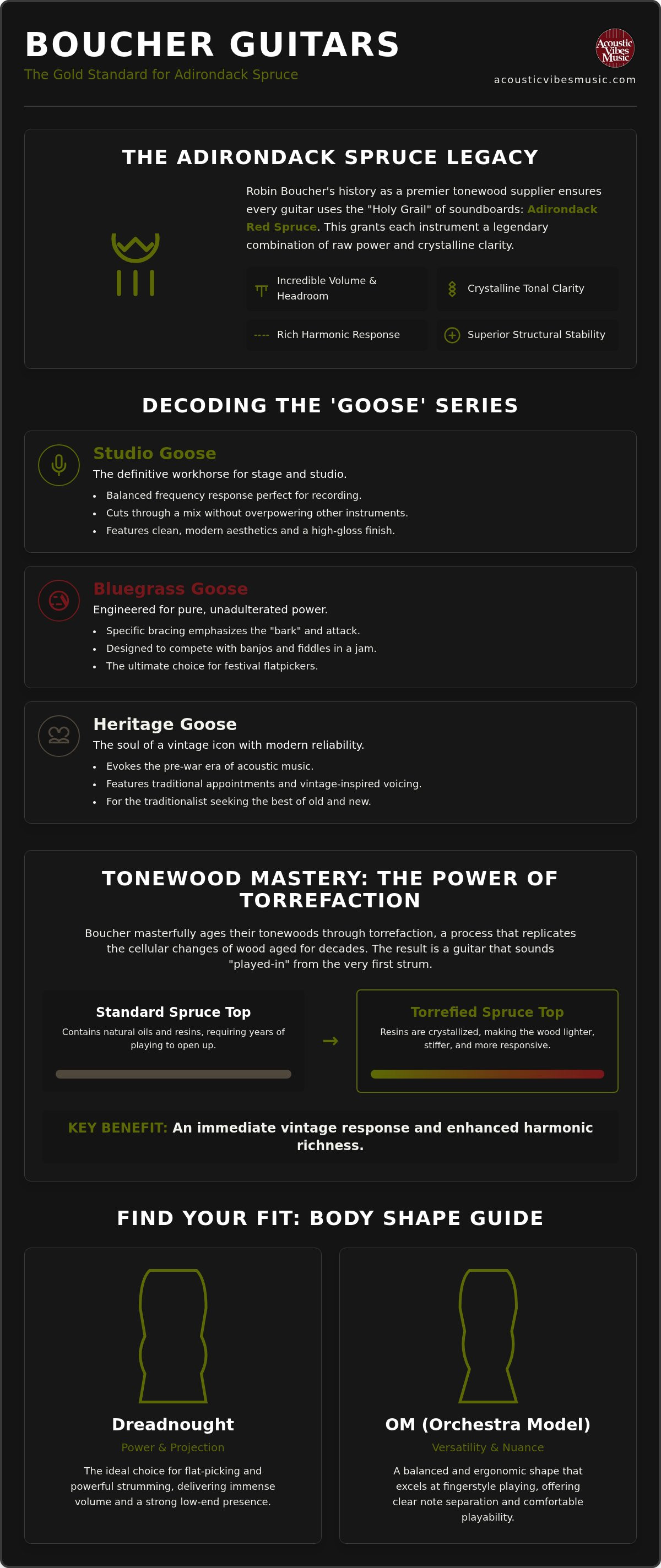
Body architecture is the final piece of the tonal puzzle. While the spruce top provides the engine, the body shape determines how that energy is dispersed. Choosing between a Dreadnought and an OM isn't just a matter of size; it's a choice of musical mission. Boucher guitars excel in both categories, but the experience of playing them is vastly different. Every curve and brace is designed to maximize the potential of the Adirondack soundboard, ensuring that no matter which size you choose, you're getting a world-class response.
The BG series is the undisputed champion for flatpickers and ensemble players. Take the Boucher BG-151, for instance. It possesses a massive internal volume that translates into a cavernous bass response. However, unlike many factory-made dreadnoughts that can sound "woofy" or indistinct, the hand-voiced Adirondack top keeps the low end tight and articulate. This prevents the "muddy" frequencies that often plague large-bodied instruments in a full band setting. If you’re competing with a banjo or mandolin, you need this specific projection to hold your ground. For those weighing the pros and cons of larger bodies, our guide on Dreadnought vs. Grand Auditorium for Strumming offers deeper insights into these acoustic powerhouses.
If the Dreadnought is a cannon, the SG series instruments are scalpels. The Orchestra Model (OM) is a favorite for fingerstyle players because of its impeccable string-to-string balance. Every note in a chord carries equal weight, which is essential for complex arrangements. There is also the 000-12 fret model to consider. By moving the bridge further back on the soundboard, Boucher creates a warmer, more intimate voice that feels incredibly responsive to a light touch. Scale length also plays a role here. The standard OM scale provides the tension needed for alternate tunings, while the shorter 000 scale offers a "slinkier" feel that’s easy on the hands.
Boucher necks are carved with a modern, comfortable profile that avoids the "baseball bat" feel of some vintage recreations. You can find various nut widths to suit your fingerpicking style or chord-shaping preferences. It’s this attention to the player’s physical connection that makes these instruments so rewarding to own. Ready to feel the difference for yourself? You can browse our current selection of Boucher guitars to find the body shape that speaks to your playing style.
The modern acoustic landscape is witnessing a renaissance. While heritage brands certainly have their place, a new generation of players is looking for something more personal and meticulously voiced. In our shop, Boucher guitars and Atkin Guitars have become the most requested "new classics." Both brands represent the pinnacle of boutique lutherie, yet they approach the "perfect" acoustic voice from different geographical and tonal philosophies. While Boucher harnesses the raw power and headroom of the Canadian wilderness, Atkin captures the dry, papery soul of the pre-war era from their workshop in the United Kingdom. Together, they offer a complete spectrum of high-end acoustic possibilities.
If you find yourself drawn to the immediate response of Boucher guitars, you’ll likely find a kindred spirit in the work of Alister Atkin. While Boucher is the master of Adirondack power, Atkin focuses on a specific vintage "relic" aesthetic and a tonal profile that mimics a played-in instrument from the 1930s. Operating as a small, seven-man team, Atkin produces a limited number of instruments each year. Their approach to bracing and finish is designed to maximize resonance and provide a haunting, woody character that feels decades old. It’s a different flavor of excellence; one that prioritizes vintage "vibe" and delicate harmonic complexity. You can browse our exclusive collection of Atkin Guitars to see how this British boutique approach compares to the Canadian powerhouse.
We understand that purchasing an investment-grade instrument online can feel like a leap of faith. That is why our role as an authorized dealer goes beyond simple retail. Every instrument is treated with the reverence it deserves before it ever leaves our doors. We prepare high-end guitars for national shipping with a rigorous inspection process and a professional setup tailored to your playing style. This ensures that when you unbox your new heirloom, it plays perfectly and is structurally stable for its new environment. Choosing a boutique instrument is about more than just the name on the headstock; it is about the expert curation and maintenance that happens before the guitar reaches your hands.
Before you make your final selection, use this checklist to ensure you’ve found the right match:
Whether you choose the crystalline power of a Boucher or the vintage soul of an Atkin, you are investing in a tool that will grow with you for a lifetime. Explore our full range of Boucher guitars to start your journey toward the perfect Adirondack voice.
Choosing a boutique instrument is an investment in your musical identity. We've explored how Robin Boucher’s vertical integration ensures only the finest soundboards make the cut, providing the crystalline clarity and massive headroom that defines the brand. From the thunderous projection of the Bluegrass Goose to the nuanced response of an OM, these instruments are built to inspire every time you open the case. You aren't just buying a guitar; you're acquiring a legacy of Canadian craftsmanship that will only improve with age.
As an authorized dealer for both Atkin and Boucher guitars, we specialize in curating a collection of master-grade tonewoods that you won't find in a typical music store. We stand behind every instrument with a free professional setup on all national orders, ensuring your guitar arrives ready to perform. Your search for the ultimate Adirondack voice is a journey worth taking with an expert guide by your side. Browse our curated collection at acousticvibesmusic.com today to find the guitar that will define your sound for decades to come. We're eager to help you find an instrument that feels as good as it sounds.
Boucher guitars are handcrafted in the heart of the Canadian forest in Berthier-sur-Mer, Quebec. This location is strategic because it allows the lutherie team to be physically close to the source of their world-class Adirondack spruce. Every instrument is built in this specialized workshop by a small team of artisans who oversee the entire production process from raw timber to finished masterpiece.
Adirondack spruce provides a much higher ceiling for volume and dynamic range than Sitka spruce. It is notably stiffer and lighter, which allows the player to dig in with a heavy pick without the sound becoming muddy or compressed. This results in a punchy, crystalline response that is highly prized by professional players who need their instrument to project clearly in a large room.
You can identify a torrefied top by its distinctive golden-brown or amber color, which resembles the look of a vintage instrument from the 1930s. Beyond the visual cues, these models are clearly designated in the technical specifications as having a heat-treated or aged top. This process ensures the wood is stable and resonant right out of the case, providing an immediate vintage character.
The Bluegrass Goose series is the definitive choice for players who need to compete with loud acoustic instruments like banjos and fiddles. These dreadnoughts feature a specific bracing architecture and top thickness designed specifically for flatpicking power. They deliver the legendary "bark" and low-end authority required for traditional bluegrass ensembles while maintaining the harmonic richness common to all Boucher guitars.
These instruments hold their resale value remarkably well because they are produced in limited quantities using the world's finest wood supply. Because Robin Boucher is a primary supplier of Adirondack spruce to the industry, his own instruments receive the absolute best cuts available. This rarity and material excellence make them highly sought after on the secondary market by serious collectors and professional musicians alike.
The Studio Goose is a versatile workhorse with a balanced frequency response that is perfect for recording engineers and stage performers. In contrast, the Bluegrass Goose is a power-focused dreadnought built for maximum volume and a punchy midrange. While the Studio model excels in clarity across the entire spectrum, the Bluegrass model is voiced specifically for aggressive flatpicking and ensemble projection.
You can certainly customize your instrument when ordering through an authorized boutique dealer. Whether you need a specific nut width for complex fingerstyle or a particular tonewood like Bubinga for the back and sides, we facilitate the process directly with the workshop. This ensures that your custom build maintains the structural integrity and tonal standards that have made Boucher guitars a modern classic.
The Boucher neck profile is designed with a modern, ergonomic carve that feels fast and comfortable in the hand. It is generally less chunky than a traditional vintage Martin profile but offers a bit more palm support than the very slim profiles found on modern Taylor models. This middle ground makes it an excellent choice for players who move frequently between different styles of acoustic music.