My shopping cart
Your cart is currently empty.
Continue ShoppingIs the "organic" choice always the superior one for your guitar's voice? Many players assume bone is the undisputed gold standard, but the reality of the bone nut vs tusq saddle sound is far more nuanced than tradition suggests. You've likely felt the frustration of a dull high E string or inconsistent sustain that makes your favorite chords feel flat. It's common to think your instrument has hit its ceiling, especially when harsh frequencies or tuning instability at the nut start to compromise your performance.
We believe every acoustic deserves to reach its full sonic potential. By exploring the harmonic differences between organic bone and engineered TUSQ, you can finally eliminate those "dead" spots and find the clarity you've been seeking. This guide provides a deep dive into the tonal profiles of these materials, explaining how the consistent density of TUSQ compares to the rich, variable warmth of hand-carved bone. Whether you're playing a vintage Martin or a modern Taylor, you'll discover which material suits your specific tonewoods and how a precision setup can breathe new life into your music.
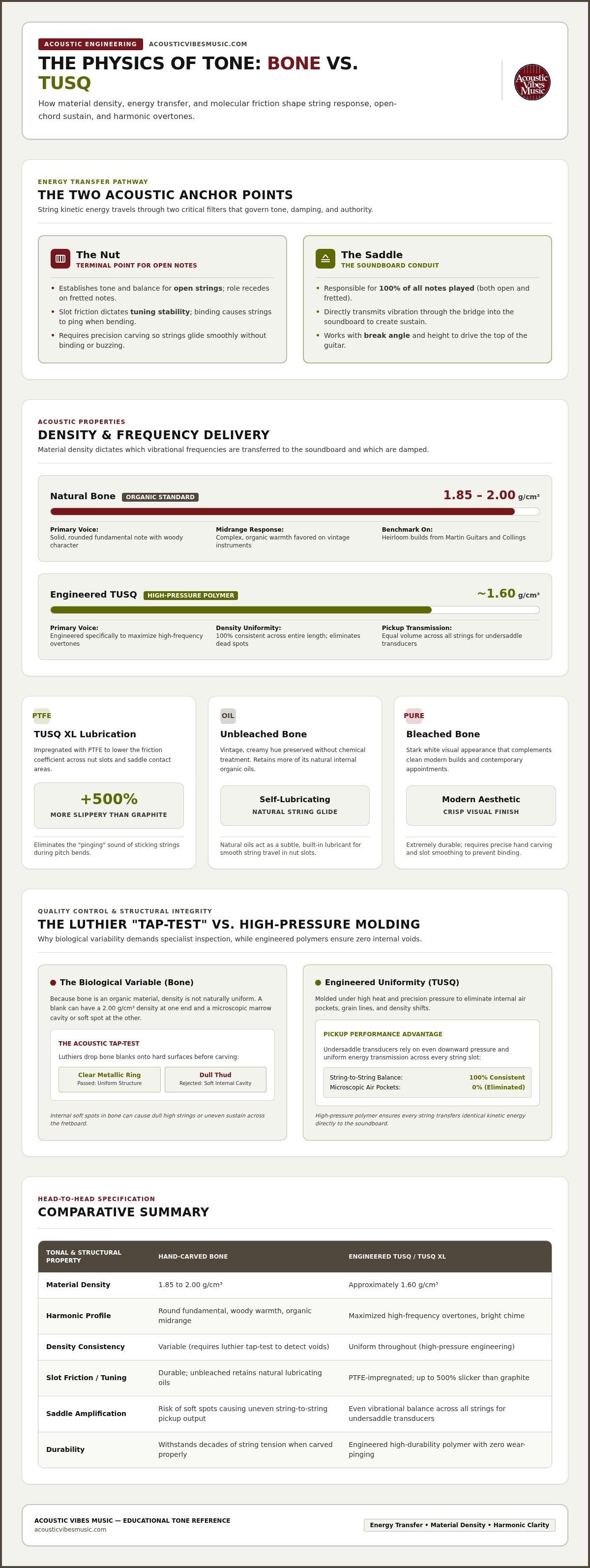
The acoustic guitar is a complex machine of vibration. When you pluck a string, you initiate a transfer of kinetic energy that must travel through two critical anchor points: the nut and the saddle. These small components act as the primary filters for your instrument's voice. The efficiency of this energy transfer determines whether your guitar rings with authority or sounds choked and thin. Understanding the bone nut vs tusq saddle sound begins with the study of density. Material density dictates which frequencies are transmitted to the wood and which are dampened. High-density materials like bone, averaging 1.85 to 2.00 g/cm³, provide a solid fundamental note. In contrast, engineered TUSQ has a uniform density of approximately 1.60 g/cm³, designed specifically to maximize high-frequency harmonic overtones.
The nut serves as the terminal point for every open note. While its influence on tone diminishes once you press a string against a metal fret, it remains vital for tonal balance and tuning stability. A deep understanding of string instrument nut mechanics reveals that the material's friction coefficient is just as important as its acoustic properties. If strings bind in the slots, your tuning will suffer during every bend. TUSQ XL is often impregnated with PTFE, making it up to 500% more slippery than graphite. This prevents the "pinging" sound of a sticking string. Bone is naturally durable and provides a classic, woody response for those open chords, but it requires expert luthier carving to ensure the slots are smooth and perfectly sized.
If the nut is the gateway, the saddle is the heart of your guitar's resonance. It's responsible for 100% of the notes you play, whether open or fretted. Sitting directly atop the bridge, the saddle communicates string energy directly into the soundboard. The material's ability to vibrate consistently across its entire length is crucial for a balanced performance. Natural bone can occasionally have microscopic air pockets or variations in marrow density. These organic inconsistencies can cause uneven string-to-string volume, a common frustration for players using undersaddle pickups. TUSQ eliminates these variables through high-pressure engineering, ensuring every string receives the same level of clarity. The height of the saddle also determines the break angle, which works in tandem with the material to drive the top of the guitar and create sustain.
For centuries, bone has remained the undisputed benchmark for high-end acoustic appointments. Walk into any world-class gallery and you'll find it on heirloom instruments from Martin Guitars or Collings. This preference isn't just a nod to nostalgia. Bone offers a complex, organic warmth that synthetic materials often struggle to replicate. It provides a rounder fundamental note and a specific type of midrange clarity that feels "woody" and alive. When debating the bone nut vs tusq saddle sound, many purists point to this unpredictable harmonic character as the secret to an instrument's soul. It's remarkably durable, too. A well-carved bone nut can easily withstand decades of string tension while maintaining its structural integrity.
Nature doesn't manufacture in a vacuum. Because bone is a biological material, its density isn't perfectly uniform. You might find a piece with a density of 2.00 g/cm³ on one end and a hidden marrow cavity on the other. This variability is why professional luthiers perform a "tap-test" on every blank before carving. They drop the bone on a hard surface, listening for a clear, metallic ring rather than a dull thud. A piece with internal soft spots can lead to "dead" strings or inconsistent sustain across the fretboard. This risk is a primary differentiator in the bone nut vs tusq saddle sound comparison; bone requires a specialist's eye to ensure every note rings true.
Choosing between bleached and unbleached bone is often a matter of aesthetic harmony. Bleached bone offers a clean, stark white look that complements modern builds. However, many enthusiasts prefer unbleached bone for its vintage, creamy hue. Beyond looks, unbleached bone retains more of its natural oils. These oils act as a subtle, built-in lubricant, helping strings glide through the slots during tuning. For a detailed look at how these variations impact your setup, this guide to guitar nut materials is an excellent resource. Matching the component's color to your guitar's binding or trim creates a cohesive, artisanal appearance that reflects the instrument's heritage. If you're looking to refine your instrument's voice, exploring our curated selection of premium acoustics can help you hear these artisanal differences in person.
While the previous section explored the organic allure of bone, TUSQ represents a triumph of modern acoustic engineering. Developed by Graph Tech, this man-made material is often referred to as "engineered ivory." It isn't a simple plastic; rather, it's a specialized polymer created under intense heat and pressure to ensure a completely uniform structure. This isotropic nature is the secret behind the bone nut vs tusq saddle sound. By eliminating the microscopic air pockets and soft spots inherent in biological materials, TUSQ allows string energy to travel with surgical precision. The result is a crystalline high-end and a rich harmonic bloom that many players find addictive.
The tonal signature of TUSQ is defined by its resonance. If you drop a TUSQ saddle on a hard surface, it produces a clear, bell-like tone. This high resonant frequency translates to your instrument as enhanced "sparkle" and chord definition. It's a deliberate design choice that has led premium builders like Taylor Guitars and Yamaha Acoustic Guitars to adopt it as their factory standard. These manufacturers value the predictability of the material, knowing that every guitar leaving the bench will meet a specific tonal benchmark.
TUSQ is particularly effective for instruments equipped with under-saddle pickups. Because the material is consistent from end to end, it provides even pressure across the piezo element. This ensures a balanced amplified signal, preventing the "hot" or "dead" strings that can occur when organic density varies. Many professionals find that the bone nut vs tusq saddle sound debate is settled the moment they plug in; TUSQ simply offers a more reliable electronic translation. For a deeper look at these properties, exploring acoustic guitar nut materials and tone can provide further technical clarity on why synthetic polymers are gaining ground in high-end workshops.
Beyond its acoustic merits, TUSQ is a favorite among touring musicians for its sheer reliability. It's virtually immune to the shrinking or cracking that can affect bone during rapid temperature or humidity shifts. This makes it an ideal choice for players who travel through diverse climates.
Choosing between these materials is an exercise in tonal curation. When we examine the bone nut vs tusq saddle sound, we're looking at two distinct philosophies of vibration. Bone delivers a punchy, immediate attack with a strong fundamental note. It anchors the sound with an authoritative "snap" that many traditionalists find indispensable. TUSQ, however, leans into shimmering resonance. It feels more like a hi-fi system for your strings, emphasizing the "air" around each note. This material is engineered for harmonic oscillation, allowing it to sustain frequencies that organic bone might naturally dampen.
Sustain benchmarks often favor TUSQ in a lab setting. Its engineered rigidity and uniform density allow it to keep the string vibrating longer by minimizing energy loss through internal friction. Bone provides a more organic decay. It's slightly shorter in duration but feels more "correct" to players raised on the legendary recordings of the 1950s and 60s. This difference in the bone nut vs tusq saddle sound is most apparent during slow, melodic passages where you want the notes to linger and interact.
Harmonic bloom is the way a note’s overtones swell and expand after the initial strike, creating a layered, orchestral resonance. TUSQ excels here. It deliberately boosts the mid and high-range frequencies, giving your chords a bell-like quality. Be careful, though. On a bright guitar with maple back and sides, TUSQ can occasionally cross the line into harshness. Bone acts as a natural filter. It tames those brittle, glassy highs while providing a rich, low-mid warmth that rounds out the instrument's voice. This filtering effect is why bone is often the first choice for taming an overly aggressive instrument.
The synergy between your saddle and your tonewoods is where the magic happens. Pairing a bone saddle with a rosewood instrument often enhances that deep, low-end growl and complex midrange. It's a combination that defines the "vintage soul" of many high-end builds. Conversely, a mahogany or cedar-topped guitar can sometimes sound a bit dark or "boxy" in certain registers. Swapping in a TUSQ saddle can brighten the response, adding much-needed definition to the treble strings and helping the guitar "cut" through a mix. To understand how these woods behave at a fundamental level, explore our guide on Rosewood vs. Mahogany Back and Sides.
Finding the right balance requires an expert ear and a deep understanding of your specific instrument's needs. If you're ready to unlock your guitar's true voice through a professional setup, explore our curated collection of world-class acoustics to hear these tonal nuances in action.
Listen closely to your instrument's current voice before making a final decision. Every guitar tells a story, but sometimes that story needs a clearer narrator. If your dreadnought feels overly boomy or "dark," a TUSQ saddle can provide the necessary treble lift to bring chords into focus. Conversely, if your small-bodied acoustic sounds brittle or thin, the organic density of bone can act as a natural tether, grounding the high end with woody warmth. The bone nut vs tusq saddle sound isn't about which material is objectively better. It’s about which one provides the missing piece of your guitar's tonal puzzle.
Your playing style also dictates the ideal material. Fingerstyle players often gravitate toward TUSQ because its harmonic richness highlights delicate overtones and subtle nuances. The consistent sustain allows every fingerpick to bloom. Flatpickers, however, often prefer the fundamental "thump" and immediate snap of bone. It provides the headroom needed for aggressive strumming without the frequencies becoming cluttered or harsh. It’s about synergy between your hands and the bridge.
Manufacturers choose their factory specs with specific tonal goals in mind. Many Martin Guitars ship with bone components because they reinforce that classic Americana thump and dry, vintage character. It’s a tradition that respects the heritage of the build. In contrast, the synergy between Taylor Guitars and TUSQ is legendary. Taylor utilizes engineered materials to ensure a modern, hi-fi performance that remains perfectly balanced across their proprietary pickup systems. For players who want the best of both worlds, a hybrid setup is a sophisticated solution. Installing a self-lubricating TUSQ XL nut ensures world-class tuning stability, while a hand-compensated bone saddle retains that organic, fundamental soul at the bridge.
Perform a "before and after" listening test by recording your guitar with fresh strings before the swap. You'll likely notice the biggest shift in the decay of the notes and the clarity of the midrange. While the material choice is vital, the quality of the installation is what truly unlocks the potential of these parts. A poorly fit bone nut will sound far worse than a precision-molded TUSQ one. Precision is everything. To ensure your instrument receives the artisanal care it deserves, consider the broader context of Acoustic Guitar Bridge Repair Cost and the value of professional luthier services. A master setup doesn't just change the material; it refines the entire playing experience.
The journey to perfecting your guitar's resonance is a deeply personal pursuit. Whether you choose the organic warmth of a hand-carved bone nut or the engineered harmonic richness of TUSQ, your decision shapes how your instrument interacts with your unique playing style. Choosing between the bone nut vs tusq saddle sound is about more than just physics; it's about finding the specific frequencies that inspire you to play more. High-end materials only reach their full potential through professional installation. A precision-slotted nut and perfectly intonated saddle are the final steps in your guitar's tonal refinement.
We invite you to experience these nuances firsthand through our hand-selected inventory from world-class builders like Martin, Taylor, and Collings. Every instrument in our gallery is a testament to material excellence and artisanal skill. Explore our curated collection of premium acoustic guitars today and discover the clarity your music has been missing. We offer national shipping with expert-level packing and insurance to ensure your next heirloom arrives in perfect condition. Your perfect tone is waiting to be unlocked.
Bone is often preferred for its organic warmth and traditional woody character, making it a favorite for heirloom-quality instruments. TUSQ offers a more consistent, bell-like high end that suits modern playing styles. Neither is objectively superior; the choice depends on whether you want the unpredictable richness of natural material or the engineered precision of a man-made alternative. Both require professional installation to perform at their peak.
TUSQ is generally considered superior for guitars with undersaddle piezo pickups. Because TUSQ is engineered to be isotropic, it lacks the internal soft spots or marrow cavities found in natural bone. This uniformity ensures even pressure across the pickup element, eliminating the hot or dead strings that can plague organic materials. When comparing the bone nut vs tusq saddle sound through an amplifier, TUSQ provides a more balanced and reliable signal.
While you can sand a drop-in saddle at home, replacing a nut is a high-precision task that usually requires a professional luthier. Slotting a nut involves specialized files and measurements down to the thousandth of an inch. Incorrect slot depth leads to buzzing or poor intonation. For premium instruments from brands like Martin or Collings, expert installation is vital to protect your investment and ensure the material actually improves your tone.
Both materials are remarkably durable and can last for decades under normal playing conditions. Bone is a very hard material that resists string grooves well, but it can be brittle if it dries out over many years. TUSQ is specifically designed to withstand high string tension and is completely unaffected by humidity or temperature changes. Regular maintenance and a proper setup will maximize the lifespan of either component on your acoustic guitar.
A bone nut can significantly improve tuning stability if the slots are polished and sized correctly by a specialist. Natural bone contains oils that provide a small amount of lubrication. However, TUSQ XL is often impregnated with PTFE, which is up to 500% more slippery than graphite. This helps prevent the string binding that causes tuning pings. The quality of the carving is usually more important than the material itself for staying in tune.
TUSQ is engineered to maximize harmonic oscillation, which often results in a longer, more shimmering sustain. Its high resonant frequency allows notes to ring with a hi-fi clarity. Bone provides a more traditional sustain profile with a strong fundamental note and an organic decay. When weighing the bone nut vs tusq saddle sound, consider if you want notes that bloom and linger or a punchy, immediate attack that settles quickly.
Taylor Guitars utilizes TUSQ primarily for its incredible consistency across large production runs. They need every guitar to meet a specific tonal benchmark, and TUSQ eliminates the variables of organic bone. Additionally, TUSQ provides the perfect physical interface for their proprietary Expression System 2 pickups. This ensures that the balanced acoustic voice Taylor is known for translates accurately when the player plugs into a sound system or recording interface.
The nut material only influences the tone of open, unfretted strings. Once you press a string against a metal fret, that fret becomes the new anchor point for the vibrating length of the string. At that moment, the nut's acoustic properties are bypassed. However, the nut still dictates string spacing and height at the headstock, which affects the overall playability and feel of the instrument regardless of whether you are fretting a note.