My shopping cart
Your cart is currently empty.
Continue ShoppingA $10,000 heirloom acoustic is only as good as its last five minutes on a luthier's bench. You've likely felt the frustration of a world-class instrument that feels "tight" or demands too much force for a simple barre chord. When strings sit too high, your focus shifts from the melody to the physical struggle of the fretboard. Achieving the perfect acoustic guitar setup for fingerstyle is about more than just lowering the action; it's about optimizing the ergonomic geometry of the instrument to favor responsiveness over raw percussive volume.
We believe your guitar should be an effortless extension of your hands, not a source of hand fatigue. By dialing in the specific tolerances required for intricate picking, you can eliminate muffled notes and the annoying buzz often found in alternate tunings. This guide explores the technical adjustments that create clear note separation and that coveted "broken in" feel. Discover how a precision fingerstyle setup transforms your high-end acoustic into a responsive tool that finally stays out of your way. We'll examine everything from nut height to saddle compensation to ensure your Martin, Collings, or Taylor performs at its peak.
An elite instrument arrives from the factory with a "safe" setup designed to perform reasonably well for the average player. For the manufacturer, this means setting the action slightly higher to ensure the guitar doesn't buzz when a heavy-handed strummer tests it in a showroom. However, a generic configuration rarely meets the demands of a dedicated picker. A true acoustic guitar setup for fingerstyle is a precise calibration of action, neck relief, and string spacing tailored for a lighter, more nuanced touch. It's the difference between a guitar that feels like a stiff tool and one that feels like a natural extension of your fingertips.
The primary philosophy here is a strategic trade-off. We purposefully trade maximum headroom and raw percussive volume for tactile responsiveness and ease of play. In a professional setup, we aim to lower the threshold of energy required to move the guitar's top. This ensures that even the softest ghost note or harmonic rings out with clarity. When your instrument is properly dialed in, you don't have to fight the tension to produce a beautiful tone; the guitar responds to your intent instantly.
Strummers require higher action because a heavy pick attack causes the strings to vibrate in a wide, aggressive arc. Without that clearance, the strings would "bottom out" against the frets, creating unwanted noise. Conversely, fingerstyle players rely on technical maneuvers that demand a softer feel. To understand what fingerstyle guitar is in a technical sense, one must look at the reliance on hammer-ons, pull-offs, and complex chord voicings that span multiple frets. Lowering the action and optimizing string tension makes these intricate movements feel effortless, allowing you to hold difficult shapes without the hand fatigue that plagues factory-spec instruments.
Every body style requires a unique approach to its ergonomic geometry. An OM or 000 model, often considered the gold standard for picking, is configured for immediate mid-range response. We focus on a setup that highlights note separation so each voice in a contrapuntal piece remains distinct. Dreadnoughts, while known for their power, often require careful saddle height adjustments to manage their natural low-end "boom," ensuring the bass doesn't swallow your melody lines.
Specialized builds also demand bespoke attention. For instance, Lowden guitars feature a unique bridge design and internal bracing that often require a different approach to bridge geometry compared to traditional American builds. Achieving a perfect acoustic guitar setup for fingerstyle on these instruments involves respecting their specific heritage while pushing the playability to its absolute limit. Whether it's a boutique build or a vintage workhorse, the goal is always a guitar that invites you to play longer and explore further.
Achieving a professional acoustic guitar setup for fingerstyle requires a holistic view of the instrument's geometry. It isn't just about one screw or a single file stroke; it's a sequence of delicate calibrations. We begin with the truss rod to set the neck relief, move to the nut for first-position ease, and finish at the saddle to dial in the final action height. When these three elements work in harmony, the guitar stops being a physical challenge and starts being an inspiration.
Most factory guitars arrive with nuts that are set purposefully high. While this prevents buzzing for heavy strummers, it makes the common F-chord a nightmare for fingerstyle players. You can test your instrument using the "3rd fret test." Simply press a string down at the 3rd fret and look at the gap between the string and the 1st fret. There should be a hair-thin space, barely visible to the eye. If it looks like a canyon, you're fighting unnecessary tension. Precision filing here fixes intonation issues in the lower register and allows for effortless fretting. High-end builds like those from Collings Guitars utilize bone for its superior density and crisp tonal transfer, which is the preferred material for any serious nut replacement.
Relief is the slight concave bow in the neck that allows strings room to vibrate. While bluegrass players often need a deeper "dip" to accommodate aggressive flatpicking, fingerstyle players generally prefer a straighter neck. This provides a more consistent feel across the entire fretboard. Professionals use feeler gauges to reach a precision of .005" to .008" at the 7th fret. Too much relief makes the middle of the neck feel "spongy" and increases the distance your fingers have to travel. A straighter neck ensures that complex, multi-fret chord voicings feel uniform from the nut to the body joint.
Once the neck and nut are perfect, we shave the bottom of the saddle to reach the final action height. For a fingerstyle focus, we often aim for a height of 5/64" on the bass side and 4/64" on the treble side at the 12th fret. However, we must maintain a healthy "break angle"—the angle at which the string travels from the bridge pin over the saddle. If the saddle is shaved too low, you lose the downward pressure required to drive the guitar's top, resulting in a thin, weak tone. A master luthier balances this height with saddle compensation to ensure every note remains perfectly in tune. If you're hesitant to take a file to your prize instrument, our luthier repair services can handle these delicate adjustments to create the perfect acoustic guitar setup for fingerstyle.
Most discussions about an acoustic guitar setup for fingerstyle focus entirely on the vertical distance between the string and the fret. While action is crucial, this overlooks the horizontal geometry of the instrument. The way strings are spaced at both the nut and the saddle dictates how much room your fingers have to breathe. For the intricate movements of solo pieces, every fraction of an inch matters. A guitar that feels "crowded" will inevitably lead to muffled notes and technical frustration, regardless of how low the action sits.
Nut widths generally fall into three categories: 1 11/16", 1 3/4", and 1 13/16". While 1 11/16" is a standard for many vintage-style strummers, it often feels cramped for complex fingerwork. The 1 3/4" width has become the modern gold standard for a reason; it offers a perfect balance of reach and room. For those with larger hands or a preference for traditional ragtime and blues, 1 13/16" provides a luxurious amount of surface area that prevents accidental muting of adjacent strings.
A wider nut is essential for maintaining clarity during complex chord voicings. If strings are too close together, the "meat" of your fretting fingers can easily dampen the ring of an open string or a neighboring fret. Martin guitars addressed this evolution with their High Performance Taper necks. These designs combine a comfortable 1 3/4" nut with a taper that feels slim and fast as you move up the fretboard. If you're struggling with "dead" notes in a difficult passage, the issue might not be your technique. It's often a neck width that doesn't match your physical anatomy.
This is where many generic setups fail to meet the needs of a specialist. String spacing at the saddle, measured from the center of the high E to the center of the low E, is the most critical factor for your picking hand. A standard 2 1/8" spacing is frequently too narrow for clean, modern attacks. Fingerstyle specialists generally prefer 2 1/4" or even 2 5/16" at the bridge. This extra width provides the necessary clearance for your nails or fingertips to engage the string without clipping the one next to it.
Whether you use a heavy thumb pick or play with bare flesh, wider saddle spacing allows for a more aggressive and precise right-hand attack. While you cannot easily change the bridge pin placement on an existing guitar, a skilled luthier can "cheat" the spacing when cutting a new bone nut. By moving the strings slightly closer to the edge of the fretboard, we can maximize every millimeter of available space. This level of granular customization is a hallmark of a professional acoustic guitar setup for fingerstyle.
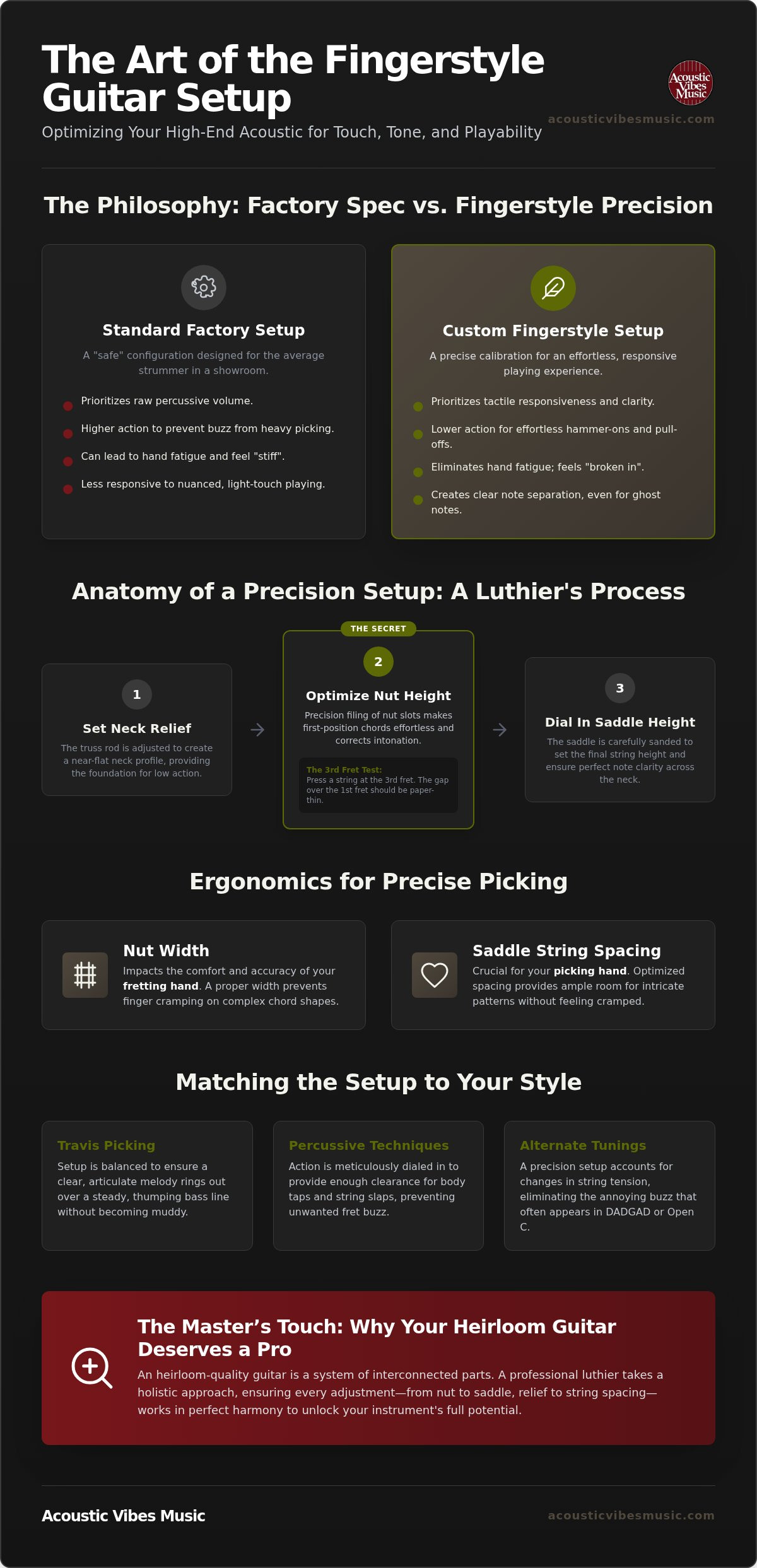
Fingerstyle is a broad church, and your specific technique dictates the final millimeters of your instrument's calibration. A player chasing the delicate nuances of a Celtic ballad requires a different acoustic guitar setup for fingerstyle than a modern percussive soloist. If your style involves hitting the body or slapping the strings, ultra-low action becomes your enemy. You need enough "air" between the string and the fret to prevent unwanted metallic clatter during aggressive passages. Precision matters here. Conversely, for the steady "thump" of Travis picking, we focus on balancing the bass string tension to ensure that alternating rhythm remains punchy and defined without becoming floppy under a heavy thumb.
Stability is the goal. When you move away from standard tuning, the physical forces acting on your guitar change instantly. To maintain a professional feel, your setup must account for these shifts in tension. A compensated saddle is mandatory for this level of play. It ensures that as you move up the neck, your intonation remains flawless, even in deep, resonant open tunings. It's a delicate dance of physics and artistry that separates a good guitar from a truly great one.
Dropping into DADGAD or Open G significantly reduces the total tension on the neck. This often causes the neck to straighten too much, leading to buzzing on the lower frets. Specialists frequently opt for "True Medium" gauges. These sets feature slightly heavier gauges on the strings that are tuned down, maintaining a consistent tactile feel across the fretboard. We adjust the saddle specifically to prevent that low "D" from buzzing, ensuring your alternate tuning explorations are met with pure, clean resonance rather than mechanical noise.
String choice is the final layer of your setup. Phosphor bronze offers a rich, complex warmth, while 80/20 bronze provides the crystalline brightness needed to cut through a dense mix. Modern players are increasingly turning to technology to solve age-old problems. In fact, data from 2026 shows that 42% of players now prefer advanced coated strings to extend playability and reduce finger squeak during recording. Matching your string material to your instrument's construction is vital; explore our Rosewood vs. Mahogany Back and Sides guide to see how tonewoods influence these decisions.
Ready to transform your playing experience? Visit Acoustic Vibes Music today to consult with our master luthiers and unlock the perfect acoustic guitar setup for fingerstyle for your unique voice.
A premium instrument is a complex ecosystem where every adjustment ripples through the entire build. You shouldn't view an acoustic guitar setup for fingerstyle as a simple checklist of isolated tasks. It's a holistic calibration. When a luthier adjusts the nut slot depth, they're simultaneously calculating how it interacts with the neck relief and the specific break angle at the saddle. This interconnectedness is why professional intervention is vital for heirloom-quality pieces. A master luthier doesn't just measure; they listen to how the wood responds to tension.
High-performance instruments from world-class makers like Collings or Boucher Guitars are built to incredibly exacting tolerances. Attempting a DIY setup on such a machine carries significant risks. One slip with a nut file can ruin an expensive bone blank instantly. Over-tightening a truss rod can lead to internal fractures or stripped threads that are far more costly to repair than a standard service. At Acoustic Vibes Music, we treat every guitar as a curated work of art. Our philosophy centers on "unlocking" the tactile responsiveness that the original builder intended for the discerning collector.
Communication is the bridge between a good setup and a perfect one. Don't just ask for "low action." Instead, describe the specific physical sensations you're experiencing. Tell your luthier if you're feeling hand fatigue during long practice sessions or if you've noticed muffled notes when playing complex chord shapes. Bringing your preferred strings and your own tuner helps the technician replicate your exact playing environment. This level of environmental consideration is similar to the approach taken by a luxury wedding florist South Florida, where every detail of the venue is analyzed to ensure a flawless presentation. Remember that wood is a living, breathing material. Seasonal shifts in humidity can alter your guitar's geometry, making a regular check-up essential to maintain a consistent acoustic guitar setup for fingerstyle.
You don't need to be local to access our specialized craftsmanship. We handle professional setups and luthier services for customers nationwide, ensuring your instrument returns in concert-ready condition. Our team understands the logistical care and security required when shipping high-end acoustics. Whether your guitar needs a routine calibration or more intensive structural work, such as those detailed in our guide on Acoustic Guitar Bridge Repair Cost, we provide the expert precision your instrument deserves. Your guitar is an investment in your musical voice; protect it with the master's touch.
A world-class instrument is only the beginning of your musical journey. Achieving a precision acoustic guitar setup for fingerstyle ensures that every technical nuance, from delicate harmonics to complex alternate tunings, is expressed with absolute clarity. We've explored how balancing neck relief, nut height, and string spacing at the saddle creates a responsive tool that works with you. Precision matters. Whether you're playing a vintage dreadnought or a modern parlor, the right configuration eliminates hand fatigue and opens new creative doors.
As an authorized dealer for Martin, Lowden, and Taylor, we specialize in the technical demands of premium acoustics. Our expert luthier services provide the meticulous care required for high-end maintenance. We even offer national shipping for players who demand the best. Explore our curated collection of fingerstyle-ready acoustic guitars and discover how a professional touch transforms your playability. Your next masterpiece is waiting just beneath your fingertips.
Yes, lowering the action typically results in a slight reduction in maximum volume and headroom. Because the strings have less room to vibrate before striking the frets, the energy transfer to the soundboard is capped at a lower threshold. However, for fingerstyle players, this is a deliberate and beneficial trade-off. You gain tactile sensitivity and responsiveness, which are far more valuable for intricate picking than raw percussive power or loud strumming.
Most fingerstyle specialists find their "sweet spot" at 5/64" for the low E string and 4/64" for the high E string at the 12th fret. These measurements provide a low, fast feel that facilitates complex fretting without excessive buzzing. While bluegrass players might prefer 6/64" or higher, the slightly lower threshold is necessary for the lighter touch required in solo fingerstyle arrangements and modern percussive techniques.
You can certainly use light gauge strings on a dreadnought to make fingerstyle playing more comfortable. While dreadnoughts are traditionally built for the high tension of medium strings to drive their large tops, light strings reduce the physical effort needed for bends and vibrato. If you find the tone becomes too thin, a professional acoustic guitar setup for fingerstyle can help optimize the instrument's resonance for these lighter gauges.
We recommend a professional setup at least twice a year, ideally during the transition between major seasons. Changes in humidity and temperature cause the wood to expand or contract, which shifts the neck relief and action. For players who use alternate tunings frequently, more regular check-ups ensure that intonation remains precise. Keeping your instrument in peak condition prevents long-term structural issues and maintains that responsive, broken-in feel you expect.
Yes, a wider nut width, such as 1 3/4" or 1 13/16", provides more space between the strings, which significantly helps beginners avoid accidental muting. This extra room allows for cleaner chord voicings and more precise finger placement. While a narrower 1 11/16" nut might feel easier for small hands to wrap around, the increased string spacing of a wider nut is almost always preferred for developing clean, articulate picking technique.
If the neck relief is too straight or back-bowed, you will experience persistent buzzing, especially on the first few frets. Strings need a slight concave curve in the neck to vibrate freely without hitting the fret wire. While fingerstyle players prefer a straighter neck than strummers, a completely flat fretboard usually results in a choked tone and loss of sustain. A luthier uses a truss rod to dial in the perfect microscopic curve.
Bone is the gold standard for high-end fingerstyle instruments due to its superior density and organic tonal transfer. It provides a crisp, clear high end and excellent sustain that synthetic materials often struggle to match. While TUSQ is a consistent, high-quality engineered alternative, most discerning collectors prefer the traditional heritage and tactile response that a hand-carved bone nut offers. It ensures every note in your arrangement rings with absolute purity.
Buzzing in alternate tunings occurs because dropping the pitch reduces the overall tension on the neck, causing it to straighten. When the neck loses its relief, the strings sit closer to the frets and lack the tension to stay taut. This is a common challenge that requires a specific acoustic guitar setup for fingerstyle to resolve. A luthier can compensate for this by adjusting the truss rod or suggesting custom string gauges.