My shopping cart
Your cart is currently empty.
Continue ShoppingYour premium acoustic guitar should feel like an extension of your hands, not a physical obstacle to overcome. Many enthusiasts settle for factory settings that lead to finger fatigue or muffled barre chords, fearing that any adjustment might ruin their prized instrument. It's a valid concern when you're handling a high-end Martin or a handcrafted Boucher. However, the secret to that effortless, professional feel lies in a precise acoustic guitar setup for low action, where every fraction of a millimeter counts toward your playing experience.
We understand the reverence you have for your collection and the desire for a clean tone with minimal buzz. You don't have to sacrifice the resonance of your guitar just to make it easier to play. This guide will help you master the technical nuances of string height by explaining the symbiotic relationship between the nut, the neck relief, and the saddle. By the end, you'll know exactly how to achieve a buttery-smooth setup that preserves the heritage and artistry of your instrument. We're diving deep into the geometry of playability to transform your guitar into the responsive, high-performance tool it was meant to be.
Action is the mechanical foundation of guitar playability. In its simplest terms, it refers to the vertical distance between the top of the fret and the bottom of the string. While the visual beauty of a Martin or a Collings is undeniable, the true soul of the instrument is felt in how it responds to your touch. A precise acoustic guitar setup for low action removes the physical barriers between your musical intent and the sound emerging from the soundhole. It reduces hand tension, increases your playing speed, and makes complex chord voicings feel effortless.
There is a delicate balance to strike between tone and playability. You might hear traditionalists argue for a higher "bluegrass" action. This extra height allows the strings more room to vibrate without hitting the frets, which can translate to increased volume and a bolder projection. However, for most modern players, the goal is to find the threshold where the strings feel light under the fingers but still retain their full resonance. If you push the action too low, you risk replacing your instrument's rich, complex overtones with a thin, metallic fret buzz that kills sustain. Understanding What is guitar action? is the first step in deciding where your personal preference lies on this spectrum.
Your ideal string height is deeply personal and depends heavily on your playing style. A light-touch fingerstyle player can get away with an incredibly low setup that would cause a heavy strummer to experience constant rattling. There's no universal measurement that works for everyone. String gauge also dictates perceived playability; a set of heavy strings at a low height might still feel stiffer than light strings at a medium height. When we evaluate an instrument from a maker like Boucher, we consider how the top's stiffness and your specific attack influence the final geometry.
High action doesn't just hurt your fingers; it hurts your pitch. When strings sit too high off the fingerboard, you have to press them a greater distance to make contact with the fret. This extra travel physically stretches the string, pulling the note sharp and ruining your intonation. By investing in a professional acoustic guitar setup for low action, you ensure that your chords remain true and your melodies stay in tune across the entire length of the neck. It's about achieving a level of precision that allows the craftsmanship of a premium instrument to shine through every note you play.
Achieving a professional acoustic guitar setup for low action isn't about a single screw turn; it's about managing a delicate system of physical angles. We call these the Three Pillars: nut slot depth, truss rod relief, and saddle height. To get it right, you must take a holistic view of guitar setup. Most players make the mistake of heading straight for the saddle with a piece of sandpaper. In reality, a truly refined, professional-feeling setup almost always starts at the nut.
Let's clear up a common misconception: the truss rod is not a tool for adjusting action. Its sole purpose is to control the curvature of the neck to compensate for string tension. While tightening it might technically lower the strings in the middle of the fretboard, doing so to fix high action usually leads to dead notes and excessive buzzing. The truss rod sets the stage, but the nut and saddle do the heavy lifting for playability.
Relief is the slight concave bow in your guitar's neck. While it's tempting to want a perfectly straight neck, a small amount of relief is essential to give the strings room to vibrate. Without it, you'll experience maddening buzz on the lower frets. Environmental factors play a massive role here. Humidity changes cause wood to swell or shrink, shifting that bow seasonally. For instance, the stability of your instrument can vary based on its construction, as explored in our guide on Rosewood vs. Mahogany Back and Sides. Keeping a close eye on your neck relief ensures your playability remains consistent year-round.
If your guitar feels stiff in the first three frets, the nut is likely the culprit. When nut slots are too high, you have to exert excessive force just to fret a basic open chord. This creates immediate hand fatigue. Conversely, if the slots are too deep, you'll get "open string" buzz that disappears once you fret a note. Premium instruments like Martin Guitars often use high-quality bone or TUSQ nuts to ensure both durability and tonal clarity. Getting this height perfect is the secret to that "buttery" feel everyone craves.
Once the nut and relief are dialed in, the saddle becomes your fine-tuner. This is where you make the final adjustments to the overall string clearance. It's the last piece of the puzzle in your acoustic guitar setup for low action. Because these adjustments involve removing material from the instrument, many collectors prefer to trust these refinements to our professional luthier services to ensure their heirloom instruments reach their full potential.
Precision is the hallmark of a master luthier. Before making any permanent alterations to a premium Taylor or a Martin, you must gather objective data. You'll need a high-quality string action gauge, a set of feeler gauges, and a precision straightedge. These tools allow you to move beyond "feel" and into the realm of exact specifications, ensuring your acoustic guitar setup for low action is repeatable and safe for the instrument. Start by checking the nut with the "Third Fret" test. Press the string down between the second and third fret. Look at the gap between the bottom of the string and the top of the first fret. If there's no visible gap, your nut slots are too deep. If the gap is excessive, you've found the source of your high action at the lower frets.
Measurements are typically taken at the 12th fret, measuring from the top of the fret wire to the bottom of the string. The bass side requires more clearance because the thicker strings have a larger vibrational arc. While factory standards often sit around 6/64" on the low E, a professional low-action setup typically targets 5/64" on the bass side and 3/64" on the treble side. For a dedicated fingerstyle setup, aim for a 12th fret gap of approximately 3/64" on the high E string to ensure effortless fretting without losing clarity.
To isolate neck relief from saddle height, use your string as a straightedge. Place a capo at the first fret and hold the string down at the fret where the neck meets the body, usually the 14th. Use a feeler gauge to measure the gap at the 7th fret. A measurement of .005" to .010" is standard. If the gap is significantly larger, or if the string is touching the frets, your truss rod needs attention before you touch the saddle. If you notice the action is high but the saddle is already extremely low, it may be a sign that a neck reset is required rather than a simple setup.
Identify the "Buzz Zone" to avoid unnecessary work. If the guitar buzzes only on the first few frets, the nut or relief is likely the issue. If it buzzes across the entire neck, the action is likely too low for your playing style. If you're unsure how these measurements translate to the physical adjustment, seeing in a workshop setting can clarify the level of precision required. Diagnosing these nuances prevents you from sanding a saddle when the real problem lies in an uneven fret.
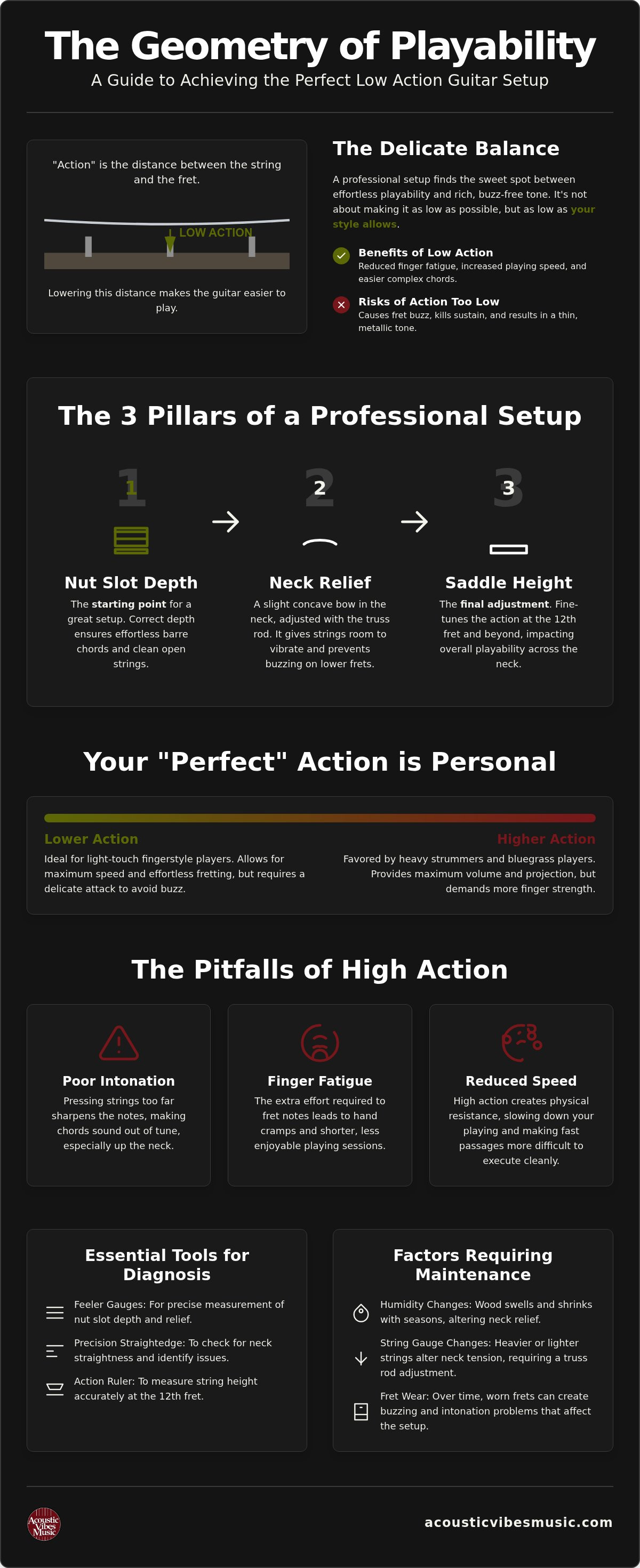
Executing a flawless acoustic guitar setup for low action requires a disciplined, sequential approach. You can't skip ahead. The process begins with adjusting the truss rod to establish the perfect neck relief. Once the neck's curvature is set, we move to the nut. This stage involves using specialized luthier files to refine the depth of each slot. It's a game of microns. After the nut is dialed in, we calculate the necessary saddle adjustment. To lower your action at the 12th fret by a specific amount, you must remove exactly twice that height from the bottom of the saddle. Finally, we re-check the intonation. Lowering the strings changes their break angle, and a final polish ensures every chord rings true across the entire fingerboard.
When you're working with heirloom instruments like Collings Guitars or Boucher Guitars, the stakes are significantly higher. These instruments often feature thin, hand-applied nitrocellulose finishes that are incredibly sensitive to heat and pressure. A professional bench setup requires specialized padding to prevent "finish blushing" or scratches. Additionally, many premium models utilize undersaddle pickups. If the bottom of the saddle isn't sanded perfectly flat and square, you'll end up with uneven string balance when plugged in. Precision isn't just a preference; it's a requirement to maintain the technical integrity of a boutique build.
Many enthusiasts feel comfortable making minor truss rod adjustments at home. It's a great way to stay connected to your instrument's needs as the seasons change. However, filing nut slots and re-shaping bone saddles are irreversible operations. One stroke too many with a file can result in a ruined nut and a frustrating string buzz that requires a total replacement. Beyond the parts themselves, there's the risk of collateral damage to the bridge or headstock. If you're concerned about the potential complications, you can explore our guide on Acoustic Guitar Bridge Repair Cost to see why professional intervention is often the most cost-effective path. Protecting your investment is just as important as improving its playability.
Your premium instrument deserves to play as beautifully as it looks. If you want to ensure your guitar reaches its full potential without the risks of a DIY mishap, book a professional setup with our expert luthier services today.
A masterful acoustic guitar setup for low action is a living achievement, not a static one. Wood is organic. It breathes. It moves. Because premium acoustics are constructed from thin, responsive tonewoods, they remain in a constant state of flux. Your guitar reacts to the air it breathes and the tension it carries. To preserve that buttery playability, you must adopt a proactive maintenance mindset. This involves monitoring environmental factors and understanding how your own playing habits impact the instrument's geometry over months and years.
The most significant threat to a stable setup is fluctuating humidity. Ideally, your instrument should live in an environment between 45% and 55% relative humidity. When the air gets too damp, the solid wood top swells, raising the bridge and increasing your action. Conversely, a dry environment causes the top to sink. This leads to maddening string buzz and, in extreme cases, structural cracks. Protecting your investment from Taylor Guitars or Gibson Acoustic Guitars requires a high-quality case humidifier and a reliable hygrometer. Without these tools, even the most expensive luthier setup will eventually drift out of alignment.
Beyond the air, your string choice plays a vital role. Switching from a light gauge to a medium gauge increases the total tension on the bridge by several pounds. This extra pull can bow the neck and lift the top, necessitating a fresh acoustic guitar setup for low action to compensate for the new physics. Similarly, as you play, your frets will inevitably develop small divots or "valleys," particularly under the plain strings. Low action is unforgiving of fret wear; what feels smooth on a fresh setup can quickly become buzzy as the frets lose their level profile.
As a high-end acoustic ages, it undergoes a process often called "playing in." The wood cells stabilize, and the bridge may develop a slight "belly" or lift due to years of string tension. This isn't always a defect, but it does mean your initial setup specs will need to evolve with the guitar. A 6-month checkup with a professional luthier is standard practice for serious collectors. These seasonal adjustments allow an expert to tweak the truss rod or slightly adjust the saddle to account for the natural movement of the wood. Building a long-term relationship with a trusted luthier ensures that your instrument continues to reach its full potential, providing a lifetime of effortless inspiration.
Mastering the technical nuances of your instrument transforms a standard practice session into a moment of pure artistry. You now understand that a professional acoustic guitar setup for low action is a holistic system, requiring the perfect alignment of the nut, neck relief, and saddle height. By prioritizing environmental stability and recognizing the early signs of shifting geometry, you can protect the heritage and tone of your premium acoustic for decades to come.
Our team at Acoustic Vibes Music shares your reverence for exceptional craftsmanship. With decades of experience in high-end acoustic maintenance, we serve as an authorized service center for legendary brands like Martin and Taylor. Every instrument in our gallery is meticulously inspected by experts before shipping to ensure it meets our rigorous standards for playability and resonance. Explore our curated collection of professionally setup Acoustic Guitars to find your next heirloom instrument. Your journey toward effortless playability and superior tone starts with a guitar that has been precisely calibrated for your success. Embrace the joy of discovery and let your music reach its full potential.
Lowering your string height can cause buzz if your frets aren't perfectly level or if your playing style is particularly aggressive. An acoustic guitar setup for low action requires a delicate balance between mechanical clearance and vibrational energy. If you experience buzzing after an adjustment, it often indicates that your neck relief is too straight or that a specific fret is sitting higher than its neighbors, requiring professional leveling to restore clarity.
Industry averages for a standard setup typically range between $50 and $100, though specialized services like PLEK machine leveling can reach significantly higher price points. These common costs generally cover truss rod adjustments, nut filing, and saddle shaping but exclude the price of new strings. For high-value instruments from brands like Collings or Boucher, investing in an expert luthier ensures that your setup is handled with the precision necessary to protect your investment's long-term value.
You shouldn't use the truss rod as a primary tool for lowering your action. While tightening the rod might pull the strings closer to the frets in the middle of the neck, its true purpose is to manage neck relief and compensate for string tension. Attempting to fix high action solely through the truss rod often leads to a "back-bow," which causes maddening buzz on the first few frets while leaving the upper-fret action unchanged.
Lowering your action can slightly reduce the maximum volume and "headroom" of your instrument because the strings have less room to vibrate. Heavy hitters often prefer a higher setup to drive the top harder for maximum projection. However, for fingerstyle players or those seeking a modern, fast feel, the gain in playability and intonation accuracy far outweighs the slight reduction in acoustic punch, especially on highly responsive instruments with premium tonewoods.
Martin typically ships guitars with a factory action of approximately 6/64" at the 12th fret on the low E string and 4/64" on the high E string. These measurements provide a versatile starting point for most players. If you're pursuing an acoustic guitar setup for low action, these benchmarks can often be safely reduced by a fraction of an inch to improve comfort, provided the nut and neck relief are correctly dialed in first.
Most experts recommend a professional checkup at least once a year or whenever you experience significant seasonal humidity changes. Wood is a hygroscopic material that swells in the summer and shrinks in the winter, which directly alters your string height. If you notice your chords are suddenly harder to press or if new buzzing develops, it's a sign that your guitar's geometry has shifted and requires a fresh calibration to maintain peak performance.
Low action is almost always superior for beginners because it minimizes the physical barrier to learning. High strings require more finger pressure, which leads to early fatigue, sore fingertips, and frustration when trying to master clean barre chords. A setup that prioritizes ease of play allows new students to focus on their technique and musicality rather than struggling against the instrument's physical resistance, making the early stages of the journey much more encouraging.
Rising action is often caused by high humidity, which makes the guitar's top swell and pulls the bridge upward. Over several years, the constant tension of the strings can also cause the neck angle to shift or the top to develop a slight "belly" behind the bridge. If your action continues to climb despite regular truss rod adjustments, it may indicate that your instrument requires a more involved structural correction, such as a professional neck reset.