My shopping cart
Your cart is currently empty.
Continue ShoppingA luthier-built guitar’s value isn’t determined by craftsmanship alone. It reflects the maker, condition, materials, construction, and demand for that particular instrument. Used listings offer useful context, but handmade guitars don’t all share the same value.
It’s natural to look for one price that captures the appeal of a carefully made instrument. A better approach is to consider the guitar’s construction and tonewoods alongside its condition and demand for the maker’s work.
This guide explains how used acoustic guitar listings shape expectations, why tonewoods and construction matter, and what to consider when assessing luthier-built classical guitars. You’ll get a clearer framework for evaluating an instrument, whether you’re drawn to a particular guitar’s sound or weighing a purchase.
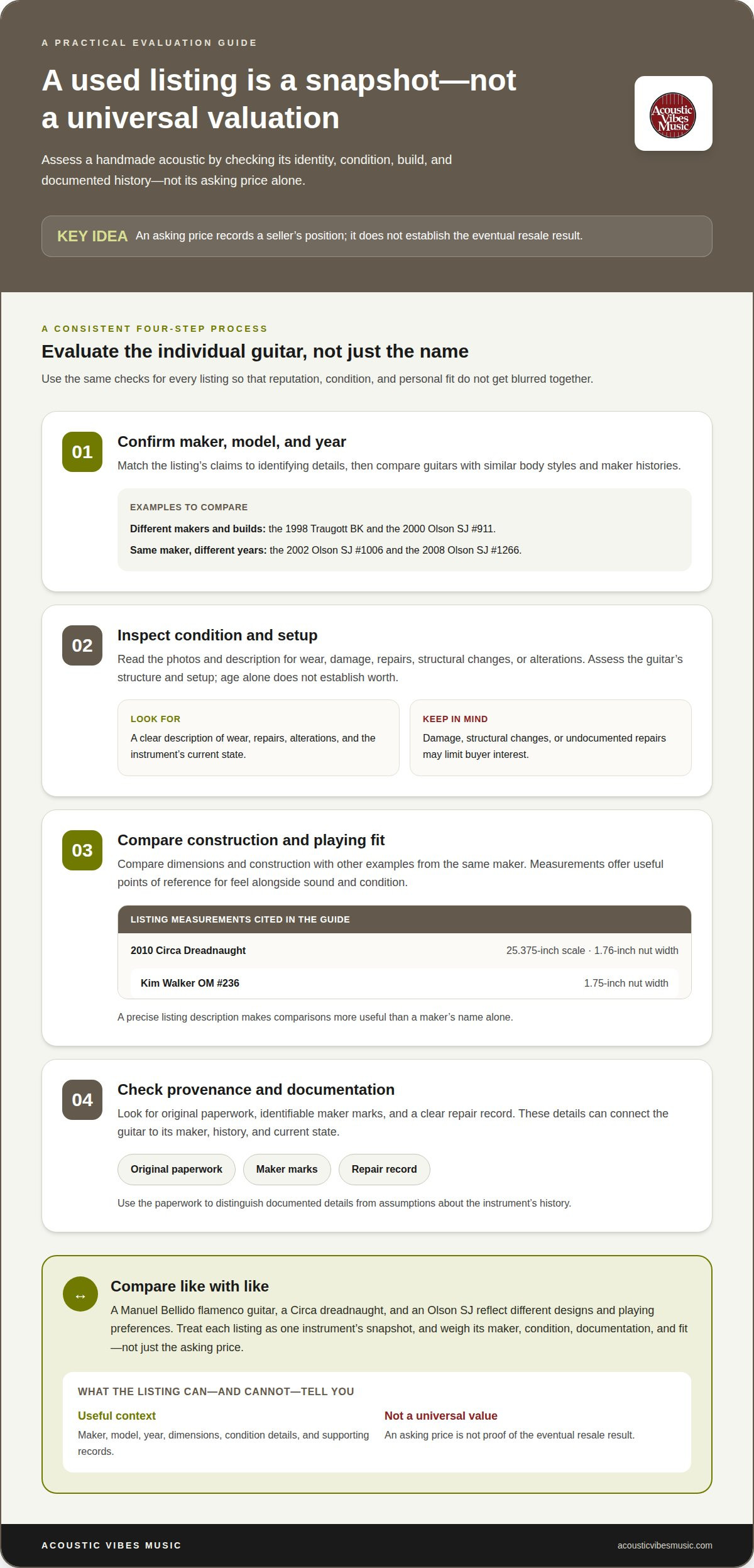
Used handmade acoustic prices are best read as instrument-specific asking signals, not universal valuations. Listings include a 1998 Manuel Bellido Flamenco Guitar and a 2013 Kim Walker Style “A” Special OM 41 #236. The difference between those examples shows why maker, model, condition, and demand must be considered together. An asking price records a seller’s position; it doesn’t establish the eventual resale result.
Provenance, condition, and documentation can build buyer confidence by linking a guitar to its maker, history, and current state. Original paperwork, identifiable maker marks, and a clear repair record help separate documented details from assumptions. Damage, structural changes, or undocumented repairs may limit buyer interest.
Compare guitars with similar body styles and maker histories before drawing conclusions. The 1998 Traugott BK and the 2000 Olson SJ #911 represent different makers and builds. A 2002 Olson SJ #1006 and a 2008 Olson SJ #1266 offer further same-maker comparisons across production years. Together, these examples help separate a model’s market position from an individual instrument’s condition. Age alone doesn’t establish worth; assess the specific guitar’s structure and setup.
Measurements also help explain why two listings may attract different players. The 2010 Circa Dreadnaught has a 25.375-inch scale and a 1.76-inch nut width. Kim Walker OM #236 has a 1.75-inch nut width. These details give prospective players useful comparison points for feel, alongside sound and condition. A precise listing description makes comparisons more useful than a maker’s name alone.
Use a consistent process to assess a used listing. First, compare the maker, model, and year with the instrument’s identifying details. Next, examine photos and descriptions for wear, repairs, or alterations. Compare its dimensions and construction with other examples from the same maker. Finally, see whether the paperwork supports its stated history. This helps distinguish an instrument’s individual merits from reputation alone.
Listed examples show why handmade guitars aren’t interchangeable. A Manuel Bellido flamenco guitar, a Circa dreadnaught, and an Olson SJ reflect different designs and playing preferences. Compare similar instruments, and treat each listing as a snapshot of one guitar. When judging the value of a luthier-built guitar, consider the maker, condition, documentation, and fit, not just the asking price.
Price differences among listed examples show why you should compare specific instruments rather than infer a general rate for handmade acoustics.
These figures offer comparison points, but the instruments may differ in condition, documentation, and appeal. Use the listings to frame questions about each guitar, then weigh its asking price against the available evidence and your playing needs.
A handmade guitar’s materials matter for its sound, feel, and construction. A luthier can tailor its size, woods, and bracing to a player’s preferences, making those choices part of the instrument’s identity rather than a fixed recipe. Consider each choice alongside the desired response, playing style, and comfort. Wood names alone don’t tell the whole story.
Classical guitars offer clear examples of varied material combinations. A 1998 Yamaha GC 71 pairs spruce with Brazilian rosewood. A classical guitar by Sumio Kurosawa, made in 1981, uses cedar and rosewood. Thomas Humphrey’s 1982 instrument pairs spruce with CSA rosewood. These examples show how distinct makers combine materials across different builds and eras.
Other instruments broaden the comparison. German Vazquez Rubio’s 1997 classical guitar uses cedar and rosewood, while Joshia de Jonge’s 2016 guitar pairs spruce with katalox. Sergei de Jonge’s 1985 instrument combines cedar and CSA rosewood. Dake Traphagen’s 1989 guitar uses spruce and CSA rosewood. These details help identify a build, but don’t by themselves establish its sound or value.
Construction deserves equal attention. Bracing supports the top and affects how it vibrates; a luthier can shape the design for the intended instrument. Body size also influences the playing experience and response. These decisions work together: materials, dimensions, and bracing form a coordinated build, not separate markers of value.
For a practical comparison, start with the guitar’s maker, model, and stated materials. Note whether it has a solid top or double-top construction, if that detail is available, and record the back and side woods. Compare similar builds before interpreting differences in sound or asking price. A cedar-and-rosewood guitar isn’t directly equivalent to a spruce-and-katalox guitar simply because both are handmade.
Materials contribute to the value of a luthier-built guitar when they serve a coherent design and suit the player. A distinctive wood pairing may attract interest, but condition, workmanship, sound, and personal fit also matter. Treat each specification as one piece of evidence, then listen to and assess the complete instrument.
Classical guitar listings cover a range of makers, designs, and construction choices. Compare similar instruments, then assess each guitar’s condition, provenance, and intended use.
Consider the total purchase cost, not just the instrument’s asking price. Shipping and insurance are separate expenses; their costs depend on distance, packing, carrier, and the guitar’s declared value.
A luthier-built classical guitar reflects an individual maker’s design and construction, while a factory-made instrument follows a production model. Compare the features that matter to your playing, including materials, setup, condition, and sound. Then consider whether the asking price aligns with comparable instruments from the same maker. Reputation matters, but it shouldn’t replace assessing the specific guitar.
For an appraisal, gather the guitar’s maker, model, identifying marks, purchase records, and repair history. An assessment can then consider its construction, condition, and comparable examples. Authentication draws on consistent details such as labels, signatures, serial information, and documented provenance. A clear record helps separate verifiable history from seller descriptions, while photographs preserve identifying details for reference.
Named listings show the variety within the classical market. An Oscar Muñoz Concert Classical Guitar and a Tony Ennis Classical Guitar represent different makers and builds. The Tony Ennis example is identified as a 2023 spruce-and-padauk model. A German Vazquez Rubio Solista Concert classical guitar and a Steven Walter guitar offer further maker-specific comparisons.
Older instruments add another dimension. A 1969 Ignacio Fleta e Hijos classical guitar represents a different era from the 2023 Tony Ennis model. Compare each guitar with instruments of similar maker, construction, and age. Avoid treating age alone as a measure of value; condition and documented identity matter too.
Use a practical comparison sequence before deciding:
These steps clarify what a listing represents. Oscar Muñoz and German Vazquez Rubio instruments, for example, shouldn’t be treated as interchangeable simply because both are concert classical guitars. Their makers, specifications, condition, and playing character all inform an assessment. The strongest comparison connects each asking price with evidence about that particular guitar.
There’s no single useful price for every new luthier-built guitar. A custom classical instrument and a steel-string acoustic can involve different designs, materials, and construction choices. The price depends on the specific build, not just the word “handmade.” To estimate value, first define the instrument and compare similar work.
Customization is a key cost factor. A player may request a particular body size, tonewoods, or bracing design, and each choice affects the work and materials involved. A straightforward design differs from a build with several individual specifications. Before comparing offers, list the features that matter most, such as body shape, playing feel, and desired sound.
Materials also affect the build. A spruce top paired with padauk, for example, is a different specification from cedar with rosewood. Double-top construction using Nomex is another distinct approach. These descriptions identify meaningful differences, but don’t establish a price on their own. Compare instruments with similar materials and construction, then consider workmanship and the maker’s record.
Use these steps to make a realistic comparison:
A new luthier-built guitar’s value comes from more than its materials list. The maker’s skill, design complexity, and time spent on individual construction all inform the asking price. A custom instrument shaped around a player’s requirements isn’t directly comparable to a standard production model. Compare the complete build and its features rather than relying on a broad category label.
For example, compare a classical guitar designed around a player’s preferred dimensions with similarly specified classical instruments. A steel-string build should be compared with other steel-string guitars. A named maker can narrow the comparison, but model, materials, condition, and customization still matter. Weigh these factors together when considering an offer.
In the United States, the clearest way to judge a new guitar’s price is to match its specifications with comparable builds. Decide which custom features are essential, then assess the maker’s construction and the instrument’s fit. This gives you a grounded view of what the price represents and whether the guitar’s design and craftsmanship align with your priorities.
A luthier-built guitar and a factory-made instrument offer different kinds of value. A luthier can adapt a guitar’s size, woods, and bracing to a player’s preferences. Factory production follows established designs, and extensive customization is less practical because it makes factory setup costly. The better comparison starts with the player’s needs, not a blanket claim that one approach is superior.
Start by considering customization. A player seeking a particular body shape, neck feel, or material combination may value a maker’s ability to tailor those details. A factory model may suit someone who prefers a defined design without commissioning individual changes. Compare each guitar’s fit, sound, construction, and condition to see whether it suits its owner, regardless of how it was made.
Construction also shapes how you assess long-term usefulness. A luthier applies knowledge of materials and building to serve the player’s goals. With a factory guitar, assess the finished instrument and whether its established design suits your playing. Neither label alone determines resale value. Maker recognition, condition, documentation, and demand for a specific model all influence what buyers may consider.
Use a consistent comparison when weighing two instruments:
Repairability can also affect ownership value. A luthier is well placed to repair a guitar they built because they know its construction. That can matter when the instrument has distinctive design choices. A factory-made guitar can also be assessed on its condition and repair needs. For either type, examine workmanship and the quality of previous repairs as well as appearance.
For example, a player who needs specific dimensions may place greater value on a custom-built guitar’s tailored fit. Another may prefer a factory model whose established design already feels comfortable. Compare actual instruments, not assumptions about categories. Assessing fit, sound, construction, identity, and condition gives you a more useful basis for judging lasting value.
Explore acoustic guitar options with these comparison points in mind, and focus on the instrument that best matches your playing.
Acoustic Vibes Music provides luthier repair services for players caring for a valued instrument. Consider repair or maintenance when wear, damage, or changing playability calls for professional attention. Services for stringed instruments are available by appointment.
A handmade guitar’s construction and materials call for careful attention. Share its history and the concern you’ve noticed, such as a change in feel or a visible issue, to give context for a repair discussion. Acoustic Vibes Music also offers acoustic, classical and flamenco guitars, and banjos.
If your instrument needs attention, contact Acoustic Vibes Music to discuss luthier repair services.
Let the music you want to make guide your next decision. The value of a luthier-built guitar is personal as well as practical: it should invite you to play, feel right in your hands, and support the sound you’re pursuing. Take time to connect those priorities with an instrument instead of letting the maker’s reputation decide for you.
Acoustic Vibes Music offers acoustic guitars, classical and flamenco guitars, and banjos, along with luthier repair services. Whether you’re considering a new instrument or caring for one you own, contact the shop to discuss the next step for your playing.
Contact Acoustic Vibes Music to discuss your instrument or what you’re looking for. Keep exploring, keep listening, and let the right guitar bring fresh inspiration to your playing.
Custom acoustic guitar prices vary by maker and requested build. A straightforward design differs from one requiring unusual dimensions, specific woods, or extensive customization. For a useful estimate, describe the instrument you want and separate essential features from optional preferences. Compare quotes only when their specifications closely match, including construction, materials, and what the price covers.
The value of a luthier-built guitar reflects its maker, condition, originality, documentation, and appeal to a particular player. For example, clear maker identification and ownership records offer buyers more context than an uncertain history. Repairs and modifications matter too. Consider their effects on structure, sound, and originality rather than judging by appearance alone.
A used luthier-built guitar can sell for widely varying amounts, depending on its maker, model, condition, and buyer demand. Treat an asking price as the seller’s request, not proof of the final sale value. For a grounded comparison, look at examples from the same maker and model, then account for repairs, originality, and documentation. A broad category average can hide those differences.
Compare used listings for the same maker and model, checking condition, construction, and identifying details. Asking prices offer useful market signals, but they don’t establish the final resale price.