My shopping cart
Your cart is currently empty.
Continue ShoppingThe appeal of urban ash tonewood is partly its sound and partly the story behind it. Taylor’s Urban Ash is Shamel ash, also known as evergreen ash, sourced from urban trees removed because of age, safety concerns, or disease. Its voice is often described as warm and focused, with a character compared to Honduran mahogany.
That description is a starting point, not a complete prediction of how a guitar will sound or feel. Body shape, top wood, construction, and setup all contribute to the playing experience. When comparing instruments, it’s easy to focus on the tonewood name and overlook details that may matter more to your hands and music.
This guide explains Urban Ash in practical terms and shows you what to compare when choosing a guitar. Taylor’s compact GT and GTe models, Builder’s Edition 324ce guitars, 424ce limited editions, and 314ce LTD models illustrate different body formats and wood combinations. Use the wood story to narrow your options, then compare the complete instrument against the way you play.
Urban Ash is Taylor’s name for wood from Shamel ash trees, a species also known as evergreen ash. The name describes a particular source and material, not every kind of ash. Ash species can differ, so broad assumptions about “ash tone” can be misleading. For background on how woods are considered in instrument making, the Tonewood Wikipedia article offers a general overview.
Guitarists may be drawn to Urban Ash for its reported tonal character and its sourcing story. Taylor’s approach uses suitable timber from urban trees to make instruments, giving the wood a second purpose through guitar construction.
Tonewood can shape a guitar’s character, but the instrument’s voice comes from its design, construction, setup, and materials working together. Treat the species as a useful clue, not a guarantee of exactly how a particular guitar will sound.
Taylor describes Shamel ash trees being planted as urban shade trees. When those trees are removed because of age, safety concerns, or disease, suitable logs can be milled for guitar-grade wood rather than discarded. Taylor describes sourcing the wood in partnership with West Coast Arborists, which manages municipal trees.
This is a particular sourcing program, not a description of how all ash used by guitar makers is obtained. Its appeal is practical as well as distinctive: a tree removed from an urban setting may still provide useful timber. For a player, that origin is worth understanding alongside the guitar’s materials and build.
Taylor describes Urban Ash as having a bold midrange response, with properties broadly compared to high-grade mahogany. Treat the comparison as a reference point, not a promise that every Urban Ash guitar will sound like a mahogany model. The individual pieces of wood, body format, top, construction, and setup all contribute to the result.
Listen to complete instruments instead of trying to judge the species in isolation. Play with a light touch and a stronger attack. Notice whether the strings sound balanced together and how clearly the notes carry. These observations turn a tonewood description into details you can hear and feel.
Urban Ash’s origin adds context to its appeal, while its reported tonal profile gives you a starting point for listening. Use both to guide your comparison, then judge the character of the whole guitar in your hands.
Urban Ash gives you a useful point of comparison, but it doesn’t tell the whole story. The same wood can appear in different body designs and material combinations, so compare the complete build rather than expecting one label to predict an instrument’s voice. Taylor’s comparison with high-grade mahogany can help orient your expectations, but it doesn’t mean two guitars will sound alike.
Taylor describes Urban Ash as sharing some properties with high-grade mahogany. Think of that as a general tonal reference, not a claim that the woods are interchangeable. A guitar’s response also depends on which parts use each wood and how the instrument is built. The 324ce examples pair Urban Ash with mahogany, while the 424ce limited editions are described as all-Urban-Ash builds. Comparing these configurations can help you notice differences in the complete instruments without assigning every audible change to one species.
Keep the comparison grounded in what you hear and feel. Play a familiar passage on each guitar, listen for balance and response, and notice which instrument feels more comfortable under your hands. Don’t assume the wood will change in a particular way as it ages; the descriptions here don’t establish that.
A guitar’s tone comes from the whole instrument, not one wood label. Species and placement are only part of the picture. Body design affects how the guitar sits against you and how comfortable it feels during a playing session. Taylor’s GT and GTe models, for example, use a compact Grand Theater body format. That makes body size a practical comparison point, but it doesn’t promise a particular sound.
Look closely at the wood configuration. An all-Urban-Ash model uses the material across its stated wood build; a mixed-wood guitar pairs Urban Ash with another species. The 314ce LTD models are described with Urban Ash back and sides and Sitka spruce tops, while some 324ce guitars pair Urban Ash and mahogany. These are useful construction differences to compare, not a ranking of which model must sound best.
Electronics matter if you plan to connect the guitar to amplification, so include the stated electronics in your comparison. Setup also affects the playing experience: string height and neck feel, for example, can influence how comfortable the guitar is to fret and play. Keep those details separate from tonewood claims. A comfortable setup may make an instrument feel easier to play, but it doesn’t establish a fixed tonal signature for Urban Ash.
To make a comparison useful, play the same short passage on each guitar, seated and standing if possible. Notice body comfort, response to your touch, and how well each instrument suits your intended use. To compare configurations, browse the Urban Ash guitar collection and focus on each model’s stated woods and design.
Model names alone don’t tell you how Urban Ash is used. Compare the top separately from the back and sides, then consider body format and electronics. “Solid” and “layered” describe construction, not a promise of better tone or value. They help you understand how the guitar is built and make comparisons more precise.
| Model or configuration | Top wood | Back and sides | Body format | Stated electronics |
|---|---|---|---|---|
| 224ce description | Solid Urban Ash | Layered Urban Ash | Compare model details | Compare model details |
| 424ce LTD descriptions | Urban Ash | Urban Ash | Compare model details | Compare model details |
| 324ce Builder’s Edition | Compare model details | Urban Ash and mahogany | Compare model details | Compare model details |
| 314ce LTD | Sitka spruce | Urban Ash | Compare model details | Compare model details |
| GT Urban Ash | Compare model details | Urban Ash configuration | Compact Grand Theater | No electronics |
The 424ce LTD descriptions identify Urban Ash for the top, back, and sides. The 224ce description specifies a solid Urban Ash top with layered Urban Ash back and sides. That distinction matters: both use the same named species, but the construction differs. The 324ce Builder’s Edition pairs Urban Ash with mahogany, and the 314ce LTD combines Urban Ash back and sides with a Sitka spruce top. These configurations offer useful points of comparison without implying that one is inherently superior.
Limited-edition status identifies a model designation, not a guaranteed tonal advantage or better value. Let the materials help narrow your shortlist, then judge each instrument’s response and feel for yourself.
The GT Urban Ash is described as a compact Grand Theater model. Compare each other guitar’s stated shape and how it sits against you rather than assuming its size from a model number. Electronics are a separate decision: the GT listing specifies no electronics, while acoustic-electric models should be compared by the features stated for each one.
For broader model comparisons, the Taylor acoustic guitar collection provides context beyond Urban Ash configurations. Keep the urban ash tonewood label in perspective: top choice, back-and-sides construction, body format, and electronics each answer a different question about the guitar. You can also explore the Urban Ash guitar collection with those distinctions in mind.
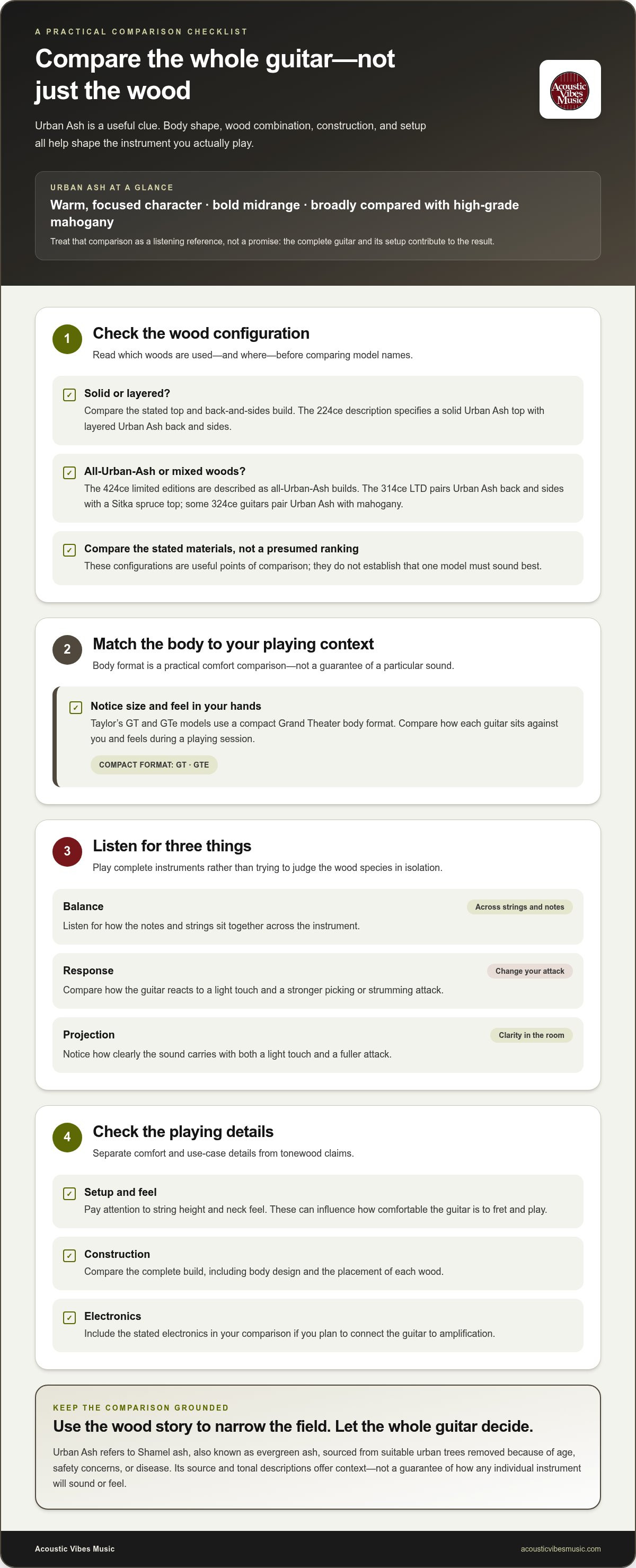
Choosing among Urban Ash guitars gets easier when you start with your playing habits instead of the wood label. Consider where you’ll play, how the body feels, which construction details matter, and whether you need electronics. Then compare complete instruments. This approach turns the details of an urban ash tonewood model into a practical shortlist without assuming that one material guarantees a particular sound.
First, picture the guitar in your routine. Will it mostly stay at home for practice, accompany you in performance settings, or do both? Your answer helps determine whether unplugged playing is the priority or whether amplified use should factor into your choice. For musicians who also maintain dedicated home listening spaces or playback equipment, quality audio furniture from HiFi Rack can help support that listening environment. Body shape is a fit decision, not a substitute for listening: a comfortable guitar still needs to sound and respond in a way you enjoy.
Keep your priorities in order: playing context first, then fit, construction, electronics, and a hands-on comparison. That way, a striking material description or limited-edition label doesn’t distract from how you’ll use the guitar. The right choice is the one whose stated features and playing experience match your priorities, not the specification that sounds most impressive on its own.
Ready to put those criteria to work? Explore Urban Ash guitars and compare the listed body shapes and wood configurations as you build your shortlist.
The Urban Ash models in the collection show how one tonewood can appear in different body formats and wood combinations. Start with the features that affect your playing: compact or larger body feel, acoustic or amplified use, and the stated top and back-and-sides woods. Then compare complete guitars by sound and comfort rather than expecting “Urban Ash” to describe every part of their character.
The Taylor GT Urban Ash is a compact Grand Theater model designed with comfort and playability in mind. Its description also notes a resonant acoustic voice. If you prefer a compact body for your playing routine, the GT gives you a clear format to consider, but its size alone can’t tell you whether its sound will suit your taste. Listen to the instrument and notice how it feels in your hands.
The GTe Urban Ash is an acoustic-electric example in the collection. That distinction may matter if you expect to play both unplugged and amplified, while the GT is described as having no electronics. Compare them according to how you’ll use them: prioritize acoustic playing if amplification isn’t part of your plans, or include the stated acoustic-electric feature if you’ll connect to amplification. The descriptions don’t establish that either compact model has a particular sound because of its format.
For a different wood pairing, consider the Builder’s Edition 324ce, described with Urban Ash and mahogany. It provides a comparison with the 424ce LTD descriptions, which identify Urban Ash for the top, back, and sides. The 314ce LTD takes another approach, pairing Urban Ash back and sides with a Sitka spruce top. These distinctions help you compare material layouts without treating one build as automatically better.
Use the stated details to narrow your shortlist. If you’re drawn to an all-Urban-Ash configuration, focus on the 424ce LTD descriptions that specify Urban Ash across the top, back, and sides. If a mixed-wood build interests you, compare the 324ce Builder’s Edition and 314ce LTD, noting their different pairings. “LTD” and “Builder’s Edition” identify model designations; they aren’t proof of superior tone or value. Let your hands and ears make the final call.
When comparing urban ash tonewood models, keep the questions practical: Which body format feels right? Do you want an acoustic-electric guitar or one without electronics? Which stated wood combination interests you? Use those priorities to compare the options, then judge each complete instrument on its own merits.
Browse the Urban Ash guitar collection to compare these Taylor models and their stated configurations.
Use your shortlist as a starting point, not a final verdict. Specifications tell you what a guitar is made from, but your playing habits reveal whether it feels like a natural fit. As you compare, notice which instrument makes you want to keep playing. That connection matters alongside your preferences for body format, construction, and amplified use.
The urban ash tonewood story can add meaning to your choice, but the best match is the guitar that fits your practical needs and musical instincts. Compare thoughtfully instead of chasing a single feature or label. A clear set of priorities makes it easier to choose a guitar for familiar songs, new ideas, or the next step in your playing.
Ready to compare your options? Explore the Urban Ash guitar collection and find a model that fits the way you play.
Urban Ash is Taylor’s name for wood from Shamel ash, also known as evergreen ash. Taylor describes using suitable timber from removed urban trees, giving the material a reuse-focused origin. For buyers, the name identifies the wood and its sourcing story, but it doesn’t tell you everything about a guitar. Compare each model’s construction, then consider how the finished instrument feels and responds.
Not exactly. Taylor describes Urban Ash as sharing properties with high-grade mahogany and having a bold midrange, but that comparison is a reference rather than a guarantee of identical sound. To compare models, play the same chord progression or picking pattern on each and notice which sounds balanced to you. Body design, other woods, and construction can all shape what you hear.
Taylor’s sourcing account describes using guitar-grade Shamel ash from urban trees that have been removed, where the timber might otherwise be discarded or used for firewood. Reuse is part of this material’s story, but it doesn’t by itself establish every environmental impact of a finished guitar. Consider the maker’s sourcing description and the model’s wood configuration rather than assuming every product called Urban Ash has an identical origin.
There isn’t enough information here to say that Urban Ash necessarily changes in a particular way over time. Avoid choosing a guitar based on a promise that its tone will improve with age. For an older instrument, focus on its current condition and sound, and consider how it has been maintained. Listen for clarity and balance, and assess whether its response suits your playing today.
Start by deciding where you’ll play and whether you need electronics, then compare body comfort and the listed wood configuration. A preference for a compact body may lead you to compare GT or GTe options, while a mixed-wood build may interest you if you want to compare different pairings. Don’t rely on model numbers alone. Use product details to narrow your choices, then compare complete instruments by sound and feel.
No. The term doesn’t mean every part of every guitar uses Urban Ash. Some model descriptions specify the wood for the top, back, and sides; others pair it with mahogany or a Sitka spruce top. Construction can differ too, such as a solid Urban Ash top with layered Urban Ash back and sides. Read the details for the model you’re considering instead of inferring its build from the material name.
It can be a good option if the particular guitar suits your playing, but the wood name alone can’t determine whether it’s right for you. Consider how comfortably you reach around the body, whether you prefer an acoustic-electric guitar, and how the instrument responds to your touch. A first high-end acoustic should fit your needs as a whole. Compare models on those practical points, then choose the one that inspires you to play.