My shopping cart
Your cart is currently empty.
Continue ShoppingThe most coveted acoustic guitars on the planet aren't necessarily the ones coming off the bench today; they're the battle-worn relics from the 1930s that have spent decades vibrating and drying out. You've likely felt the pull of that dry, woody "Golden Era" snap, yet the price of a genuine vintage specimen is often astronomical. It's easy to feel skeptical when manufacturers claim they can replicate eighty years of soul in a few hours inside a specialized kiln. You might worry that paying a premium for a "baked" top is just buying into a marketing trend or, worse, a brittle instrument that won't stand the test of time.
Understanding the nuances of a torrefied top vs natural top is essential for any player looking to invest in a high-end heirloom. This guide strips away the industry jargon to reveal the technical and tonal trade-offs between these two paths. We'll show you why torrefaction offers immediate stability and "old-soul" resonance while exploring how a natural top evolves its own unique voice over a lifetime of play. From the "Torrefied Top Secret" Adirondack spruce at Boucher to the refined VTS systems at Martin, you'll gain the confidence to choose the sound that resonates with your personal style.
Torrefaction is the luthier’s answer to the ticking clock. It is a sophisticated thermal treatment that fundamentally alters the cellular structure of tonewood to mimic the effects of natural aging. While a traditional natural top relies on the slow passage of time to dry out and settle, a torrefied top undergoes a high-heat transformation inside a specialized, oxygen-free kiln. This process isn't just about removing water; it is a chemical re-engineering of the wood itself. By breaking down hemicellulose and volatile resins, builders can create an instrument that possesses the dry, woody snap of a vintage relic from the moment it leaves the workbench. When comparing a torrefied top vs natural top, the primary distinction lies in this immediate maturity. You are essentially choosing between a "new-old" sound and a "fresh" sound that will require decades of playing to reach its full potential.
The magic of torrefaction happens in a vacuum or a nitrogen-rich environment. Without this oxygen-free atmosphere, the intense heat required for the process would simply cause the spruce to combust. Instead, the wood is safely "baked" to the point where its internal moisture content drops to nearly 0%. After the roasting is complete, the wood is carefully re-hydrated to a stable 3-6% moisture level. This cycle does more than just dry the wood; it crystallizes the sap and resins that usually dampen vibration in younger instruments. It's a chemical mimicry of the natural cellular breakdown that occurs over fifty years of seasonal changes. This treatment makes the top lighter, stiffer, and significantly more resistant to the swelling and shrinking caused by humidity fluctuations.
This technology didn't start in a guitar shop. It was originally developed in the Scandinavian timber industry to create rot-resistant wood for outdoor siding and decking. It took the visionary eyes of boutique builders like Dana Bourgeois and the team at Boucher Guitars to recognize the musical potential of this "baked" timber. They pioneered the application of torrefaction to Adirondack spruce, realizing that the process unlocked a level of resonance previously found only in museum-grade instruments. What began as an experimental boutique technique has now become a cornerstone of the industry. Today, legendary brands like Martin and Taylor offer torrefied options across their premium lineups, providing players with a reliable gateway to that elusive vintage tone without the fragility of an actual antique.
The first strum on a torrefied instrument often catches players by surprise. It's the immediacy of the note that stands out first. Because the kiln process increases the wood's weight-to-stiffness ratio, the top becomes exceptionally efficient at moving air. It requires less energy to vibrate; your lightest touch translates into instant volume. When you evaluate a torrefied top vs natural top, you're essentially comparing the speed of the note's response. A natural top can feel a bit "tight" or resistant when new, whereas a baked top feels like it's already been played for decades.
This "drier" sound is the result of losing those "green" overtones that characterize young wood. In a fresh, natural top, the resins are still semi-liquid. This can dampen certain frequencies and create a complex, if sometimes muddy, harmonic profile. Torrefaction crystallizes these elements, leaving behind a pure fundamental clarity. If you compare a torrefied Adirondack spruce top to a natural Sitka spruce top, the Adirondack version will typically offer much higher headroom and a more aggressive "pop." It's a powerhouse configuration that doesn't compress under heavy flatpicking, making it a favorite for those who need to cut through a mix.
A baked top's frequency response is often described as having a focused mid-range "honk," a trait highly prized in vintage pre-war instruments. This focus comes at the expense of the shimmering, metallic high-end overtones often found in natural tops. Natural spruce starts its life "bright and tight," offering a complex sparkle that some players find more versatile for modern fingerstyle or studio work. Over time, the natural top will lose its "zing" and gain warmth, but the torrefied top starts its journey with that warm, woody fundamental already dialed in. It’s a choice between the immediate satisfaction of a "played-in" voice and the evolving, shimmering complexity of a fresh build.
The appeal of torrefaction extends beyond the ears to a full sensory experience. The most striking feature is the "roasted gold" aesthetic. The high heat caramelizes the sugars in the wood, resulting in a deep amber hue that perfectly mimics the look of aged nitrocellulose lacquer. It’s a stunning visual that gives the instrument an instant heirloom quality. You might even notice a faint, pleasant scent of woodsmoke or campfire when you first open the case. Beyond looks and smell, the tactile feel of the wood is different. Because the cellular structure is now more stable, the top is less reactive to humidity changes. This means your action stays more consistent through the seasons compared to a natural top. If you want to experience these differences firsthand, exploring our curated collection of premium acoustics is the best way to find the voice that speaks to you.
While the allure of an "instant vintage" instrument is undeniable, many enthusiasts find a profound sense of satisfaction in the traditional path. Choosing a natural top is a commitment to a shared evolution between player and instrument. It is a relationship that matures over seasons and years. The debate of torrefied top vs natural top often comes down to whether you want the destination today or the joy of the journey over the next decade. A natural top is a living thing that reacts to your specific touch, slowly shedding its "green" overtones to reveal a voice that is uniquely yours. This process is deeply rewarding for collectors who want to "earn" their tone through thousands of hours of play.
Stability is the hallmark of the baked top, but evolution is the soul of the natural one. Over the first 2 to 5 years, a natural spruce top undergoes a dramatic harmonic shift. The initial "tightness" begins to relax, the bass response deepens, and the high-end sparkle rounds off into a sophisticated glow. For a deeper look at this phenomenon, you can explore our guide on whether acoustic guitars truly get better with age. This unpredictability is precisely what makes natural instruments so special; you are participating in the final stages of the luthier’s art every time you pick up the guitar.
The "opening up" process isn't just a myth; it's a physical transformation of the wood fibers. Fresh spruce contains volatile resins and hemicellulose that act as internal dampeners. As you play, the mechanical vibrations physically loosen these resins, allowing the wood to vibrate more freely. Unlike torrefied wood, which is intentionally made brittle and stiff to mimic age, natural wood retains more of its inherent flexibility. This makes natural tops slightly more resilient to impact and less prone to the "shattering" cracks that can occasionally plague overly dry, baked wood. There is a powerful emotional connection formed when you can hear your instrument growing more resonant alongside your own musical progress.
Not every player is searching for the dry, fundamental-heavy "honk" of a 1930s flat-top. If your style leans toward modern fingerstyle, new-age, or pop-acoustic, a natural top often provides a superior palette. Natural tops excel at producing a "lush" sound, characterized by a complex harmonic halo and crystalline shimmer that torrefaction can sometimes strip away. This extra "zing" provides a sense of air and space in a recording that is highly prized by studio musicians. When choosing your top, consider how it interacts with your choice of back and sides. You can see how these pairings change the overall character in our Rosewood vs. Mahogany back and sides guide. For many, the shimmering complexity of a fresh Sitka or European spruce top is the perfect canvas for a modern musical voice.
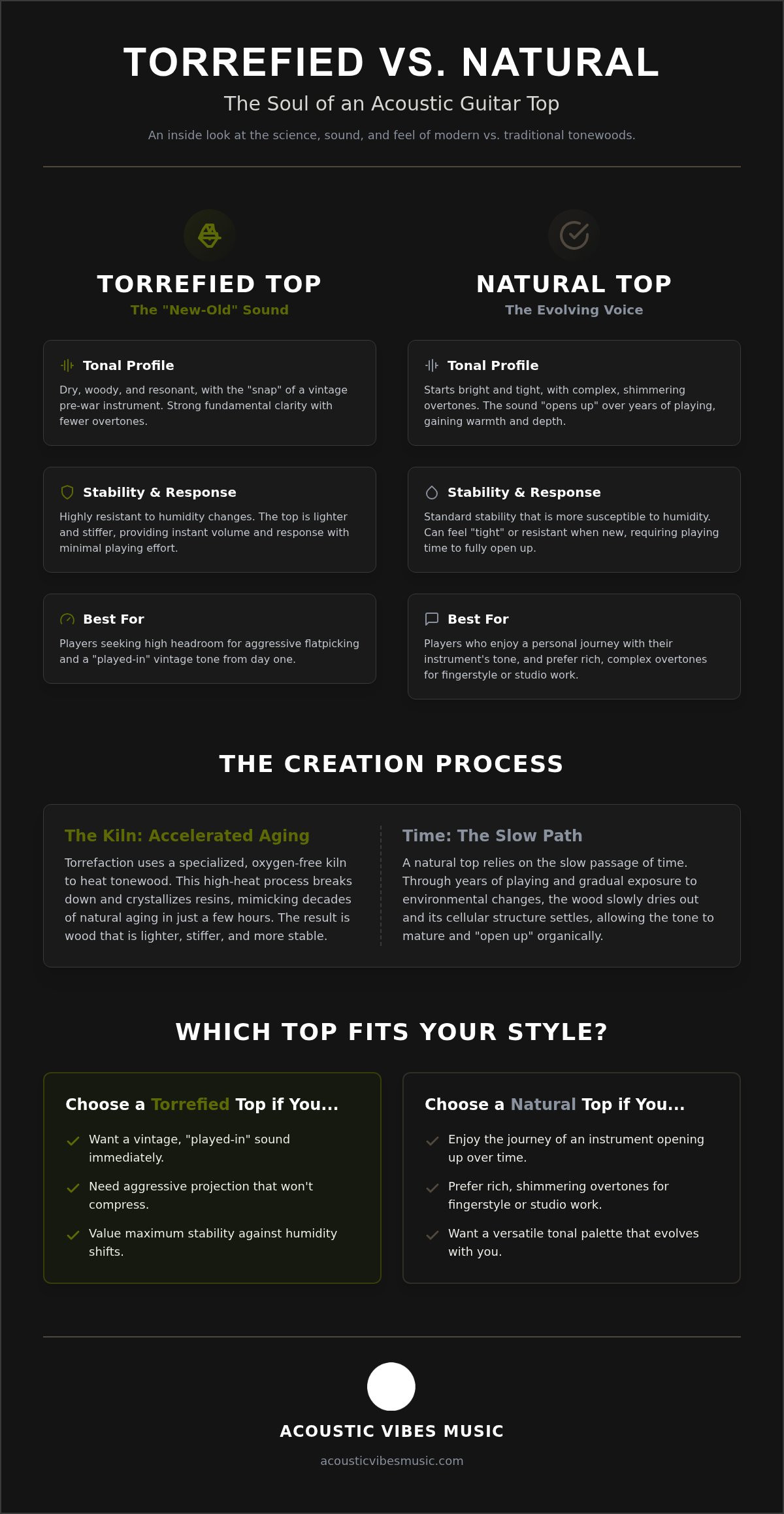
Choosing between a torrefied top vs natural top isn't just about science; it's about the specific stage you intend to occupy. While the technical differences are clear, the practical application depends entirely on your repertoire and environment. For the bluegrass powerhouse, the decision is often a foregone conclusion. Flatpickers demand "cut" and projection. A torrefied Adirondack spruce top provides that explosive, dry snap that ensures your lead lines aren't swallowed by the banjo or mandolin. It offers the high headroom and immediate fundamental response required for aggressive playing styles.
Conversely, the studio musician often finds that a natural top provides a more versatile, "modern" recording profile. In a controlled environment, the lush harmonic complexity and shimmering high-end of a fresh natural top can be a benefit rather than a distraction. Beyond tone, the climate factor is a significant consideration for touring professionals. Because torrefied wood has already been "pre-shrunk" in a kiln, it is remarkably stable. It is far less likely to suffer from the top-sink or swelling that plagues natural instruments when moving between humid and arid environments. Collectors also value the "vintage-correct" appeal, as baked wood holds its value well among those seeking the aesthetic of a golden-era relic.
Stop chasing the ghost of a 1930s dreadnought that costs as much as a luxury sedan. If you want that dry, woody bark and the haunting resonance of an antique, torrefaction is your shortcut to tonal nirvana. When high-end builders combine these baked tops with authentic hide glue construction, they create the "secret sauce" for pre-war tone. We highly recommend exploring the specialized offerings from Martin Guitars and Collings. These makers excel at capturing the lightning-fast response and fundamental clarity that defines the vintage acoustic experience.
If your music relies on maximum harmonic complexity and a sweet, singing high end, a natural top is likely your best fit. Natural spruce paired with modern bracing systems, such as those found in Taylor Guitars, allows for a broader frequency response that feels "alive" and evolving. Don't let the "brittleness" myth deter you; while torrefied wood is stiffer, modern lutherie has ensured these instruments are just as repairable and durable as their natural counterparts. If you want a guitar that grows with you and develops its own unique shimmer over time, the natural path remains the gold standard. To find the instrument that perfectly matches your playing persona, browse our hand-selected inventory of world-class acoustics today.
While the technical debate of a torrefied top vs natural top provides the foundation, the true magic happens in the hands of master luthiers. Different builders approach the kiln with varying philosophies, resulting in distinct tonal signatures. At Acoustic Vibes Music, we act as your expert guide, hand-selecting instruments from the few makers who have truly mastered this volatile science. Whether you are seeking the surgical precision of a Collings or the historical reverence of a Martin Custom Shop build, understanding these brand-specific "recipes" is the final step in finding your perfect heirloom instrument.
Boucher Guitars occupies a unique position in the industry due to their geographical proximity to the world’s finest Adirondack spruce forests. This "Adirondack Excellence" is the heart of their "Torrefied Top Secret" process. Because they have first-pick access to the raw timber, they can select sets with the ideal grain density for thermal treatment. Their torrefaction is considered among the most musical in the industry; it doesn't just dry the wood, it unlocks a massive, piano-like resonance that is particularly prized by flatpickers. If you want a guitar that feels like a cannon from the first strum, exploring the Boucher Guitars collection is a revelation in modern power.
Martin’s Vintage Tone System (VTS) changed the game by introducing era-specific "recipes" for aging. Rather than a one-size-fits-all bake, Martin can target the specific cellular profile of a 1930s "Golden Era" instrument or the slightly different characteristics of a 1940s model. This allows players to choose a level of "dryness" that matches their favorite historical recordings. While a standard D-18 offers a wonderful, shimmering natural top that will open up over decades, a VTS-topped Custom Shop model provides that haunting, pre-war fundamental on day one. For those who still prefer the authentic, slow-aging process of a natural top but want a head start, our curated selection of Used and Consignment Instruments often features premium pieces that have already begun their natural tonal journey.
Collings approaches torrefaction with the same obsessive attention to detail that defines their entire build process. Their "Aged Tone" models are designed to balance the increased stiffness of baked wood with the structural integrity required for a lifetime of play. They are particularly successful at maintaining a "sweet" high end, avoiding the overly brittle treble response that can sometimes plague lesser torrefied instruments. This meticulous approach ensures that every Collings guitar we ship maintains its world-class setup regardless of the climate it enters. By bridging the gap between vintage soul and modern reliability, these builders have ensured that the choice between a torrefied or natural top is no longer a compromise, but a deliberate artistic decision.
Choosing between a torrefied top vs natural top ultimately comes down to how you want to experience your instrument's evolution. If you crave the dry, fundamental snap of a pre-war relic and the rock-solid stability of kiln-aged wood, a torrefied top is your shortcut to tonal nirvana. However, if you find joy in the long-term "opening up" process and want to hear your guitar's harmonic complexity deepen over years of play, a natural top remains the gold standard for traditionalists. Both paths lead to a world-class heirloom; it's simply a matter of when you want that vintage soul to emerge.
As an authorized dealer for Boucher, Collings, and Martin, we're here to help you navigate these nuances with confidence. Every instrument in our gallery is expert luthier-inspected to ensure it meets our rigorous standards for playability and tone. We provide insured national shipping on all premium acoustics, bringing the world's finest craftsmanship directly to your door. Explore our curated collection of Torrefied and Natural Top Guitars and discover the instrument that will define your sound for decades to come. Your next great musical chapter is waiting to be written.
When weighing the merits of a torrefied top vs natural top, players often ask if the baking process compromises durability. Yes, the thermal treatment makes the wood fibers stiffer and less flexible. This brittleness is what gives the guitar its vintage fundamental snap. While it is more prone to shattering under high impact compared to natural wood, it is perfectly stable for normal musical use. Modern luthiers adjust construction to account for these changes.
Absolutely. While torrefied wood is significantly more stable and less reactive to moisture than a natural top, the rest of the instrument is not. The mahogany neck, ebony fretboard, and internal bracing still swell and shrink with humidity changes. You must maintain a consistent environment, usually 40 to 50 percent relative humidity, to prevent the bridge from lifting or the fret ends from sprouting. Proper care ensures heirloom longevity and consistent playability.
Not exactly. The comparison of a torrefied top vs natural top reveals that torrefaction targets specific cellular components like hemicellulose more aggressively. While a natural top will open up and lose its green overtones over several decades, it doesn't undergo the same rapid chemical breakdown as wood in a kiln. A natural top will develop its own unique, rich complexity that some players find more nuanced than a pre-aged instrument.
The higher cost reflects the specialized equipment and labor intensive process required to bake the wood safely. Using an oxygen-free kiln is an expensive industrial operation. Additionally, there is a higher drop out rate for builders because wood that has hidden flaws can sometimes crack or warp during the high heat cycle. You are paying for the specialized technology and the increased risk the luthier takes during production to ensure quality.
Yes, many builders now offer torrefied maple, mahogany, and even rosewood for back and side sets. This creates an instrument that is exceptionally stable and consistent across its entire body. When an entire guitar is torrefied, it often possesses a very dry, hollow vintage resonance that mimics a 1920s or 1930s instrument. It is a popular choice for touring musicians who travel through varying climates and need reliable performance every single night.
The most obvious sign is the color. Torrefied spruce usually has a deep amber, caramel, or roasted hue that penetrates through the entire thickness of the wood. Unlike a natural top that might have a surface level toner or stain, a torrefied top looks naturally aged and dark even around the soundhole edges. You might also notice a faint, pleasant woodsmoke scent coming from the soundhole when you first open the guitar case.
No, major manufacturers like Martin, Taylor, and Collings provide the same structural warranties for their torrefied models as they do for their traditional builds. These builders have spent years testing the longevity of thermal treatment. As long as you purchase from an authorized dealer and maintain proper humidity levels, the baked nature of the wood does not negatively impact your long term protection or the instrument's investment value. It is considered a premium upgrade.
It can be more challenging for an inexperienced repair person. Because the wood is drier and less flexible, it doesn't always swell back together as easily with moisture as natural spruce does. However, professional luthier repair services use specialized adhesives and techniques designed specifically for these modern vintage instruments. When handled by an expert, a crack in a torrefied top can be repaired just as invisibly and reliably as one in a natural top.