My shopping cart
Your cart is currently empty.
Continue ShoppingWhat if the "beginner" instrument you buy today is actually the same heirloom you'll be playing on stage twenty years from now? It's a common fear among players that they'll quickly outgrow their first real investment; however, the catalog of deering banjos is built on a different philosophy. You probably already know that Deering represents the pinnacle of American craftsmanship, but choosing between the approachable Goodtime series and the legendary Flagship models can feel like a daunting task. You want a banjo that matches your current skill while providing the tonal overhead to support your future growth.
In this guide, we'll peel back the layers of artisanal skill that make these instruments the gold standard of the industry. You'll discover the precise tactile differences between various tone ring materials and learn how each series is voiced for specific musical genres. Whether you're drawn to the vintage warmth of a Vega or the modern punch of a Sierra, our goal is to give you the confidence to select a "forever" instrument. We're going to explore the heritage, construction, and soul of the Deering family to find your perfect musical companion.
Imagine a small shop in San Diego during the early 1970s. It wasn't just a workshop; it was a crucible for the future of acoustic music. This was the "American Dream" shop, where a group of young builders nicknamed the "luthier baseball team" began their journey. Greg Deering, Bob Taylor, and the Breedlove brothers were all part of this incredible roster. While some went on to redefine the acoustic guitar, Greg remained singularly focused on the banjo. He wanted to rescue the instrument from a market flooded with cheap, unplayable imports. Today, Deering remains a family-owned operation, led by Jamie Deering, maintaining a gold standard that few can match.
At Acoustic Vibes Music, we've been an authorized dealer of deering banjos since 2007. We've watched the brand grow while staying true to its roots. We treat these instruments with the same reverence as a boutique Collings or a vintage Martin guitar. This isn't just retail for us; it's a partnership with a family that shares our obsession with tone and playability.
The connection between Greg Deering and Bob Taylor of Taylor Guitars is more than just a historical footnote. It's the reason Deering instruments are so consistently excellent. These builders shared a philosophy that precision manufacturing shouldn't replace artisanal skill, but rather support it. They pioneered techniques in neck shaping and fretwork that brought a new level of comfort to the banjo. Greg's background in guitar building influenced his neck profiles, making them slimmer and more ergonomic than the bulky designs of the past. This shared heritage led to a revolution in the industry, proving that American-made instruments could be both innovative and deeply traditional.
When you pick up a Deering, you're feeling the results of a meticulous supply chain. They don't just buy generic parts. Instead, they use locally sourced, Violin Grade Maple for their rims and necks. This specific wood choice is critical for the "snap" and clarity that defines a professional banjo. The Deering Banjo Company history is also marked by their commitment to internal foundry work. They use precision sand-casting for their bronze tone rings right here in the US. This process ensures that every ring meets a specific resonant frequency, providing the sustain and power that serious players demand. Investing in an American-made Deering means you're getting an instrument that holds its value, supported by a lifetime warranty on professional models.
Selecting the right instrument is a deeply personal evolution. Deering understands this journey, offering a tiered catalog that ensures you never have to settle for "good enough." Whether you are striking your first clawhammer chord or performing on a festival stage, the range of deering banjos provides a specific tool for every sonic requirement. The lineup spans from the utilitarian brilliance of the Goodtime series to the uncompromising engineering of the Tenbrooks models, each reflecting a different facet of American lutherie.
The Goodtime series is often called the ultimate entry-level instrument, but that description sells it short. These are professional-grade tools favored by touring musicians as reliable travel companions. The standard Goodtime features a bright, natural blonde maple aesthetic and a lightweight design that makes it incredibly approachable. In contrast, the Artisan Goodtime offers a sophisticated step up. You'll notice the dark-stained maple that mimics the look of vintage instruments, paired with high-quality planetary tuners and a midnight maple fingerboard. As noted in a Banjo Newsletter feature, the consistency of these rims is what sets them apart from the competition. Even without a traditional metal tone ring, the multi-ply violin-grade maple rim produces a surprisingly punchy and clear voice.
For many players, the search for a "forever" instrument ends in the Flagship series. The Sierra is the undisputed workhorse of the professional world. It strips away ornate pearl inlays to focus entirely on the components that matter: a 06-piece bronze tone ring and a three-ply maple rim. It delivers the heavy, pre-war growl that bluegrass players demand without the high-end price tag of a decorative model.
If you require more versatility, the Eagle II is a revolutionary alternative. It features the patented "Twenty-Ten" brass tone ring. Unlike the focused bite of bronze, this brass ring offers a broader frequency response. It is equally at home in a loud bluegrass jam as it is in a folk ensemble. While the Sierra embraces aesthetic minimalism, models like the Maple Blossom provide that classic, ornate look with intricate floral inlays and high-gloss finishes. Both series benefit from Deering’s commitment to longevity, including an 8-year warranty on Goodtimes and a lifetime warranty on professional models. If you are ready to find your signature sound, you can explore our current inventory of these master-built instruments.
At the top of the mountain sits the Tenbrooks series. Developed in collaboration with world-renowned players, these banjos utilize a Swiss-made Jens Kruger tone ring. This series represents the absolute pinnacle of banjo engineering, offering a level of clarity and sustain that mirrors a grand piano. For those seeking the "old-time" aesthetic, the Vega line continues to honor folk traditions with its specialized pot designs and historical neck profiles.
The choice between an openback and a resonator is the most significant decision a player faces. It isn't just about appearance; it's about physics. A resonator banjo features a wooden bowl on the back of the pot that reflects sound waves forward, creating the "snap" and volume necessary to cut through a loud ensemble. Conversely, the openback design allows sound to escape against the player's body, producing a mellow, woody tone that feels intimate and organic. When exploring the catalog of deering banjos, you'll find that weight is also a major factor. Resonator models are typically heavier due to the additional wood and metal flange, while openbacks are favored by folk musicians and travelers for their portability and physical comfort during long porch sessions.
In the world of bluegrass, the resonator is non-negotiable. For Scruggs-style picking, you need that immediate response and bright sustain to keep pace with the fiddle and mandolin. Deering’s resonator construction is world-class, utilizing a precision-fit flange that anchors the pot to the resonator for maximum energy transfer. If you're building a classic ensemble, matching a resonator Deering with Martin Guitars creates that iconic, balanced acoustic foundation. Models like the Deering Calico demonstrate this perfectly, offering a piercing clarity that remains musical even at high volumes. The projection is focused and sharp, designed to reach the back of a concert hall without losing its tonal character.
If your heart lies in old-time "clawhammer" or vocal accompaniment, the openback is your best ally. These instruments excel at the "cluck" and "thump" that define traditional Appalachian music. The Vega series, a vital part of the Deering Banjo Company history, remains the gold standard for this style. Many of these models feature a "scooped" fingerboard. This design removes a section of the frets near the pot, allowing the player to strike the strings over the hollow area for a deeper, percussion-heavy tone. A Vega Senator, for instance, offers a subtle warmth that complements a singer-songwriter's voice without overpowering it. It provides a rich, atmospheric bed of sound that feels ancient and soulful, making it a favorite for those who value texture over sheer volume.
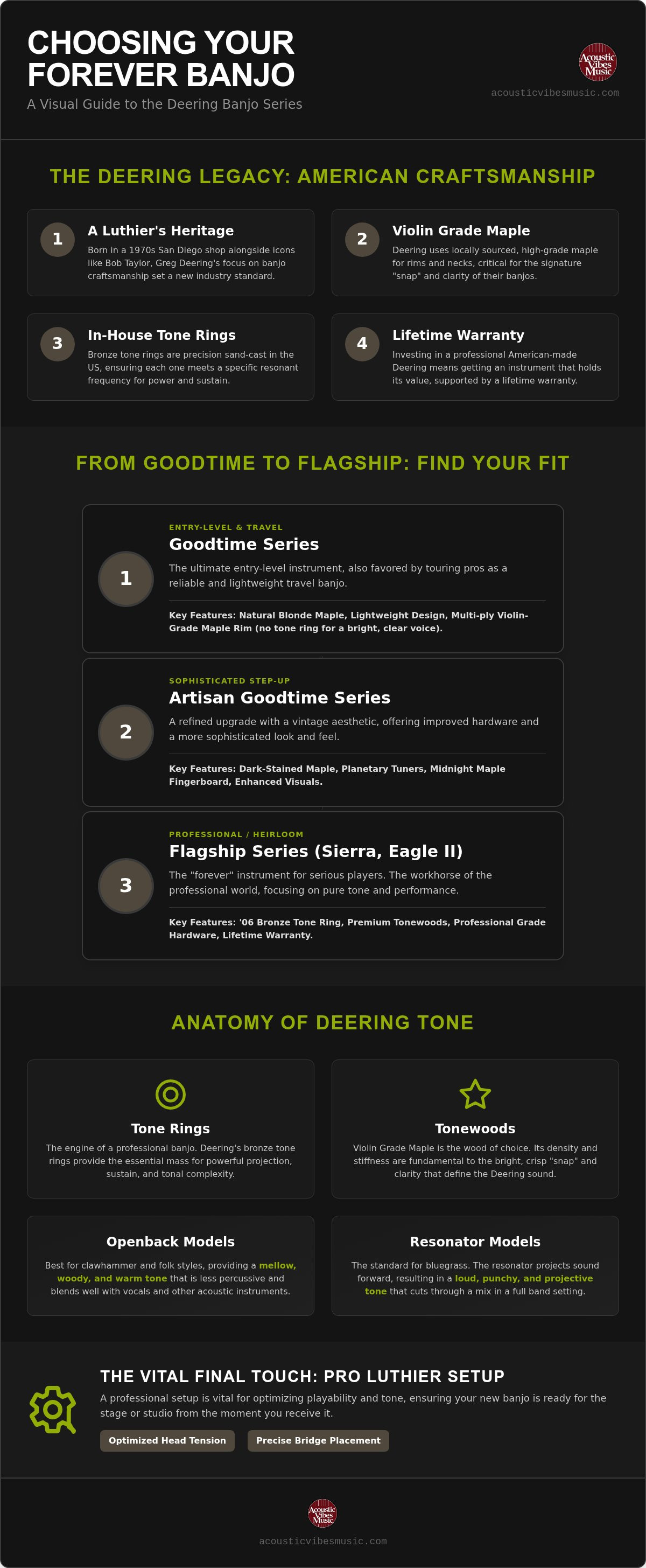
Understanding the technical DNA of deering banjos is the key to choosing an instrument you'll never outgrow. While the exterior beauty of an instrument is undeniable, the internal components dictate the response, sustain, and fundamental frequency of every note you play. By dissecting the relationship between metals, woods, and hardware, you can move past the jargon and find the specific configuration that speaks to your ears and your playing style.
The tone ring is the engine of the banjo. Deering’s legendary '06' bronze tone ring is the industry standard for that heavy, pre-war growl. It is a dense, sand-cast component that provides massive sustain and a piercing high-end. If you want the sound that defined 20th-century bluegrass, this is the essential component. For those seeking a more modern, responsive feel, the Eagle II brass tone ring offers a broader frequency range. It is lighter and more "forgiving" than bronze, making it ideal for players who cross over between genres. Finally, wood-rimmed models like the Goodtime series rely on the rim itself to produce sound. This "old-wood" vibe is perfect for folk and singer-songwriters who want a lighter instrument with a more organic, percussive decay that doesn't overwhelm their vocals.
Wood choice is not just a matter of visual preference; it is a critical tonal filter that shapes the character of every note. Maple is the densest option in the lineup, making it the premier choice for maximum projection and razor-sharp clarity. It reflects sound quickly, which is why most high-end bluegrass banjos utilize maple to ensure they aren't buried in the mix. Mahogany, on the other hand, is more porous and less dense. It absorbs some of the high-end "zing," resulting in a sweeter, warmer mid-range that many soloists find more pleasing. If you are struggling to decide between these profiles, our Rosewood vs. Mahogany guide offers a deeper look at the physics of tonewoods. Regardless of the wood, Deering necks are famous for their slim, ergonomic profiles. They feel more like a high-performance guitar than a vintage log, which significantly reduces hand fatigue during those long festival sets.
Stability is non-negotiable for any serious musician. While geared tuners are functional for entry-level models, professional deering banjos often feature planetary tuners. These provide a 4:1 gear ratio, allowing for surgical precision and rock-solid stability even under the tension of heavy-gauge strings. This level of hardware ensures that your instrument stays in tune through aggressive three-finger rolls and temperature changes alike. Ready to experience this level of precision for yourself? You can browse our curated selection of Deering models today and feel the difference that master-grade hardware makes in your playing experience.
Choosing an instrument is an investment in your musical future. At Acoustic Vibes Music, we've spent nearly two decades cultivating a deep, personal relationship with the Deering family. Since becoming an authorized dealer in 2007, we've treated deering banjos with the same reverence and meticulous care as the world-class instruments from Collings or Martin. This isn't just a retail transaction for us. It's a curation of American artistry. We understand that a high-end banjo is a "forever" piece, which is why we treat every arrival with the mindset detailed in our Collector's Guide to Heirloom Quality. When you buy from us, you aren't just getting a box from a warehouse; you're gaining a partner dedicated to your instrument's longevity.
A banjo is a mechanical marvel, and its performance depends entirely on the harmony of its parts. Most factory-direct instruments arrive with "safe" settings that rarely unlock the true potential of the wood and metal. Our expert luthier services go far beyond a simple visual inspection. We meticulously tune the head tension to reach that perfect sweet spot of "snap" and resonance. We precisely calculate bridge placement for flawless intonation across the entire fingerboard. We also adjust the tailpiece height and action to match your specific playing style. Whether you prefer a light touch for melodic styles or a higher action for aggressive bluegrass driving, we customize the tactile experience before the instrument ever leaves our shop. This level of precision ensures your new companion is stage-ready the moment you open the case.
Our inventory is a constantly evolving gallery of the finest deering banjos available today. We carry a diverse selection of new flagship models alongside rare, pre-owned gems that have been thoroughly vetted by our team. Because we operate with a national focus, we've mastered the art of secure, climate-controlled shipping. Your banjo will arrive safely, precisely tuned, and ready to play regardless of where you are in the country. If you're still uncertain which series matches your musical journey, our team of experts is eager to share their knowledge and guide you toward the right choice. Explore our curated selection and Shop Our Full Collection of Deering Banjos to find the American voice that was built for you.
Finding the right instrument is about more than just comparing spec sheets; it's about discovering a voice that resonates with your musical soul. We've navigated the technical nuances of bronze tone rings and the tactile comfort of Deering’s ergonomic neck profiles. You now have the framework to distinguish between the travel-ready Goodtime series and the stage-dominating power of the Flagship models. Every choice you make, from wood selection to resonator design, brings you one step closer to an instrument you'll never outgrow.
At Acoustic Vibes Music, we've been a trusted authorized dealer of deering banjos since 2007. We don't just move boxes. We provide an expert pro-shop setup for every instrument and offer national shipping with premium insurance to ensure your investment is protected. It's time to stop searching and start playing an instrument that truly reflects your passion. Explore the Best Selection of Deering Banjos for Sale and take the first step toward your new musical legacy today.
Deering banjos are exceptional for beginners, particularly the Goodtime series which was designed specifically to provide a high-quality, American-made entry point. Unlike cheap imports that are often difficult to tune and play, these instruments feature a slim neck profile and low action. This ensures that new players don't struggle with hand fatigue or poor intonation. Starting with a reliable instrument prevents the frustration that leads many newcomers to quit too early.
Deering is the parent company, while Vega is a specialized line focusing on old-time and folk traditions. While the flagship Deering series often targets bluegrass players with resonator designs and bronze tone rings, Vega models are typically openback. They utilize historical pot designs and specialized wood rims to produce the warm, percussive "cluck" required for clawhammer styles. Choosing between them depends on whether you seek modern bluegrass projection or vintage folk intimacy.
These instruments hold their value remarkably well due to their "Made in America" pedigree and the company’s reputation for lifelong durability. Professional models even come with a lifetime warranty, which is a testament to their build quality. In the secondary market, well-maintained deering banjos often command a significant portion of their original retail price. Collectors and serious players view them as heirloom assets rather than disposable goods, ensuring a stable and reliable resale environment.
You should generally change your strings every two to three months if you play regularly. Over time, oils from your fingers and environmental humidity cause the metal to oxidize, leading to a dull and "thuddy" tone. If you notice your banjo has lost its characteristic "snap" or clarity, it's time for a fresh set. Proactive maintenance ensures your instrument always delivers the vibrant, articulate sound that Deering is famous for.
You can certainly play bluegrass on an openback model, though you'll lack the forward projection and "bite" of a resonator. Bluegrass ensembles typically rely on the resonator to reflect sound waves toward the audience, helping the banjo cut through the fiddle and mandolin. While an openback is perfect for solo practice or intimate jams, it might feel slightly underpowered in a traditional high-volume bluegrass setting. It's all about matching the tool to the environment.
A tone ring is a precision-machined metal ring that sits atop the wooden rim, acting as the primary resonant surface for the head. It matters because the material, whether it's sand-cast bronze or Twenty-Ten brass, fundamentally dictates the instrument's sustain and frequency response. Bronze provides the heavy, pre-war bluegrass growl, while brass offers a more versatile, modern clarity. It's essentially the tonal engine that powers your banjo's unique and powerful voice.
Caring for your instrument in a dry climate requires consistent humidity management to prevent wood shrinkage or cracking. We recommend keeping your banjo in its case with a high-quality humidifier when not in use. Aim for a stable environment between 40% and 50% relative humidity. Sudden drops in moisture can cause the neck to bow or the rim to warp, potentially affecting the professional setup and overall playability of your deering banjos over time.
We provide comprehensive pro-shop setups for every instrument we sell. Our expert luthiers adjust head tension, bridge placement, and tailpiece height to optimize the specific "snap" and response of your banjo. Since 2007, we've specialized in fine-tuning these instruments to meet the exacting standards of professional players. A factory-direct box can't compete with the precision of a hand-adjusted setup performed by a specialist who understands the deep nuances of American craftsmanship.