Slotted Headstock Design, Construction and Guitar Types
Those open slots are more than a visual signature: they change how the tuners are arranged and how the strings wind. If you’re wondering what a slotted headstock is, it’s a headstock with two openings cut into the wood. Metal tuner rollers span the slots, and the strings wrap around them.
The silhouette is easy to recognize, but the details matter when comparing guitars or restringing one. On a six-string guitar with a slotted headstock, all six tuners face the back of the headstock, and the strings follow a different path than they do on a solid design.
This guide explains how slotted headstocks are constructed, why they’re common on classical guitars and some steel-string acoustics, and how their layout compares with a solid headstock. You’ll also learn what the design means for string winding, tuning, and traditional craftsmanship, helping you focus on the details that matter when choosing an instrument.
Key Takeaways
- Recognize why slotted designs are especially associated with classical guitars, 12-fret instruments, and some parlor acoustics.
- Understand how the slots, tuner rollers, and string path shape the headstock’s construction and restringing needs.
- Compare the slotted layout with a solid headstock, including differences in tuner access and string winding.
- Separate the design’s traditional appeal and playing feel from claims about tone or sustain.
- Use headstock design as one consideration when exploring acoustic, classical, or flamenco guitars.
Guitars that commonly have slotted headstocks
Classical guitars are the category most commonly associated with slotted headstocks. The design has been standard on classical and nylon-string guitars for many years, and its familiar silhouette is part of the traditional look. Still, a slotted headstock doesn’t by itself mean a guitar is classical. Steel-string acoustics can use this design too, so consider the headstock alongside other features.
Look next at the fret position where the neck meets the body. On a 12-fret guitar, the neck joins the body at the 12th fret. Slotted headstocks are almost exclusively found on 12-fret guitars, making that neck-body junction a useful detail to notice. The fret count describes the neck layout, while the headstock describes the tuner arrangement. Together, those features create a distinctive profile often associated with traditional acoustic designs.
Some steel-string acoustics also have slotted headstocks, particularly many 12-fret and parlor models. These examples show why the design isn’t limited to classical instruments. A parlor guitar’s compact body and a 12-fret guitar’s neck layout are separate characteristics, yet either style may appear with a slotted headstock. When comparing instruments, consider the body shape, string type, and neck joint alongside the headstock.
The open cutouts give the headstock a more detailed outline than a solid face. Tuner rollers are visible inside the slots, making the hardware part of the instrument’s appearance. The result can look traditional without making the guitar feel old-fashioned. Classical guitars are a familiar example, while a steel-string parlor guitar shows how the same feature can suit a different acoustic design.
For a quick identification, examine the top of the neck and the guitar’s overall design. A classical guitar with a slotted headstock is a common pairing; a steel-string acoustic with a 12-fret neck is another recognizable example. A solid headstock, by contrast, has no cutout windows. Don’t use appearance alone to decide whether an instrument is classical or steel-string. Check the strings and body style as well.
These patterns are useful when browsing or comparing acoustic guitars, but they’re tendencies, not a rigid classification system. A slotted headstock may signal a traditional design direction, especially on a classical guitar or 12-fret parlor model. The instrument’s construction and playing character depend on more than that feature. Treat the headstock as a meaningful design detail, then consider how the guitar’s other elements fit your preferences.
Slotted headstock construction
A slotted guitar headstock has two openings cut into the wood, creating the open windows that distinguish it from a solid headstock. A metal bar, called a roller or tuner post, sits across each opening. Strings wind around these bars rather than around posts mounted on the face of a solid headstock. The cutouts are functional: they make room for the rollers and the strings’ path.
On a six-string instrument, all six tuners face the back of the headstock. The rollers sit across the slots, and each string passes through an opening to reach its roller. This layout makes the tuner mechanism visible within the headstock’s silhouette and gives the strings a different winding path from that of a solid design. The wood frames the hardware, while the rollers bridge the open spaces.
Each tuner post passes through a hole in the wood, and the fit matters. Poorly fitted holes can create friction and interfere with tuning. Unlike many solid-headstock arrangements, slotted-headstock tuners are generally fitted directly into holes in the wood rather than mounted in bushings. This keeps the hardware aligned with the slots, but makes accurate fitting around each post important.
Low-friction bushings can also be fitted around tuner posts on a slotted headstock, providing a smoother surface where each post passes through the wood. The design doesn’t require one specific hardware setup. A luthier can use direct wood contact or add bushings while preserving the defining structure: two slots with rollers spanning them.
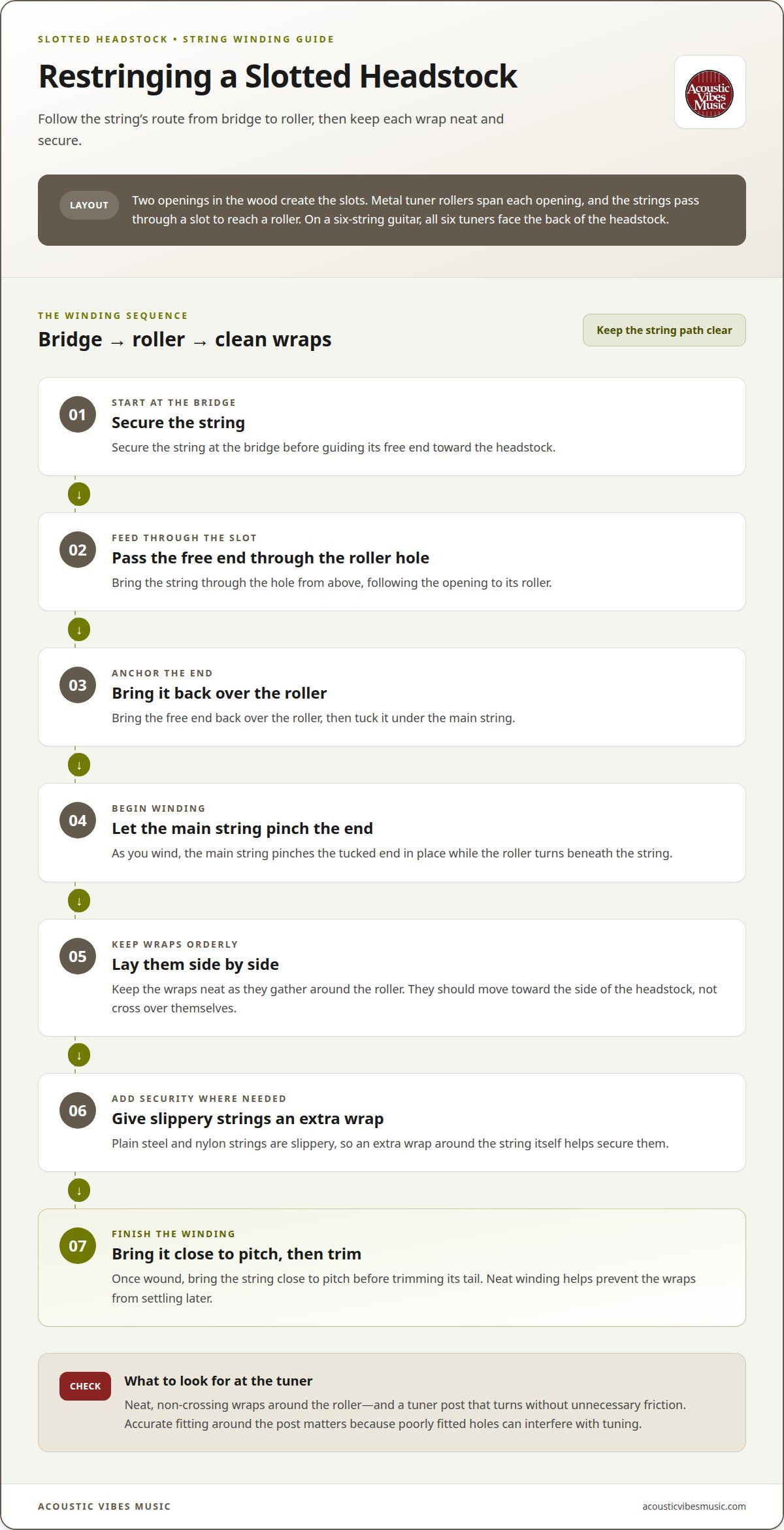
The path from bridge to roller explains why restringing calls for attention to the headstock’s layout. First, secure the string at the bridge, then pass its free end through the roller hole from above. Bring the end back over the roller and tuck it under the main string. As you wind, the main string pinches the end in place. The roller turns beneath the string as it winds into the slot.
Keep the wraps neat as they gather around the roller. They should sit side by side and move toward the side of the headstock, rather than crossing over themselves. Plain steel and nylon strings are slippery, so an extra wrap around the string itself helps secure them. Once wound, bring the string close to pitch before trimming its tail. These steps suit the roller arrangement and help prevent loose winding from settling later.
Construction quality is easiest to assess around the tuner holes and roller alignment. A clean fit lets the posts turn without unnecessary friction, while the paired slots leave room for the strings to reach each roller. On a six-string guitar, look at how the woodwork, hardware, and winding path fit together to make the slotted design work.
Slotted versus solid headstocks
A slotted headstock routes strings across rollers inside two openings; a solid headstock mounts its tuners on a continuous face. The difference affects string angle, tuner access, and winding, but the headstock alone doesn’t determine a guitar’s price.
Cost Compared with Solid-Headstock Guitars
Headstock style alone doesn’t establish a fixed price difference. A guitar’s cost reflects the complete instrument, so comparing two models takes more than checking whether their headstocks are slotted or solid.
For a useful comparison, consider the maker, materials, construction, and other design choices alongside the tuner layout. A slotted headstock is a structural detail, not a price category on its own. Compare the instruments’ full specifications rather than assuming either shape automatically costs more.
Classical Guitars and Slotted Headstocks
Classical guitars commonly have slotted headstocks because this design has been standard on nylon-string instruments for many years. Its open, traditional form also resembles the pegboxes of violins and cellos, where the strings attach.
That history explains the familiar pairing, but slotted headstocks aren’t exclusive to classical guitars. Some steel-string acoustics use them too. When comparing instruments, consider string type and overall construction as well as the headstock’s traditional appearance.
The string path differs in a practical way. On a slotted design, tuner rollers sit across the openings, and the strings wind around them inside the slots. A solid headstock instead has tuner posts mounted on its face. The slotted arrangement gives strings a steeper break angle over the nut, a visible difference when tracing each string from fretboard to tuner.
Tuner access changes as well. Slotted-headstock posts can be harder to reach, and the strings can be more difficult to control as they come up to tension. Careful winding matters because the rollers sit across the slots rather than facing outward like the posts on a solid design. The process is different, not automatically better or worse.
The hardware openings add another construction consideration. Slotted-headstock tuner posts pass through a pair of holes, creating twice the potential for fitting and friction problems compared with posts passing through one hole. That describes potential points of fit, not a guarantee of tuning trouble. Poorly fitted holes can interfere with tuning, so alignment and smooth post movement matter.
A solid-headstock guitar typically has three tuners on each side. By contrast, a six-string slotted design points all six tuners toward the back. The choice depends on the guitar’s overall design and your preferences for access, string handling, and appearance. Neither layout alone determines sound quality or instrument value.
Why do classical guitars have slotted headstocks?
Classical guitars have slotted headstocks largely because the design became part of their established tradition. Slotted headstocks were typical in guitar luthiery about 100 years ago, and they’ve remained a standard design for nylon-string and classical guitars for many years. That history helps explain why the silhouette still feels closely associated with classical instruments today.
The design also shares a visual language with older stringed instruments. A slotted guitar headstock resembles the open pegboxes of violins and cellos, where strings attach. This connection gives a classical guitar a distinctive, traditional profile. It’s an aesthetic and historical link, not proof that every guitar with slots is classical.
Tradition doesn’t make the headstock a purely decorative feature. Its slots house metal rollers around which the strings wind, so its appearance comes from a working arrangement of wood and hardware. On a classical guitar, this construction preserves a familiar form while providing the tuner layout. The result is recognizable at a glance, with details that make sense on closer inspection.
Nylon strings and a slotted headstock are a common pairing, but the design isn’t exclusive to nylon-string guitars. Some steel-string acoustics also use slotted headstocks, including many 12-fret and parlor models. This contrast matters when identifying an instrument: the headstock offers a useful clue, while the strings and the rest of the guitar provide more context.
For a player choosing a classical guitar, the headstock can shape the instrument’s visual character and its connection to tradition. A slotted design gives the upper end of the neck an open, detailed outline, while a solid headstock has a different appearance and tuner layout. Neither shape alone tells you how a guitar will feel or sound, so treat it as one part of the overall design.
The historical connection is especially useful when comparing modern classical guitars with other acoustic styles. A slotted headstock reflects a form that was typical in guitar luthiery about 100 years ago, while its continued use keeps that heritage visible. At the same time, steel-string examples show that luthiers can use the design beyond classical instruments. The category and construction of the whole guitar still matter.
In short, classical guitars have slotted headstocks because a traditional design became standard and endured. The open pegbox resembles those of instruments such as violins and cellos, while the rollers provide the guitar’s string-winding arrangement. Recognizing these details helps you understand the design without mistaking a familiar silhouette for a complete description of the instrument.
Do slotted headstocks affect guitar tone or sustain?
Some players associate a slotted headstock with a tonal difference, and many fingerstyle players appreciate that character. But the headstock alone doesn’t define a guitar’s tone or sustain. A guitar is a complete system: its strings, body, neck, and construction all contribute to the sound.
The slotted design changes the strings’ path at the headstock. They pass over the nut at a steeper break angle, a geometric feature rather than a tone rating. That angle distinguishes the design, but doesn’t tell you whether a particular guitar will sound brighter, warmer, louder, or sustain longer.
Sustain describes how long a note continues after it’s played. Tone describes the qualities that shape the note’s character. They’re related listening considerations, but they aren’t interchangeable. A guitar may sustain a note without sharing another instrument’s tonal balance, so consider each quality separately when comparing a slotted model with a solid-headstock guitar.
Your response as a player matters too. A fingerstyle player may notice or value a tonal quality that another guitarist prioritizes less. The same instrument can feel different depending on playing style, musical passage, and touch. Listen to single notes and chords, then play with the technique you use most. That gives you a more relevant impression than judging the headstock’s appearance alone.
For a fair comparison, use the same guitar, string condition, tuning, and playing passage where practical. Move between freely ringing notes and chords across the neck. Listen to how each note starts, develops, and fades. This helps you judge the whole instrument rather than assume its slotted headstock guarantees a particular sound.
Consider the instrument’s setup and condition too. A guitar that won’t hold tuning or has uneven string winding can distract from listening closely to tone and sustain. Those practical details don’t prove that the headstock creates a tonal effect. They help ensure your comparison reflects the instrument’s response rather than a string or tuning issue.
Choose by ear, not by silhouette. If a slotted guitar invites your playing and its notes respond as you like, that matters more than expecting a fixed tonal result from its headstock. Compare the complete instrument, including comfort, sound, and the music you play. Explore acoustic guitars to consider how different designs suit your preferences.
Acoustic Vibes Music
Acoustic Vibes Music offers acoustic guitars, including classical and flamenco models, so you can explore how headstock design fits into an instrument’s overall character. If you’re weighing a slotted design against a solid one, comparing different acoustic styles can put that detail in context. Consider sound, feel, and construction together rather than choosing by silhouette alone.
Whether you’re drawn to the traditional look of a classical guitar or comparing acoustic designs, Acoustic Vibes Music can help you explore the options. The same interest in craftsmanship extends to instruments such as banjos and mandolins.
Have questions as you consider your next instrument? Contact Acoustic Vibes Music to talk through your options.
Choose the Design That Inspires Your Next Session
Let the way you want to play guide your next guitar choice. Understanding what a slotted headstock means can help you notice an instrument’s design, but your comfort and musical goals should lead the decision. Spend time with the guitar, listen to how it responds, and consider whether its character suits the music you want to make.
Acoustic Vibes Music offers acoustic guitars, classical and flamenco guitars, and banjos, giving you different instrument styles to explore as your interests develop. A conversation can help connect the design details you’ve learned with the feel and sound you’re looking for, whether you’re choosing a first instrument or refining a collection.
Take the next step at your own pace, and let curiosity lead. Contact Acoustic Vibes Music to talk through your instrument questions and discover a direction that feels right for you.
Frequently Asked Questions
What is a slotted headstock on a guitar?
A slotted headstock is a guitar headstock with two openings cut into the wood, creating space for tuner rollers and strings. On a six-string guitar, all the tuners face the back of the headstock. This open construction gives the guitar a distinctive outline, but doesn’t by itself identify the string type. Classical nylon-string guitars and some steel-string acoustics use this design.
How does a slotted headstock differ from a solid headstock?
A slotted headstock places tuner rollers across openings, while a solid design mounts tuner posts on a continuous wooden face. This changes how strings reach the tuners and how the hardware is accessed. For example, rollers on a slotted design can be harder to reach while restringing. The main difference is layout and string handling, not a guarantee of sound or quality.
What are the advantages and disadvantages of a slotted headstock?
A slotted headstock has an open, traditional appearance and gives the strings a steeper break angle over the nut. Its trade-offs include less direct access to tuner posts and winding that takes careful control as strings come up to tension. For example, a player who changes strings often may prefer the more exposed posts of a solid design. The right choice depends on appearance, handling, and the individual guitar.
Are slotted headstocks stronger or weaker than solid headstocks?
Headstock style alone doesn’t establish whether a guitar is stronger or weaker. A slotted design has openings in the wood, while a solid design has a continuous face, but that distinction doesn’t determine the durability of a finished instrument. Construction quality, the fit around tuner posts, and the guitar’s condition all matter. A visible crack or loose hardware deserves attention regardless of headstock type.
Which types of guitars commonly have slotted headstocks?
Classical guitars commonly use slotted headstocks, and the design also appears on some steel-string acoustic guitars. Examples include many 12-fret guitars and parlor models. A 12-fret guitar joins neck and body at the 12th fret, which is a useful identifying feature alongside the headstock. Use the strings and overall guitar design as additional clues, since a slotted shape doesn’t mean an instrument must be classical.
How do slotted headstock tuners work?
Turning a tuner rotates its roller, winding or releasing the string and changing its tension. That change raises or lowers the note’s pitch. On a slotted headstock, each roller sits across an opening, so the string winds within the slot rather than around a post on a solid face. Neat, controlled wraps help keep the string seated as you tune and reduce slack settling after installation.