My shopping cart
Your cart is currently empty.
Continue ShoppingA single millimeter of worn bone or misfiled synthetic material is often the only thing standing between a world-class heirloom and a frustratingly dull performance. It's a humbling reality for any collector; the most sophisticated bracing and rarest tonewoods are effectively silenced if the strings aren't seated with absolute perfection. Identifying the signs of a bad guitar nut is the first step toward restoring that lost magic. You've likely felt the frustration of a guitar that refuses to stay in tune or heard that sharp, metallic "ping" during a delicate adjustment.
We believe your instrument is a legacy of craftsmanship that deserves to sing. You shouldn't have to settle for persistent buzzing or tuning instability that ruins the flow of your music. This guide will help you master the art of diagnosing nut-related playability issues so you can restore your acoustic instrument’s precision and tone. We'll explore whether your current nut requires a luthier's touch for a simple adjustment or if it's time to upgrade to high-density materials like unbleached bone for a superior tonal return.
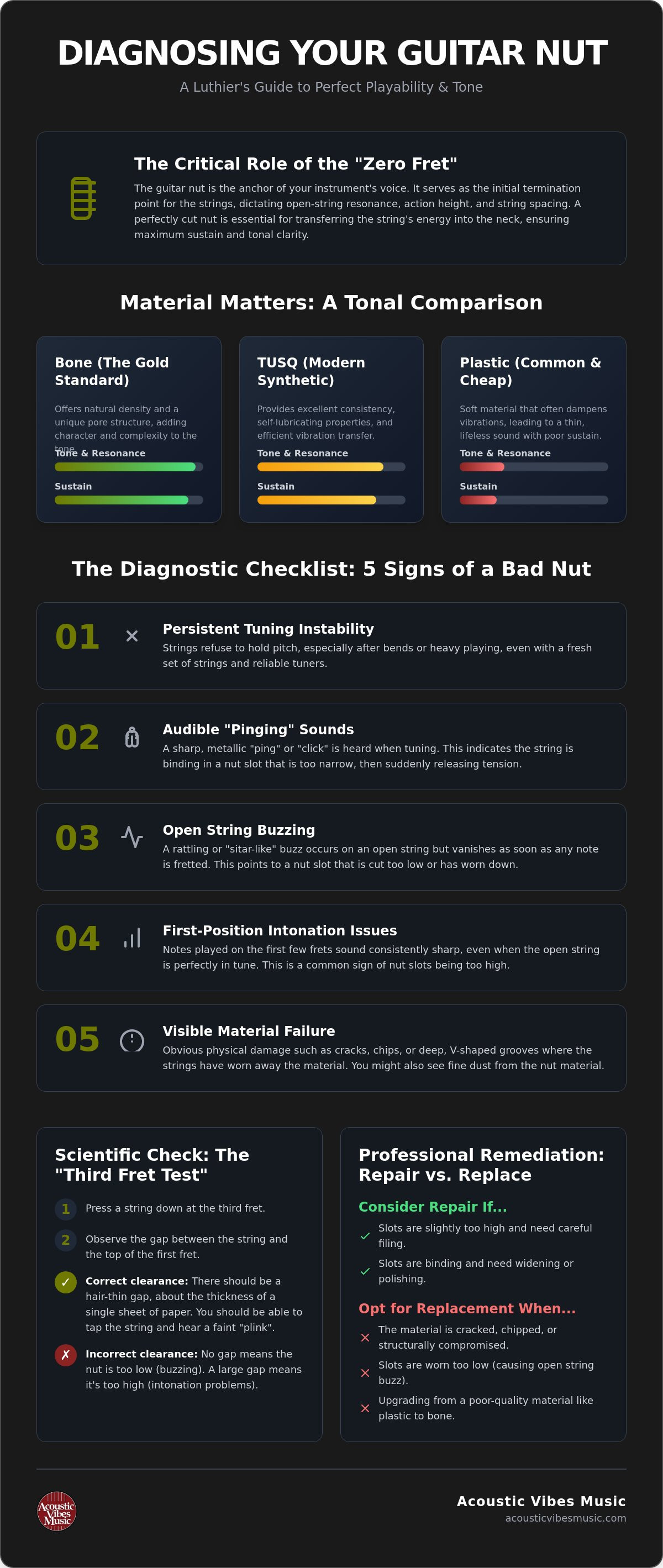
Think of the guitar nut as the anchor of your instrument's voice. It's often called the "zero fret" because it serves as the initial termination point for the vibrating string length. This small piece of material carries an enormous responsibility. It dictates the open-string resonance and sets the stage for every note you play. When players overlook this component, they often miss the early signs of a bad guitar nut that could be stifling their instrument's potential. A perfectly cut nut ensures that the transition from the headstock to the fretboard is seamless, preserving the energy of your performance.
Choosing the right material isn't just about durability; it's about the harmonic profile. High-end builders like Collings Guitars prioritize hand-carved nuts because they understand that every grain of the material matters. Bone remains the gold standard for many collectors due to its natural density and unique pore structure, which adds a sophisticated character to the tone. Synthetic materials like TUSQ offer consistency and self-lubrication, while cheap plastic often drains the energy from the string, resulting in a thin, lifeless sound that fails to inspire.
Beyond tone, nut width and string spacing are the silent partners in player comfort. A few fractions of an inch can change how a neck feels in your hand. If the spacing is cramped or the width is mismatched to the neck profile, even the finest instrument will feel cumbersome. Precision here is non-negotiable for high-end acoustics.
Maximizing energy transfer from the string directly into the neck and headstock requires a perfectly seated nut. Harder materials like bone or high-grade composites encourage sustain and a rich note bloom where the harmonics develop fully after the initial attack. Soft materials act as dampeners, absorbing the vibrations you want to hear. This leads to a muddy tonal response that lacks the clarity required for professional-level playability.
Technical artistry is most visible within the nut slot itself. The break angle, the angle at which the string heads toward the tuning peg, must be steep enough to keep the string seated without causing binding. A perfect slot bottom is rounded to match the string's gauge exactly. If it's V-shaped or too wide, you'll see the classic signs of a bad guitar nut, such as rattling or a loss of sustain. Slot depth also dictates the action at the first fret, where even a thousandth of an inch matters for intonation.
Diagnosing a premium instrument requires the keen eye of a curator and the precision of a technician. Just as you rely on your sight to identify these subtle mechanical issues, maintaining your own visual health is essential for any craftsman; you can find out more about professional optometric care to ensure you never miss a detail. When your acoustic masterpiece begins to lose its luster, the culprit is often hiding in plain sight at the top of the fretboard. Recognizing the signs of a bad guitar nut early can prevent minor frustrations from evolving into permanent damage. Use this checklist to evaluate your instrument's health and restore its professional-grade playability.
Have you ever turned a tuning peg only to hear a sharp "ping" followed by a sudden jump in pitch? This is a classic symptom of a binding nut. The physics of friction dictates that if a slot is too narrow, the string becomes trapped. Tension builds up behind the nut until it suddenly releases with a snap. It's easy to mistake this for tuner backlash, but if the pitch jumps specifically during the act of tuning, the nut is the bottleneck. A smooth glide is essential for performance reliability. If your instrument is struggling with these symptoms, consulting professional luthier repair services can ensure your nut is filed to the exact tolerances your strings require.
Listen for a "sitar-like" drone when you strike an open string. If that buzzing disappears when you fret a note, the nut slot is likely too wide or has worn down too low. This is distinct from neck relief issues, which usually cause buzzing across the middle of the neck. Environmental factors often exacerbate these problems. As humidity levels shift, the wood expands and contracts, which can expose imperfections in the nut's geometry. Understanding acoustic guitar materials science reveals why high-density materials like bone are favored. They resist the wear and environmental stress that lead to these irritating tonal artifacts better than cheap synthetics.
Poor intonation in the first three frets is another definitive sign. If your open G is perfectly in tune but the A on the second fret sounds sharp, the nut slot is likely too high. The string has to travel too far to reach the fret, stretching it out of pitch. Finally, inspect the material itself. Any visible cracks or piles of "nut dust" indicate that the material is literally disintegrating under the pressure of the strings. Identifying these signs of a bad guitar nut is the first step in preserving the heritage and voice of your instrument.
Transitioning from observation to objective measurement is what separates a casual player from a true enthusiast. While identifying the visual signs of a bad guitar nut is helpful, scientific verification provides the certainty needed before making any permanent alterations. Precision instruments like Collings Guitars are engineered with exacting tolerances, meaning your diagnostic approach must be equally refined. By using a few simple tests, you can determine if your nut slots are the true source of your playability woes.
This classic luthier's technique is the most reliable way to check if your nut slots are cut too high or too deep without needing specialized tools. Follow these steps for each string:
The ideal clearance is roughly the thickness of a human hair or a thin business card.
For those seeking professional-level precision, feeler gauges are indispensable. On high-end instruments like Taylor Guitars, the standard for first-fret action often falls between 0.010" and 0.020" depending on the string gauge and playing style. If your measurements exceed these values, you'll likely experience the sharp intonation mentioned in the previous section. Conversely, a measurement of zero means the string is resting on the fret, which causes the dreaded open-string buzz.
Don't forget to evaluate the slot width and the "back-file" angle. A "side-to-side" test involves gently nudging the string within its slot to see if it has room to oscillate without being pinched. If the string feels wedged, the slot is too narrow. The back-file angle, the slope of the slot toward the headstock, must also be steeper than the string's path to the tuner. A flat or improperly angled slot creates a "sitar" effect because the string doesn't have a clean, singular break point. This lack of a definitive termination is one of the most common signs of a bad guitar nut on custom-builds or poorly maintained vintage pieces.
Before assuming a replacement is necessary, try the lubrication test. Applying a small amount of graphite or a specialized dry lubricant can rule out simple surface friction. If the "pinging" sound disappears, your slots may just need a professional cleaning and polish. However, when lubrication fails to solve the tuning jumps, it's a clear indicator that the slot geometry is fundamentally flawed. Be careful with your materials; you should never use oil-based lubricants on a bone nut. Bone is porous, and oils can seep into the material, causing it to soften or discolor, which ultimately compromises the heritage and tone of your Martin Guitars or other premium acoustics.
The relationship between an acoustic instrument and its environment is a delicate dance of expansion and contraction. While a nut may leave the workshop with perfect tolerances, the reality of wood as a living material means that change is inevitable. Understanding how time and climate affect these components is essential for any serious collector. Often, the signs of a bad guitar nut aren't just about the initial cut; they're about how the material has stood up to the stresses of its surroundings. When humidity drops, the fretboard and neck can shrink, causing the nut to lose its snug fit or revealing that the slots have become too low relative to a shifting neck profile.
Vintage Martin Guitars and other heirloom instruments often tell a story through their nut wear. Over decades, the constant friction of tuning can deepen slots beyond their intended depth. While some technicians might suggest temporary shims to raise the action, we believe that preserving the harmonic integrity of a world-class instrument often requires a complete replacement. Mid-tier instruments frequently suffer from factory-made nuts with inconsistent densities, leading to dead spots or uneven string heights that stifle the guitar's natural resonance from the day it leaves the box.
Material choice is the primary factor in long-term durability. High-quality unbleached bone is prized for its natural oils and self-lubricating properties, which help prevent the "pinging" sounds discussed earlier. Synthetic materials like TUSQ offer remarkable consistency and a bright harmonic profile, though they can be more prone to "string sawing," where the wound strings gradually file the slot deeper over time. In contrast, cheap plastic nuts are the most vulnerable. They often compress under high tension, leading to a permanent loss of sustain and the classic signs of a bad guitar nut that ruin the playing experience.
Extreme temperature changes and dry environments are the enemies of a stable setup. In very dry conditions, the wood of the neck can pull away from the nut, leading to "nut lift" or a total loss of the adhesive bond. This creates a gap that swallows vibrations and kills note bloom. A seasonal setup is vital for maintaining the relationship between the nut, the truss rod, and the saddle. If you've noticed your playability shifting with the seasons, it might be time to explore our curated collection of premium acoustics and consult with a specialist about a professional environmental assessment for your current instruments.
Deciding how to address the signs of a bad guitar nut requires a balance between preserving original components and ensuring peak performance. In the DIY community, you'll often hear about the "Baking Soda Trick," which involves filling a deep slot with a mixture of baking soda and superglue. While this might get you through a weekend gig, it's rarely a solution for a high-end instrument. This patch lacks the uniform density and harmonic transfer of a solid piece of bone. For a professional-grade restoration, we believe in using materials that match the heritage of your guitar rather than temporary chemical fillers.
When the slots have worn too deep or the material has begun to crack, a full nut replacement is often the only way to save your tone. A custom-carved nut offers benefits that factory-slotted alternatives simply can't match. A skilled luthier can personalize the string spacing to fit your specific hand size and playing style, providing a level of comfort that transforms the feel of the neck. This artisanal approach ensures that every string is seated with surgical precision, eliminating the "pinging" and buzzing that stifle your musical expression.
Investing in your instrument's playability is a commitment to its longevity. While you might be concerned about the acoustic guitar nut replacement cost, the return in tonal clarity and tuning stability is immense. Professionals often pair a new nut installation with fret dressing or a refret to ensure the entire neck is perfectly calibrated. This comprehensive setup transforms a "stiff" guitar into a dream to play, allowing the notes to bloom with the resonance the builder intended.
Preparing your guitar for a professional evaluation is a straightforward process. Before your appointment, make sure to bring a fresh pack of your preferred string gauge. Because nut slots are filed to tolerances of a thousandth of an inch, a change in string brand or gauge can alter how the string seats in the slot. A trusted luthier will use these specific strings to dial in the action perfectly. If you're ready to restore the precision and voice of your heirloom instrument, schedule a professional luthier consultation at Acoustic Vibes Music. We treat every instrument with the reverence it deserves, ensuring your guitar remains a source of inspiration for years to come.
Developing a keen eye for your acoustic's anatomy is a rewarding journey for any dedicated collector. By learning to recognize the signs of a bad guitar nut, you've taken the most critical step toward reclaiming the precision and resonance your instrument was built to deliver. Whether you've identified a binding slot through the "ping" test or discovered environmental wear during a seasonal shift, you now have the diagnostic tools to act with confidence. Your guitar's voice depends on the perfection of these small, hand-carved details.
As an authorized dealer for Martin, Taylor, and Gibson, we understand the reverence required to maintain heirloom-quality instruments. Our specialists provide expert repair services for all stringed instruments, ensuring every adjustment meets our high standards of craftsmanship. If you're ready to elevate your playing experience, explore our professional luthier services and premium acoustic collection. With national shipping available for our curated inventory, the pursuit of tonal excellence is always within reach. Trust your passion to the experts and let your music sing with newfound clarity.
Yes, a bad guitar nut is a frequent cause of fret buzz, specifically on open strings. If the slots are filed too deep, the string won't have enough clearance to vibrate freely over the first fret. This creates a distracting rattle that disappears once you fret a note. It's one of the most reliable signs of a bad guitar nut that indicates the material has worn down or was improperly cut during manufacturing.
Industry costs for nut replacement in 2026 vary based on material choice and the complexity of the instrument. A custom bone nut typically requires more labor than a pre-shaped synthetic option. Most professional luthiers recommend a full setup alongside the replacement to ensure the new nut works in harmony with your bridge and truss rod. You should expect the total investment to reflect the artisanal skill required for a perfect, hand-filed fit.
You can verify if your slots are too low by performing the Third Fret Test. Press the string down at the third fret and look for a tiny gap between the string and the first fret wire. If the string is resting directly on the fret or there's no audible "click" when you tap it, the slot has reached its limit. This loss of clearance is a definitive indicator that the nut needs professional attention to restore playability.
Bone is often preferred for heirloom acoustics because of its natural density and superior energy transfer. It provides a rich, organic note bloom that many collectors find indispensable for high-end instruments. TUSQ is an excellent alternative that offers consistent density and built-in lubrication. While both are significant upgrades over plastic, bone remains the standard for those seeking the most traditional and sophisticated harmonic profile.
Using sandpaper to widen a slot is generally discouraged for premium guitars. Sandpaper is difficult to control and rarely maintains the perfectly rounded bottom required for the string to seat correctly. You risk creating a flat or V-shaped slot, which leads to buzzing and poor sustain. Professional nut files are designed with specific radii to match your string gauges, ensuring a precise and friction-free fit that preserves your tone.
The G-string is notoriously prone to tuning issues because it often has a steep break angle and a specific core-to-wrap ratio that creates high friction. If the slot isn't polished and angled correctly toward the tuner, the string will bind and "jump" during adjustments. This is one of the more frustrating signs of a bad guitar nut, but it can usually be resolved with precise filing and proper lubrication by a specialist.
A nut slot that is too wide for your string gauge allows the string to shift laterally during play. This movement creates a distracting rattle and can cause the string to vibrate against the sides of the slot, killing your sustain. It also ruins your intonation because the string doesn't have a fixed, singular break point. Proper slotting should cradle the string securely without pinching it to maintain tuning stability.
A high-quality bone nut can easily last twenty to thirty years with regular play. Because bone is significantly harder than the plastic found on entry-level models, it resists the "sawing" action of wound strings much more effectively. You'll likely only need a replacement if you change to a drastically different string gauge or if the neck undergoes significant structural changes due to extreme environmental stress over the decades.