My shopping cart
Your cart is currently empty.
Continue ShoppingA flatter fretboard isn’t automatically easier to play. In the radiused vs flat fretboard comparison, curvature is measured by the radius of an imagined circle that matches the board’s crosswise curve: a larger radius means a flatter surface, and 16 inches is one common guitar radius. A flat board has little or no curve.
That measurement is a useful starting point, but it doesn’t determine how an instrument will feel in your hands. You may find a curved board comfortable for chords, while a flatter one feels more natural for bends and lead playing. Your technique, hand position, and the instrument’s setup all shape the experience.
Here, you’ll learn how fretboard radius is measured, how curved and flat boards feel, and where a compound radius fits. We’ll connect the measurements to practical playability, from chord comfort to bending, so you can interpret specifications and focus on the feel that suits your music.
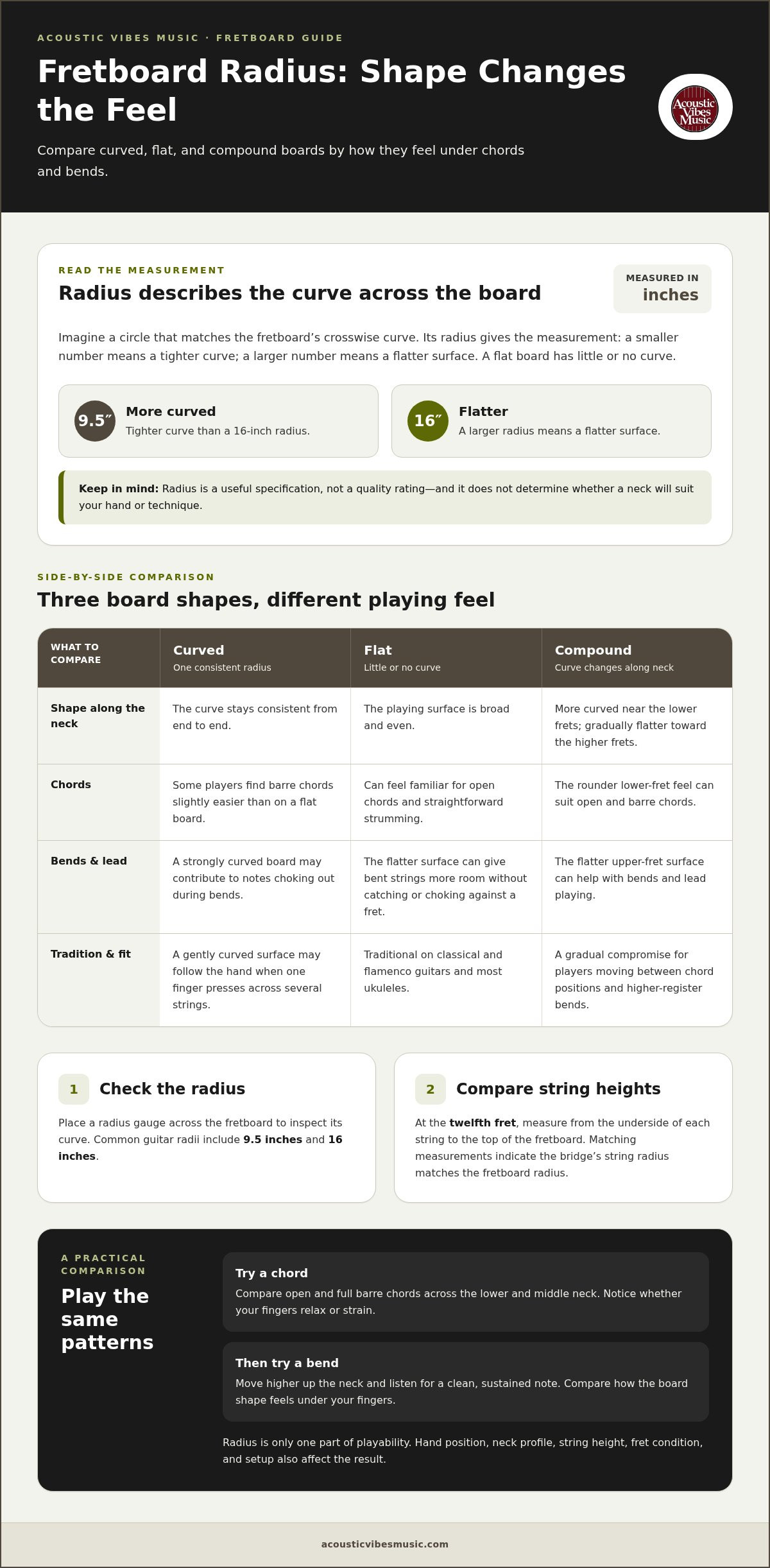
Fretboard radius describes the curve across a board, from its bass edge to its treble edge. Imagine a circle that matches the curve: the circle’s radius, measured in inches, gives the fretboard radius. A smaller number means a tighter curve; a larger number means a flatter surface. A truly flat board has little or no curve across its width.
Common guitar radii include 9.5 inches and 16 inches. Picture each measurement as the radius of a much larger circle, not the width of the fretboard. A 16-inch radius is flatter than a 9.5-inch radius. That distinction helps translate a specification into a feel, but it doesn’t determine whether a neck will suit your hand or technique.
Flat fingerboards have a long history on classical and flamenco guitars, and they’re traditional on most ukuleles. Their broad, even surface can feel familiar for open chords and straightforward strumming. For example, a ukulele player who regularly plays standard instruments may prefer that consistent feel. A flat board isn’t just for beginners; it’s a design choice rooted in the instrument and its playing traditions.
Curvature changes how your fingers meet the strings. Some players find barre chords slightly easier on a board with some radius than on a flat board. A gently curved surface can follow the hand’s shape as one finger presses across several strings. Still, thumb position, neck profile, string height, and chord shape all affect the sensation. Radius alone won’t make a barre effortless.
To inspect a guitar’s radius, place a radius gauge across the fretboard. To compare the setup, measure from the underside of each string to the fretboard’s top at the twelfth fret. Matching measurements indicate that the bridge’s string radius matches the fretboard radius. This relationship matters because uneven string heights can affect how chords feel across the neck.
Can fretboard radius be changed, and what does it cost? Yes. Changing the curvature involves reshaping the board or replacing it. The cost depends on the work required: reshaping, fret removal, replacement, leveling, and crowning can all affect the labor involved.
The radiused-versus-flat fretboard decision comes down to both measurement and playing feel. Compare familiar chord shapes, including open and full barre chords, across the lower and middle neck. A curved surface may feel more natural for a barre, while a flat board can suit direct strumming. Play the same progression on each and notice whether your fingers relax or strain.
A compound-radius fretboard changes curvature along the neck instead of keeping one radius from end to end. It’s more curved near the lower frets and gradually flattens toward the higher frets. This creates two different contact shapes on one board: a rounder feel for chords and a flatter surface for lead playing.
The design aims to balance comfort with room for bends. Near the nut, a more pronounced curve can feel natural for open chords or barre chords. Higher up, a flatter surface can help with string bends, where a strongly curved board may cause notes to choke out. The changing radius addresses both areas without making the entire neck uniformly curved or flat.
There’s history behind the idea. Luthier Denny Rauen developed his multi-radius fingerboard concept in 1978 while refretting a Stratocaster. He later published the idea in American Lutherie and String Instrument Craftsman in the mid-to-late 1980s. This early example shows how compound geometry emerged from practical instrument work, rather than from a purely theoretical comparison.
On a single-radius board, the curve across the playing surface stays consistent along the neck. A compound design changes the curve as you move from the first frets toward the body. The transition is gradual, not a sharp step between shapes. Your hand may therefore notice a more curved feel during lower-position chords and a flatter feel during higher-register soloing.
That difference matters most when your playing moves between positions. Try a first-position barre, then play a bend higher up the neck. Notice whether the chord feels comfortable and whether the bent note sustains cleanly. A compound radius can help address fretting out associated with a radiused board, but it doesn’t replace good fretwork or a suitable setup.
Think of the design as a tailored compromise, not an automatic upgrade. A player focused on open chords may prefer the consistency of one radius, while a lead player may value flatter upper frets. For a guitarist who regularly moves between barre chords and expressive bends, the gradual transition may feel especially natural. Your preferred neck shape, technique, and setup still influence the result.
When comparing a compound board with a single-radius instrument, test the same chord and bend patterns on both. Move from the lower frets to the upper register, and pay attention to finger pressure and note clarity. This simple comparison reveals whether the changing curve suits your style better than one consistent radius.
Fretboard radius affects how strings sit across the neck and how the playing surface feels. Radius doesn’t determine string action by itself; setup, fret condition, and string height also affect buzz and playability.
A flatter fretboard can give a bent string more room to move without catching or choking against a fret. This can matter during sustained lead notes, especially when bending across several frets. Some players report that flat boards allow lower action and nearly eliminate fret-out during bends, though the result also depends on fretwork and setup.
Radius figures offer a useful comparison. A 7.25-inch radius is common on many vintage Fender guitars, while a 12-inch radius is common on most Gibson guitars. Modern Fender guitars commonly use a 9.5-inch radius. Since a larger radius means a flatter board, those measurements help explain why two guitars can feel different during the same bend.
Try a bend on the upper frets of each instrument, then listen for a note that dies prematurely. Bends can choke out more easily on a smaller-radius board higher up the neck, particularly when the action is low. A flatter board may provide more room for the string’s path, but it won’t fix poorly leveled frets.
That trade-off matters to lead players who alternate bends with fast passages. Some shredders use radii of 18 inches or even 20 inches. Those flatter surfaces can feel open under the fretting hand, while a more curved board may suit players who value its contour during chord work.
String action is the height of a string above the frets, while fret buzz occurs when a vibrating string contacts a fret. Radius affects the strings’ curve across the neck, so the bridge’s string radius should match the fretboard’s curve. A mismatch can leave some strings higher or lower relative to the board, changing the feel across the neck.
On a guitar, compare the underside of each string with the fretboard’s top at the twelfth fret. Matching measurements indicate that the bridge’s string radius matches the fretboard radius. This check can help explain uneven action, but it doesn’t establish the full setup: neck relief, fret level, and playing attack also influence buzz.
Some players report that a flatter board allows lower action and reduces fret-out during bends. Yet lowering the strings too far can create buzz if the frets or neck relief don’t support that adjustment. Conversely, a rounded board can feel comfortable for chording while requiring careful bridge adjustment to follow the string arc.
Compare the open strings, a barre chord, and a high-fret bend. If one string buzzes while the others play cleanly, inspect its height and the bridge’s curve before blaming radius alone. Setup brings the geometry together; fretboard curvature is one part of that relationship.
Hand comfort depends on how your fingers meet the strings, not on a radius number alone. A radiused ukulele fingerboard follows the fingers’ natural arc, creating a gently curved surface beneath the fretting hand. During extended playing, that shape may reduce hand fatigue. A flat ukulele board offers a different sensation, with a more even surface beneath each finger.
Try the same chord on both shapes, then notice where your fingertips land. On a curved board, the middle strings sit along a shallow arc, which can feel aligned with a relaxed hand. On a flat board, the strings share a plane, a feel that suits players accustomed to standard ukuleles. Neither design guarantees comfort; the chord shape and the way your hand approaches the neck matter too.
Barre chords reveal another difference. A little curvature can help the index finger press across the strings without flattening its entire length. One bass player reported that a small amount of radius noticeably helped with barre chords. Try the same test: hold a barre, then relax your thumb and wrist. If the curved surface eases the pressure, that contour may suit your hand.
Classical guitar technique adds a reminder that posture changes what the hand feels. In a described proper left-hand position, the guitarist holds the neck at a 45-degree angle. That angle gives the fingers room to approach the strings cleanly. A flat classical fingerboard can work comfortably within that position, showing why fretboard curvature shouldn’t be judged apart from playing posture.
Bass players also choose curvature to suit their technique. Bass players may find that fingerboard curvature affects string clearance during harder plucking. A flatter or completely flat bass board is often preferred for modern playing with fast, light fingertip plucking. The deciding detail is how the picking hand strikes the strings, not a universal rule about comfort.
Compare instruments with a short playing test: form an open chord, hold a barre, then play a passage that stretches across the strings. Repeat the sequence standing and seated, keeping your wrist relaxed. On a ukulele, include a strummed chord; on a bass, try both a light and forceful pluck. These tests show whether curvature supports your movement or feels intrusive.
For a comfortable fit, evaluate the neck, hand position, and playing style together. A curved board can feel supportive during chord work, while a flat surface can feel natural for direct strumming or light plucking. A compound design changes curvature along the neck, so the feel shifts between lower and higher frets. Let your hands judge the differences while you play.
For lead playing, fretboard curvature affects how the fretting hand moves and how much room a bent string has. A flatter surface can make bends easier and reduce fret buzz during them. A curved board may feel more contoured beneath the fingers, especially during runs across several strings. The best comparison is practical: play the same phrase on both shapes.
Start with a bend on the upper frets, where a string travels sideways across the fretboard. On a tighter curve, that movement can bring the string closer to a neighboring fret, causing the note to choke out. A flatter board provides a more even surface beneath the string’s path. Fret level and string action matter too, so listen for a clear, sustained note rather than judging curvature alone.
Then play a short lead line across the neck. A flatter board can feel open during fast position shifts, particularly if your fingers move lightly and close to the frets. One player found a radius above 16 inches suitable for shredding and bending. That is an individual preference, not a universal threshold; hand position, technique, and setup still shape the experience.
Curved boards offer a different tactile reference. Their contour can help the fingers settle onto strings during bends and vibrato, while some players prefer the consistent plane of a flatter surface. Try a whole-step bend, release it, then add vibrato on the same note. Notice whether the string moves cleanly and whether your fingertip stays in control throughout.
Lead playing involves more than isolated bends. During a run from the bass strings to the treble strings, the board’s curve changes the angle at which each finger contacts the fretboard. A flatter radius can feel consistent across that sweep. A curved radius may feel more defined beneath the hand. Neither shape prevents accurate picking or expressive phrasing.
For a useful comparison, keep the passage, tuning, and picking attack consistent on both instruments. Play one bend high on the neck, a vibrato note, and a scale passage across all six strings. If a note chokes, check fret contact and action alongside the radius. If your hand feels strained, notice whether you’re pressing harder or changing your wrist angle.
Choose based on the lead techniques you use most. Frequent wide bends and fast runs may make a flatter board appealing, while a curved board can provide a familiar contour for players who prefer that feel. A compound radius offers a changing curve along the neck, blending a rounder lower position with a flatter upper register. Let sustained bends and clear notes guide your assessment.
Acoustic Vibes Music can help you connect fretboard design with the feel of an instrument you’re considering. If you’re comparing acoustic guitars, use what you’ve learned about curvature during your playing test: try familiar chords, a barre shape, and a passage that moves across the strings. Focus on how the neck feels under your hand rather than choosing by radius figure alone.
Classical and flamenco guitars offer another useful comparison, since flat fingerboards are traditional for these instruments. Compare their feel with an acoustic guitar and consider how your playing style shapes your preference. The goal is a neck that feels comfortable for the music you play, not a particular curvature on paper.
Explore instruments with these details in mind, or visit acousticvibesmusic.com to learn more about Acoustic Vibes Music.
Let your next instrument earn its place through the music you want to make. Bring a familiar piece to your comparison, then notice which neck helps you play with ease and expression. The right feel is personal, and listening to your hands can be more revealing than choosing by a specification alone.
Acoustic Vibes Music offers acoustic guitars, classical and flamenco guitars, and banjos, giving you different instruments to explore as you consider how neck feel shapes your playing. Keep the radiused-versus-flat-fretboard question in mind, but let your preferred sound and technique guide your decision.
Ready to explore an instrument that feels right for your style? Contact Acoustic Vibes Music and take the next step toward music that feels truly your own.
A compound radius combines changing fretboard curves along one neck instead of keeping one shape throughout. Its appeal lies in offering a different feel in lower and higher playing positions. To assess the transition, play a chord near the nut, then move through a scale toward the body. Notice whether the changing contour feels natural beneath your hand or distracts from your usual movement.
Either shape can work for chords; finger placement and pressure affect the feel too. For an F-shaped barre chord, place your index finger close behind the fret, form the remaining notes, and relax your thumb. Repeat the shape on each board. Notice whether pressure feels even across the strings and whether your wrist stays relaxed as you change chords.
Radius can influence how the strings feel beneath your fingers, but it doesn’t tell you whether a neck fits your hand. Hand span, thumb position, neck profile, and string spacing all contribute. If a neck feels awkward, try a familiar chord and a short melody before deciding. A comfortable wrist and relaxed grip are more useful signals than hand size alone.
A compound board changes its contour along the neck; a single-radius board keeps one curve, while a flat board has no curve across its width. The compound design is an option for players who want different sensations in different positions. Consider whether you prefer a consistent feel across the neck or welcome a gradual change. Your hand may also need time to adjust when switching shapes.