My shopping cart
Your cart is currently empty.
Continue ShoppingWhat if your mandolin isn't actually difficult to play, but is simply fighting against its own physics? Many enthusiasts assume that punishing string tension and stubborn intonation are just part of the instrument's character. You might find yourself dreading certain chords or noticing a persistent buzz that ruins a clean tremolo. A professional mandolin setup changes everything; it’s a precision calibration that turns a stiff, uncooperative instrument into a resonant extension of your own hands.
We understand that your mandolin is more than just wood and wire. It's a marvel of high-tension engineering that requires a specialist's touch to truly sing. You deserve an instrument that offers low, buttery action without the heartbreak of fret rattle. This guide explores how expert adjustments to the floating bridge, nut slots, and neck relief maximize your volume and projection. Discover how a master luthier’s attention to detail ensures perfect intonation across all eight strings, allowing you to play with newfound confidence and ease. We will look at the exact steps required to unlock the full tonal potential of your handcrafted instrument.
A professional mandolin setup is far more than a simple tune-up; it is a multi-point mechanical optimization designed to balance the extreme physical forces at play. While many players think of a setup as just "lowering the strings," it's actually a holistic calibration of the instrument's geometry. Every component, from the nut slots to the tailpiece, must work in harmony to handle the intense torque generated by eight high-tension strings. This isn't a task for a generalist. It requires a specialist who understands the unique architecture of the mandolin family.
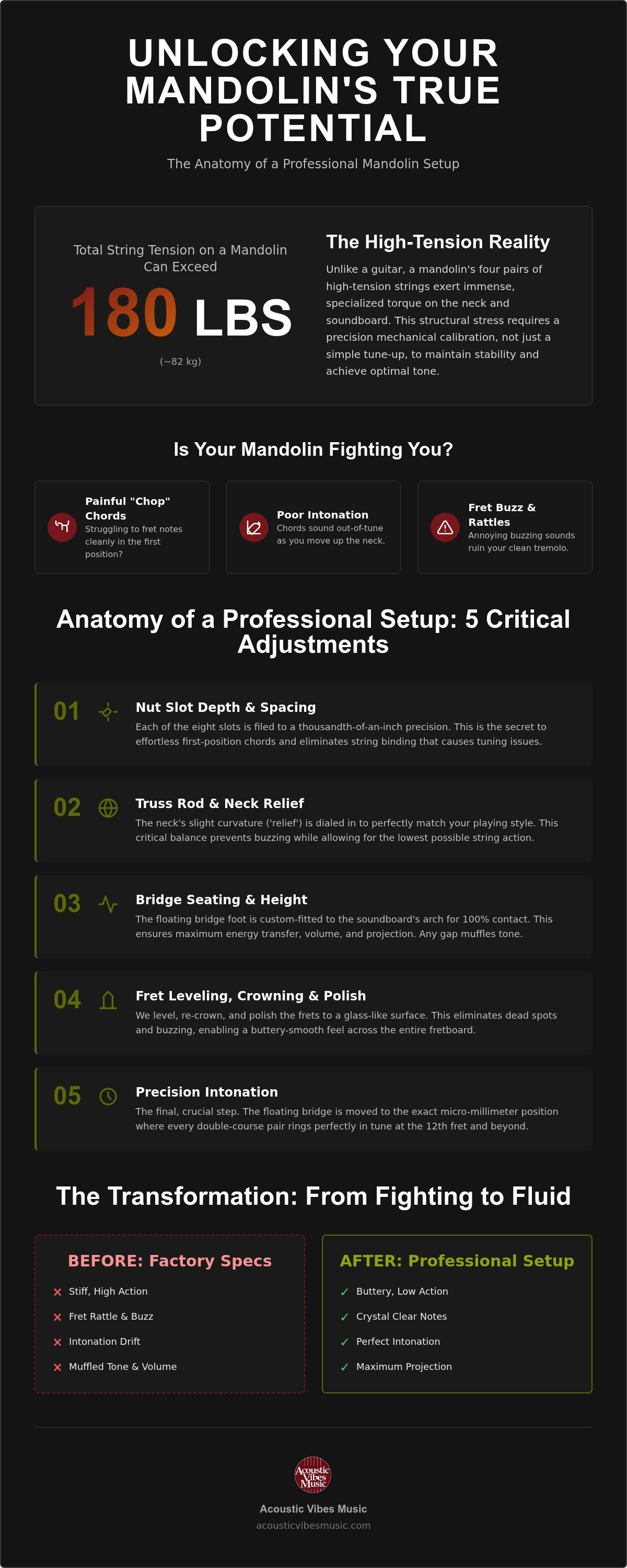
The "double-course" challenge is the primary reason these instruments are so temperamental. Mandolins exert a massive amount of stress on their tonewoods. With four pairs of strings, the total tension often exceeds 180 pounds. This creates a specific type of torque that can cause the neck to bow or the floating bridge to shift. Because wood is an organic material, it reacts constantly to environmental shifts. A soundboard that was perfectly arched in a humid summer might sink slightly in a dry winter, throwing the intonation and action out of alignment. A precision setup accounts for these shifts, ensuring the instrument remains stable through the seasons.
Even premium instruments from world-class builders like Collings Guitars or Gibson are often delivered with "factory specs" that serve as a generic baseline. These settings are rarely ideal for every musician. Professional players require a setup tailored to their specific attack and repertoire. A bluegrass player needs a different break angle and action height than a classical mandolinist to achieve the necessary "chop" and projection. We treat these factory settings as a starting point, refining them to match your personal playing style.
The bridge isn't glued down. It's held in place by pure downward pressure. This force is what drives the soundboard to produce sound, but it also makes the bridge susceptible to leaning or sliding. During a professional mandolin setup, we ensure the bridge foot is perfectly mated to the top's contour. Even a tiny gap can lead to lost energy. We also adjust the truss rod to find the ideal "relief," which is the slight curve in the neck. On such a short scale length, even a fraction of a millimeter change in relief drastically alters how the strings feel under your fingers.
When the mechanical alignment is perfect, the tonal rewards are immediate. You'll notice improved sustain because the strings have better contact at the nut and bridge. We work to eliminate "ghost notes" and those annoying sympathetic vibrations that often ring out from the tailpiece or the string length behind the bridge. This level of detail maximizes volume and projection. Whether you are playing in a loud bluegrass circle or a quiet concert hall, a calibrated mandolin ensures every note is crisp, clear, and resonant.
A professional mandolin setup requires a level of microscopic precision that standard guitar maintenance simply cannot match. Because the scale length is so short, a deviation of even half a millimeter at the nut or bridge can make the difference between a world-class instrument and one that is physically painful to play. Our technical checklist focuses on five critical areas of mechanical optimization:
If you’ve noticed your instrument struggling to stay in tune or feeling stiff, our specialists at Acoustic Vibes Music can perform a comprehensive diagnostic to identify these hidden mechanical issues.
The floating bridge is the heart of the mandolin’s acoustic engine. Unlike a guitar bridge, it is held in place solely by the downward pressure of the strings. This makes it prone to "tilting" forward over time as you tune up. During a setup, we ensure the bridge stands perfectly perpendicular to the top. We also calibrate the height-adjustment thumbwheels. These allow you to make minor seasonal tweaks as the wood expands and contracts, keeping your action consistent year-round without compromising the bridge's structural health.
The transfer of vibration begins at the nut and ends at the bridge saddle. We prefer using high-density bone or specialized synthetic materials to ensure maximum energy transfer. A common issue we fix is "string binding," where the slot is too narrow, causing the string to jump or ping during tuning. Perhaps most importantly, we perform radius matching. This ensures the arc of the strings at the nut and bridge perfectly mirrors the curve of your fretboard, providing a uniform feel across all eight strings.
Entrusting your instrument to a general guitar technician is a gamble that rarely pays off for the serious enthusiast. While a tech may be a wizard with a six-string, the unique physics of the mandolin often fall outside their daily repertoire. This leads to the "Guitar Bias," a common pitfall where technicians set the action far too high. They often fail to realize that because of the double-course tension, a professional mandolin setup requires significantly lower tolerances to remain playable. If the action is set to guitar standards, the mandolin becomes stiff and nearly impossible to fret cleanly.
Bridge placement errors are another frequent casualty of non-specialist work. Because the bridge is floating, it is easily moved during restringing or cleaning. A generalist might eyeball the position or rely on old finish marks, which ruins intonation as you move up the neck. Specialized tools are also a non-negotiable requirement. Standard guitar nut files and fret levelers are too wide and aggressive for the tiny wire used on mandolins. Using the wrong tools can lead to gouged fretboards and "tinny" notes that lack the woody resonance enthusiasts crave. A specialist knows that every adjustment on a 13 7/8 inch scale has a massive impact on the final sound.
We often see instruments where an amateur has attempted to fix bridge height issues by over-adjusting the truss rod. This creates a "ski jump" effect in the neck that no amount of bridge tweaking can resolve. Another frequent error is filing nut slots too wide. On a mandolin, the string must be cradled perfectly; a wide slot allows the string to vibrate side-to-side, resulting in a persistent, annoying buzz. Many generalists also overlook the tailpiece, failing to dampen the sympathetic vibrations or address a rattling cover plate that can mask the true tone of the instrument.
High-end instruments from builders like Collings Guitars or Gibson feature incredibly delicate internal bracing and thin, hand-carved tops. A specialist understands the structural limits of these heirloom pieces. They know how to apply just enough pressure to seat a bridge without risking a crack in the spruce. If you are currently playing a starter model and considering an upgrade, understanding these nuances is vital. You can explore our guide on the Best Intermediate Mandolin to see how build quality affects your setup options. Ultimately, a luthier who actually plays the mandolin brings an intuitive understanding of the "chop" and response that a non-player simply cannot replicate.
Identifying when your mandolin has drifted from its optimal state is crucial for maintaining both its value and your enjoyment. Even the finest instruments require periodic recalibration. Perform the "12th fret test" by comparing the natural harmonic at the 12th fret to the fretted note. If the fretted note is sharp or flat, your bridge has shifted, and your intonation is compromised. This drift happens naturally over time due to string changes and vibration, but it shouldn't be ignored.
Pay attention to the physical effort required to play. If you find it increasingly difficult to press down strings at the first fret, your nut slots have likely worn or shifted, causing high action where it hurts most. Look for visible gaps between the bridge feet and the instrument top; 100% contact is mandatory for tonal transfer. Sudden buzzing that wasn't present when you first acquired the instrument often signals a change in neck relief or a fret that has unseated. Finally, if your tuning machines feel "jumpy" or offer uneven resistance, it's time for a professional mandolin setup to ensure your hardware isn't working against you.
Wood is an organic, breathing material. Winter dryness often leads to "top sink," where the carved spruce top loses moisture and flattens, causing the action to drop and strings to buzz against the frets. Conversely, high humidity can cause the wood to swell, increasing the neck relief and making the instrument feel stiff. If you notice these shifts, a simple home adjustment is rarely enough. These are signs that the structural geometry has changed, requiring a specialist to restore the balance and ensure the instrument's longevity.
Don't assume a factory-fresh mandolin is ready for the stage. Shipping across different climates causes wood to react, and new instruments often require a few months to settle under the intense tension of eight strings. A professional mandolin setup on a new instrument allows you to customize the playability to your specific string gauge preference. Whether you prefer the bite of heavy phosphor bronze or the warmth of monel, the nut and bridge must be calibrated for those specific diameters to prevent binding and tuning instability.
If your instrument exhibits any of these symptoms, don't let the problem worsen and affect your technique. You can schedule a professional mandolin setup with our expert luthiers to restore your instrument's precision and clarity.
Every instrument that enters our studio is treated as a unique piece of functional art. We don't just "fix" mandolins; we curate their performance. Our philosophy centers on the belief that a professional mandolin setup should be a bespoke experience, tailored to the specific voice of the wood and the unique touch of the player. We approach each calibration with a blend of high-end authority and genuine enthusiast passion, ensuring your instrument returns to you in its most inspired state.
Our luthiers possess deep, specialized experience with world-class builders, including Collings Guitars and Gibson. These heirloom instruments require a level of reverence and technical nuance that general shops simply cannot provide. To maintain this standard of excellence, we utilize an appointment-based system. This allows us to dedicate focused, uninterrupted time to your instrument’s evaluation and adjustment. Whether you are a local collector or a national enthusiast, our shipping expertise ensures that players across the country can access our premium luthier services with absolute confidence.
A thorough evaluation occasionally reveals needs that go beyond standard calibration. Our shop provides comprehensive maintenance, ranging from precision fret dressing to complex structural stabilization. Understanding the distinction between maintenance and restoration is vital for any collector. For context on more intensive structural work, you might explore our guide on acoustic guitar bridge repair cost, which outlines the precision required for high-end bridge work. We also specialize in the custom fabrication of nuts and saddles using premium materials, ensuring every contact point on your mandolin maximizes tonal clarity.
We embrace the role of "Expert Guide" for our clients. It isn't enough to simply hand back a playable instrument; we aim to educate you on the specific health and geometry of your mandolin. This collaborative approach helps you understand how environmental shifts and playing habits affect your setup over time. Every professional mandolin setup concludes with a rigorous final inspection and play-testing by a specialist. We verify that the "chop" is percussive, the sustain is singing, and the intonation is flawless before the instrument is cleared for performance.
Ready to unlock the full potential of your instrument? Schedule your professional mandolin setup appointment today and experience the difference that specialist craftsmanship makes.
Your mandolin is a sophisticated piece of acoustic engineering that deserves more than a standard tuning. By prioritizing a professional mandolin setup, you transform the physical experience of playing. You turn high-tension struggle into effortless musical expression. We have explored how specialized knowledge of floating bridges and nut geometry protects your investment while maximizing its tonal clarity. Don't let seasonal shifts or generic factory baselines limit your instrument's potential.
As an authorized dealer for Martin, Taylor, and Collings, we bring a curator's eye to every repair. Our specialized luthier services are designed for those who demand the same excellence in maintenance that they find in our expert-curated selection of premium mandolins. Whether you are navigating a recent humidity change or preparing for a national tour, our team provides the dedicated, professional attention your instrument requires. We treat every adjustment as an opportunity to refine a masterpiece.
Book Your Professional Mandolin Setup Appointment and rediscover the joy of an instrument that responds to your every touch. Your finest performance is waiting to be unlocked.
The investment for this service varies based on the current state of your instrument and the level of precision required. A basic calibration focusing on string height and intonation is typically less involved than a comprehensive service that includes fret dressing or nut replacement. We recommend contacting a specialist for a personalized evaluation, as high-end instruments from boutique builders often require more delicate, time-intensive labor to achieve optimal playability without compromising their structural integrity.
Turnaround times depend on the current shop schedule and the complexity of the adjustments needed. A standard setup usually requires several days of observation as the wood settles under new tension. Because we operate an appointment-based system, we provide a dedicated timeline for each instrument. This ensures your mandolin receives focused attention rather than being rushed through a crowded repair queue, allowing the organic materials to stabilize perfectly before you take it home.
Most modern digital tuners handle the frequency range of a mandolin perfectly well. However, for a professional mandolin setup, we utilize high-precision strobe tuners. These offer a much higher degree of accuracy than standard clip-on models, which is essential when moving a floating bridge to the exact micro-millimeter. Accurate intonation on such a short scale length requires precision that basic consumer tuners often struggle to provide during the calibration process.
Yes, a setup is often most transformative on entry-level instruments. These mandolins are frequently shipped with high, uncomfortable action that discourages new players. By optimizing the nut slots and bridge height, we can make a modest instrument feel significantly more responsive. It removes the physical barriers to learning, allowing you to focus on your technique rather than fighting against the strings. It’s an essential step in making any instrument truly playable.
We generally recommend a professional check-up once or twice a year, ideally during the transition between major seasons. Drastic shifts in humidity and temperature cause the tonewoods to expand and contract, which can alter your action and intonation. Regular maintenance prevents these minor shifts from becoming permanent structural issues. If you play heavily or travel frequently between different climates, you might find that more frequent calibrations help maintain a consistent feel.
A setup is the primary solution for most buzzing issues. We identify the root cause, which is often a combination of low bridge height, insufficient neck relief, or uneven frets. By balancing the truss rod tension with the bridge elevation, we create a clear path for the strings to vibrate. If the buzz persists due to worn frets, we may suggest additional leveling or crowning services to restore that glass-like surface you expect from a premium instrument.
While we stock a curated selection of premium strings from world-class manufacturers, you are welcome to provide your preferred set. The choice of string gauge and material is a personal preference that dictates the final calibration of the nut and bridge. If you have a specific brand you love, bringing them ensures the setup is tailored exactly to the tension and diameter of your favorite strings, providing the most accurate and comfortable results.
A professional mandolin setup focuses on the adjustable components of the instrument, such as the nut, truss rod, and bridge. A fret level is a more intensive mechanical procedure where we physically sand the frets to ensure they are perfectly even across the entire fretboard. While a setup optimizes the geometry, a fret level removes physical imperfections in the metal itself. Often, we perform both to achieve the lowest possible action without any unwanted noise.