My shopping cart
Your cart is currently empty.
Continue ShoppingA banjo’s sound begins with two assemblies working as one: the neck and the pot. The neck holds the fingerboard, frets, strings and tuners, while the pot brings together the head, rim, bridge and tailpiece. With the parts of a banjo explained as a connected system, it’s easier to see how each component contributes to playing feel and sound.
If you’re learning the instrument, its terminology can feel overwhelming. Each part, however, has a clear place and purpose, from the fifth-string tuner on the neck to the flange that attaches a resonator.
This guide covers the neck, fingerboard, frets, and inlays, then follows the strings and tuners into the pot assembly. You’ll also see how the flange and resonator fit together, and how open-back and resonator banjos differ in construction and sound. Read on for a practical, component-by-component guide to the instrument.
The banjo neck carries the fingerboard, frets, nut, tuning pegs, and strings; the peghead holds the tuners. The phrase “parts of a banjo explained” makes most sense when you follow how these pieces guide strings from the headstock toward the pot.
The peghead, also called the headstock, sits at the end of the neck and carries the tuning pegs. Turning the pegs adjusts string tension, while slots in the nut align the strings before they run down the fingerboard. The peghead may also have an overlay and a truss rod cover, which provides access to the neck’s adjustment mechanism.
Nut materials include bone, wood, ebony, and plastic. The nut’s slots guide each string onto its path over the frets, so correct alignment matters. Tuning pegs may be guitar-style, extending from the sides of the neck, or planetary-style, extending from the back. Check the sides and rear of the peghead to tell these arrangements apart.
The neck’s heel is the lower end that meets the pot. Hanger bolts at the heel attach the neck, and the heel cut helps set its fit against the instrument. That cut commonly accommodates a 5/8-inch bridge, linking the neck’s angle to bridge height. The bridge sits on the head, while the tension hoop holds tension around the head.
The fingerboard, also called the fretboard, sits on top of the neck and carries the frets and inlays. Frets divide the playing surface into positions, while inlays mark selected spots as visual references. Players can use these markers to find their way between notes instead of judging position only by the neck’s edge.
Beneath the fingerboard, a truss rod helps stabilize the neck and adjust string height above the playing surface. It runs inside the neck, not in the pot assembly. The neck also supports the strings and may have spikes that hold the fifth string at alternate pitches. Together, these features make the fingerboard both a playing surface and a place for decorative inlays.
Long-neck banjos have an extended neck, increasing the distance between the peghead and the pot. This affects how far the player’s hand travels to form notes. The parts remain familiar: peghead, nut, fingerboard, frets, and heel. Following them in order shows how the neck connects string control with the instrument’s body.
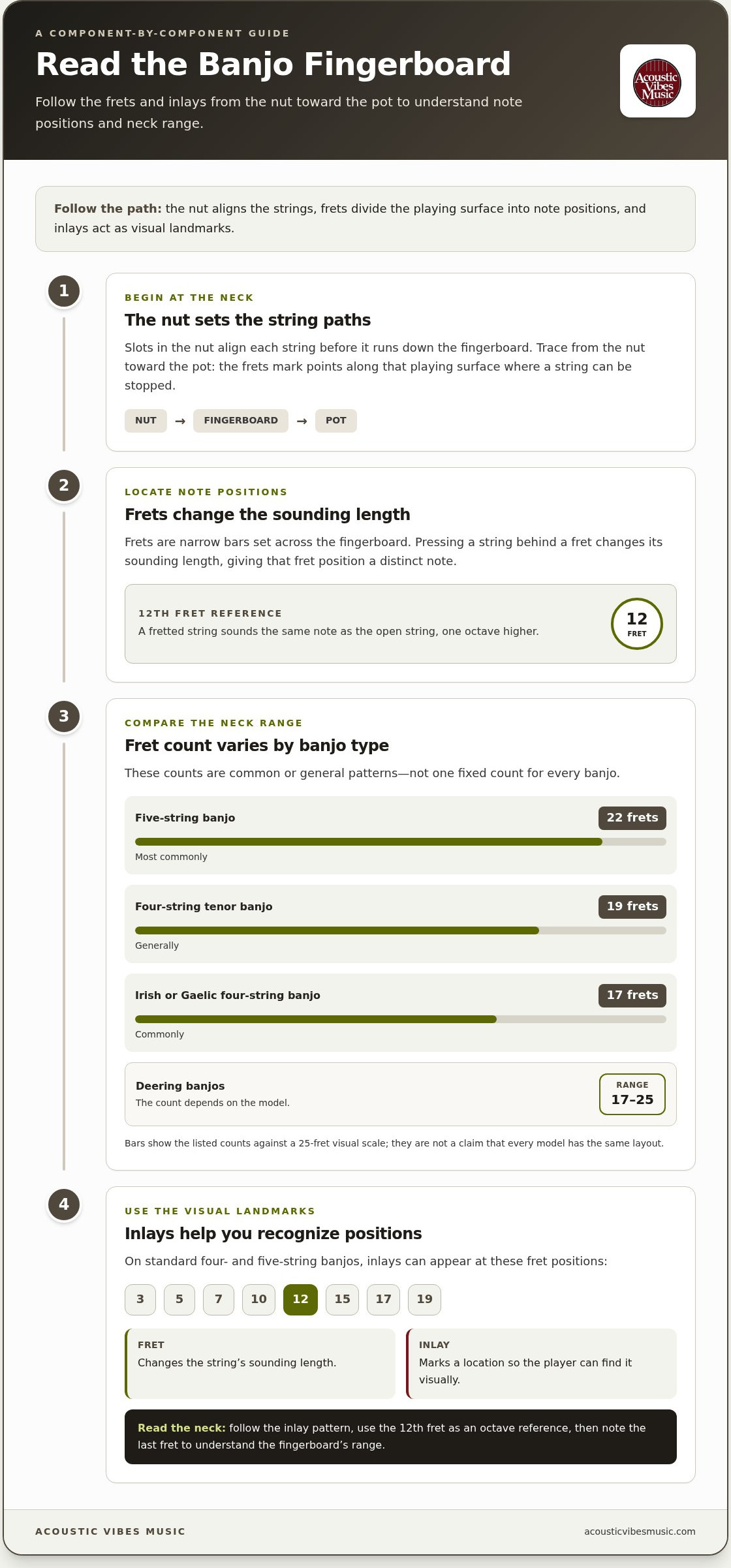
Frets divide the banjo’s fingerboard into note positions, and inlays provide visual landmarks. Their layout helps players locate notes and see how far the neck extends.
Frets are narrow bars set across the fingerboard, and pressing a string behind one changes its sounding length. This gives each fret position a distinct note. At the 12th fret, a fretted string produces the same note as the open string, one octave higher, making that position a useful reference point.
Fret counts depend on banjo type. Five-string banjos most commonly have 22 frets, while four-string tenor banjos generally have 19. Irish or Gaelic four-string banjos commonly have 17 frets. Deering banjos can have between 17 and 25 frets, so the instrument’s style and model matter more than assuming one count fits every neck.
Moving from the nut toward the pot assembly, each fret marks another point where a string can be stopped. Compare the fingerboard’s final fret with the bridge and tailpiece below: they sit in separate areas but work together along the string’s path from neck to pot. Counting the frets also gives you a sense of the fingerboard’s playing range.
Inlays are markers mounted on the fingerboard, and they give the eye clear landmarks between frets. On standard four- and five-string banjos, inlays can appear at frets 3, 5, 7, 10, 12, 15, 17, and 19. Their placement helps players find a position quickly without counting every fret from the nut.
Look at both the inlay pattern and the fret numbers it marks. For example, the 12th-fret marker identifies the position where a fretted string sounds an octave above its open note. Inlays are not frets: the fret changes the string’s sounding length, while the marker helps the player recognize the location.
Fret and inlay layouts can also help distinguish banjo configurations. A five-string instrument with 22 frets may show markers beyond the 19th-fret position, while a 17-fret Irish banjo has a shorter fingerboard range. Treat the marker pattern as a map, then use the fret count to understand the neck’s reach.
When examining a banjo, trace the fingerboard from the nut to its last fret and note the inlay positions. This simple visual sequence connects fret locations with octave landmarks and the instrument’s playing range.
The flange and resonator connect to the banjo’s pot assembly, where hooks and nuts also secure the head’s tension hoop. Their arrangement shows how the back of a resonator banjo attaches to and is supported by the pot.
Hooks and nuts hold the tension hoop in place, helping maintain tension across the banjo head. The hooks run around the rim and engage with the hoop; tightening their nuts draws the hoop into position. Banjo rims are fitted with between 16 and 24 hooks, so the hardware forms a series around the pot.
The flange attaches the resonator to the pot assembly. It sits between the rim and resonator, while the hooks and nuts secure the tension hoop. Keeping these functions separate makes the layout easier to understand: the hoop hardware secures the head, and the flange provides the resonator’s attachment point.
Bracket shoes are fittings on the rim that provide attachment points for the hooks. Their connection to the hooks and flange depends on the banjo’s hardware layout. To follow the arrangement, trace a hook from its nut toward the rim, then note where the flange sits in relation to the resonator back.
A resonator flange is mounted at the rim and helps attach the resonator, while bracket shoes support the hook hardware around the pot. Together, they organize the components around the rim. This distinction helps you identify which parts hold the head and which secure the resonator.
Resonator attachment methods vary by banjo design. Goodtime banjo resonators attach with four Phillips screws. Another design uses four wall lugs and four thumb screws to hold the resonator in place. These examples show why it helps to understand the attachment hardware as a system rather than assume every flange or resonator uses the same fasteners.
The pot assembly can include a rim, head, tension hoop, hooks and nuts, tailpiece, and bridge. A resonator banjo also has a flange and resonator back. Each part has a distinct position: the head spans the rim, the tension hoop surrounds its edge, and the hooks and nuts secure the hoop. The flange connects the resonator to the pot assembly.
To understand the layout, start at the head and follow the metal hoop around its edge. Find the hooks and nuts, then locate the flange where the resonator attaches. This sequence separates the head-tension hardware from the resonator attachment hardware, keeping both distinct from the neck.
An open-back banjo has no resonator behind its pot, while a resonator banjo adds a back and flange. That difference changes how sound projects from the banjo head and toward the player.
The banjo’s pot assembly supports the head, bridge, and strings. The head acts as a vibrating membrane, much like a soundboard. When a player plucks a string, the bridge transfers its vibrations to the head, producing the banjo’s characteristic sound. The rim beneath the head also matters, as its material can affect the instrument’s sound.
A resonator sits behind the pot and reflects sound outward. It increases volume by projecting sound forward instead of letting it dissipate through the open back or be absorbed by the player’s body. This projection can help the banjo carry clearly in settings where it needs to be heard. The resonator doesn’t replace the head or bridge; it works with them to shape how sound reaches the audience.
On an open-back banjo, the uncovered rear lets sound travel out the back. This construction creates a different playing experience from a resonator model, particularly in how sound is directed around the player. It also leaves the pot’s rear and rim visible, while a resonator covers that area.
Compare the two by looking behind the pot. An open-back model shows the back of the rim; a resonator model has a resonator attached behind it, typically through a flange. In the Hornbostel-Sachs system, resonator banjos are classified as 321.312, and open-backed banjos as 321.314. Those identifiers distinguish the construction types, not their quality or suitability for a particular player.
Other pot components also influence sound. A tone ring can add volume and dimension, while its material and construction affect tonal qualities. These may include a full, powerful sound; a warm, round one; or a bright, crisp, dry, sparkling character. The wooden rim contributes, too. Deering rims, for example, are made of three-ply violin maple.
The bridge connects the strings to the head, so its height and position affect how vibrations reach the membrane. The heel cut should match the bridge height, linking the neck angle to the bridge’s position relative to the head. A tuning peg changes string tension and pitch, while the pot, head, bridge, tone ring, and resonator shape how those vibrations are projected. Consider the whole assembly, not just one part.
Banjo strings run from the nut across the fingerboard to the bridge, and tuning pegs adjust their tension. Four-string and five-string banjos have different string layouts; a five-string design adds a short fifth string with its own tuner. A six-string model has a different configuration, not the specific fifth-string arrangement described here.
On a five-string banjo, the fifth-string tuner sits at the fifth fret, where the traditional fifth-string nut is also positioned. The string is most commonly tuned to G. Because it is shorter, it starts partway along the neck rather than at the peghead, giving the instrument its distinctive layout.
Alternate-tuning spikes hold the fifth string at selected fret positions. They’re usually placed at the 7th, 9th, and 10th fret positions for A, B, and C tuning. The spikes provide a way to raise the fifth string’s pitch for those tunings without moving the other strings from their usual positions.
At the peghead, the nut’s slots align the strings before they run down the fingerboard. Look along the neck to check that each string follows a clear path from its nut slot toward the bridge. Tuners may be guitar-style, extending from the sides of the neck, or planetary-style, extending from the back.
Four-string banjos include tenor models, which generally have 19 frets, and Irish or Gaelic models, which commonly have 17. Five-string banjos most commonly have 22 frets and include the short fifth string. Those differences help identify the instrument’s layout; the fifth-string tuner and spikes are defining landmarks on the five-string design.
To identify the basic parts, trace a string from its tuner to the nut, along the fingerboard, and over the bridge. On a five-string banjo, locate the fifth-string tuner and any spikes as well. This visual check distinguishes the main tuners from the shorter string’s dedicated hardware and shows how each string reaches the pot.
For routine care, keep strings aligned in their nut slots and use the tuning pegs to bring them to their intended pitches. When replacing a string, follow its route from tuner to bridge so it sits along the same path. A damaged tuner, nut, or spike affects a different part of that route, so identify the component before choosing a replacement.
If you’re comparing banjo layouts or exploring a different acoustic instrument, browse banjos and other acoustic instruments to see how their construction suits your playing.
If learning about banjo construction has you exploring stringed instruments, Acoustic Vibes Music offers banjos, mandolins, acoustic guitars, and classical and flamenco guitars. Each instrument brings a different approach to tone, feel, and playing style.
When comparing a banjo with an acoustic guitar, consider how each instrument’s strings, body, and playing surface shape its sound and feel. Trying instruments in person can help you connect those construction details with what feels comfortable in your hands. If the banjo’s bright character appeals to you, explore different banjos to find the sound and feel that suit you.
Explore Acoustic Vibes Music’s acoustic instruments and discover a direction for your next musical journey.
Now that you understand the parts of a banjo, use that knowledge to make your next musical choice more deliberately. Consider what draws you in: the banjo’s distinctive voice, an acoustic guitar’s resonance, or the expressive range of a classical or flamenco guitar. Listening closely and noticing how an instrument feels in your hands can turn technical curiosity into a rewarding next step.
Acoustic Vibes Music offers banjos, acoustic guitars, and classical and flamenco guitars, so you can explore these instrument families as you consider what suits your musical interests. Whether you’re choosing your first instrument or broadening your collection, let curiosity guide you. Think about the qualities you value most, then use them to focus your listening.
Contact Acoustic Vibes Music to continue exploring, and take the next step toward the sound that excites you.
A banjo’s neck supports the fretted playing surface, while the pot assembly produces and projects sound. The headstock carries the tuning pegs; the nut guides strings onto the fingerboard, where frets mark note positions. At the pot, the head vibrates, the bridge transfers string vibrations, and the tailpiece anchors the strings. Resonator models also have a flange and resonator. To identify each part, trace a string from tuner to tailpiece.
The pot assembly is the banjo’s circular body, built around a rim and vibrating head. The rim supports the head, and the tone ring sits where they meet, contributing to volume and tonal character. A metal tension hoop helps maintain head tension and is held in place by hooks and nuts. When examining a banjo, look for these parts around its circumference, then check whether a resonator and flange complete the assembly.
The bridge transfers string vibrations to the banjo head, while the tailpiece anchors the strings at the opposite end of the pot. Their positions establish the strings’ path across the head. For a practical visual check, follow a string from the tailpiece, over the bridge, and along the neck. The bridge height should correspond to the neck’s heel cut, so these parts need to work together as a setup.
Banjo strings are commonly made from metal, while gut strings were often used in the 17th and 18th centuries. They stretch from the tailpiece, cross the bridge, pass over the fingerboard, and reach the nut or their tuning pegs. A five-string banjo adds a shorter fifth string that begins partway along the neck. That distinct arrangement means its fifth string doesn’t follow the same full-length route as the others.
A resonator banjo has a back attached behind the pot, while an open-back model leaves the rear uncovered. The resonator directs sound forward instead of letting it dissipate behind the instrument or be absorbed by the player’s body. This construction also increases volume. The two types have distinct Hornbostel-Sachs classifications: resonator banjos are 321.312, and open-backed banjos are 321.314.
The fifth string is the short string on a five-string banjo, most commonly tuned to G. Its tuner is set into the side of the neck near the fifth fret, giving that string its own pitch control. Spikes provide stopping points for alternate tunings. For example, spikes at the 7th, 9th, and 10th fret positions are usually used for A, B, and C tuning.
The head, rim, tone ring, bridge, and resonator shape the sound, while the neck, frets, nut, and bridge height affect playing feel. A tone ring’s material and construction can contribute to a full, warm, or bright character. The resonator helps project sound forward and increase volume. For playability, check how the strings sit over the frets and whether the bridge height suits the neck’s heel cut.