My shopping cart
Your cart is currently empty.
Continue ShoppingThe heaviest instrument on the wall isn't always the one that will sing for you. It's common to feel a bit lost among technical specs like flange types and tone rings, especially when you're searching for a sound that feels truly authentic. You've likely worried about the physical weight of a professional model or wondered if a specific style will limit the music you can play. Deciding between an open back vs resonator banjo is more than a technical choice; it's about finding the voice that matches your musical spirit.
In this guide, we'll pull back the curtain on these two legendary designs to help you select a master-crafted heirloom, even as high-end instruments become increasingly rare. You'll learn exactly how construction impacts tone, which styles suit your preferred genre, and how a professional luthier's setup ensures effortless playability. We'll explore the artisanal details and structural nuances that turn a simple instrument into a lifelong companion. Prepare to find the clarity you need to choose an instrument you'll cherish for decades.
The pot is the central engine of the banjo's sound. It's the complex circular assembly where the head, rim, and tension hardware converge to create vibration. When you explore the Anatomy of the Banjo Pot, you'll find that every component, from the choice of wood in the rim to the tension of the hooks, contributes to the instrument's final voice. The most significant structural decision you'll make involves the presence or absence of a back. This architectural choice defines the open back vs resonator banjo debate and dictates how the instrument interacts with both the player and the audience.
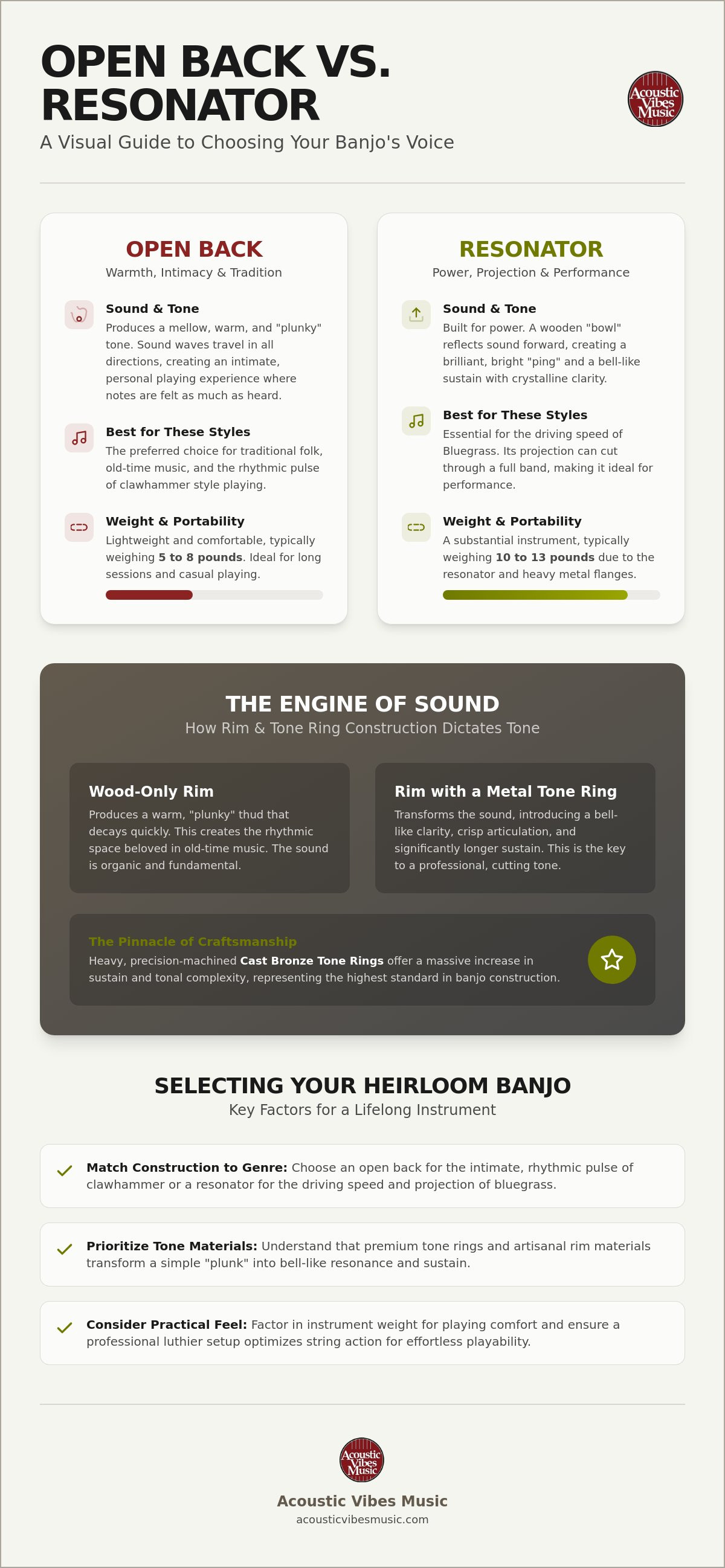
Weight is a primary consideration for many enthusiasts. A resonator banjo is a substantial piece of equipment, often weighing between 10 and 13 pounds due to the additional wood of the resonator and the heavy metal flanges required for attachment. In contrast, an open back model is a marvel of portability and comfort. These instruments typically weigh between 5 and 8 pounds, making them an excellent choice for long sessions of standing or casual porch picking. This difference in mass isn't just about physical burden; it fundamentally changes the physics of how the instrument vibrates against your body.
The open back design is celebrated for its warmth and organic honesty. Without a back plate, the sound waves are free to travel in all directions, including directly into the player's chest. This creates a deeply personal playing experience where you don't just hear the notes, you feel them. The lack of a reflective chamber means the sound is less focused, resulting in a "plunky" and mellow tone that's highly sought after for traditional folk styles. Artisanal wood rims are often left exposed, showcasing the natural beauty of maple, walnut, or mahogany. It's an aesthetic of simplicity and tradition that emphasizes the tactile connection between musician and wood.
A resonator banjo is built for power. It features a wooden "bowl" attached to the back of the pot, which acts as a sophisticated sound chamber. Instead of the sound being absorbed by your clothing, the resonator reflects those sound waves forward with incredible force. This creates a brilliant "ping" and a bell-like sustain that can cut through a full bluegrass band. You'll notice metal flanges surrounding the pot; these aren't just decorative. They provide the structural mounting points for the resonator and contribute to the instrument's mechanical brilliance. If you're looking for an instrument that can command a room and project with crystalline clarity, the resonator design is your gateway to professional performance.
Tone is the heartbeat of the instrument. It is the result of a deliberate marriage between physics and fine materials. While the history of the banjo reveals a journey from West African gourd lutes to modern masterpieces, the core of the open back vs resonator banjo distinction lies in how energy is managed within the pot. Premium construction treats the rim as a resonant foundation rather than just a frame. A wood-only rim produces a warm, "plunky" thud that decays quickly, creating the rhythmic space beloved in old-time music. In contrast, adding a metal tone ring introduces a bell-like clarity. It's a sensory transformation. You feel the vibration sustain through the neck, turning every note into a crisp, articulate statement.
Material excellence is non-negotiable for an heirloom instrument. As global markets face shifting regulations on rare materials like Pernambuco wood, manufacturers are focusing more than ever on the artisanal quality of their metalwork and rim construction. This dedication to superior materials ensures that the instrument doesn't just sound better today; it matures and gains value over decades of play. The tactile feedback of a high-end build is unmistakable. The weight, the smoothness of the finish, and the immediate response to a light touch all signal an instrument crafted by masters.
The choice of tone ring is the most critical variable in professional banjo design. Rolled brass rings offer a bright, punchy response that is lighter and more accessible. However, heavy cast bronze rings represent the pinnacle of the craft. These rings are precision-machined to fit the rim perfectly, providing a massive increase in sustain and tonal complexity. Rim density is the key to this relationship; higher density and a tighter fit between the ring and rim result in significantly longer sustain. For the old-time player, a simple multi-ply maple rim provides a "woody" honesty that a heavy metal ring might overshadow. It's about finding the specific vibrational energy that speaks to your soul.
If the tone ring is the engine, the resonator is the speaker cabinet. The wood species used in its construction acts as a natural filter for the sound. Mahogany resonators are prized for their warmth and rich mid-range, offering a "softer" bluegrass sound. Maple is the choice for those seeking maximum brightness and cutting power, while walnut provides a balanced, dark complexity. The depth of the resonator also matters. A deeper bowl increases the low-end response, giving the instrument a growl that commands attention on stage. We view these instruments as curated pieces of art where every curve serves a purpose. If you are ready to experience these tonal nuances firsthand, exploring a hand-selected collection is the best way to find your voice.
The music you intend to play is the ultimate guide for your purchase. In the evolution of banjo construction, the divergence between playing styles led directly to the structural changes we see in modern workshops. Choosing between an open back vs resonator banjo is essentially a choice between a rhythmic, percussive tradition and a fast, driving melodic one. Both paths offer immense satisfaction; however, they require different mechanical tools to achieve their signature sounds. Understanding these nuances ensures your instrument supports your technique rather than fighting against it.
We encourage every enthusiast to explore the joy of discovery in both genres. While most players eventually gravitate toward one primary style, the most versatile musicians often keep one of each in their collection. This allows them to match the instrument's voice to the specific emotional requirements of a song. Whether you're seeking the haunting, hollow ring of a mountain ballad or the aggressive "crack" of a high-speed bluegrass breakdown, your choice of pot architecture will be your most important artistic decision.
Old-time music is built on the "clawhammer" or "frailing" technique. This style uses a downward strike of the fingernail followed by a thumb catch on the fifth string. It's a percussive, dance-oriented approach that thrives on a "cluck" or "thump." Because an open back banjo has a shorter sustain and a more focused mid-range, it allows these complex rhythmic patterns to remain distinct. If you used a high-sustain resonator model, the notes would bleed together, losing that essential "gallop." Achieving this specific tonal balance is easier when you understand the nuances of a Clawhammer Banjo Setup.
Bluegrass is a different beast entirely. Pioneered by masters like Earl Scruggs, this style utilizes metal fingerpicks and a three-finger "roll" to create a wall of sound. You aren't just playing rhythm; you're often the lead voice. To cut through the high-frequency "chop" of a fiddle or the percussive bark of a mandolin, you need the mechanical projection of a resonator. The "bowl" reflects every ounce of energy forward, providing the "snap" and "pop" required for high-speed rolls. While you're honing your bluegrass ensemble sound, you might also consider Upgrading Your Mandolin to ensure your entire acoustic arsenal matches the quality of your banjo.
Beyond the sonic profile, the physical interaction with your instrument dictates how often you'll pick it up. The debate of open back vs resonator banjo often centers on weight and playability. A master-crafted resonator model is a serious piece of engineering, often tipping the scales at 12 to 15 pounds. This heft isn't accidental. It's the byproduct of a heavy bronze tone ring and a solid wood resonator, components that are essential for that professional projection. If you prefer a lighter, more nimble experience, an open back model typically weighs a manageable 6 to 8 pounds. This makes it a favorite for traveling musicians and casual jam sessions.
The bridge is another critical component in fine-tuning your banjo's voice. It acts as the primary conduit between the strings and the head. A thinner, lighter bridge can brighten a dark-sounding instrument, while a heavier bridge made of dense maple or ebony can add warmth and stability. These small adjustments, when combined with the right head tension, can completely transform a banjo's personality. Because these nuances are so delicate, we recommend scheduling a professional luthier setup to ensure your heirloom instrument is perfectly calibrated to your hands and your musical goals.
Don't let the weight of a professional resonator banjo deter you. High-quality metal components are the secret to that sought-after sustain and mechanical brilliance. To manage the burden, we recommend a wide, padded leather strap that distributes the weight across your shoulder. A well-balanced instrument shouldn't feel like a chore to hold. Instead, the mass should provide a sense of stability, anchoring your technique as you navigate complex rolls. For many, the physical presence of a heavy banjo is a reassuring sign of artisanal excellence and material density.
The "action," or the distance between the strings and the fretboard, is where the art of the luthier truly shines. Clawhammer players often request a higher action. This extra clearance prevents the strings from buzzing against the frets during aggressive downward strikes. It also helps produce a cleaner percussive "cluck." Bluegrass pickers, conversely, demand the lowest action possible without sacrificing tone. Low action allows for the lightning-fast speed and surgical accuracy required for Scruggs-style playing. Choosing the right strings is the final ritual; light gauges offer ease of play, while medium gauges provide the tension needed to drive a heavy tone ring to its full potential.
Choosing a forever instrument requires more than a simple transaction. It requires a partnership with a specialist who understands the gravity of your investment. At Acoustic Vibes Music, we view our collection as a curated gallery of artisanal excellence rather than a standard retail inventory. The decision between an open back vs resonator banjo is deeply personal; it's a choice that defines your musical legacy. By moving away from the impersonal environment of big-box retailers, you gain access to a trusted advisor who has hand-selected every instrument for its tonal complexity and aesthetic integrity. We pride ourselves on being an accessible gateway to the world's finest craftsmanship, ensuring that every player finds a voice that resonates with their soul.
Every instrument that enters our shop undergoes a rigorous inspection process. We examine the fretwork, the neck relief, and the mechanical stability of the pot assembly to ensure it meets our exacting standards. This attention to detail is why seasoned collectors and newcomers alike trust us to guide their journey. Whether you are seeking a pre-war inspired powerhouse or a modern masterpiece, our expertise ensures that your selection is a true heirloom-quality piece that will mature alongside your playing.
Our commitment to quality extends beyond our banjo collection. We apply the same level of scrutiny to our world-renowned brands of mandolins and ukuleles. This holistic approach to acoustic music allows us to provide a comprehensive perspective on instrument construction. For those who also appreciate the rich resonance of six strings, our guide on High End Acoustic Guitars offers deeper insight into the world of premium tonewoods and luthier techniques. Should your instrument ever require maintenance, our professional luthier services are available by appointment to keep your collection in peak performing condition for decades to come.
Distance should never be a barrier to acquiring a world-class instrument. We have developed specialized packing techniques specifically designed for the delicate nature of high-end banjos. Resonators, in particular, require precise bracing to ensure they arrive without a single scratch on their polished surfaces. Every banjo is professionally set up by our team before it leaves the shop, meaning it arrives at your door ready to play right out of the case. Our national reach is built on a foundation of reliability and a deep respect for the tradition of these instruments. We take the anxiety out of the shipping process, allowing you to focus entirely on the joy of your new acquisition.
The journey to find your perfect instrument is a pursuit of quality that defines your artistic path. We've navigated the technical nuances of tone rings and the stylistic requirements of different genres, proving that the choice of an open back vs resonator banjo is the foundation of your unique sound. Your instrument should be more than just a tool; it's a partner in your musical discovery. Every detail, from the density of the rim to the height of the action, contributes to a voice that is uniquely yours.
As an authorized dealer for world-renowned acoustic brands, we pride ourselves on a collection that meets the highest standards of artisanal skill. Every instrument in our gallery receives an expert luthier setup to ensure flawless playability from the moment you open the case. We provide national shipping with premium protection, guaranteeing your investment arrives safely regardless of the distance. Our team is dedicated to helping you navigate these choices with the confidence of a seasoned collector.
Explore Our Curated Collection of Professional Banjos and take the first step toward owning a true heirloom. We're here to guide you toward the instrument that will inspire you for a lifetime. Your perfect sound is waiting.
Yes, an open back banjo is naturally quieter because it lacks the reflective wooden "bowl" found on resonator models. The sound waves aren't projected forward; instead, they're partially absorbed by the player's clothing and body. This creates a more intimate, mellow volume that's perfect for solo practice or small parlor gatherings where a massive acoustic presence isn't necessary.
You can certainly play bluegrass on an open back, but you'll notice a significant lack of the signature "snap" and volume. Bluegrass relies on the mechanical brilliance of a resonator to cut through a full band of fiddles and mandolins. While the notes remain the same, the tonal experience will feel much more subdued and less aggressive than the traditional Scruggs-style sound enthusiasts expect.
The weight difference is primarily due to the heavy cast bronze tone rings and metal flanges required for the resonator assembly. A professional-grade resonator banjo often weighs between 12 and 15 pounds to achieve its superior sustain and projection. These high-density components are essential for the mechanical power and bell-like clarity that define a premium, heirloom-quality instrument.
Your choice should depend entirely on the musical genre you wish to master first. If you're drawn to the rhythmic, percussive "clawhammer" style, an open back is the correct starting point. For those aiming for the fast-paced drive of bluegrass, a resonator is essential. Beginners often find open back models more approachable initially due to their lighter weight and simpler physical profile.
Conversion is technically possible but rarely recommended for high-end instruments. Adding a resonator usually requires specific metal flanges and mounting hardware that your open back pot may not be drilled to accommodate. It's almost always more effective to invest in a dedicated resonator model to ensure the tonal balance and structural integrity of the build remain uncompromised and professional.
Professional instruments require regular attention to head tension and bridge placement to maintain perfect intonation and clarity. Seasonal humidity changes can affect the wood, so keeping your banjo in a climate-controlled environment is vital for long-term health. We recommend an annual check-up with a professional luthier to ensure the neck relief and hardware remain in peak condition for optimal playability.
Fingerpicks are standard for resonator banjos used in bluegrass to achieve maximum volume and a sharp, articulate attack. Conversely, open back players typically use their natural fingernails for the "frailing" motion of the clawhammer technique. While there are no strict rules, using metal picks on an open back can sometimes produce a tone that's too harsh for traditional, old-time folk styles.
Wood choice significantly colors the instrument's final voice and emotional character. Maple is prized for its crystalline brightness and sharp attack, making it a favorite for lead players who need maximum cutting power. Mahogany offers a richer, warmer mid-range that provides a "softer" and more balanced bluegrass sound. Choosing between them is a key step when navigating the open back vs resonator banjo landscape.