My shopping cart
Your cart is currently empty.
Continue ShoppingThat crystalline, high-velocity "snap" of a bluegrass banjo is a marvel of engineering, but it's often the very thing standing between you and the soulful, percussive "plunk" of authentic old-time music. If your instrument sounds too bright and "tinny," or if the action feels too low for comfortable frailing, you aren't alone. Many players struggle with strings that feel too stiff for rhythmic drop-thumbing, leaving their high-end instruments sounding thin and uninspiring.
A precision clawhammer banjo setup is an intentional departure from mainstream configurations. It's about finding the sweet spot where warmth meets playability. In this guide, you'll learn how to master professional setup techniques tailored specifically for old-time styles. We'll explore how adjusting head tension, bridge height, and string gauges can transform your banjo into a rhythmic powerhouse. Whether you're chasing a deep, earthy tone or looking to optimize a scooped fingerboard for better hand clearance, these insights will give you the confidence to maintain your instrument like a seasoned luthier. Prepare to unlock a richer, more resonant voice from your banjo today.
Bluegrass is defined by the "snap." It's a world of high tension, low action, and resonators that project sound like a cannon. Old-time music lives in a different space. It's an earthy, percussive landscape where the "plunk" reigns supreme. Achieving this specific aesthetic requires a clawhammer banjo setup that prioritizes warmth and a rhythmic thud over crystalline sustain. While a bluegrass player wants their notes to ring out with surgical clarity, a clawhammer player needs the note to decay quickly. This creates the necessary "air" for the next rhythmic strike to land with impact.
Open-back banjos are the preferred canvas for this artistry. Without a resonator to reflect sound forward with aggressive force, the tone remains intimate and woody. It's a tactile experience that emphasizes the heritage of the instrument. To master this sound, you have to balance three critical pillars: head tension, bridge height, and string gauge. Each element must work in harmony to transform a bright, "tinny" instrument into a rhythmic powerhouse, much like how a percussionist might select high-quality Gretsch drum kits UK to anchor a band's performance.
The rim and tone ring are the heart of your banjo's voice. In an old-time setup, we often look for heavy wood rims, like multi-ply maple or thick cherry, which naturally absorb piercing high frequencies. If your instrument features a tone ring, designs like the "Whyte Laydie" or "Tubaphone" provide a sophisticated complexity without the aggressive bite of a heavy leaded-bronze ring. Sustain can actually be a hindrance in fast rhythmic frailing; too much ring creates a muddy wash of sound that obscures your timing. We're chasing a high ratio of the fundamental note to overtones, which produces that dry, satisfying "plunk" that defines the genre.
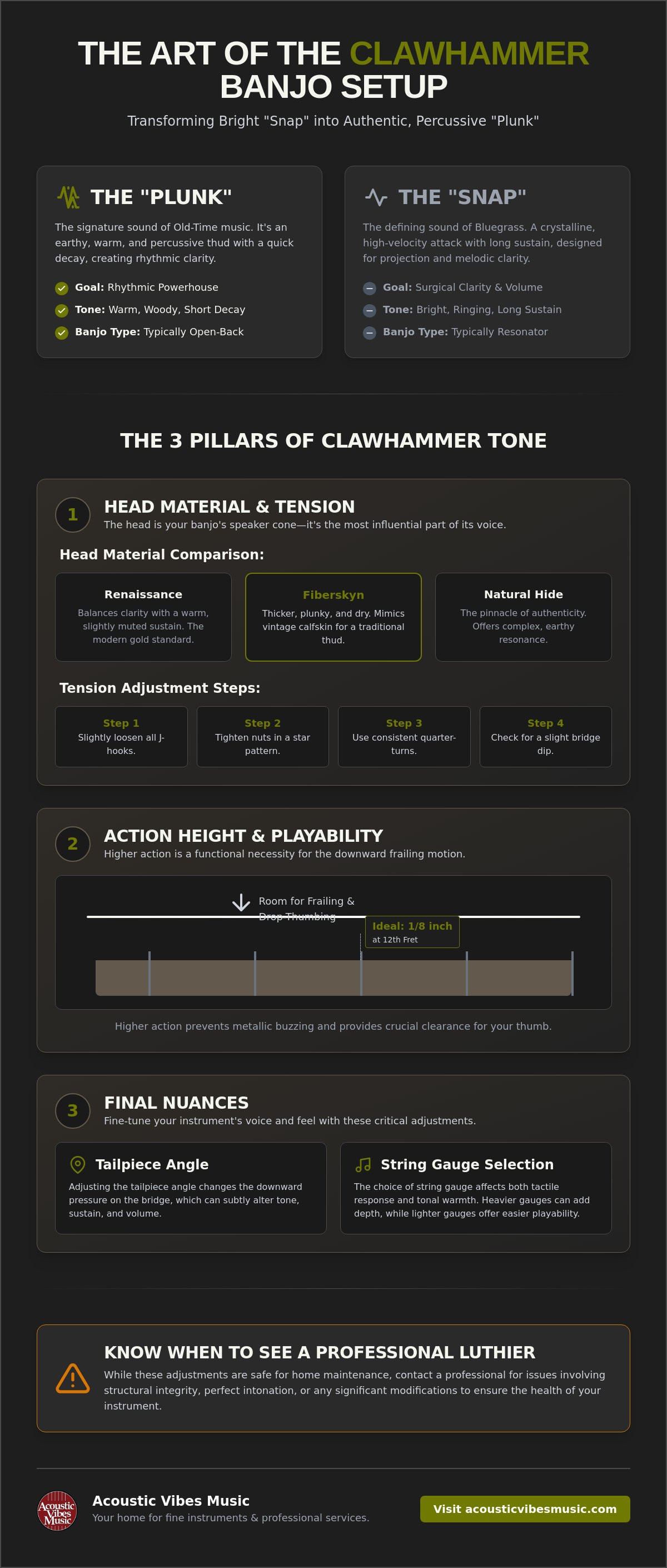
In many stringed instruments, low action is the goal for ease of play. In the world of old-time music, higher action is a functional necessity. The downward "frailing" motion of the index or middle finger requires the string to have significant room to vibrate. If your strings are too close to the frets, you'll experience a metallic buzzing that kills the warmth of your tone. Higher strings also provide the essential clearance your thumb needs to catch the 5th string during intricate drop-thumbing maneuvers. For a standard clawhammer banjo setup, the ideal action height is 1/8 inch measured at the 12th fret. This height offers the perfect compromise between comfortable fretting and percussive power.
The head is the most influential variable in your quest for the perfect old-time tone. While the rim provides the foundation, the head acts as the speaker cone, determining how energy from the strings is translated into sound. A successful clawhammer banjo setup hinges on selecting a material that tames harsh overtones while preserving the percussive "thud" of the strike. The goal is to create a controlled environment where the fundamental note is clear, but the high-frequency "zing" is intentionally suppressed.
Renaissance heads are often the gold standard for modern old-time players. They offer a honey-colored aesthetic and a sound that balances clarity with a warm, slightly muted sustain. It's a sophisticated choice for those who want their notes to bloom without becoming shrill. In contrast, Fiberskyn heads are thicker and designed to mimic the texture and "plunky" response of vintage calfskin. They maximize the mid-range frequencies, providing a dry, short decay that works beautifully for solo frailing. For the ultimate traditionalist, natural hide remains the pinnacle of authenticity. While sensitive to humidity, a well-mounted hide head offers a complex, earthy resonance that synthetic materials can't quite replicate.
Achieving even tension is vital for the health of your instrument and the consistency of your tone. Follow these steps to refine your setup:
A clawhammer head should generally be tuned to a lower pitch than a bluegrass head to emphasize lower frequencies. Many enthusiasts use a DrumDial to measure physical tension, aiming for a reading between 88 and 90. If you prefer tap-tuning, aim for the head to resonate at a "G" or "G#." This sweet spot allows the banjo to vibrate freely, providing a rich bed of sound for your rhythmic melodies. If you're looking to upgrade your current instrument, exploring a curated collection of premium banjos can reveal just how much a high-quality build impacts these tonal nuances.
Geometry is the bridge between tonal potential and physical comfort. A precision clawhammer banjo setup requires more than just a resonant head; it demands a neck that works in harmony with your striking hand. We use the 12th fret as the industry standard for measuring action because it represents the mathematical center of the vibrating string. While we established 1/8 inch as a target height earlier, the true feel of your instrument is determined by how the nut, bridge, and truss rod interact to create a consistent tension across the fingerboard.
The "scoop" is a hallmark of high-end old-time banjos, characterized by the removal of the fingerboard and frets from approximately the 17th or 19th fret down to the rim. This architectural choice serves a vital purpose: it creates a hollowed-out space that allows you to strike the strings directly over the neck rather than near the bridge. Playing in this "sweet spot" produces a rounder, flute-like quality that is significantly warmer than the bright, metallic sound found closer to the tailpiece. If your current banjo doesn't have a factory scoop, you can still explore this tonal territory by shifting your striking hand toward the neck-rim junction. Just be mindful of your fingernails clicking against the high frets, a common frustration that often leads players to seek out a professionally scooped neck.
The truss rod is a powerful tool, but it's often misunderstood. It isn't a primary tool for adjusting action height; instead, it controls "relief," which is the slight upward curve, or up-bow, of the neck. A perfectly straight neck might look impressive, but it often results in excessive buzzing during heavy rhythmic frailing. You want a subtle arc that provides "breathing room" for the strings to vibrate in their natural elliptical pattern. This relief is what allows your drop-thumbing to remain clean and articulate even when you're digging in for maximum volume.
Conversely, a "back-bow," where the neck arches toward the strings, is the enemy of playability and will cause dead notes across the lower frets. When adjusting your truss rod, always use small increments, usually an eighth of a turn at a time. If you encounter significant resistance, stop immediately. Forcing a structural adjustment can lead to permanent neck damage. At this stage, it's wise to consult professional luthier repair services to ensure your neck relief and bridge height are perfectly synchronized. Maintaining the correct break angle, the angle at which the strings pass over the bridge toward the tailpiece, is equally critical for keeping the bridge stable during energetic performances.
The final stage of a professional clawhammer banjo setup involves the hardware that dictates string response. These are the tactile details that define how the instrument pushes back against your hand. It's the difference between a banjo that feels loose and unpredictable and one that responds with surgical precision to every rhythmic strike. Once the neck geometry is perfected, these finishing touches bridge the gap between a good instrument and a truly transcendent playing experience.
Medium gauge strings, typically ranging from .010 to .023, are the workhorse of the old-time world. While light strings might feel easier on the fretting hand, they often lack the necessary tension for stable drop-thumbing. You want a string that "bounces" back. This physical resistance allows your picking finger to maintain a consistent cadence without the string yielding too much under the weight of a heavy strike. High-end makers like Collings Guitars prioritize this string-to-string balance in their builds, ensuring that the transition from the drone string to the lower registers feels seamless and intentional.
The tailpiece is your primary tool for controlling the instrument's "breath." In bluegrass, tailpieces are often cranked down toward the head to increase brightness and volume. For clawhammer, we often prefer a "floating" position. Raising the tailpiece reduces the break angle over the bridge, which decreases down-pressure and allows the head to vibrate more freely. This results in a massive increase in warmth and a more open, airy tone. The "No-Knot" tailpiece is the classic hardware choice for this aesthetic, providing zero down-pressure to stay true to the 19th-century sound.
Bridge materials play a subtle but vital role in this final stage. While maple with an ebony cap is the industry standard, specialized woods like cherry or walnut can offer a softer, mellower attack that complements an open-back design. If you still find your instrument has too much unwanted ring, the "stuffing" trick is a time-honored solution. Wedging a small piece of sea sponge or a soft cotton cloth between the coordinator rods and the head can effectively dampen high-frequency overtones. It's a simple, non-invasive way to finalize your pursuit of the perfect "plunk." Experiment with these final nuances to discover the unique voice of your instrument. Explore our exclusive inventory of artisan banjos to find your next heirloom-quality instrument.
While many enthusiasts find a deep sense of satisfaction in performing a home clawhammer banjo setup, there is a threshold where artisanal expertise becomes essential. High-end open-back banjos are precision-engineered instruments with complex internal geometries. Subtle structural issues, such as loose rim bolts or microscopic shifts in the coordinator rods, can sap the resonance from an otherwise magnificent build. A professional luthier doesn't just make adjustments; they perform a comprehensive diagnostic to ensure the foundation of your instrument is rock-solid before the fine-tuning begins.
A master technician identifies the microscopic details that a player might easily overlook. Fret leveling is a prime example. Even on boutique instruments, seasonal humidity changes can cause frets to shift slightly, creating localized buzzes that no amount of bridge adjustment can solve. Beyond technical repair, a professional setup is an act of personalization. A luthier can tailor the string spacing at the nut and the specific break angle over the bridge to match your unique hand size and striking strength. This commitment to securing a true heirloom-quality experience is a philosophy we explore deeply in our guide on choosing a mandolin for a beginner adult, where the focus remains on the joy of premium craftsmanship.
Perfect intonation is another hallmark of professional intervention. Slotting a nut or bridge requires specialized files and an expert hand to ensure each string sits at the precise depth and angle. This precision ensures your banjo remains perfectly in tune as you explore the higher registers of the neck, a common challenge in old-time music where alternate tunings can strain the limits of standard setups. When these elements are synchronized, the instrument feels less like a tool and more like an extension of your own rhythmic pulse.
Entrusting a high-value instrument to a workshop requires absolute confidence. For collectors of premium brands like Collings or Martin, professional maintenance is a vital investment in the instrument's longevity and future value. We provide a streamlined process for national shipping, ensuring your instrument is handled with the reverence and security it deserves. From the initial inspection of the rim integrity to the final, appreciative polishing of the hardware, every step is designed to breathe new life into your collection. If you're ready to restore your banjo to its peak potential, explore our professional repair and maintenance services to see how our expert guides can assist you in your pursuit of quality.
Mastering the specific nuances of a clawhammer banjo setup is about more than just mechanics; it's about unlocking the authentic, percussive voice of your instrument. By balancing head tension for that earthy resonance and optimizing neck geometry for rhythmic clarity, you create a tool that inspires every frailing strike. These intentional adjustments transform a standard sound into a soulful, resonant performance that honors the deep traditions of old-time music.
We take pride in being an authorized dealer for world-renowned brands like Martin and Collings, offering a level of expertise that matches the quality of the instruments we curate. Our shop provides expert luthier services by appointment and reliable nationwide shipping for all premium acoustic instruments. View our curated collection of high-end banjos today to find your next rhythmic powerhouse. Your journey toward a superior playing experience is just beginning, and the right setup is the key to unlocking your true potential.
The ideal action height is approximately 1/8 inch at the 12th fret. This elevation provides the necessary clearance for the downward frailing strike and ensures your thumb can cleanly catch the 5th string during drop-thumbing maneuvers. While bluegrass setups favor low action for speed, a higher setup prevents metallic buzzing and allows the string to vibrate with a full, warm fundamental note.
Renaissance and Fiberskyn heads are the premier choices for achieving a traditional aesthetic and sound. A Renaissance head offers a sophisticated balance of clarity and warmth, while a Fiberskyn head provides a thicker, thumpy response that mimics vintage calfskin. Your choice depends on whether you prefer a note that blooms or a dry, percussive decay.
Many players opt for a taller bridge, such as an 11/16" or 3/4" model, to help achieve higher action. Beyond height, bridges crafted from specialized woods like cherry, walnut, or submerged maple can significantly soften the attack. These materials help tame the brightness of a clawhammer banjo setup, moving the tone away from a sharp "snap" toward a resonant "plunk."
Placing a sponge or cloth between the coordinator rods and the head is a time-honored technique for dampening unwanted overtones. This mechanical mute reduces sustain and "ring," focusing the instrument's energy on the rhythmic strike. It's a simple, non-invasive way to achieve a drier, more focused sound that doesn't get lost in a wash of high-frequency overtones.
While you can use bluegrass strings, most players find them too light and "floppy" for the demands of frailing. Medium gauge strings, typically .010 to .023, provide the physical resistance needed for a stable rhythmic cadence. This increased tension ensures the string doesn't yield too much under your finger, allowing for a more predictable and articulate performance.
A frailing scoop is a section of the fingerboard where the last few frets and wood have been removed to allow for playing over the neck. This architectural feature is essential for those who want to access the warmest, most "flute-like" tones of their instrument. It provides the necessary hand clearance to strike the strings in their most resonant sweet spot without clicking against frets.
You should check your head tension at least twice a year during seasonal humidity shifts. Banjo heads, even synthetic ones, can expand or contract with the weather, leading to a "tinny" sound or a sinking bridge. Maintaining even tension is a core part of a consistent clawhammer banjo setup, ensuring your instrument remains a reliable rhythmic partner year-round.
The No-Knot tailpiece is highly recommended for those seeking a warm, open tone with minimal sustain. Unlike modern tailpieces that apply heavy down-pressure on the bridge, the No-Knot design allows the head to vibrate with maximum freedom. This hardware choice is a hallmark of the old-time aesthetic, favoring an airy and intimate sound over aggressive projection.