My shopping cart
Your cart is currently empty.
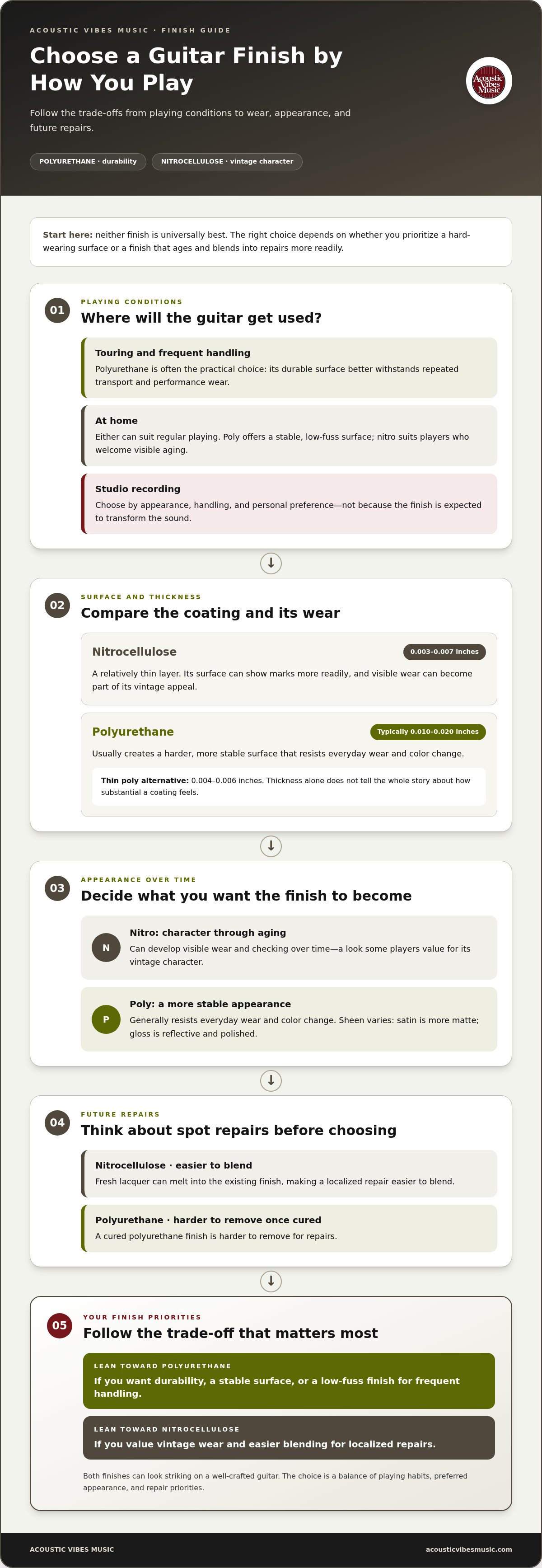
Continue ShoppingPolyurethane is usually the practical choice for durability, while nitrocellulose stands out for its vintage character and easier spot repairs. In the nitrocellulose vs polyurethane finish debate, neither is universally best: the right choice depends on whether you value a hard-wearing surface or a finish that ages and blends into repairs more readily. Both can look striking on a well-crafted guitar.
It’s easy to focus on nitro’s familiar look or poly’s reputation for resilience. But a finish also affects how a guitar wears over time and what refinishing may involve.
This guide compares durability, aging, application, and repairability so you can weigh the trade-offs against how you play and care for your instrument. You’ll also find a practical decision guide to help match the finish to your priorities, whether you prefer a polished, stable surface or the character that develops with age.
Polyurethane generally offers better scratch resistance and durability; nitrocellulose is easier to blend during refinishing and develops vintage wear. For touring, frequent handling favors poly, while traditional aging may favor nitro. Neither finish alone determines a guitar’s sound.
Nitrocellulose lacquer forms a relatively thin layer, typically 0.003-0.007 inches, and its surface can show marks more readily than poly. That wear can be part of its vintage appeal, especially on instruments inspired by classic Fender designs. For repairs, fresh lacquer can melt into the existing finish, making a localized repair easier to blend than one on cured polyurethane.
Polyurethane usually creates a harder, more stable surface that resists everyday wear and color change. Guitar poly finishes are typically 0.010-0.020 inches thick, although a thin poly finish of 0.004-0.006 inches offers a slimmer alternative. Appearance varies by sheen: satin poly has a more matte texture, while a glossy finish creates a reflective, polished look.
Thickness matters, but it doesn’t tell the whole story. A thin poly finish and nitro can differ by only a few tenths of a millimeter, so the label alone won’t reveal how substantial the coating feels. Polyurethane and polyester finishes became popular alternatives to nitro lacquers in the late 1960s; by the 1980s, poly finishes dominated production guitar manufacturing worldwide.
For touring, polyurethane is often the practical choice because its durable surface better withstands repeated transport and performance wear. For studio recording, choose based on appearance, handling, and personal preference rather than expecting the finish to transform the sound. At home, either finish can suit regular playing: poly offers a stable, low-fuss surface, while nitro suits players who welcome visible aging.
Nitrocellulose lacquer is extremely flammable while in solution, and its fumes and explosive qualities require a dedicated workspace. Polyurethane also requires careful handling during application, with precautions guided by the specific product instructions. The U.S. Environmental Protection Agency notes that lacquer finishes lack crosslinking and can melt or mar easily.
| Finish | Typical thickness | Wear and appearance | Repair considerations |
|---|---|---|---|
| Nitrocellulose | 0.003-0.007 inches | Develops visible aging; more prone to marks | Fresh lacquer can blend into existing finish |
| Polyurethane | 0.010-0.020 inches | Hard, stable surface; available in satin or gloss | Cured finish is harder to remove for repairs |
Use the table as a starting point, then decide what matters most: touring durability, a particular sheen, vintage wear, or easier spot repairs.
Finish history can offer clues, but a guitar’s body style alone doesn’t identify its coating. Fender and Gibson adopted nitrocellulose almost exclusively for their electric guitars in the 1950s and ’60s, making nitro familiar on many vintage electric models from those makers. Nitrocellulose lacquer had already been used in instrument making for well over a century. That history explains its association with traditional guitar construction, not a guarantee that every older instrument has nitro.
Electric and acoustic guitars both use protective finishes, but their construction and appearance vary by maker and model. The historical evidence for nitro is especially clear for Fender and Gibson electric guitars of the 1950s and ’60s. Don’t assume an acoustic guitar has the same finish as a similarly aged electric, or that one brand used one coating across every model. Model details and production history matter more than body shape alone.
Polyester and polyurethane became popular alternatives to nitro finishes in the late 1960s. Poly finishes dominated production guitar manufacturing worldwide by the 1980s, as makers adopted coatings suited to consistent factory production. That timeline helps explain why a later production guitar may have a poly finish, but it doesn’t prove the finish on any individual instrument. A brand can use different finishes across models, periods, or production runs.
On a used guitar, identify the finish through a careful sequence rather than relying on color alone. First, find the exact model and production year from its identifying information. Next, compare those details with maker documentation or reliable records for that model and period. Then inspect the surface for wear patterns, checking, repairs, or areas that look different from the surrounding finish. These observations can guide your research, but appearance alone isn’t conclusive: aging, refinishing, and repairs can alter the original surface.
A glossy surface doesn’t automatically mean polyurethane, and yellowing doesn’t prove nitro. Lighting, original color, storage, and later repairs can all affect a guitar’s appearance. Check less-exposed areas, such as beneath a pickguard or around hardware, for differences in color or texture. Don’t remove parts or apply solvents to test a finish; these steps can damage the instrument. Documented model history is more useful than an improvised spot test.
For a practical comparison, use three clues: maker and model records, the guitar’s production period, and visible evidence of refinishing. Then weigh conflicting clues rather than treating one feature as proof. If you’re comparing instruments, explore different guitar builds and consider how each model’s construction and finish suit your preferences.
Nitrocellulose changes in appearance as the instrument ages, developing a patina unlike polyurethane’s more color-stable surface. Knowing what normal checking looks like helps distinguish cosmetic aging from damage that needs attention.
Nitrocellulose lacquer continues releasing solvents for years as it cures, and its appearance can change over time. Polyurethane resists color degradation and discoloration with age, while nitro can take on a warmer, more yellowed look. That contrast appeals to some players, but the exact appearance depends on the instrument’s finish and its exposure over the years.
Consider vintage Gibson Les Paul Bursts, which have aged over 65 years. Their finish reflects decades of aging rather than a fresh, uniform coating. Yellowing and surface changes can contribute to an instrument’s character, but they don’t establish its history on their own. A refinished guitar, for example, may look different from one retaining its original lacquer.
Nitro finishes can show marks and wear as the guitar is handled and played. Their typical thickness is 0.003-0.007 inches, but thickness alone doesn’t determine how an individual instrument will age. Players may notice changes around frequently touched areas, such as the neck or body edges. Those visible changes distinguish an aged nitro surface from polyurethane’s more stable appearance.
After several years, nitro finishes can develop small cracks called checking. Fine checking is normal cosmetic aging and doesn’t affect playability or sound. It may be especially visible across a guitar’s top or back, where the lacquer shows fine lines. Treat it as evidence of finish aging, not proof that the wood or instrument has failed.
To assess checking on a used guitar, inspect the surface in clear light for fine lines, chips, or areas where the finish appears separated. Then check whether the pattern is limited to the coating or accompanies visible impact damage. Fine, even checking can be cosmetic; a deep crack with a dent calls for closer assessment of the affected area.
Temperature changes can contribute to finish stress, so avoid abrupt shifts when moving a guitar between environments. Let the instrument adjust gradually inside its case rather than exposing it immediately to a different temperature. This practical step helps protect an aging nitro finish, especially one already showing checking. Assess the finish alongside the guitar’s overall condition, not by its patina alone.
Nitrocellulose lacquer’s chemistry shapes its layered application, while polyurethane and polyester finishes follow different curing processes. These differences affect workshop requirements, finishing schedules, and how fresh coats join existing layers.
Nitrocellulose lacquer is made by treating cellulose with nitric and sulfuric acids. In guitar finishing, it’s applied in 10-20 or more thin coats, with each coat allowed to flash off for 15-30 minutes before the next. The process builds a surface gradually, rather than reaching final thickness in just a few applications.
Fresh lacquer melts into the previous coat, so sanding between layers is unnecessary. This also helps explain why lacquer can be spot-repaired and blended later. According to the U.S. Environmental Protection Agency, lacquer finishes have no crosslinking and can melt or mar easily, so the quality that enables blending also makes the surface more vulnerable.
Polyurethane can be applied quickly and is easier to buff to a glossy finish. Polyurethane and polyester finishes are generally associated with a hard, stable surface. Polyester guitar finishes can reach final thickness in as few as 2-3 coats and cure in hours. These polyester figures shouldn’t be mistaken for a specific polyurethane schedule.
In the United States, nitrocellulose lacquer is extremely flammable while in solution, and its fumes and explosive qualities require a dedicated workspace. Follow the coating manufacturer’s safety directions for the specific product; polyurethane and nitrocellulose should not be treated as interchangeable materials.
Drying and full curing aren’t the same milestone. Nitrocellulose lacquer is applied over several days, while the complete process of building up coats, sanding, and buffing takes days to weeks. It continues releasing solvents for years as it cures. Modern poly finishes generally cure faster, and polyester can cure in hours, but that detail about polyester does not establish a universal polyurethane cure time.
For a Gibson-style instrument with nitro, the gradual build lets finishers add thin coats and later blend fresh lacquer into the existing surface. Polyurethane’s quick application and stable shell suit a different workflow; its cured finish cannot be re-dissolved. A thinner coat doesn’t make the materials behave alike: their chemistry still affects curing and repair.
Think of the trade-off as process versus repair behavior. Nitro requires more coats and a longer finishing schedule, but new lacquer can melt into the old layer. Polyurethane offers a faster route to a glossy surface, while polyester is a separate example of a rapidly curing finish. Keep each finish’s application and curing characteristics distinct when comparing a guitar’s construction or planning refinishing.
Repairability depends on how the coating reacts to fresh material, not just how visible a blemish is. Nitrocellulose lacquer can bond with new lacquer as it melts into the existing layer, making localized blending possible. Cured polyurethane cannot be re-dissolved, so repairs and refinishing typically involve more work. For players keeping an instrument for decades, this difference can inform long-term maintenance choices.
With nitro, a repairer can address a small finish blemish by applying fresh lacquer and blending it into the surrounding surface. Because the new material joins the old coating, the repair can transition more naturally than a patch over a stable, non-dissolving surface. The damage still matters: a superficial mark differs from a deep gouge that reaches the wood or crosses a body edge.
Polyurethane presents a different repair challenge. Its cured coating won’t dissolve back into the original finish, and removing it for broader refinishing is difficult and time-consuming. A repair may require careful work through the hard surface before the damaged area can be addressed. That makes the nitrocellulose vs polyurethane finish distinction especially relevant when preserving an original finish matters more than minimizing repair effort.
Describe the damage before choosing a repair approach. Is it a surface scuff, a chip, or a crack? Is bare wood visible? Does the area show signs of earlier touch-up work? On a used guitar, these details help distinguish a localized finish repair from a more extensive refinishing project. Avoid experimenting with solvents or abrasives, which can enlarge the damaged area or affect the surrounding finish.
Neither coating is automatically better for every repair. Nitro’s blending behavior can help preserve the look of an existing surface, but lacquer can melt or mar more readily. Polyurethane’s stable shell resists that kind of change, yet its resistance to re-dissolving makes removal harder. A custom-shop instrument with an original finish may call for different priorities than a heavily played guitar with a large damaged area.
For a useful assessment, note the damage’s location, size, and depth, then consider whether your priority is reducing its visibility, protecting exposed wood, or refinishing a broader surface. A luthier evaluates the coating and repair area together. That practical distinction is central to a nitrocellulose vs polyurethane finish comparison: blending is more straightforward with nitro, while cured poly can make removal more demanding.
If finish damage is affecting how you care for or play your guitar, explore guitar repair options and consider the repair scope alongside the instrument’s existing finish.
Acoustic Vibes Music helps you put finish preferences in context as you consider an instrument. Explore acoustic guitars alongside classical and flamenco guitars, then compare how each guitar’s feel, appearance, and construction suit your playing. If an existing instrument needs attention, the shop’s luthier repair services can help with repair and maintenance.
Finish is one part of choosing a guitar, not the whole story. Consider its sound, comfort, and the care its surface may need over time. Contact Acoustic Vibes Music to discuss your instrument or visit acousticvibesmusic.com to explore the selection.
The nitrocellulose vs polyurethane finish decision is one part of a more personal choice: finding an instrument whose sound, feel, and character keep drawing you back to play. Let your priorities guide the next step, whether you’re choosing a guitar or considering how a finish suits an instrument you already own.
Acoustic Vibes Music offers acoustic guitars, classical and flamenco guitars, and banjos for players exploring different voices and playing styles. Matching your finish preferences with the right instrument can make the decision feel less like a technical comparison and more like a clear expression of what you value as a musician.
Bring your questions and the details that matter to you. Contact Acoustic Vibes Music for finish advice and take your next step toward an instrument that inspires you to play.
Polyurethane is usually the better fit for players who prioritize a durable, low-maintenance surface; nitrocellulose suits those who value traditional aging and easier spot repairs. Before choosing, decide whether visible wear would bother you or add character. If you’re evaluating a specific guitar, consider its overall condition and how you’ll use it, not just the finish label. Neither finish is automatically best for every player.
On electric guitars, finish type plays only a very minor role in overall tone compared with pickups, hardware, and neck construction. If you’re comparing two electric instruments, prioritize those components and how each guitar sounds and feels in your hands. Finish preference can still matter for appearance, maintenance, and repair planning, but it shouldn’t outweigh the parts that shape the instrument’s sound.
Nitro can be worth choosing if you appreciate traditional aging and value finish repairs that blend into the existing surface. That preference doesn’t mean every guitar with nitro is automatically worth a higher price. Polyurethane is cheaper to buy as a finish material, but a guitar’s overall value involves more than its coating. Decide whether nitro’s character matters enough to guide your instrument choice.
Nitrocellulose is a lacquer finish built through multiple thin applications, and it continues releasing solvents as it cures. Polyurethane cures into a hard, stable coating and is generally applied and finished more quickly. These different behaviors affect the surface, aging, and repair approach. For a prospective buyer, the useful distinction is not simply the finish name, but whether its wear pattern and maintenance needs suit your preferences.
For electric guitars, finish type plays only a very minor tonal role compared with pickups, hardware, and neck construction. Thickness can matter more as a physical property: older poly finishes can be thicker and heavier, potentially reducing acoustic resonance and sustain. That possibility isn’t a reliable shortcut for judging an individual guitar. Listen to the instrument itself and consider its construction rather than assuming the finish determines its voice.
Nitro can yellow, show wear, and develop fine checking, while polyurethane resists color degradation and discoloration with age. On a used instrument, inspect the finish in consistent light and distinguish surface checking from damage that reaches the wood. Photos of the same area over time can help track changes. A guitar’s appearance reflects its finish history and care, not just its age or original coating.
Nitrocellulose is generally easier to spot-repair because fresh lacquer can blend into the existing finish. Polyurethane is harder to refinish because its cured coating cannot be re-dissolved, and removal can take more work. When considering a repair, note whether the damage is limited to a small surface mark or covers a larger area. That distinction helps determine whether blending or broader refinishing is the relevant approach.
Polyurethane is cheaper to buy as a finish material than nitrocellulose, but that alone doesn’t determine a guitar’s price. The instrument’s maker, construction, condition, and other features also shape its value. For refinishing, the preparation and labor required depend on the existing coating and damage. Compare the specific guitar and work involved rather than treating finish type as a complete cost guide.