My shopping cart
Your cart is currently empty.
Continue ShoppingWhat if the most expensive instrument in the room is actually the most practical investment you'll ever make? It's a common dilemma for any dedicated player. You find yourself staring at a beautifully figured Adirondack spruce top, feeling the pull of a handcrafted Collings or a Martin Custom Shop, yet the price tag gives you pause. You aren't just paying for a headstock logo. You're looking for a way to bridge the gap between a hobby and a lifelong pursuit. Learning how to justify buying an expensive guitar starts with understanding that premium craftsmanship isn't a luxury. It's a commitment to your own musical evolution.
We understand the weight of this decision. It's often difficult to explain to a family member why a premium instrument is fundamentally different from a mass-produced model, especially when you worry about the law of diminishing returns. This guide will reveal the technical, emotional, and financial reasons why a high-end acoustic is a sound decision for any serious musician. You'll discover how these instruments act as legacy assets that offer superior tonal growth and impressive resale stability. We'll explore the tangible benefits of artisan construction and why the right instrument pays dividends in inspiration for decades to come.
The law of diminishing returns is a reality in every luxury market. For guitarists, the jump from a $500 starter kit to a $1,500 solid-top instrument is massive. However, as prices climb toward the boutique level, the gains become more nuanced. Understanding how to justify buying an expensive guitar requires looking past the surface. You aren't just buying a louder box; you're investing in the threshold of quality where mass production ends and true lutherie begins. A functional tool gets the job done, but an inspirational instrument removes the barriers between your hands and the music. Achieving that final 10% of tonal perfection often requires a 50% increase in labor because machines simply cannot hear a piece of wood.
Artisans at shops like Collings or Boucher spend hours hand-scalloping braces to maximize resonance. Mass-produced guitars use machine-pressed parts that prioritize structural safety over tonal brilliance. You also pay for the material science. High-end builds utilize premium tonewoods that have been air-dried for years rather than kiln-dried in days. This patience ensures the wood is stable and resonant. Even the finish matters. A thin nitrocellulose lacquer allows the body to move freely, while the thick polyester used on budget models acts like a sonic dampener. These details are invisible to the eye but obvious to the ear.
Critics often claim you're just paying for a headstock logo. While brand prestige exists, heritage makers like Martin invest heavily in R&D and specialized tooling that smaller copycats can't afford. These innovations lead to better intonation and long-term structural stability. When you choose a reputable name, you're buying a history of reliability. It's about distinguishing marketing hype from genuine artisan pedigree. Learning how to justify buying an expensive guitar involves recognizing that a Taylor or a Gibson isn't just a label. It's a guarantee of seasoned materials and proven construction methods that protect your investment for a lifetime.
Acoustic guitars are unique among luxury possessions because they are biologically active. Unlike a car or a piece of technology that depreciates the moment you take it home, a high-end solid wood instrument evolves. This is a central point when considering how to justify buying an expensive guitar. Over years of consistent playing, the resins within the wood's cellular structure begin to crystallize. This process, often called "opening up," makes the wood lighter and more responsive to vibration. A guitar that sounds great today will sound magnificent in twenty years. It's a rare example of a tool that improves with age and use.
This transformation is impossible with entry-level instruments. A $500 guitar typically uses laminate back and sides, which is essentially high-quality plywood. While durable, laminate is sonically static. It will never sound better than it does the day it leaves the factory. Premium builds utilize rare materials like Adirondack Spruce for the top, providing massive volume and headroom. When paired with exotic back and sides like Brazilian Rosewood, the result is a complex harmonic profile that budget brands cannot replicate. These materials are becoming increasingly scarce, making instruments built from them true investment-grade assets. You can find these elite pairings within our curated collection of premium acoustic guitars.
Craftsmanship extends to how these rare woods are joined. Traditional dovetail neck joints are labor-intensive and require master-level skill, but they offer superior vibration transfer compared to cheaper bolt-on systems. Brands like Collings Guitars are famous for their obsessive wood selection, ensuring every piece of grain is perfectly aligned for maximum stability. Many boutique builders also return to using animal hide glue. This adhesive dries much harder than modern synthetic glues, creating a glass-like bond that doesn't dampen the sound. It also makes the instrument easier for a luthier to disassemble and repair decades from now, ensuring your legacy instrument stays playable for generations.
If you don't want to wait thirty years for that "opened up" sound, modern science has an answer. Torrefaction involves baking the wood in an oxygen-free kiln. This process mimics the natural aging of the wood's cells by removing moisture and volatile oils. Builders like Boucher use torrefied Adirondack tops to deliver immediate vintage warmth and clarity. This wood is also significantly more stable. It's less reactive to changes in humidity, protecting your investment against the cracks and movement that often plague new instruments. Experience the difference for yourself by exploring our latest hand-selected inventory of heirloom-quality instruments.
Many musicians fall into the expensive trap of the "Upgrade Cycle." You start with a $600 entry-level model, realize its limitations, and trade it in for a $1,500 mid-tier instrument. Two years later, you crave the depth of a boutique build and trade up again. In each of these transactions, you likely lose 30% to 50% of the instrument's original value. Learning how to justify buying an expensive guitar is easier when you look at the raw numbers. By investing in a "forever" instrument early on, you bypass the cumulative losses of multiple trade-ins. Quality pays for itself. It's the difference between buying a disposable tool and acquiring a permanent asset.
Resale value is a critical component of this financial framework. While a generic import might lose half its value the moment you leave the shop, a Taylor 800 series or a Martin Standard Series holds its worth remarkably well. These instruments are recognized global commodities with high liquidity in the enthusiast market. Think of your purchase as a "Cost Per Hour of Joy." If you own a $5,000 guitar for 20 years, the cost breaks down to less than 70 cents per day. For more on why these pieces are considered legacy assets, explore our guide to high end acoustic guitars for sale.
Understanding the market is key to a savvy investment. New instruments have an initial "drive-off-the-lot" price drop, but boutique names often defy standard depreciation. In fact, instruments from makers like Lowden or small-bench luthiers often appreciate as builders retire or material costs rise. If you're looking for a savvy entry point, our used and consignment selections offer high-end performance without the initial retail premium. These pieces have already weathered their first depreciation curve, making them exceptionally stable financial holds.
High-end guitars are designed to be serviced, not replaced. This is a fundamental part of how to justify buying an expensive guitar. While a budget model might be "totaled" by a major neck issue, a premium instrument is built for luthier repair services. Features like traditional dovetail joints allow a specialist to reset the neck and restore original playability decades later. When you combine this repairability with proper humidification, you aren't just buying a guitar for yourself. You're preserving an heirloom for the next generation. Professional setups ensure that the instrument's structural integrity and market value remain intact throughout your ownership.
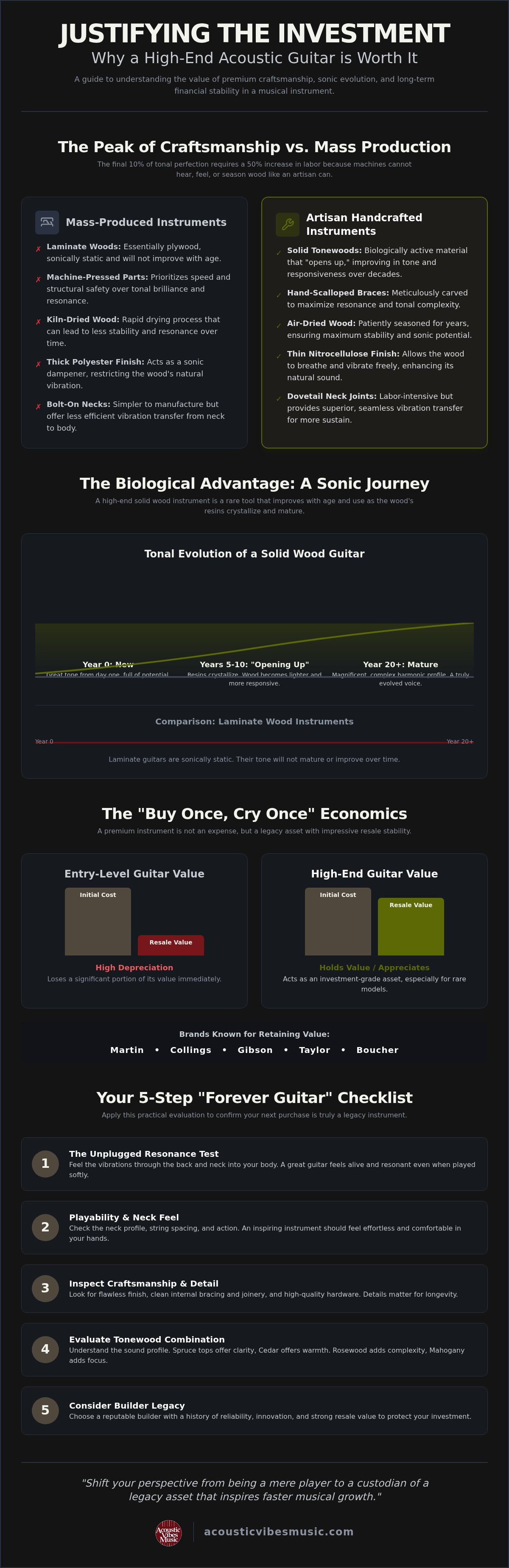
Moving from the abstract idea of quality to the physical instrument in your hands requires a disciplined approach. You shouldn't rely solely on a gut feeling. Instead, use a structured evaluation to ensure the instrument meets the high standards of its price point. Learning how to justify buying an expensive guitar becomes simple when the instrument's performance objectively outclasses the competition. Use this five-step checklist during your next audition.
Long-term satisfaction depends heavily on ergonomics. Your choice between a Dreadnought vs. Grand Auditorium should reflect your body size and playing style. A large dreadnought offers incredible power but can be fatiguing for smaller players or those who primarily play on a couch. Consider the nut width as well. A slightly wider 1.75-inch nut is often preferred by fingerstyle players, while a narrower profile might suit those with smaller hands. Matching the body size to your primary environment ensures you'll reach for the instrument every day.
Every premium guitar has a unique "voice" characterized by its balance of overtones and fundamental notes. Rosewood instruments often sparkle with complex overtones, while mahogany models provide a dry, punchy fundamental. You must also distinguish between "loudness" and "projection." A guitar can be loud to the player but fail to project its sound to the back of a room. Some instruments are "recording" specialists with a focused, balanced EQ. Others are "cannons" designed to cut through a bluegrass jam. To hear these nuances in person, we invite you to explore our curated gallery of world-class instruments.
Owning a premium instrument marks a shift in your musical journey. You transition from being a mere player to becoming a custodian of a piece of functional art. This perspective is vital when you consider how to justify buying an expensive guitar. You aren't just purchasing wood and wire; you're preserving a legacy of artisan craftsmanship that will outlive your own playing years. These instruments are built to endure, carrying the stories of every song you play into the next generation. It's a profound connection that a mass-produced model simply cannot offer.
There is also a tangible "Inspiration ROI" to consider. A superior tool removes the physical and sonic obstacles that often hinder progress. When every note rings with clarity and the action is perfectly calibrated, you find yourself practicing longer and exploring more complex arrangements. This accelerated learning curve is a primary reason why serious students often find that a high-end acoustic is their most effective educational investment. The joy of hearing a professional-grade tone every time you strike a chord provides a constant incentive to improve.
Where you buy matters as much as what you buy. Big-box retailers often ship instruments straight from a warehouse without a second thought. In contrast, a specialist boutique provides a luthier's final inspection and a professional setup before the guitar ever reaches your hands. This ensures that your investment arrives in peak playing condition, with the intonation and action dialed in to perfection. Our luthier repair services are dedicated to maintaining this long-term value, ensuring your guitar remains a joy to play for decades.
Every legendary builder offers a distinct sonic signature. You might prefer the "Modern" shimmer and playability of Taylor Guitars, or perhaps you crave the "Vintage" depth and iconic growl found in a Martin. For those seeking a unique, ethereal clarity, the "Celtic" voice of Lowden Guitars offers a completely different harmonic experience. Even brands like the Yamaha L-Series provide a unique high-end value proposition by combining traditional methods with modern consistency. Understanding these tonal personalities is how to justify buying an expensive guitar that specifically complements your artistic voice. We invite you to explore our curated gallery of acoustic excellence to find the one that speaks to you.
Choosing a forever instrument is more than a purchase; it's a commitment to your own artistic growth. We've explored how artisan craftsmanship and the biological evolution of solid tonewoods create a value that budget models can't touch. When you understand how to justify buying an expensive guitar, the decision shifts from a short-term expense to a long-term investment in a legacy asset. You aren't just buying a tool. You're becoming the custodian of a piece of functional art that will inspire you for decades.
As an authorized dealer for the Martin Custom Shop, Collings, and Lowden, we offer the expert guidance and specialized knowledge required to find your perfect match. Every instrument we sell includes nationwide shipping and a professional luthier setup to ensure it performs flawlessly the moment it arrives. Don't settle for the endless cycle of mid-tier upgrades when you can own a masterpiece today. Explore our curated collection of heirloom-quality acoustic guitars and discover the instrument that will define your sound for generations. Your musical future deserves nothing less than the best.
A premium instrument won't instantly grant you new skills, but it certainly accelerates your progress by removing physical obstacles. Better ergonomics and lower action reduce hand fatigue, allowing for longer practice sessions. The superior tonal feedback also helps you hear nuances in your technique that budget models mask. This creates a positive feedback loop where you're more inspired to play, ultimately leading to faster skill acquisition and a more rewarding experience.
The ideal entry point for true heirloom quality generally begins where mass production ends and small-shop lutherie starts. At this level, you're securing solid premium tonewoods and individual attention to the top's bracing. While prices vary by builder, this range ensures you're moving beyond industrial compromises. It's the point where the instrument's resale value stabilizes and its potential for tonal opening up over decades is virtually guaranteed by the quality of materials.
Investing in a single $4,000 instrument is usually the wiser path for serious enthusiasts. A higher-tier guitar often represents a significant jump in material rarity and hand-crafted detail that two mid-range models cannot match. When you understand how to justify buying an expensive guitar, you realize that owning one world-class tool provides more inspiration and better long-term resale stability than maintaining a collection of lesser instruments that you'll eventually want to upgrade anyway.
Premium instruments from heritage brands like Martin or boutique makers like Collings hold their value remarkably well compared to generic imports. These guitars are seen as global commodities with high liquidity among collectors. While mid-range models often lose a significant percentage of their retail price immediately, high-end pieces frequently stabilize or even appreciate over time. This financial reliability is a cornerstone of how to justify buying an expensive guitar as a legacy asset.
Start by inspecting the internal joinery and kerfing for any excess glue or rough edges. A boutique builder's attention to detail should be visible even where the eye doesn't normally look. Next, check the tap tone of the top to hear its natural resonance. Finally, examine the neck-to-body joint and the bridge for perfect contact. These technical details indicate the structural integrity and artisan care that define a high-end acoustic instrument.
While a famous logo carries some weight, the majority of the cost in a premium build pays for the craftsman's time and the quality of the wood. Machines can't voice a guitar top; only an experienced luthier can shave braces to perfection. You're also paying for the years of seasoning required for rare tonewoods. This specialized labor and material scarcity represent tangible value that far outweighs the perceived brand tax of heritage makers.
Beginners often have the best reason to invest in quality because a poorly made guitar is the number one reason new players quit. A high-end instrument is easier to play, stays in tune better, and sounds more rewarding from day one. By starting with a professional-grade tool, you ensure that any difficulties you face are purely about learning the music rather than fighting against an instrument's physical defects or excessively high action.
If you choose a reputable brand or a recognized boutique builder, your exit strategy is very secure. These instruments are in high demand on the secondary market, especially if they've been well-maintained. You can often sell them through consignment services or trade them toward a different tonal profile without losing much of your initial investment. This liquidity makes the decision much less risky than buying a niche, low-resale brand that lacks a dedicated following.