My shopping cart
Your cart is currently empty.
Continue ShoppingThe familiar A-style outline isn’t the whole answer: for Irish traditional sessions, prioritize tone and playability over shape. Irish mandolins are typically flat-backed with oval soundholes, a design also known as A-style, making it a natural starting point. The best mandolin for Irish music feels responsive in your hands, holds its tuning reliably, and blends or carries clearly at the volume your session needs.
If you’re weighing A-style against F-style, the outline can seem like the obvious deciding factor. Yet both can suit Irish tunes, and their voices and projection can differ. Setup, strings, and picking technique also shape the result. This guide compares mandolin styles by tone, volume, and tuning stability, then explains which traits suit quieter circles, louder sessions, and players building confidence. You’ll get practical criteria for choosing an instrument that supports clear melodies without forcing your sound or fighting your hands.
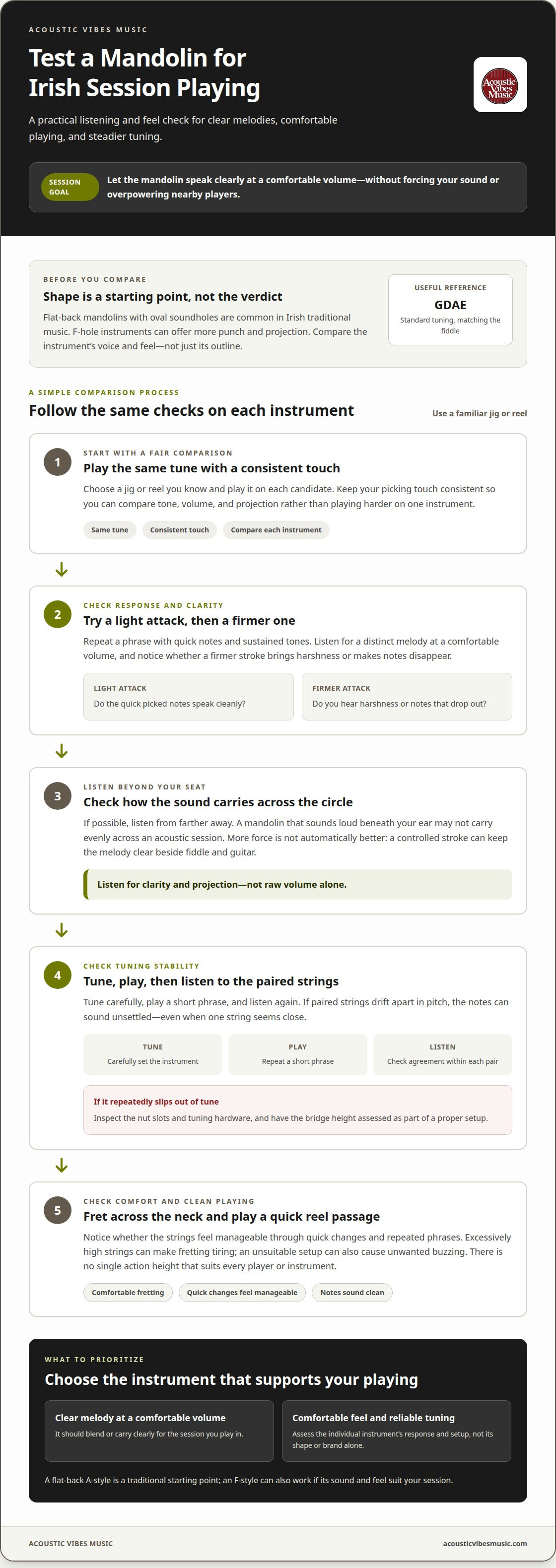
For Irish traditional sessions, start with tone and playability, not scrollwork. Flat-back mandolins are the type most commonly played in Irish music. They typically have oval soundholes and are often called A-style. That familiar design is a strong starting point, but an F-style mandolin can also work for Irish tunes. Choose an instrument that feels comfortable and speaks clearly when you play a jig or reel.
“A-style” and “F-style” describe body shapes, while “flat-back” and “arch-top” describe construction. These terms aren’t interchangeable: a flat-back instrument can have different body outlines. The three main mandolin types played around the world are Neapolitan or Italian-style bowl-back, arch-top, and flat-back. For Irish session playing, the flat-back is the most common choice. Prioritize its sound and feel over decorative details.
Standard tuning is GDAE, matching the fiddle’s tuning. The mandolin has eight strings arranged in four pairs, called courses. That layout supports melody playing across familiar Irish tunes. For strings, D’Addario EJ74 and John Pearse 2500M are popular medium or light-medium phosphor bronze choices among Irish traditional mandolinists. Gauge and material can affect feel and response, so consider how the strings behave under your picking hand.
For jigs and reels, look for a mandolin that responds cleanly to quick picked notes and feels manageable through repeated phrases. An oval-hole, flat-back A-style is a traditional starting point; an F-style may suit you better if its feel and voice work for your playing. Play a tune you know on each candidate rather than judging by appearance alone.
Octave mandolins and bouzoukis offer a different playing experience, not an automatic upgrade over a standard mandolin. For compact melody lines in a session, a standard mandolin is a practical choice. Consider the larger-voiced alternatives if their range and role better match the sound you want.
Eastman, Kentucky, and Weber are names players may encounter while comparing mandolins, but the brand alone doesn’t determine suitability. For example, compare the feel, response, and tuning behavior of Eastman 04 mandolins rather than assuming two instruments will play alike. A-style and F-style options can both work; assess each instrument individually.
A flat-back A-style can be a sensible place to begin, while an F-style remains an option if its sound and feel suit your session. The best mandolin for Irish music is the one that supports your playing, not simply the one with the most elaborate outline.
In a small Irish session, resist the urge to strum harder to compete. Let the mandolin produce its natural volume, then adjust your picking so notes stay clear without overpowering nearby players. A strong attack can make a bright instrument dominate the room, while a controlled stroke helps melodies sit comfortably beside fiddle and guitar. Listen across the circle, not only from your seat: projection can feel different at a distance.
Compare tone, volume, and projection by playing the same jig or reel on each instrument with a consistent touch. Notice whether the melody remains distinct at a comfortable volume, then listen from farther away if possible. A sound that feels loud beneath your ear may not carry evenly across an acoustic session. Pay attention to clarity as well as raw volume: more force isn’t automatically better.
Pick a familiar phrase with quick notes and sustained tones. Repeat it with a light attack, then a firmer one, and listen for harshness or notes that disappear. This gives you a practical comparison without relying on a loud, forceful strum. In a smaller gathering, restraint is especially useful: let the instrument speak and leave space for the other players.
Tuning stability depends partly on setup. If paired strings drift apart in pitch, the notes can sound unsettled even when one string seems close. Tune carefully, play a short phrase, and listen again for agreement between each pair. If the instrument repeatedly slips out of tune, inspect the nut slots and tuning hardware, and have the bridge height assessed as part of a proper setup.
Action affects how easily the strings respond under your fingers. Excessively high strings can make fretting tiring, while an unsuitable setup can also cause unwanted buzzing. There’s no single action height that suits every player or instrument, so use a practical test: fret notes across the neck, play a quick reel passage, and notice whether the strings feel comfortable and sound clean.
For Irish session playing, a well-set-up mandolin should feel manageable through quick changes and stay settled as you play. Ask for attention to the nut slots and bridge height when setup adjustments are needed; those details influence comfort and reliable playing. Explore mandolins for acoustic playing with these session needs in mind, and compare the sound at a measured volume before choosing.
Oval holes and F-holes offer a useful visual distinction, but the opening alone doesn’t tell you everything about tone. F-hole mandolins are described as offering more punch and projection than oval-hole instruments. That extra presence can help a melody stay distinct in a busy session. An oval-hole mandolin remains a familiar choice for Irish traditional music, where flat-backed instruments with oval soundholes are common.
Separate soundhole shape from body construction when comparing instruments. A flat-top mandolin can have a broader sound, softer attack, and less projection than a carved-top instrument. Those characteristics concern top construction, not simply whether the soundholes are oval or F-shaped. Oval-hole and F-hole instruments may differ in several design details, so don’t treat the opening as the sole explanation for what you hear.
Try a practical comparison with the same short reel phrase. Play it first on an oval-hole mandolin, then on an F-hole model, using a similar picking touch and volume. Listen for the note attack, how clearly fast notes separate, and whether the melody carries across the room. The F-hole’s punch and projection may suit a louder group; an oval-hole instrument may be preferable if its response blends better with the players around you.
A-style and F-style describe body outlines, while oval-hole and F-hole describe soundhole shapes. The terms often appear together, but they identify different features. Irish mandolins are typically flat-backed with oval soundholes, a style also known as A-style. F-style instruments have a different outline, and F-hole models are associated with additional punch and projection. Compare the actual instrument rather than assuming every A-style or F-style model shares the same voice.
Use three listening checks before deciding. First, play a slow melody to hear how individual notes sustain. Next, play a quick jig passage to assess attack and clarity. Finally, listen from several steps away, where projection is easier to judge than beneath your ear. Keep your picking consistent across both mandolins: a harder stroke can make one seem louder without revealing its natural response.
For Irish tunes, choose the sound that serves your session, not the shape that looks most elaborate. A traditional oval-hole flat-back offers a recognizable starting point, while an F-hole mandolin may suit players who want stronger projection. Neither outline guarantees a better fit. Your preferred balance of attack, note separation, and room-filling sound matters more than choosing A-style or F-style by appearance alone.
A-style and F-style describe body outlines, not a guaranteed sound. A-style instruments usually have a simpler outline, while F-style models have a more elaborate body shape. For Irish traditional playing, either can work; tone and playability matter more than appearance. A-style mandolins generally cost less than F-style ones, so the simpler outline can also leave more room in a budget for a well-set-up instrument.
Irish mandolins are typically flat-backed, oval-hole instruments, often called A-style. That makes an A-style flat-back a natural reference point when comparing options. However, an F-style outline doesn’t rule out Irish session use. Listen to the instrument itself: body shape alone doesn’t tell you whether its sound will blend with a fiddle or carry through a lively room.
Soundhole shape and body outline are separate details. F-hole mandolins are described as offering more punch and projection than oval-hole models, while flat-top instruments can have a broader sound, softer attack, and less projection than carved-top instruments. Those traits relate to different design features. Don’t assume every F-style mandolin is louder or sharper than every A-style one.
Compare candidates using the same short melody. Play a jig phrase on an A-style, then repeat it on an F-style with a similar picking touch. Notice how easily quick notes separate, whether the melody stays clear, and how the sound carries away from your playing position. Repeat the test at a gentler volume. This helps distinguish the instrument’s response from the effect of simply strumming harder.
Comfort deserves equal attention. Hold each mandolin in your usual playing position and try a familiar reel passage. Notice whether the instrument feels balanced, your picking hand moves freely, and the neck stays comfortable through repeated phrases. If one shape feels awkward, its ornamental details won’t make it the better session instrument. A confident playing position can matter more than an outline preference.
For a first comparison, place an A-style flat-back and an F-style mandolin side by side. Check setup and tuning, play the same tune, then choose the instrument with the response and feel you prefer. If cost matters, A-style models generally cost less; if an F-style’s projection suits your session, its higher typical cost may be worth considering. Neither shape is a shortcut to the right sound.
A limited budget doesn’t rule out finding a mandolin suited to Irish tunes. Judge the instrument’s condition, setup, and playing response, not its ornamentation. Used Big Muddy and Mid Missouri mandolins are examples worth comparing in the American market. Assess each instrument individually: the brand name alone can’t tell you how it feels or sounds, which is essential when searching for the best mandolin for irish music.
Start with the basics. Tune all four string courses to standard GDAE, then play a familiar jig or reel. Listen for clear notes and check whether paired strings sound together. Try the same phrase across the neck, from open strings to fretted notes. If a note buzzes, feels unusually difficult, or sounds uneven, that may point to a setup issue rather than an unsuitable style.
Next, assess the neck and playing comfort through a complete tune. A mandolin that feels manageable for a short test may become tiring during repeated passages. Pick a reel with quick changes, then play it at a relaxed pace and your usual session tempo. Notice how the strings respond beneath your fingers. Comfort and a clean response matter more than decorative inlays or an elaborate body outline.
Give tuning stability its own test. Tune the mandolin, play a few phrases, and check the paired strings again. Inspect the nut slots and bridge height as setup considerations, since both can affect how the instrument plays. A seller’s description can’t replace listening to the actual mandolin. Used instruments may differ in condition, so examine each one instead of assuming examples of the same brand will behave alike.
For a session-focused shortlist, compare a used Big Muddy or Mid Missouri with any other mandolin that fits your budget. Use the same GDAE tuning, tune, and melody for each comparison. Keep your picking touch consistent and note which instrument feels easiest to play cleanly. This simple method helps separate a genuinely comfortable choice from one that only looks appealing.
Before deciding, consider whether any needed setup work changes the instrument’s overall value to you. Prioritize playable action, reliable tuning, and a sound that suits your session. You don’t need elaborate decoration to play Irish melodies well; you need an instrument that responds to your touch. Explore mandolins and use these practical checks to guide your selection.
Price can help narrow the search, but it should remain part of the same hands-on comparison. These ranges leave room to weigh setup and comfort alongside the asking price, rather than treating a lower cost as proof of a better fit. Test candidates at the same pace before making that trade-off.
Acoustic Vibes Music offers mandolins for players choosing an instrument for Irish traditional sessions. Use the differences in tone, projection, body shape, and playing comfort from this guide to narrow your preferences. A flat-back with an oval soundhole is a familiar Irish-style option, while an F-hole instrument may appeal if you want more punch and projection. The right fit depends on how the mandolin responds to your touch and sounds alongside the instruments in your session.
As you compare mandolins, keep your priorities practical: clear notes for jigs and reels, comfortable playability, and tuning stability. Acoustic Vibes Music is a natural next step when you’re ready to explore instruments and consider which style suits your playing. For questions about mandolins, contact Acoustic Vibes Music.
Your next step is to make the decision personal. Think about the tunes you most enjoy playing, the sound you want to bring into a session, and how an instrument feels in your hands. The best mandolin for Irish music is one that invites you to pick it up often and keeps you engaged as your repertoire grows. Give yourself time to listen and play before settling on a favorite.
Acoustic Vibes Music offers mandolins alongside acoustic guitars, classical and flamenco guitars, and banjos, bringing together instruments for a range of acoustic traditions. If you’d like guidance as you consider your next mandolin, contact Acoustic Vibes Music for advice. Keep exploring, trust your ear, and enjoy the music your next instrument helps you make.
Either shape can work; choose the mandolin that supports your role in the session. If you mainly carry melodies, focus on note clarity during quick phrases. If you accompany singers or other players, consider how its tone blends at a gentler volume. Try a tune you know in the setting you expect to play, and judge comfort and response rather than choosing by ornamentation alone.
Acoustic Vibes Music sells mandolins, so you can explore its selection when you’re ready to buy. Narrow your options by the music you play, your preferred feel, and the sound you want alongside fiddles or guitars. To decide between instruments, play the same passage on each. This makes differences in response easier to hear than relying on descriptions alone.
Look for a mandolin that feels comfortable through a full tune and responds clearly to your picking. For a practical test, play a quick melody and a slower phrase, then notice whether notes stay distinct without excessive effort. Consider whether the instrument’s tone suits your usual group and playing role. A decorative feature matters less than an instrument you can handle confidently.
Neither style is automatically better for Irish music. Treat A-style and F-style as useful starting points, then compare the individual instruments rather than choosing by body outline alone. Try the same melody on each, paying attention to comfort, clarity, and how the sound fits your playing. If one feels more natural and complements your session, that’s the stronger choice for you.
Best mandolin brands for Irish music: Eastman, Kentucky, Weber, and others
Eastman, Kentucky, and Weber are brands players may encounter when comparing mandolins for Irish music. Compare each instrument’s feel, response, and tuning behavior rather than relying on the brand alone.