My shopping cart
Your cart is currently empty.
Continue ShoppingWhat if that reliable instrument resting in its case is actually the hidden capital you need to secure a hand-crafted, heirloom-quality masterpiece? Every serious collector reaches a point where the desire for superior resonance and rare tonewoods outweighs the sentimentality of a standard build. You want the deep, complex voice of a premium luthier creation, but the fear of receiving a low-ball offer during an acoustic guitar trade in or the anxiety of shipping to a stranger often stalls the journey. You've likely felt the frustration of stagnant private listings or the sting of retail quotes that ignore the meticulous care you've given your gear. It's time to demand a better experience.
This strategic exchange shouldn't be a compromise; it's a tool designed to help you rotate your stable and acquire investment-grade gear with confidence. We believe in the heritage of these instruments and the joy of a perfect match. This guide will show you how to unlock maximum value and ensure a secure, professional transaction that respects the artistry of your collection. We will explore how to prepare your guitar for a high-end valuation and why a curated exchange is the most efficient path to your next discovery.
An acoustic guitar trade in is far more than a simple swap; it's a sophisticated financial maneuver for the discerning collector. At its core, this transaction allows you to use the equity currently held in your instrument as a direct credit toward a superior piece. This immediate reduction in out-of-pocket costs makes reaching for that investment-grade luthier build a reality rather than a distant dream. While big-box retailers often rely on rigid, depreciated price lists, a boutique specialist views your instrument through the lens of artistry and rarity. They understand the nuances of a specific wood set or a discontinued series, ensuring the valuation respects the actual craftsmanship of your gear. Beyond the financials, trading in provides a sanctuary of safety. You bypass the anxiety of shipping a fragile, high-value instrument to an unknown buyer and eliminate the risk of fraudulent digital payments.
Selling privately might promise a higher top-line figure, but it demands a significant investment of your most precious resource: time. You become the photographer, the marketer, and the customer service representative for every inquiry that enters your inbox. The hidden costs are substantial. Marketplace fees can eat into your margins, and professional-grade shipping insurance for a vintage piece is a heavy expense. High-end collectors often choose a professional dealer to avoid these hurdles; they prioritize a secure, guaranteed transaction over the uncertainty of the open market. It's about the peace of mind that comes from knowing your instrument is being handled by experts who value it as much as you do.
Dealers meticulously evaluate how quickly a model will find its next home. While ubiquitous brands like Taylor or Yamaha offer high liquidity due to their broad appeal, specialized instruments require a different expertise. For instance, Lowden guitars possess a distinct tonal profile and artisanal heritage that command a dedicated following in the boutique world. Understanding this demand is key to receiving a fair offer. If your timeline is flexible and you seek the absolute maximum return, you might eventually explore the consignment process, which balances market value with professional representation. However, for those ready to move immediately into a new sonic experience, the trade-in remains the most efficient path to your next heirloom.
Maximize your return by treating the preparation process with the same reverence you'd give a gallery showing. A dealer’s first impression of your instrument sets the stage for the entire valuation. Start with a meticulous cleaning. Remove the dust from the headstock and the grime from the hardware. Gather every piece of case candy you've tucked away. This includes the original hardshell case, hangtags, and owner’s manuals. These small details signal to a specialist that the instrument has been curated, not just owned. If you're ready to see what your well-maintained instrument is worth, consider browsing our current collection of premium acoustics to find your next upgrade.
Provenance is everything in the world of high-end collecting. A Martin Custom Shop certificate of authenticity is a vital asset for an accurate valuation. It verifies the specific tonewoods and custom appointments that might not be visible to the naked eye. Keep a clear record of any stringed instrument repairs or professional setups performed by a luthier. Original receipts are equally vital. They establish a clear history for rare or limited-edition models, giving the dealer the confidence to offer a top-tier price. Documentation transforms a used guitar into a documented piece of musical history.
Presentation matters. Use safe polishing techniques tailored to your guitar’s finish. A nitrocellulose finish requires a different touch than a modern poly coating to avoid hazing. Treat a dry fretboard with high-quality lemon oil or a specialized conditioner to ensure the wood looks vibrant and healthy. Be honest about play wear. Minor pick scratches or "mojo" on the neck are expected for a played instrument, but they differ significantly from structural damage. A clean, well-presented guitar tells a story of respect and care, which directly impacts your acoustic guitar trade in offer.
Take a moment for a technical self-inspection. Use professional standards when assessing your guitar's condition, focusing on neck relief and action height. If the strings are buzzing or the saddle is filed down to the bridge, it suggests a need for a luthier's attention. Inspect the frets for deep divots that might require a level and crown. If your instrument features an onboard pickup system, verify its functionality. Ensure the signal is clean and free from dropouts or scratchy pots. This transparency builds trust and streamlines the acoustic guitar trade in process, moving you closer to your dream instrument.
Choosing between these two paths is a matter of prioritizing either velocity or potential return. In an acoustic guitar trade in, the dealer acts as the buyer. They assume the risk of future market fluctuations and the costs of long-term storage to provide you with instant liquidity. You walk into the gallery with one instrument and walk out with another. Consignment flips this dynamic. Here, the dealer acts as your professional agent. They showcase your piece in a curated environment for a percentage of the final sale. While you wait for the right collector to discover your instrument, you retain ownership, but you also bear the uncertainty of the market's timeline.
Financial certainty is the hallmark of the trade-in. You receive a guaranteed credit that applies directly to your new purchase. This often provides a subtle tax advantage in many jurisdictions; you may only pay sales tax on the cash difference between the two instruments. Consignment is a more speculative venture. It relies on finding that one specific player seeking your exact vintage spec or boutique luthier build. It's a journey that can take months. For a truly rare piece, the higher net return often justifies the patience, but it requires a stable collection that doesn't rely on that equity for its next move.
Speed is your greatest ally when a rare opportunity arises. If you have spotted a specific high-end acoustic guitar for sale, waiting for a consignment sale might mean losing that dream instrument to another enthusiast. Secure your prize now. A trade-in is the perfect "one-and-done" solution. It clears space in your collection immediately and removes the ongoing responsibility of insuring and humidifying a guitar you no longer play. It is the cleanest path to a fresh sonic perspective.
For niche instruments or extremely rare vintage finds, consignment allows for a more tailored marketing approach. Use this path if you aren't in a rush to fund a new acquisition and want to maximize every dollar of your return. By placing your instrument in a specialist's hands, you benefit from their global reach and reputation. To understand how these premium pieces are presented to the market, review our guide on buying used acoustic guitars. It offers a glimpse into how we highlight the unique heritage and artisanal skill of every masterpiece we represent.
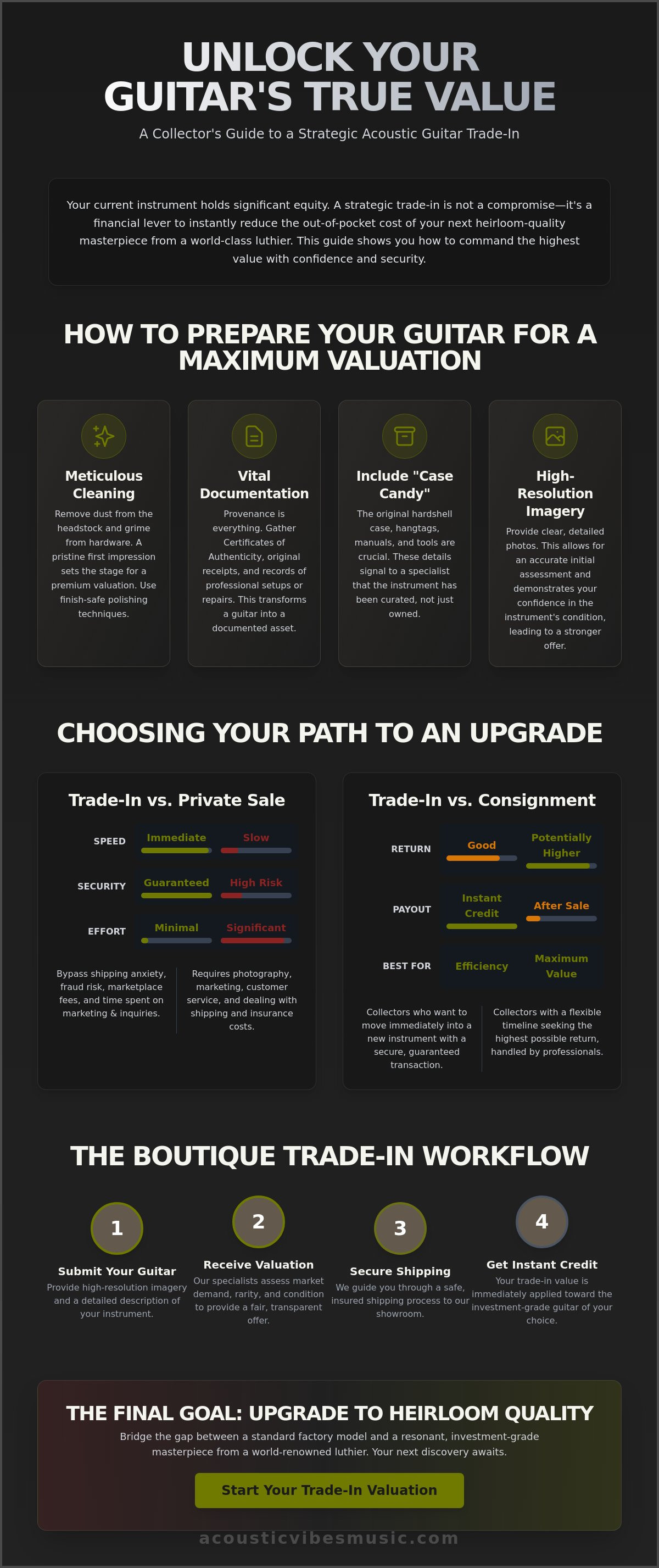
The journey from your current instrument to a new masterpiece follows a meticulous, well-defined path. It begins with a digital introduction. By providing high-resolution imagery and a comprehensive description, you allow the specialist to appreciate the nuances of your gear before it ever reaches the showroom. This initial contact leads to a preliminary quote for your acoustic guitar trade in. This figure serves as a realistic estimate based on current market data and the provided details. It's a starting point, subject to a physical inspection by a professional. Once you agree on the range, the transition moves to the logistics of secure transport or a personal drop-off at our gallery.
Upon arrival, the instrument undergoes a rigorous final evaluation. A professional luthier examines every detail. They check the structural integrity of the braces and the precision of the fretwork. This ensures your acoustic guitar trade in reflects the true artistry and condition of your instrument. Finally, the confirmed value is applied as a direct credit toward your selection. It's a seamless, professional transition. It transforms your existing equity into a new sonic reality.
Capture the soul of your instrument through the lens. Use soft, natural light to highlight the depth of the grain and the true color of the tonewoods. Avoid harsh flashes that can mask imperfections or create distracting glares. Take clear shots of the front, back, and headstock. Don't forget the serial number and internal labels; these are the fingerprints of the guitar’s history. If there are specific areas of play wear, document them clearly. This transparency ensures the most accurate preliminary valuation and builds immediate trust with the curator.
Protection is paramount during the journey. Detune the strings by a half-step to relieve tension on the headstock, then use acid-free tissue or soft padding to secure the guitar inside its hardshell case. Focus on the headstock and the heel of the neck to prevent any shifting. For the outer packaging, the "box-within-a-box" method is the industry standard for high-value shipping. This double-walled defense provides a crucial buffer against impact and temperature fluctuations. It ensures your instrument arrives in the same condition it left your home.
Begin your boutique trade-in process by exploring our current collection of world-class instruments.
The final destination for any serious collector is often a singular, transcendent voice that resonates with personal history. While factory-standard models serve as excellent companions on a musical journey, they eventually give way to the allure of small-batch craftsmanship and artisanal skill. An acoustic guitar trade in acts as the essential bridge between these worlds. It allows you to consolidate the value of intermediate pieces into one instrument that possesses true heirloom potential. This is not just about acquiring another tool; it's about refining your stable to include instruments that offer superior resonance and material excellence. Every trade is a step toward a more focused and inspiring collection.
Moving toward luthier-built guitars fundamentally changes your relationship with the instrument. You begin to appreciate the nuance of hand-carved bracing and the rarity of master-grade tonewoods that have been aged for decades. There is a profound psychological benefit to this approach. A curated collection focused on quality over quantity provides more daily inspiration than a room full of underutilized gear. By partnering with a professional dealer, you ensure that every transaction moves you closer to a world-class stable that reflects your dedication to the craft.
Selecting your next heirloom requires a deep understanding of diverse tonal signatures. For instance, exploring the Adirondack spruce tops and complex, harmonically rich overtones of Boucher guitars offers a vastly different experience than the surgical precision and balanced clarity found in Collings guitars. Each builder brings a unique philosophy to the bench. Using your acoustic guitar trade in credit gives you the leverage to reach for these artisanal heights or to secure a bespoke build from the Martin Custom Shop. These premium instruments don't just sound better; they often retain or increase in value due to their limited production and high demand. This strategic rotation allows you to access "Expert Dealer" exclusives that rarely reach the general public.
The most successful collectors view their dealer as a trusted advisor rather than a simple retail outlet. This relationship yields benefits that go far beyond a single transaction. Frequent traders often receive early access to rare arrivals and "newness" before they are publicly listed on any website. Having a specialist who knows your playing style and instrument history is invaluable. They can alert you when a specific build enters the gallery that perfectly complements your existing collection. We invite you to view our current curated collection of acoustic guitars to see the level of craftsmanship available to you today. Your next great discovery is waiting.
Refining your collection is a deliberate act of passion. By mastering the acoustic guitar trade in process, you've transformed your current gear into the capital needed for a truly transcendent instrument. You now possess the tools to prepare your instrument for a top-tier valuation and the knowledge to navigate the boutique exchange with total confidence. It's about moving beyond the ordinary to find a voice that truly resonates with your artistry. Every transaction is a step toward a more inspired stable of instruments.
As an Authorized Martin Custom Shop Expert Dealer and specialists in world-class builders like Lowden, Collings, and Boucher, we provide a level of expertise that big-box retailers simply cannot match. Every instrument we handle undergoes a rigorous professional luthier inspection to ensure its structural integrity and playability. We are here to act as your expert guide through every stage of the exchange. Don't let a masterpiece wait in its case when it could be the key to your next discovery.
Ready to upgrade? Contact us for a professional evaluation of your acoustic guitar trade-in.
You can generally expect to receive between 50% and 60% of your instrument's realistic retail market value during an acoustic guitar trade in. While private sales might yield higher gross numbers, the trade-in provides an immediate, tax-efficient credit toward your next masterpiece. We evaluate each piece based on its specific tonewoods, rarity, and current enthusiast demand rather than relying on a generic pricing spreadsheet.
Most specialized dealers accept instruments with minor damage or stable cracks, though the valuation will reflect the necessary restoration costs. Our professional luthier assesses the structural integrity of every piece to determine if it meets our gallery standards. Transparently disclosing these issues during the initial contact helps ensure a smooth transaction and an accurate preliminary quote that respects the instrument's condition.
Trading in multiple instruments toward a single, high-end masterpiece is a brilliant strategy for collectors looking to refine their stable. This approach allows you to consolidate the equity of several factory-standard models into one investment-grade heirloom. It simplifies your collection and focuses your investment on the highest tier of artisanal craftsmanship. It is the most efficient way to reach for world-class builds.
Choose a trade-in for immediate results and consignment to maximize your eventual financial payout. An acoustic guitar trade in offers the velocity needed to secure a rare find before it disappears from the market. Consignment is a patient man's game. It acts as a professional partnership where we market your instrument to a global audience for a potentially higher net return over several months.
Secure shipping requires the "box-within-a-box" method and careful tension management. Detune the strings slightly to relieve pressure on the headstock and use ample padding to eliminate any movement inside the hardshell case. This double-walled protection ensures your instrument survives the rigors of transit. It arrives at our showroom in pristine condition, ready for its final professional luthier evaluation and credit confirmation.
Provenance is paramount, so provide the original Certificate of Authenticity, hangtags, and any professional repair logs. These documents verify the instrument's heritage and build specs, which is crucial for accurate high-end valuations. Original receipts also help establish a clear history of ownership. This documentation gives the dealer the confidence to offer the most competitive credit possible for your rare or limited-edition model.
A professional setup ensures your guitar makes an exceptional first impression, though it may not drastically change the base valuation. Dealers typically perform their own luthier inspections and setups to meet their specific showroom standards. However, a guitar that plays perfectly and looks vibrant suggests a history of meticulous care. This aesthetic presentation always works in your favor during the final physical assessment.
Current market demand is highest for iconic names like Martin, Gibson, and Taylor, alongside boutique masters like Lowden, Boucher, and Collings. These brands possess high liquidity and a dedicated following of enthusiasts who value superior construction. Rare tonewoods or limited-edition runs from these builders often command the most favorable trade-in terms. Their enduring desirability makes them excellent candidates for rotating your current collection.